Jay

3.1K posts

Jay

Jay

@jaypatel

cofounder of @lygosFinance | ex @anchorage bitcoin, markets, credit, interesting things

Katılım Ekim 2013
1.1K Takip Edilen358 Takipçiler
Jay retweetledi
Sam MacPherson
Sam MacPherson@hexonaut·
Agree with this. It's why I don't think the looping use case will be durable for utilization-based lending markets. Not everything needs 24/7 liquidity. Direct allocation and active management/coordination between lender and borrower will win out due to capital efficiency.
Sonya Kim@sonyasunkim

Hot take: Tokenized asset issuers shouldn't bake liquidity sleeves into the asset. It just erodes native yield and makes the asset less attractive. If the underwriting is sound and the risk/reward is compelling, liquidity will form around the asset on its own. Let composability do the work.

English
1
1
16
2K
Jay
Jay@jaypatel·
@francispouliot_ Just trying to find down usage before my banked resets expire
English
0
0
0
72
FRANCIS ⚜️ BULLBITCOIN.COM
FRANCIS ⚜️ BULLBITCOIN.COM@francispouliot_·
those broke ass at the all-you-can-eat buffet stocking up on food to take home and unceremoniously bankrupting the bar at the all-inclusive resort? yeah thats me running 4 agents per terminal 24/7 with GPT 5.6 SOL ULTRA with my rate limits getting reset twice this weekend
English
7
0
53
5.1K
Jay
Jay@jaypatel·
But using cash reserves (or selling btc) to buy back the prefs doesn’t nullify legal liability. I presume you mean the marketing given the actual pref docs are clear it’s not a peg. I’d almost go to say that using more reserves to try and appease retail investors opens them up to suits from common holders
English
1
0
1
80
Bill Barhydt
Bill Barhydt@billbar·
Your interpretation is not correct imo. He pitched STRC to retail on the idea that the target price was $100 with a variable coupon. Any retail investors who invested at $100 (on that pitch) are in a loss right now. If he doesn’t do whatever he can to re-establish that target of $100 he will face legal liability (both civil and regulatory) for sure. He should keep buying back STRC and/or keep raising the yield until it hits $100. At that point he has two choices: 1. Keep at it and hope that bitcoin price gains materially outpace the STRC yield or 2. stop issuing/selling new STRC shares and simply call it a failed experiment.
English
5
0
7
3.1K
Ran Neuner
Ran Neuner@cryptomanran·
I have a suspicion that Saylor bought STRC based on the below. If he did it’s a huge mistake, why? STRC didn’t move , it’s still around $87. There is no reason why it would go back to $100. It’s not pegged to $100. It’s not redeemable for $100. Selling BTC or MSTR to buy up STRC is what we call “pissing into the wind “ . You shouldn’t do it because the wind is stronger and you are just wasting ammo. If he did do this , the market should punish MSTR!
Ran Neuner tweet media
English
118
13
193
103.2K
Jay
Jay@jaypatel·
@dotkrueger and yet the blocks are still empty
English
0
0
0
22
Jay
Jay@jaypatel·
For ride-hailing you can argue they expanded the size of the market (the technology made it economical where it otherwise might not have been but didn’t change the cost of inputs). Streaming services didn’t reduce the cost to produce a hit show (you could make the case they increased it because the number of culturally defining series hasn’t really increased, just more slop to scroll).
English
0
0
1
47
Gwart
Gwart@GwartyGwart·
This is all true but I would just point out that in basically all of the examples below, the end state of these markets is not materially cheaper or more efficient for consumers, or at least it’s not obvious this is true. A recent example is prediction markets. I actually thought that “peer to peer” betting would or could be much cheaper for participants. The prediction markets definitely shilled this narrative. Vegas sets lines to make ~10% in expectation. My (admittedly naive) thinking was, ok well if *anyone* can now make markets, someone will come in and do that for 5% or maybe even 1% or whatever. Surely they would be more liquid as well. In reality, the cost to trade sports (the biggest markets btw) now on PM and Kalshi is getting very close to this 10% rake we see on sportsbooks. It took roughly 2 years to be back at sportsbook prices More examples: -remember $10 Uber rides? Most Ubers now seem to cost about the same as a taxi. The cost did not *come down* to have someone drive you around, it became maybe marginally more convenient but certainly not an order of magnitude cheaper -AirBnBs are now either as expensive as hotels or they are annoying enough to deal with that you realize why hotel rooms cost what they cost. you may be able to get an Airbnb in a city for $100 where a comparable hotel room is $150, but you will have to deep clean the shower, take the trash out, wash the sheets and then maybe leave out milk and cookies for the people who clean after you just cleaned. The thing about regulatory arbitrage is that there’s very often no real gains or actual innovation occurring. And, because a lot of these companies are VC funded / have big marketing and ~incentive~ budgets, the market is distorted in the beginning: $10 subsidized Uber rides do not persist because that is not actually the market clearing price. There is some lower bound on cost to 1. Have a vehicle that requires maintenance and insurance and ongoing opex (fuel / inspections / whatever) 2. The value of someone’s labor to drive you around This applies in some capacity to almost all of these reg arbs. Maybe someone just will not quote both sides of a sports market for much less than 10% 🤷‍♀️. It’s probably just not worth it let someone stay in your vacant condo for the night for $25. Compare Uber to something like Waymo that is a *real* technological change, this is what is typically needed for orders of magnitude cheaper products or services. (Not saying this is a certainty, there are tons of bullshit regulations that will crop up with FSD that themselves will need to be arbed) In almost all the examples we think of, incumbents are supplanted by new incumbents and the idea of “consumer surplus” does not really come into fruition. This requires real innovation and real progress because eventually with enough demand and public support, they just make all this stuff legal, there’s no regulation to arb. The only real takeaway from building a business on this premise is that you really want to be the winner because then you become the incumbent and you have pricing power (and new regs that provide a new moat) and can just go back to charging what the previous incumbent charged
Yano 🟪@JasonYanowitz

Joked about reg arb on podcast today. But this isn't unique to crypto: > uber skirted medallion laws > airbnb ran unlicensed hotels > paypal moved money without MTLs > youtube copyright arbitrage > draftkings/fanduel used skill game loophole This is classic startups. Find a rule that protects incumbents more than consumers, grow faster than enforcement, turn users into constituency, help write the new rules. Nothing new under the sun.

English
22
6
109
21.7K
Jay
Jay@jaypatel·
This may be an intermediate phenomenon as software itself changes, but oai driving the cost of computer use down to effectively zero while being incredibly powerful has made me want agents in the software even less. I’d rather codex drive email, crm, wikis, project management, etc
English
0
0
0
126
ken
ken@aquariusacquah·
Notion, like most "productivity" software companies in this era will fall on the sword of their own ambition, building unnecessary scaffolding to prove you of its value ironically, this phenomenon is how Notion slayed Confluence usage for millions quickly after its founding.
Notion@NotionHQ

Introducing Ship OS: The agent-native way to ship software. Run your entire product development cycle in Notion, from customer feedback to a merged PR. Agents handle the triaging, routing, and summarizing. Your team handles the judgment calls. Set up Ship OS → notion.com/ship-os

English
17
2
156
34.8K
Jay
Jay@jaypatel·
@intangiblecoins ssh into your mac? any reason not to just use remote-control?
English
0
0
0
59
Alex Thorn
Alex Thorn@intangiblecoins·
fable saturday y’all
Alex Thorn tweet media
English
8
1
39
6.1K
@jason
@jason@Jason·
.@grok what's the average length of wars in the Middle East over the past hundred years? Please make us a list
English
28
4
185
193.7K
Jay
Jay@jaypatel·
@rasbt Kind of crazy that it’s back to a potentially 4 horse race (along with Chinese open source closing the gap), but DeepMind is nowhere to be found
English
0
0
0
50
Sebastian Raschka
Upon request, here's an updated version with Grok 4.5 and Meta's Muse Spark 1.1. Grok 4.5 seems to sit at the Pareto frontier. Good bang for the buck. (Also added harness info).
Sebastian Raschka tweet media
English
98
161
2K
187.6K
Jay
Jay@jaypatel·
This 100% The market for real credit is much larger than pseudo-credit preferreds
Mitchell Askew@MitchellAskew

I’m 10x more interested in what @Metaplanet is cooking up than I am in $STRC or $SATA If Preferred Stocks are the final form of “Digital Credit”, Bitcoin will be an order of magnitude short of its potential I love this graphic by @Croesus_BTC (it’s a great visual for what Bitcoin-backed securities are trying to accomplish) but it’s going to take a much wider range of products to actually funnel a meaningful amount of capital into Bitcoin The global market for Preferred Stock is ~$1.3 trillion; the same size as Bitcoin It’s a tiny pool of capital to draw from. Even if it were larger, there’s still a practical limitation of how much preferred stock @Strategy or @Strive could issue; you don’t want to over leverage and have dividend obligations to be too high If Bitcoin is to accomplish what’s pictured here, the corporate Bitcoin world needs to move beyond Preferred Stock - Collateralized Bitcoin Loans - Bitcoin Backed Mortgages Securities that are actually “credit” according to the law, and therefore available to be purchased by larger pools of capital (STRC is Digital “Credit” in Name Only) The Metaplanet acquisition of @siibo is a huge step in this direction; and it’s happening in the perfect market with a team of proven operators. Short yen. Long Bitcoin Bullish @Metaplanet 🟠

English
0
1
1
638
Jay
Jay@jaypatel·
@AviFelman small (historical) world..
English
0
0
1
236
Avi
Avi@AviFelman·
A while back I was going through old family documents and found a Western Union telegram my grandfather Jack sent right after being discharged from the army. He’d been in London when the war broke out and hadn’t seen his father in years. Not a particularly interesting telegram either, just writing to inform he’s been discharged from the military. It was sent to his father, William Felman, at 55 West 25th Street. Which sent me into a state of shock as at the time I quite literally was living at the *same address* Out of every address in New York, that one. I looked it up there are more than 40,000 addresses in Manhattan. I don’t really know what to do with that. Had never shared this story but it’s become foundational, as now I can’t shake the feeling we do live in a simulation
Avi tweet media
English
20
2
178
23.4K
Jay
Jay@jaypatel·
@ImperiumPaper @aave We are working on it @LygosFinance . No custodian (using DLCs), but not sure DeFi’s appetite for pools of fixed-term, fixed-rate loans
English
1
0
0
81
PaperImperium
PaperImperium@ImperiumPaper·
@jaypatel @aave Native is hard in DeFi. You need an issuer or a custodian in between. So there’s some additional friction. Good source of demand though, I agree
English
1
0
0
423
PaperImperium
PaperImperium@ImperiumPaper·
And just like that, MegaETH’s @aave deployment enters an unsubsidized, sustainable era, only a calendar quarter after TGE. We see today a completely borrower-funded lending APY on par with Ethereum Aave. Rewards distributed by Merkl had been tapering for some time, as the deployment ended up with excess liquidity compared to demand, and with its major collateral, which could not support Aave’s targeted 90% utilization. The tapering of those rewards finally hit the elastic point in some large LPers’ demand to lend USDM, resulting in a more rational size. Simultaneously, the introduction of stcUSD from @CapApp as collateral meant there was finally a yield bearing collateral able to sustain borrowing at the traditional Aave utilization target (borrow ~4%), which boosted rates as well. There are a couple lessons I think we should take away from this. 1) In a post-Kelp world, it’s a long process for Aave to onboard new collateral assets. I personally think they need to find ways to streamline this, because much of Morpho’s success has been the ceding of vast swaths of the lending market to them voluntarily. This is good and bad for them - they have kept their nose clean about onboarding *financially weak* assets, unlike the independent curators. But it also leads them to existential risk-level concentration for rail risks, as we saw with Kelp. An Aave with 50 collaterals that builds in an expectation of some losses as part of the business is stronger than an Aave with 10 collaterals and needs to seek external financing in my opinion. 2) This is a low-yield environment, and even many moderate-risk assets simply can’t support borrowing even below the risk-free rate. (s)USDe is an excellent example. You have what is a multi-strategy, actively managed credit fund, and it can only pay a few bps premium over a 4-week tbill? Even if you are willing to sit with that risk-reward on the belief the team will bring you better days in the future, it’s just not an asset you can borrow against at any reasonable rate. Even assets like syrupUSDC/T and stcUSD only get you to a modest rate in lending markets. 3) On rewards: MegaETH Aave rewards worked fairly rationally, but not perfectly so. Initially begun in a world where Aave could/would onboard multiple collaterals and e-modes, it was rational for a new deployment to err on the side of oversupply of stablecoin inventory, since no supply means no lending. (s)USDe also had higher yield 3 months ago, and a softening of the returns from the workhorse collateral on the deployment made the slow speed of post-Kelp asset listing even more painful. 4) Collateral uniqueness. For any market not named Ethereum, Aave really needs more differentiation. stcUSD is only listed in MegaETH Aave, so there is no other venue. But when you look at the most recent deployment, on Monad, you only see MM USD as a novel asset, which is not yield bearing. You can see the ossification of Aave risk tolerance in real time, as Monad launched with only familiar assets otherwise. That those familiar assets listed even in the face of literally zero liquidity is an indicator that Aave risk tolerance is very low, and makes the future of non-Ethereum deployments a question mark. If those deployments only offer leverage against assets all competitors take, and any given deployment is unlikely to have an asset different from the mainnet Aave, what is the competitive advantage? Add in that the typical interest rate curve on stablecoins only gets lenders to the risk-free rate at 90% utilization, and there is no room for a risk premium, except in the form of rewards. And all rewards have to be planned with their sunset in mind. But mostly? Low rate environments are just really challenging for everyone until DeFi discovers a way to lend to someone for purposes other than leveraged crypto exposure (whether asset price or asset yield)
PaperImperium tweet media
English
15
3
82
20.8K
Jay
Jay@jaypatel·
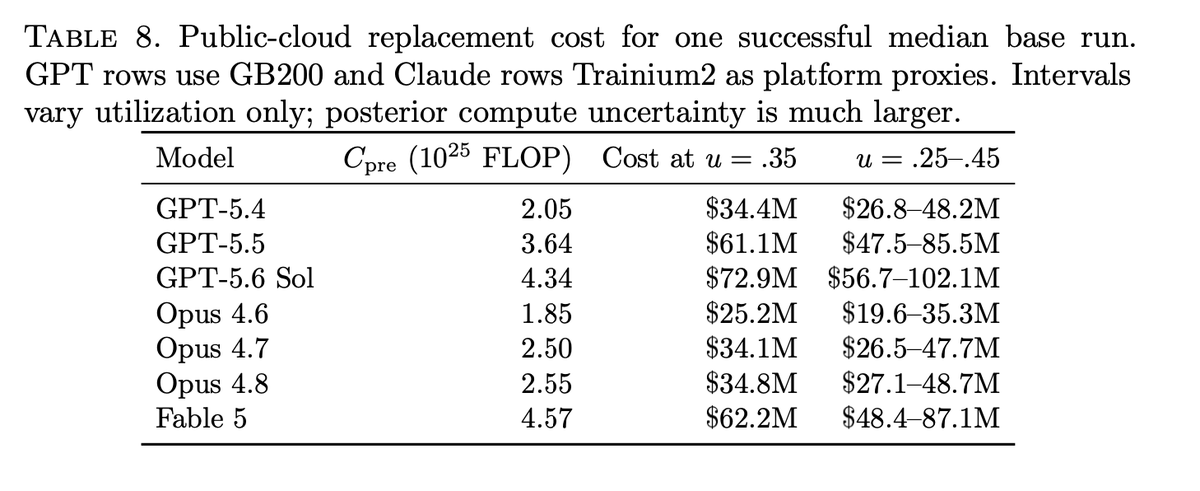
@prz_chojecki presumably most of the cost is training the base model and iterating the post-train
English
0
0
0
796
Jay
Jay@jaypatel·
@mil000 This looks like most of suburban PA. Surprised at the lack of flags on the west coast
English
0
0
0
230
Milo Smith
Milo Smith@mil000·
I went to Livermore to get a Mac mini and found one of the most beautiful neighbourhoods I’ve ever seen
Milo Smith tweet mediaMilo Smith tweet mediaMilo Smith tweet mediaMilo Smith tweet media
English
28
2
215
35.8K
Autism Capital 🧩
Autism Capital 🧩@AutismCapital·
PSA to all of the nepo children, heirs/heiresses, scions, etc., you don’t have to pretend like you do something. You don’t have to have a fake startup and waste your and others time to be seen a certain way. The world already knows. You can just be rich. You can just enjoy your money. It’s okay. It actually takes more courage to just live a fun life than to performatively suffer and pretend like you’re self made. There’s no shame in it, it’s actually more authentic and trustworthy. Go do cool stuff in the world, do art, sponsor F1 teams, whatever, but don’t burden people with your nonsense startups and force them to humor you because of your family ties. It’s disrespectful and just creates more nonsense in the world. Just enjoy life and be rich. Have actual courage. And no trustifarian behavior either. Just be rich. Stop pretending.
English
136
204
4K
194.4K
Jay
Jay@jaypatel·
@ZynxBTC Or that the market weighs the debt maturiting on the Strategy side more heavily than the longer track record / large capital pile
English
1
0
1
18
Zynx
Zynx@ZynxBTC·
Wow. Turns out this information is wrong. The effective yield for $STRC is actually 14.02% while $SATA is paying 13.3%... that's insane. Honestly quite shocked at the difference given they both now have ~18 months USD reserves. Daily dividends might be the key.
Zynx@ZynxBTC

This is strange. $STRC and $SATA have the same effective yield despite the latter being further along the risk curve. This tells me that the market is in a state of fear and irrationality. Sentiment for Bitcoin is completely dead and we are seeing that reflected here.

English
29
9
176
17.8K
Jay
Jay@jaypatel·
@MTanguma I think even if most bitcoiners have a lower time preference, zooming out to look at a timescale in line with the monetization curve is tough
English
0
0
0
15
Michael Tanguma
Michael Tanguma@MTanguma·
If bitcoin is worth something, it's worth everything. Even hardcore bitcoiners will tell you it'll coexist with the dollar forever. That says more about their lens on money than about bitcoin. Monetization doesn't stop halfway. The gap between "this has value" and "pay me in it" is the journey, and most people are still just starting it. Full TLT rip in the comments
English
5
4
14
3.5K
Jay
Jay@jaypatel·
@catwychan Is that real adoption though? Not sure these circular deals really worked in practice. I feel like the USDG vault thing is similar. You can subsidize lender rates, but if there's no borrow demand outside looping (mostly mercenary capital), it evaporates immediately.
English
0
0
0
14