
Joe Bachmore retweetledi
Joe Bachmore
1.9K posts


Joe Bachmore
@jbach2k
"We are not given a short life, but we make it short, and we are not ill-supplied but wasteful of it." — Seneca
Katılım Mayıs 2009
70 Takip Edilen705 Takipçiler
@zerohedge I would love to know how she came to that conclusion?
English

Well… oops
Elizabeth Warren@SenWarren
I've warned for months that a @JetBlue-@SpiritAirlines merger would have led to fewer flights and higher fares. @JusticeATR and @USDOT were right to stand up for consumers and fight against runaway airline consolidation. This is a Biden win for flyers! apnews.com/article/jetblu…
English




@theallinpod Thank you for making this a point!! Non - profits have gone way too far and they need to be reeled back in.
English

David Friedberg on the Nonprofit Scam: 90% Are Bullsh*t
“ The definition of exempt activities is charitable, religious, educational, scientific, literacy, public safety, or fostering amateur sports competition, or preventing cruelty to children or animals.
You tell me how the f**k 90% of what we call nonprofits today fall under that definition.
We have completely f**king closed our eyes to the fact that organizations, regardless of political affiliation or social interest, have fundamental commercial and probably not aligned interests with the definition of a 501(c)(3), and we've allowed them all to get away with it for far too long.
I don't think that this is a blue or red thing.
I think that this is a thing where we let these organizations make it easy to get money, to hide the money, and to do whatever the hell they want with the money, and we need to stop it.
And I think that it's an amazing opportunity right now for everyone to kind of reset the decks by cleaning all the sh*t up, and getting all of these organizations flushed, and make sure that any organization that wants to do whatever bullsh*t, nefarious things they want to do, by all means do it.
But it's not a nonprofit and you shouldn't get a charitable donation deduction, and the government should not be putting money into these sorts of things.
This is an entirely different sort of activity in the social order.
And as a libertarian, I'm all for it, but I don't think that they should be tax exempt, and I don't think they should be getting government money, and I don't think that individuals should be benefiting from giving them money.
And if we could fix all that shit up, I think a lot of these problems are going to go away.”
English
@Zoey_B_ @chamath @GregMartinLive Please share with me the informative aspect that you gained? Im new to this discussion and I am trying to learn. Thank you.
English

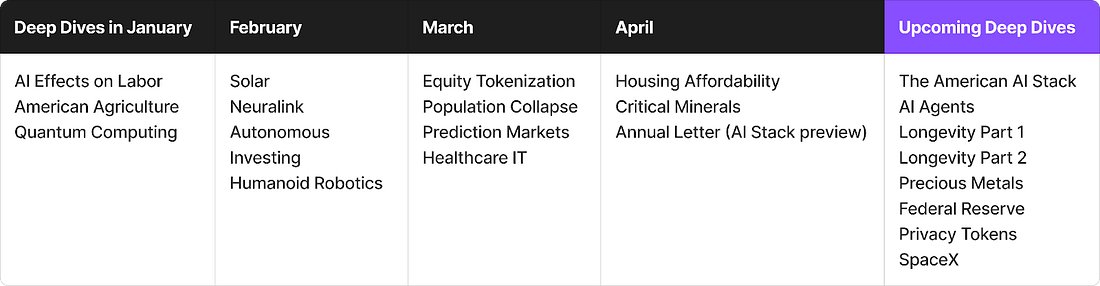
Over the last few years, my team and I have written many Deep Dives - fundamental research that I use to learn, guide my thinking and refine my decision making. We started publishing these Deep Dives once per month. We now have a team and process that allows us to publish once per week.
The topics are bangers - you can see a table below in the picture.
We call this service Learn with Me. It costs $1,000/yr.
We charge $1000/yr as a quality signal. I wanted to find a price that a) signaled when people made an important decision to subscribe to Learn with Me but also b) by staying or churning, signal to me how good the Deep Dives were.
We have many thousands of people in the Learn with Me community and it grows a lot each month.
The goal of Learn with Me will never change: explain important topics from the ground up, show why they matter now, and share the insights we use to understand the world and make better decisions (operational, organization, investment).
Over time, I will invest the capital that this creates into building a full knowledge base (starting with the Deep Dives but growing from there), giving access to some of my agents (my portfolio composer, my negotiation agent, my org design agent, my strategy consulting agent) and many other exciting ideas. It's all new but we will learn together. In other words, more is coming for folks that are a part of the community.
If you are curious about any of this you can sign up for it here: chamath.substack.com
English
@RapidResponse47 Give me a day and time and I will do my part to help!!
English



@RapidResponse47 You might not like his delivery..the answer is yes.
English
@KatieMiller ok, note taken.. use Apple iMessage and do not back up to cloud.
English

Signal, WhatsApp, Telegram & iMessage all have serious security problems:
> Signal makes it easy for hackers to steal your account by requiring your number. They had a hack last year.
> WhatsApp let anyone grab 3.5 billion phone numbers in a hack last year.
> Telegram doesn’t encrypt most chats by default — their servers can read them.
> iMessage lets Apple see your messages if they’re backed up to iCloud.
XChat is the only secure encrypted messaging app.
Nikita Bier@nikitabier
Welcoming a new member of the family Get XChat for iOS: apple.co/4sVp8bF
English

'Lying Scumbag': Schumer Blasted After Saying 'Nobody Respects' Border Patrol And ICE On Senate Floor zerohedge.com/political/lyin…
English
@chamath You are spot on.. especially zoned to build a power plant onsite...
English
The game theory in AI has shifted. Having a leading foundational model is important but increasingly it is the zoning approved, powered land that is the gating bottleneck. Add turnkey access to silicon and it’s checkmate.
If you have that, you have immense negotiating leverage right now. As data centers get voted down, this leverage will only increase.
Elon just proved it with Cursor.
Now imagine the deals that OpenAI and Anthropic will have to do in the next few years? The Amazon-Anthropic deal was an appetizer.
If you are a sharp on the other side who owns the right assets… 🤤
English
@pmarca "A great example is the refrigerator and the milkman. That technology displaced an entire industry — the milkmen. However, today we have far more refrigerator repairmen than we ever had milkmen."
English

This is obviously correct.
Alex Imas@alexolegimas
New essay on the economics of structural change and the post-commodity future of work. 1. Almost any question about the impact of advanced AI on the economy needs to start at the same place: what is still scarce? Answer that, and the analysis becomes pretty straightforward. This essay explores what becomes scarce if AI really can replicate most of what humans do in production, and what this mean for the future of jobs. 2. My conjecture, working through the economics: labor reallocates across sectors, and the sector it reallocates to has properties that keep labor a meaningful share of the economy. Ultimately this is about the structure of demand itself. For this, we have to go back to Girard, Augustine and Rousseau: once people's base needs are met, their preferences shift to comparative motives (e.g., status, exclusivity, social desirability). This motive is inherently non-satiated. 4. The key paper is Comin, Lashkari, and Mestieri (Econometrica 2021). As people get richer, they don't buy proportionally more of everything. They shift spending toward sectors with higher income elasticity. They estimate income effects account for 75%+ of observed structural change. 5. The ironic consequence: the sector that gets automated becomes a smaller share of the economy, not a larger one. Agriculture got massively more productive and its share of employment collapsed. Manufacturing too. The "stagnant" sectors absorb the spending and the jobs. 6. So the question is: which sectors have high income elasticity in a post-AGI world? I argue it's what I call the relational sector. Categories where the human isn't just an input into production, it is part of the value. 7. Why does the relational sector have high income elasticity? Because human desire has a mimetic, relational dimension. We don't just want things for their intrinsic properties. We want what others want, and we want it more when others can't have it. Girard, Rousseau, Augustine, and Hobbes all saw this. 8. In work with Kristóf Madarász, we showed this experimentally: WTP roughly doubles when a random subset of others is excluded from the good. And in new work with Graelin Mandel, AI involvement kills the premium. Human-made art gains 44% from exclusivity; AI-made art only 21%. 9. This all comes together for the core argument. The sector that absorbs spending as AI makes commodity production cheap is one where human provenance is part of the value, and demand for it grows faster than income. Exactly the profile that keeps labor meaningful. 10. To be clear about the claim: I'm NOT saying aggregate labor share must rise. It may fall. The claim is about sectoral composition, i.e., where expenditure and employment go once commodities get cheap, and the fact that the sector that will absorb reallocated labor maps to a substantial component of human preferences and desire. 11. If you're interested in the formal model, a linked companion technical note works out all the economics. Read the essay here: aleximas.substack.com/p/what-will-be…
English


I Worked on Capitol Hill. It’s Time to Expose Congress.
English