jcran

15.1K posts

jcran banner
jcran

jcran

@jcran

knowledge seeker

Austin, TX Katılım Mayıs 2007
1.8K Takip Edilen8.1K Takipçiler
jcran retweetledi
DryRun Security
DryRun Security@dryrunsec·
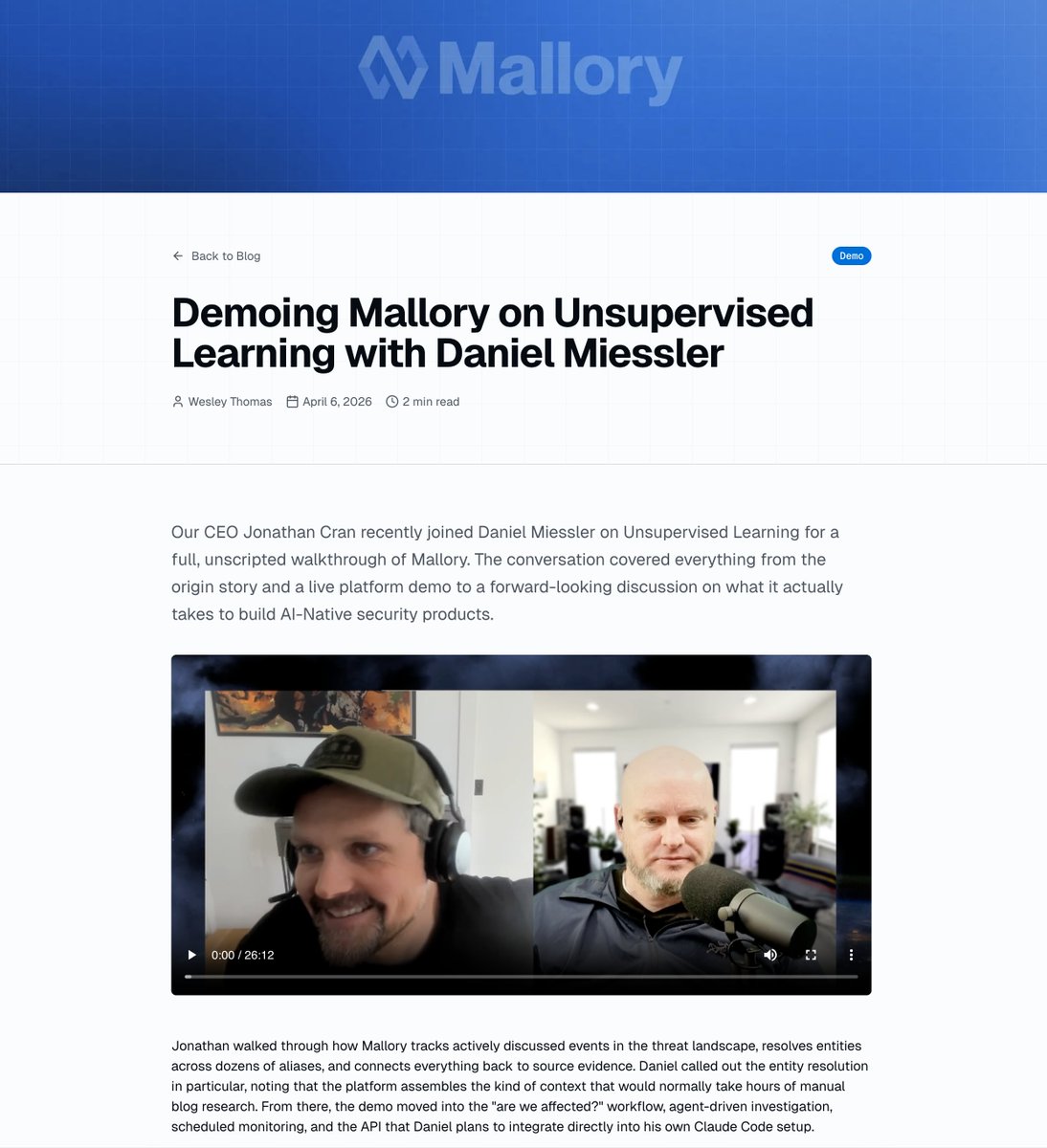
Next week, @jcran and @cktricky are doing Security Reviews, IRL: a live GitHub PR walkthrough with real agent-generated changes (Claude, Cursor, Devin) and the logic flaws that almost shipped. 🗓️ Join us: Feb 25, 1 PM EST Register at dryrun.security/webinar/securi…
DryRun Security tweet media
English
0
3
5
356
jcran retweetledi
Andrej Karpathy
Andrej Karpathy@karpathy·
A few random notes from claude coding quite a bit last few weeks. Coding workflow. Given the latest lift in LLM coding capability, like many others I rapidly went from about 80% manual+autocomplete coding and 20% agents in November to 80% agent coding and 20% edits+touchups in December. i.e. I really am mostly programming in English now, a bit sheepishly telling the LLM what code to write... in words. It hurts the ego a bit but the power to operate over software in large "code actions" is just too net useful, especially once you adapt to it, configure it, learn to use it, and wrap your head around what it can and cannot do. This is easily the biggest change to my basic coding workflow in ~2 decades of programming and it happened over the course of a few weeks. I'd expect something similar to be happening to well into double digit percent of engineers out there, while the awareness of it in the general population feels well into low single digit percent. IDEs/agent swarms/fallability. Both the "no need for IDE anymore" hype and the "agent swarm" hype is imo too much for right now. The models definitely still make mistakes and if you have any code you actually care about I would watch them like a hawk, in a nice large IDE on the side. The mistakes have changed a lot - they are not simple syntax errors anymore, they are subtle conceptual errors that a slightly sloppy, hasty junior dev might do. The most common category is that the models make wrong assumptions on your behalf and just run along with them without checking. They also don't manage their confusion, they don't seek clarifications, they don't surface inconsistencies, they don't present tradeoffs, they don't push back when they should, and they are still a little too sycophantic. Things get better in plan mode, but there is some need for a lightweight inline plan mode. They also really like to overcomplicate code and APIs, they bloat abstractions, they don't clean up dead code after themselves, etc. They will implement an inefficient, bloated, brittle construction over 1000 lines of code and it's up to you to be like "umm couldn't you just do this instead?" and they will be like "of course!" and immediately cut it down to 100 lines. They still sometimes change/remove comments and code they don't like or don't sufficiently understand as side effects, even if it is orthogonal to the task at hand. All of this happens despite a few simple attempts to fix it via instructions in CLAUDE . md. Despite all these issues, it is still a net huge improvement and it's very difficult to imagine going back to manual coding. TLDR everyone has their developing flow, my current is a small few CC sessions on the left in ghostty windows/tabs and an IDE on the right for viewing the code + manual edits. Tenacity. It's so interesting to watch an agent relentlessly work at something. They never get tired, they never get demoralized, they just keep going and trying things where a person would have given up long ago to fight another day. It's a "feel the AGI" moment to watch it struggle with something for a long time just to come out victorious 30 minutes later. You realize that stamina is a core bottleneck to work and that with LLMs in hand it has been dramatically increased. Speedups. It's not clear how to measure the "speedup" of LLM assistance. Certainly I feel net way faster at what I was going to do, but the main effect is that I do a lot more than I was going to do because 1) I can code up all kinds of things that just wouldn't have been worth coding before and 2) I can approach code that I couldn't work on before because of knowledge/skill issue. So certainly it's speedup, but it's possibly a lot more an expansion. Leverage. LLMs are exceptionally good at looping until they meet specific goals and this is where most of the "feel the AGI" magic is to be found. Don't tell it what to do, give it success criteria and watch it go. Get it to write tests first and then pass them. Put it in the loop with a browser MCP. Write the naive algorithm that is very likely correct first, then ask it to optimize it while preserving correctness. Change your approach from imperative to declarative to get the agents looping longer and gain leverage. Fun. I didn't anticipate that with agents programming feels *more* fun because a lot of the fill in the blanks drudgery is removed and what remains is the creative part. I also feel less blocked/stuck (which is not fun) and I experience a lot more courage because there's almost always a way to work hand in hand with it to make some positive progress. I have seen the opposite sentiment from other people too; LLM coding will split up engineers based on those who primarily liked coding and those who primarily liked building. Atrophy. I've already noticed that I am slowly starting to atrophy my ability to write code manually. Generation (writing code) and discrimination (reading code) are different capabilities in the brain. Largely due to all the little mostly syntactic details involved in programming, you can review code just fine even if you struggle to write it. Slopacolypse. I am bracing for 2026 as the year of the slopacolypse across all of github, substack, arxiv, X/instagram, and generally all digital media. We're also going to see a lot more AI hype productivity theater (is that even possible?), on the side of actual, real improvements. Questions. A few of the questions on my mind: - What happens to the "10X engineer" - the ratio of productivity between the mean and the max engineer? It's quite possible that this grows *a lot*. - Armed with LLMs, do generalists increasingly outperform specialists? LLMs are a lot better at fill in the blanks (the micro) than grand strategy (the macro). - What does LLM coding feel like in the future? Is it like playing StarCraft? Playing Factorio? Playing music? - How much of society is bottlenecked by digital knowledge work? TLDR Where does this leave us? LLM agent capabilities (Claude & Codex especially) have crossed some kind of threshold of coherence around December 2025 and caused a phase shift in software engineering and closely related. The intelligence part suddenly feels quite a bit ahead of all the rest of it - integrations (tools, knowledge), the necessity for new organizational workflows, processes, diffusion more generally. 2026 is going to be a high energy year as the industry metabolizes the new capability.
English
1.6K
5.4K
39.4K
7.6M
jcran retweetledi
Naval
Naval@naval·
Self-directed learning through AIs is an autodidact’s paradise.
English
779
1.9K
19.7K
862.2K
jcran retweetledi
ᴅᴀɴɪᴇʟ ᴍɪᴇssʟᴇʀ 🛡️
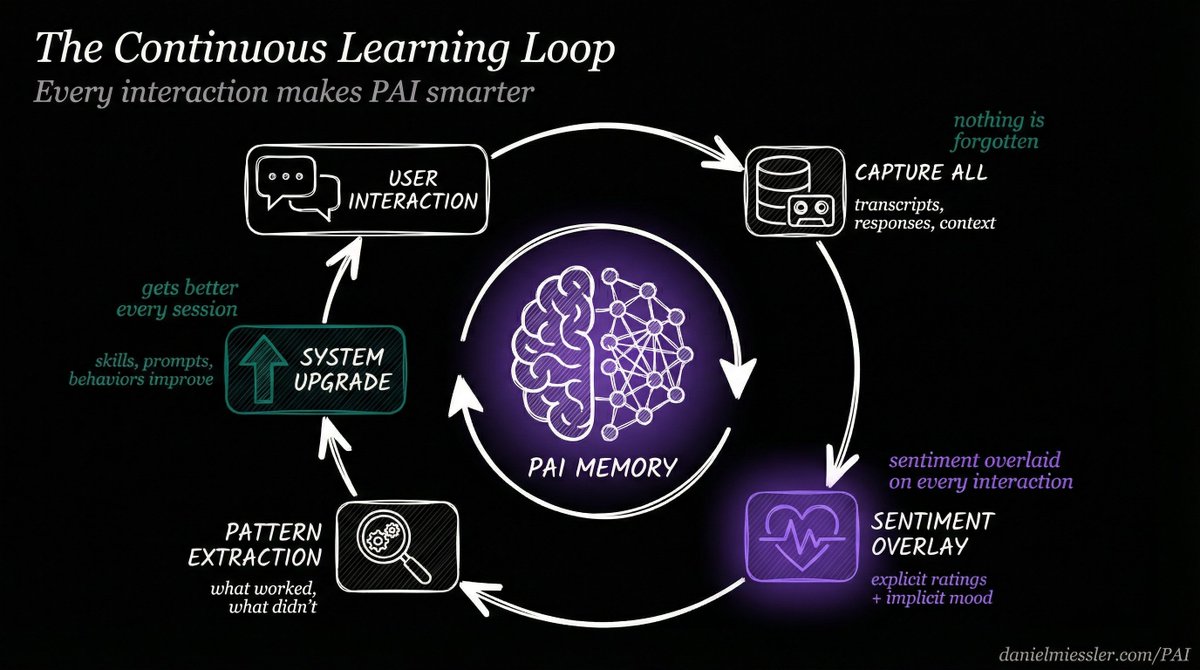
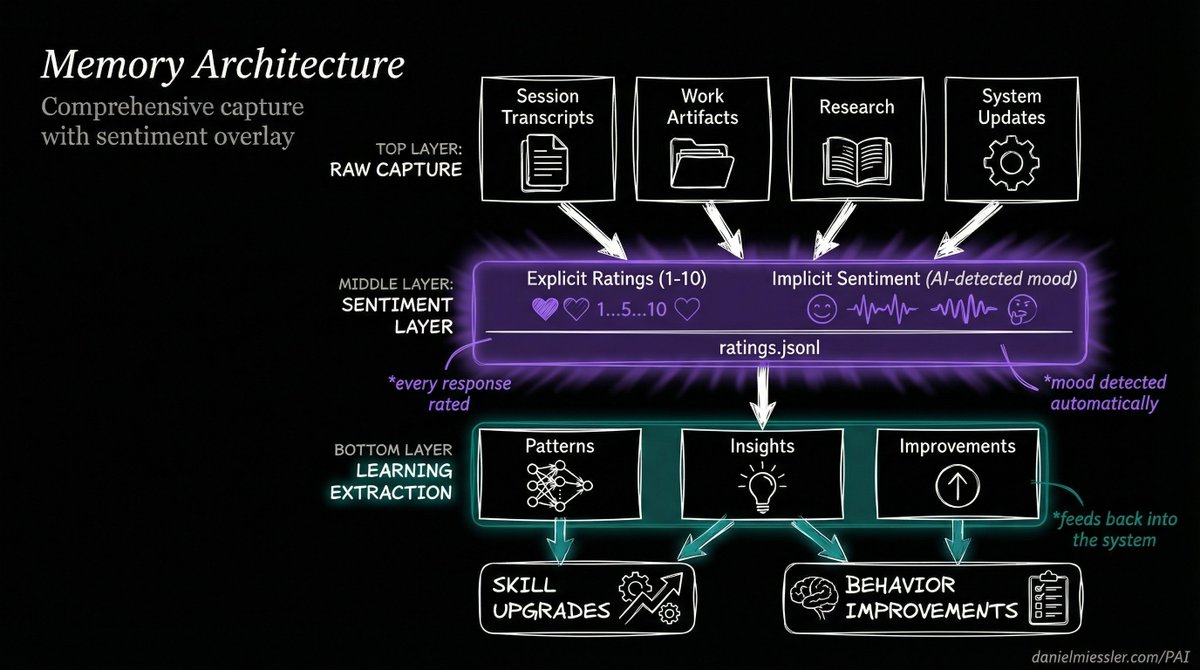
Super hyped to announce PAI 2.3!!! A complete rewrite of the PAI system focused around: - USER, WORK, and SYSTEM data isolation - A Continuous Learning system based on hook-based Sentiment gathering - User-based Skill Personalization ...
ᴅᴀɴɪᴇʟ ᴍɪᴇssʟᴇʀ 🛡️ tweet mediaᴅᴀɴɪᴇʟ ᴍɪᴇssʟᴇʀ 🛡️ tweet mediaᴅᴀɴɪᴇʟ ᴍɪᴇssʟᴇʀ 🛡️ tweet media
English
19
44
243
68.3K
jcran
jcran@jcran·
@kepano commands like /get-meetings /get-linear, /scrum to organize the day. huge time saver
English
0
0
1
335
kepano
kepano@kepano·
if you're using Obsidian with Claude Code, tell me about your workflow, and what you've used it for
English
418
320
4.8K
1.3M
Sam Bhagwat
Sam Bhagwat@calcsam·
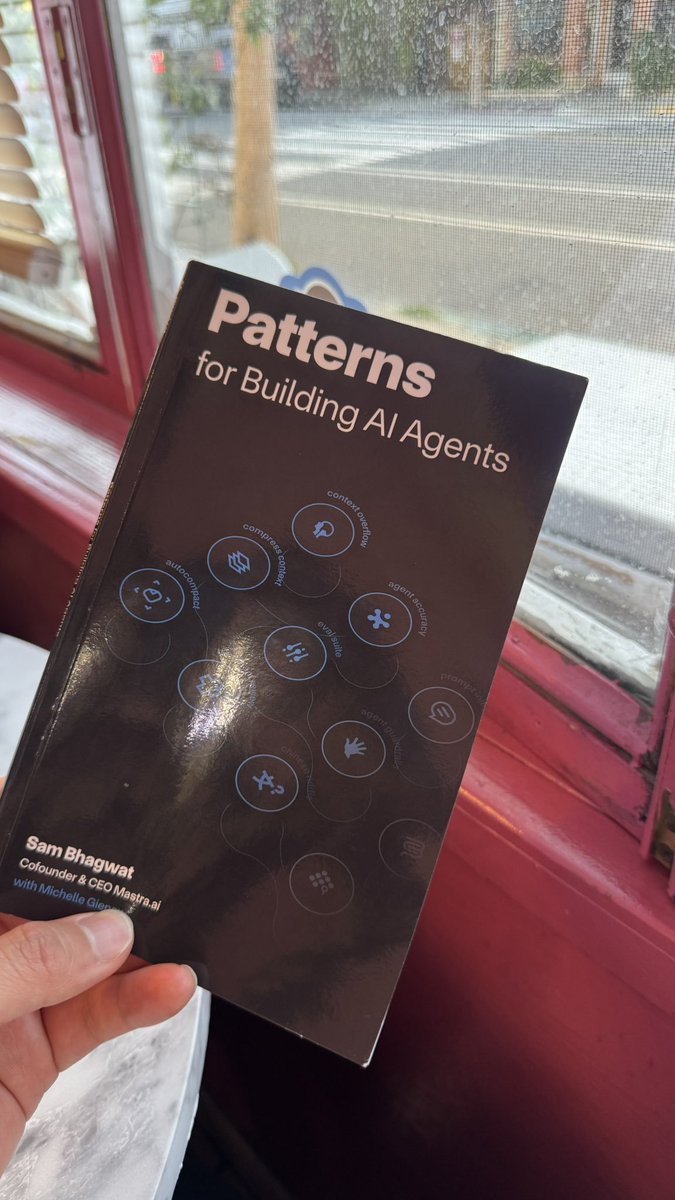
last month we wrote a new agents book: patterns for building ai agents it has everything you need to take your agents from prototype to production, like agent design patterns, the basics of security, etc reply to this tweet with BOOK and we'll dm you so you can get a copy
Sam Bhagwat tweet media
English
4.1K
454
5.1K
587.6K
jcran
jcran@jcran·
the team you build is the company you build
English
0
0
5
234
jcran retweetledi
Will
Will@BushidoToken·
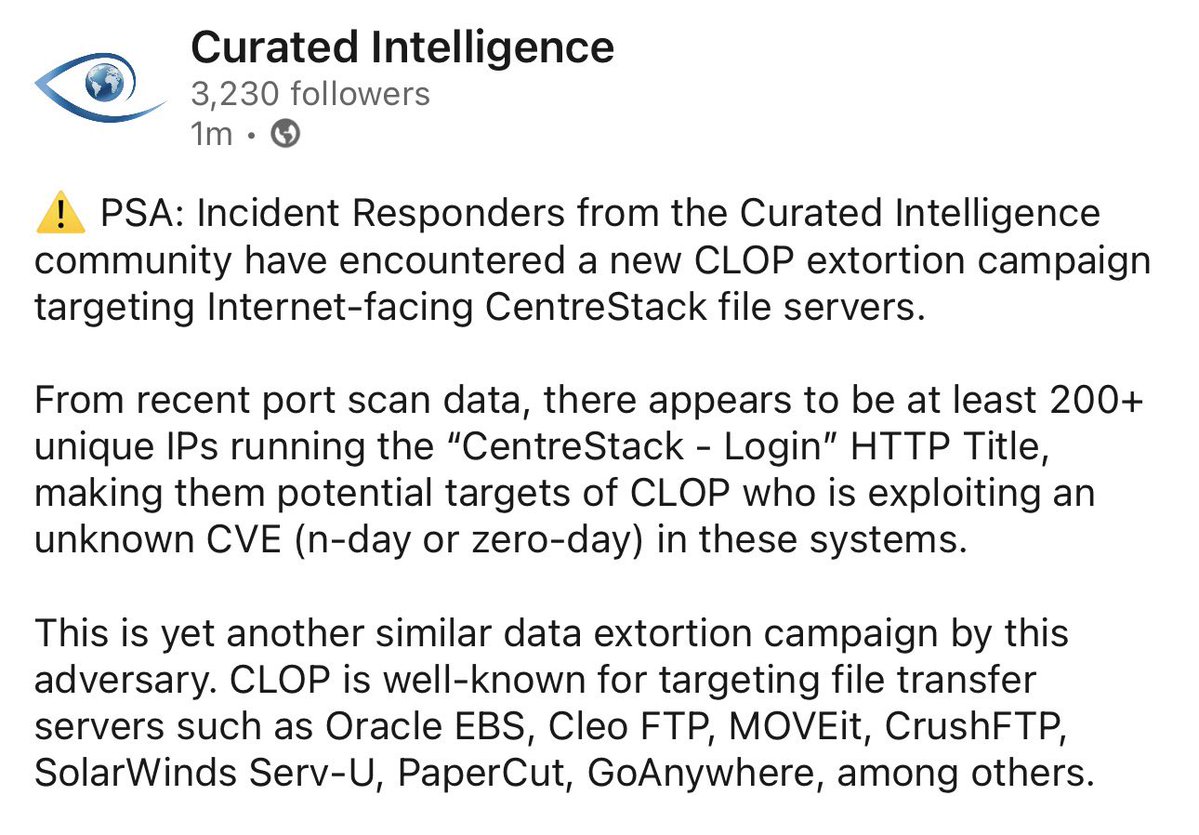
PSA from @CuratedIntel, CLOP is attacking CentreStack file servers 👇
Will tweet media
English
3
13
41
4.9K
jcran
jcran@jcran·
Heads up - active exploitation of Cisco Secure Email Gateway / Cisco Secure Email and Web Manager appliances with the Spam Quarantine feature exposed to the internet. sec.cloudapps.cisco.com/security/cente…
English
0
0
0
197
jcran retweetledi
Adrian Carmack Artist
Adrian Carmack Artist@ACarmackArtist·
Happy Birthday Commander Keen!
Adrian Carmack Artist tweet media
English
21
115
890
19.7K
jcran retweetledi
shubs
shubs@infosec_au·
Pushed a new update to github.com/assetnote/reac… -- it now scans for the RCE payload via reflection. Use the --waf-bypass flag to bypass WAFs, works well for Cloudflare/AWS. Other WAFs might need tinkering with the payload, depending on whether they don't have a max context limit.
English
14
129
627
81.9K
jcran retweetledi
swyx
swyx@swyx·
successful agent engineering is just repeating "bitter lesson will kill this some day but hey this works for now lets do it" again and again until agi
English
26
26
454
44.6K
jcran retweetledi
Andrej Karpathy
Andrej Karpathy@karpathy·
Sharing an interesting recent conversation on AI's impact on the economy. AI has been compared to various historical precedents: electricity, industrial revolution, etc., I think the strongest analogy is that of AI as a new computing paradigm (Software 2.0) because both are fundamentally about the automation of digital information processing. If you were to forecast the impact of computing on the job market in ~1980s, the most predictive feature of a task/job you'd look at is to what extent the algorithm of it is fixed, i.e. are you just mechanically transforming information according to rote, easy to specify rules (e.g. typing, bookkeeping, human calculators, etc.)? Back then, this was the class of programs that the computing capability of that era allowed us to write (by hand, manually). With AI now, we are able to write new programs that we could never hope to write by hand before. We do it by specifying objectives (e.g. classification accuracy, reward functions), and we search the program space via gradient descent to find neural networks that work well against that objective. This is my Software 2.0 blog post from a while ago. In this new programming paradigm then, the new most predictive feature to look at is verifiability. If a task/job is verifiable, then it is optimizable directly or via reinforcement learning, and a neural net can be trained to work extremely well. It's about to what extent an AI can "practice" something. The environment has to be resettable (you can start a new attempt), efficient (a lot attempts can be made), and rewardable (there is some automated process to reward any specific attempt that was made). The more a task/job is verifiable, the more amenable it is to automation in the new programming paradigm. If it is not verifiable, it has to fall out from neural net magic of generalization fingers crossed, or via weaker means like imitation. This is what's driving the "jagged" frontier of progress in LLMs. Tasks that are verifiable progress rapidly, including possibly beyond the ability of top experts (e.g. math, code, amount of time spent watching videos, anything that looks like puzzles with correct answers), while many others lag by comparison (creative, strategic, tasks that combine real-world knowledge, state, context and common sense). Software 1.0 easily automates what you can specify. Software 2.0 easily automates what you can verify.
English
556
1.5K
12.5K
2.1M
jcran
jcran@jcran·
ultimately, what happens when individual devs can build software at the complexity level of (today's) leading software companies
English
0
0
1
149
jcran
jcran@jcran·
testing is getting easier and better, and with testing comes visibility to underlying issues, but... if i have to bet, we're headed for more and more exploitable logic bugs in the future
English
1
0
2
194
jcran
jcran@jcran·
almost everyone is underestimating just how complex software systems are becoming. llms may have enabled 3x productivity, but also, 10x complexity
English
1
0
2
222