A bucket sunk into the ground at soil level is a complete wildlife pond — not just a drinking station, but a functioning food web. Cost: almost nothing.
How to build it in 30 minutes:
A 30–50 litre plastic or metal bucket or container, dug in so the rim sits exactly at soil level. No liner, no pump, no filter needed.
A layer of pebbles and gravel on the bottom — shelter for aquatic invertebrates and larvae. Dragonfly and damselfly nymphs, water boatmen, and pond skaters will colonise within weeks.
A gradual ramp of flat stones built up one side to the rim — this gives frogs, toads, hedgehogs, and birds a shallow approach and exit. No vertical wall of water that smaller animals cannot climb.
A branch or length of stick angled from the rim down to the floor — an emergency ramp for any animal that falls in and cannot locate the stone ramp.
One small marginal plant — a miniature bulrush (Typha minima), water mint (Mentha aquatica), or brooklime (Veronica beccabunga) in a small mesh basket at the edge. This provides oxygenation, perching structure for insects, and cover.
Who arrives without any introduction:
Dragonflies and damselflies — within the first few days, females will inspect the water surface. Larvae develop over one to three years in the pond floor gravel.
Common frog (Rana temporaria) — frogs find new water within a season. They do not need to be brought in. A garden pond of any size will be colonised naturally if frogs are present within a kilometre or two.
Common toad (Bufo bufo) — uses the stone ramp to enter and exit. Toads overwinter in damp sheltered spots near ponds.
Blackbird, robin, and blue tit — birds visit ponds daily for drinking and bathing. Water at soil level is what they prefer over elevated birdbaths.
Water at soil level is what most garden wildlife is looking for and rarely finds. No chemicals. No maintenance. The wildlife does the rest. 🪣🐸🦋💧
#WildlifePond#GardenPond#WildlifeFriendlyGarden
Now Hiring! We are looking for experienced and driven people to join the Karman team, and be a part of A company dedicated to providing solutions for complex missions in the space & defense industry. 🚀🌟
For flea prevention and control. This is food grade. Safe for use around pets and children. I'm going to use it on the dog beds and furniture. Then, around the garden and raised beds. I'm not pushing any product here. If it works, My theory is it's far better than chems. 😎
Your garden center often sells the problem… and the solution… in the very same aisle. 🌱🛒
Many common gardening products actually harm the soil life they claim to support. The good news? There are cheaper, healthier swaps that work even better.
Here are 6 smart swaps for healthier soil:
🌿 Skip Landscape Fabric → Use Wood Chips
Landscape fabric blocks oxygen and moisture, harming the fungal networks plants rely on. Wood chip mulch suppresses weeds while feeding beneficial fungi.
🪴 Skip Synthetic Fertilizer → Use Compost
Granular fertilizers deliver nutrients in salt form that can damage soil bacteria. Compost feeds plants through living biology and improves soil over time.
🥥 Skip Peat Moss → Use Coconut Coir
Peat moss is harvested from ancient bogs that take thousands of years to form. Coconut coir offers similar moisture retention and is renewable.
🌾 Skip Tilling → Use a Broadfork
Tilling tears apart underground fungal networks. A broadfork loosens compacted soil while preserving soil structure and biology.
🍄 Skip Chemical Fungicides → Use Compost Tea
Chemical fungicides may harm beneficial fungi in the soil. Compost tea introduces healthy microbes that naturally fight disease.
📦 Skip Weed Barrier Plastic → Use Cardboard
Plastic creates an airless zone beneath it. Cardboard blocks weeds, breaks down naturally, and adds organic matter to the soil.
✨ The pattern is simple:
The expensive option often sterilizes… the cheaper option feeds.
Even better:
✔️ Wood chips are often free from tree services
✔️ Compost may be available through local compost programs
✔️ Cardboard is easy to source from recycling bins
Healthy soil takes time—usually 1 to 2 seasons to rebuild—but once living soil is established, it improves naturally year after year.
Stop buying products that fight your soil.
Start building soil that works for you.
NASA's latest eye on the sky is coming together! ☄️🔭
The Near-Earth Object (NEO) Surveyor — NASA’s first infrared space telescope purposely designed to discover potentially hazardous asteroids and comets — is undergoing integration and testing.
You grew your herbs, they looked healthy, and you harvested some for dinner—only to find the plant didn’t grow back.
It wasn’t because you underwatered it. You just cut it in the wrong place.
Basil is where most people learn this lesson. Naturally, basil wants to grow into a single tall stem and eventually flower. But if you pinch off the top just above a pair of leaves, the plant splits into two stems. Pinch those again, and you get four. With regular pinching, a small plant quickly becomes a full, bushy one that produces far more leaves.
If you only pick leaves from the bottom, the plant grows tall, flowers sooner, turns bitter, and stops producing much earlier.
The key idea is simple: prune in a way that works with the plant’s growth pattern, not against it.
🌿 Quick guide by herb:
Basil — Pinch the top of the stem just above a pair of leaves once the plant is about 6 inches tall. More pinching means a bushier plant.
Cilantro — Cut the outer stems at the base and leave the center intact. It will eventually bolt due to heat, so replant regularly.
Rosemary & Thyme — Only cut green, leafy stems. Avoid cutting into woody parts, especially with rosemary, as those won’t regrow.
Mint — Trim it often and aggressively. Frequent cutting keeps it compact and flavorful.
Parsley — Like cilantro, cut the outer stems at the base and leave the inner growth. It continues producing for a longer season.
Your herb didn’t fail—you just needed to cut it differently.
The Way You Water Is Changing Your Root System — Not Just Your Soil 💧
Most gardeners focus on how often they water. The method matters more. Each delivery system creates a completely different root architecture — and root depth determines whether your plants survive drought, disease, and heat stress.
Watering can or overhead sprinkler deposits moisture on the top 1 to 3 inches of soil while simultaneously wetting foliage — creating the ideal conditions for fungal disease. Roots in this system never develop beyond the shallow zone because the moisture they need is always available near the surface. These plants fail the moment irrigation stops.
Drip irrigation and soaker hoses deliver water slowly at soil level, driving moisture 10 to 14 inches deep. Roots follow that moisture downward. A plant with 12-inch-deep roots accesses stored soil moisture that surface drought cannot reach. These plants survive two-week dry spells with zero intervention.
The switch costs almost nothing. A soaker hose for a 4×8 raised bed costs $8 to $12. The difference in plant resilience and harvest size is significant from the first season.
#gardeningusa#watering#vegetablegarden
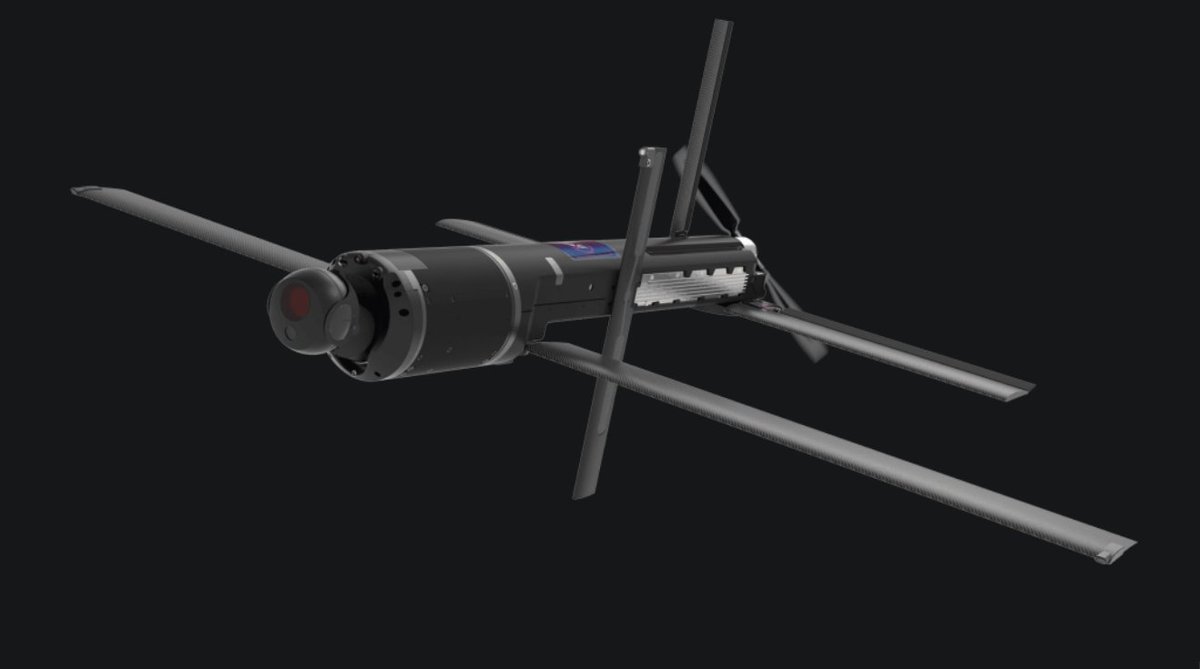
🇺🇸 AeroVironment (@aerovironment) today announced that the U.S. Army has awarded a prototype agreement for the Low-Altitude Stalking and Strike Ordnance (LASSO) program.
Switchblade also known as "Lightweight Tank Destroyer" is AV's medium-range, man-portable, anti-armor loitering munition and is the first loitering munition purpose-built to operate within AV_Halo™, AV’s modular command-and-control ecosystem.
"Switchblade 400 is the product of continuous feedback from the field and the soldiers who rely on our systems in real-world operations"
- Brian Young, Senior Vice President of Loitering Munitions at AV.
Learn more >> tinyurl.com/2dmj7xae
The spiny black and orange creature on your rose stem is eating the aphids. The spray kills it. The aphids come back.
The ladybug larva is the most commonly misidentified beneficial insect in the American garden — and the most commonly killed by mistake. The adult form (round, red-orange with black spots) is widely recognized. The larva looks nothing like it: elongated, segmented, black with orange markings, six legs, and slightly armored. It looks alarming enough to trigger an instinctive response.
That instinct is expensive. A single larva consumes around 400 aphids before it pupates. An adult consumes about 50 per day. The larva is the most voracious stage of the cycle — and the one most often eliminated before it finishes its work.
Three stages visible in your garden right now:
Eggs — small clusters of yellow-orange oblong eggs standing upright on the underside of leaves, almost always positioned next to or within an aphid colony. The female places them there deliberately so larvae have food the moment they hatch.
Larva — black with orange spots, alligator-shaped, actively hunting up and down stems. This is the stage most often mistaken for a pest.
Pupa — attached to a leaf surface, small and motionless, orange and black. Transformation is happening inside. It looks like something wrong. Leave it.
The rule for all three: leave them alone. If you see aphids on a stem and one of these stages is also present — the predator is already working. A contact insecticide applied to that stem kills the predator first. The aphids, which reproduce faster, return before the next generation of ladybugs can establish. 🌱
You mistook its work for an attack. Now you know what to look for. 🐞
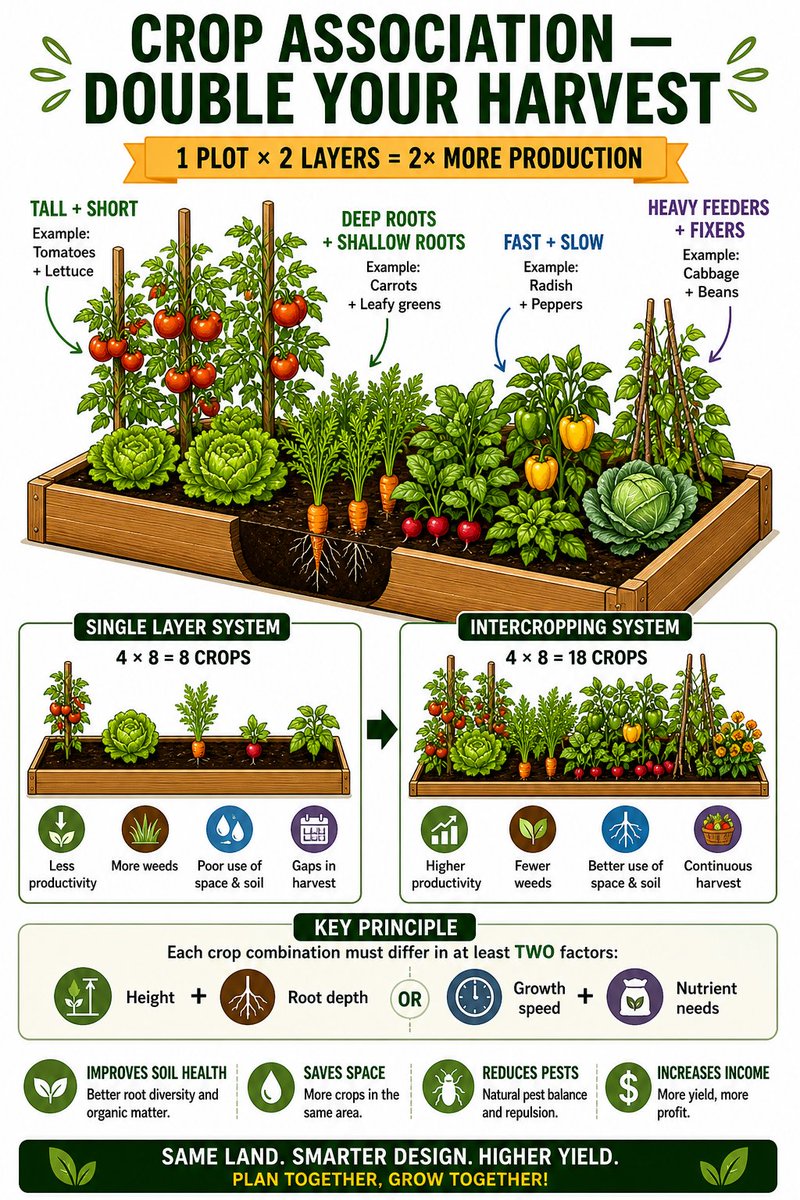
DOUBLE YOUR HARVEST WITHOUT ADDING MORE LAND
Most farmers think increasing production means expanding land.
But smart growers increase efficiency per square meter.
This image shows a powerful principle:
Crop association (intercropping).
One bed… multiple layers… continuous production.
THE SIMPLE IDEA
Instead of planting one crop per space,
you combine crops that use different resources.
That means:
• Different heights
• Different root depths
• Different growth speeds
• Different nutrient needs
HOW IT WORKS IN PRACTICE
Tall + short crops
Tomatoes grow upward
Lettuce grows below
→ No competition for light
Deep roots + shallow roots
Carrots go deep
Leafy greens stay near the surface
→ Better use of soil nutrients
Fast + slow crops
Radishes mature quickly
Peppers take longer
→ Continuous harvest
Heavy feeders + soil builders
Some crops consume nutrients
Others help restore balance
WHAT THIS MEANS FOR YOU
On the same piece of land:
• You increase total yield
• You reduce weed pressure
• You improve soil health
• You maximize space utilization
WHAT MOST FARMERS DO WRONG
They plant crops separately…
Leaving gaps in:
• Light use
• Soil layers
• Time (empty periods between harvests)
THE REAL SHIFT
Stop thinking in rows.
Start thinking in systems.
Your farm should not produce once.
It should produce continuously and efficiently.
Land is limited.
Creativity is not.
One plot, well planned, can outperform a bigger farm managed poorly.
That’s how small-scale farming becomes highly profitable. 🌿📈
Not science fiction, science fact! 🔬
Researchers are exploring an idea to use engineered bacteria to clean Martian water, turning contaminants into consumables. This concept could one day help us produce valuable resources for explorers on the Red Planet. Explore more: go.nasa.gov/42Nmmuk