Eze retweetledi
Eze
1.2K posts


Hello Supply Chainers
Here is a document containing some list of supply chain courses.
Kindly note that when I did, i was part of a challenge so it was entirely free. Now you will have to use you LinkedIn free trial or subscribe to access them.
docs.google.com/document/d/1_h…
English
Eze retweetledi

If you're a Data Analyst, Operations Analyst, or aspiring Supply Chain & Logistics Analyst who wants to move from reporting dashboards to driving real supply chain decisions, read this:
Dashboards are not enough.
Modern supply chain teams promote analysts who can:
• Forecast demand under uncertainty
• Optimise inventory and release working capital
• Model cost-to-serve and margin impact
• Quantify supplier and operational risk
• Simulate stockouts and lost-sales exposure
• Design efficient distribution and network flows
Most analysts track KPIs.
Very few understand capital and operational impact.
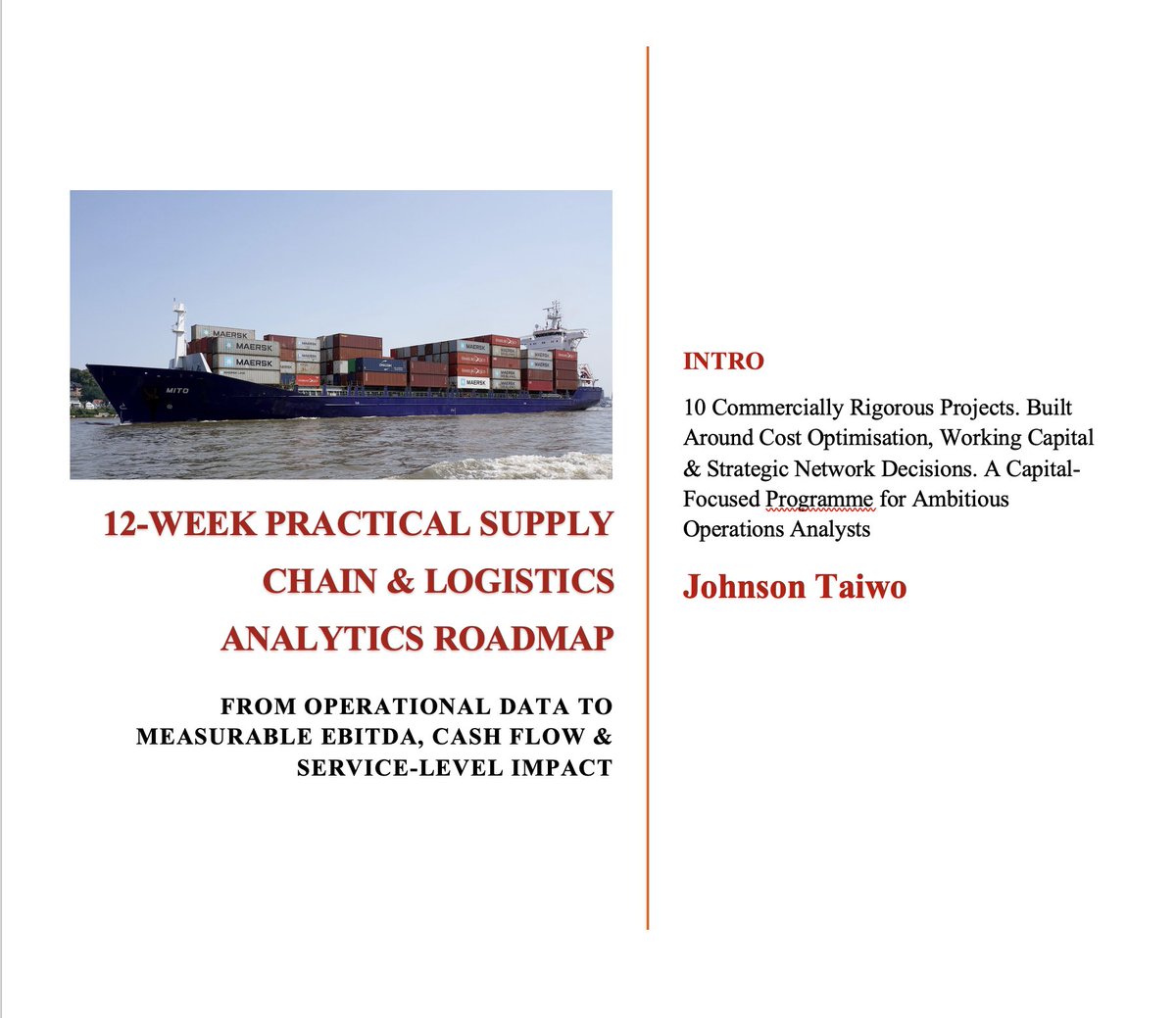
So I built the >>Supply Chain Capital Intelligence Blueprint << to move you from metric reporting to operational decision intelligence.
A system with two parts:
>>1. Supply Chain & Capital Intelligence Framework
Learn how real supply chains actually operate:
• Working capital & inventory optimisation
• Cost-to-serve and margin dynamics
• Supplier & concentration risk
• Multi-echelon inventory logic
• Transport cost volatility
• Network design and expansion strategy
• Executive operational communication
>>>2. The 12-Week Practical Supply Chain Analytics Roadmap
Build 10 real-world projects:
• Inventory optimisation (capital-focused)
• Cost-to-serve modelling
• Stockout and lost-sales simulation
• Supplier risk analysis
• Network optimisation
• Demand variability modelling
• Capacity and fulfilment analysis
• Capital allocation modelling
• Service level vs cost trade-offs
• Operational KPI system (decision-focused)
This is not decorative analytics.
This is institutional-level operational intelligence.
If you want the roadmap:
➡️Like
➡️Repost
➡️Comment ROADMAP
➡️send me a DM, I’ll share it

English

@powerfulbadeeu Good day
Am doing MBA in HR currently
Please I want to transition to supply chain
Are there any courses or anything I can do?
agbaakin please guide me
English

My very good brother. Onward onward and onward, thank you for the kind words, my DM is open to you anytime guidance is needed.
Tife Olayinka | Design + Nocode Expert@tife_olayinka
One of this Egbon’s tweet influenced me to start an MBA in procurement and supply chain management, 5 months in and just completed my first semester, I think it’s the best decision I’ve made in a long time

English
Eze retweetledi

Claude Bot on Polymarket — Full Guide
The same setup turned $1,000 into $1.5M.
2 hours.
Nothing complicated.
Bookmark this so you don’t lose it.
Kirill@kirillk_web3
English
Eze retweetledi
Eze retweetledi

SQL is tough to master — but not anymore!
Introducing "The Ultimate SQL eBook" (PDF)
You’ll get:
⚡ 74+ pages of SQL cheatsheets
⚡ Save 100+ hours of research
🎁 For 72 hrs, it’s 100% FREE!
To get it:
1. Like & RT
2. Reply “SEND”
3. Follow me [MUST]so that I can DM
#SQL #database #ArtificialIntelligence #Technologyjobs #Google #Oracle

English

@AdegbemboB Please I want to DM you but I can’t
If I have someone abroad what should I tell them to open please
English
Eze retweetledi

Master SQL step-by-step! From basics to advanced, here are the key topics you need for a solid SQL foundation.
1. Foundations:
- Learn basic SQL syntax, including SELECT, FROM, WHERE clauses.
- Understand data types, constraints, and the basic structure of a database.
2. Database Design:
- Study database normalization to ensure efficient data organization.
- Learn about primary keys, foreign keys, and relationships between tables.
3. Queries and Joins:
- Practice writing simple to complex SELECT queries.
- Master different types of joins (INNER, LEFT, RIGHT, FULL) to combine data from multiple tables.
4. Aggregation and Grouping:
- Explore aggregate functions like COUNT, SUM, AVG, MAX, and MIN.
- Understand GROUP BY clause for summarizing data based on specific criteria.
5. Subqueries and Nested Queries:
- Learn how to use subqueries to perform operations within another query.
- Understand the concept of nested queries and their practical applications.
6. Indexing and Optimization:
- Study indexing for enhancing query performance.
- Learn optimization techniques, such as avoiding SELECT * and using appropriate indexes.
7. Transactions and ACID Properties:
- Understand the basics of transactions and their role in maintaining data integrity.
- Explore ACID properties (Atomicity, Consistency, Isolation, Durability) in database management.
8. Views and Stored Procedures:
- Create and use views to simplify complex queries.
- Learn about stored procedures for reusable and efficient query execution.
9. Security and Permissions:
- Understand SQL injection risks and how to prevent them.
- Learn how to manage user permissions and access control.
10. Advanced Topics:
- Explore advanced SQL concepts like window functions, CTEs (Common Table Expressions), and recursive queries.
- Familiarize yourself with database-specific features (e.g., PostgreSQL's JSON functions, MySQL's spatial data types).
11. Real-world Projects:
- Apply your knowledge to real-world scenarios by working on projects.
- Practice with sample databases or create your own to reinforce your skills.
12. Continuous Learning:
- Stay updated on SQL advancements and industry best practices.
- Engage with online communities, forums, and resources for ongoing learning and problem-solving.
English
Eze retweetledi

🚨 90% of Data Analyst Interviews Repeat the Same Questions - But Most Candidates Still Walk In Unprepared.
After years working as a Data Analyst, Power BI Developer, Data Engineer and Automation Expert - across Gold Standard Consulting Firms, Fintech, and Enterprise Environments, I’ve noticed something interesting:
👉 Interview questions change slightly…
👉 But the core evaluation NEVER changes.
Companies are testing 3 things:
✅ Can you think analytically under pressure?
✅ Can you translate business problems into data solutions?
✅ Can you communicate insights to decision makers?
The difference between average candidates and top performers is simple:
Preparation with intention.
So I’ve compiled 50 real interview questions I’ve personally encountered or seen used repeatedly across analytics, BI, and risk/data roles.
🔥50 Data Analyst Interview Questions You Should Be Ready For
1. Introduce yourself
2. What are historical and transactional data.
3. Different types of schemas in Data Warehousing.
4. What is Filter and Row context.
5. Partitioning and Indexing in SQL. The types and what they are used for.
6. Explain Inactive, Active and Churn Customers.
7. What do you do when the head of an organization like the C level are not interested in your BI.
8. Biggest challenge you’ve faced and how did you overcome it.
9. What other tools do you use asides Power BI.
10. How do you test for Accuracy in your BI.
11. How do you do your ETL.
12. Explain KPIs and Metrix.
13. Which other tools can you do your ETL on.
14. What storage is your DAX stored on.
15. What is DAX and M Code.
17. Difference between OLAP and OLTP…. Also when do you use them ?
18. Tell us what you know about our organization
19. You’re asked to present your findings to execs. How do you simplify your insights?
20. What is a Risk Score, and how would you calculate it?
21. Explain the difference between logistic regression and decision trees for a non-technical stakeholder.
22. A senior executive tells you your report must show improvement in risk KPIs but your analysis shows the opposite. What do you do?
23. How do you maintain data security and privacy while working with customer data from home?
24. Have you ever worked remotely with stakeholders across time zones? How did you ensure effective collaboration and communication?
25. Imagine you find that most defaults come from applicants under 25 with a credit score under 600. What action would you recommend to the risk team?
26. What’s your process for dealing with dirty or incomplete financial datasets?
27. What are your most used DAX queries or measures
28. Let’s get technical. How would you calculate the default rate in SQL using a loans table with a default_flag column?
29. Tell me about a time you analyzed risk data and your findings influenced a business decision.
30. Can you walk me through your background and why you're interested in this role?
31. Can you share your experience working with cross-functional teams ?
32. How do you ensure security and compliance while handling sensitive risk data ?
33. Describe a time you had to analyze data that contradicted management's expectations.
34. You’re working remotely and need urgent data from another team that’s unresponsive. How do you handle it?
35. How would you monitor fraud using data?
36. What do you think are key risks in financial services that a data analyst should help monitor?
37. How would you handle missing or incomplete data in a financial dataset?
38. What’s the difference between correlation and causation? Why does it matter in risk analytics?
39. How would you approach building a risk scoring model from scratch?
40. How do you prioritize tasks when working on multiple datasets or requests?
41. How do you explain technical insights to non-technical stakeholders?
42. How comfortable are you with SQL? Can you write a query to find customers with overdue loans greater than 30 days?
43. How comfortable are you with SQL? Can you write a query to find active customers for the last 30 days?
44. How do you ensure data quality before analysis?
45. What KPIs would you track in a risk analytics dashboard?
46. Can you describe a project where you worked with risk data?
47. How do you calculate agent sales percentage ?
48. How do you forecast sales both on Power BI and Excel and see the forecast figures ??
49. How do you calculate running total of sales by date ?
50. Lastly, do you have any questions for us about the role or company?
💡Pro Tip:
Most analysts over-focus on tools (Power BI, SQL, Excel, Python).
But senior roles are won through:
👉 Business thinking
👉 Stakeholder communication
👉 Risk awareness
👉 Decision-making storytelling
Technical skills get you shortlisted.
Strategic thinking gets you hired.
If you’re preparing for interviews right now:
Save this. Study it. Practice explaining answers OUT LOUD.
Your future self will thank you.
#DataAnalytics #PowerBI #DataAnalyst #Excel #SQL #BusinessIntelligence #CareerGrowth #RiskAnalytics

English

To stay competitive as a data analyst in 2026, you need to evolve beyond traditional dashboarding and SQL reporting.
The market increasingly rewards analysts who combine technical depth, AI fluency, domain expertise, and decision-making impact.
If you’re interested in upscaling as a Data Analyst,
Reply Upscale in the comments and I’ll share a roadmap you can follow.
English