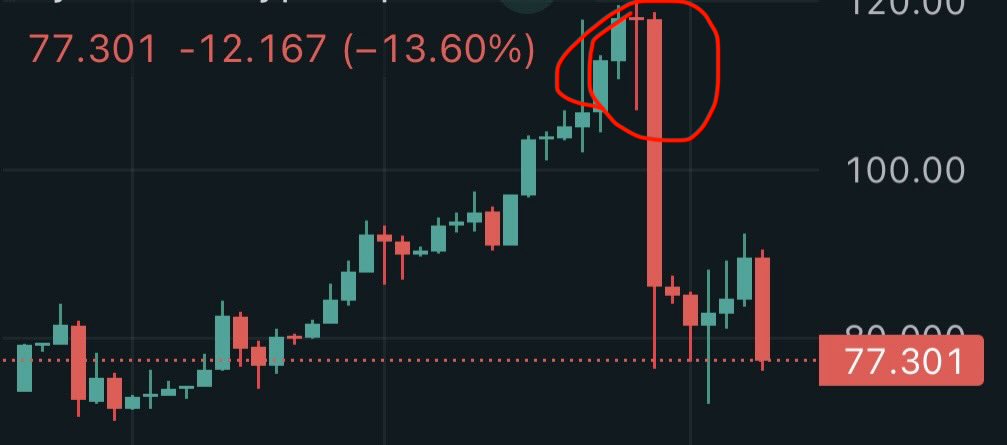
@0xQuit It's not possible that he didn't consider where the additional interest owned will come from, right?
I do think 13% on a maxed out pool is low but 50%, damn
English
Jesse Fudson (🤦♂️,🤷♂️)
5.4K posts

@jessefudson
Critical clown stuck in exit liquidity hell 🔥 @rekt_gang class of 2022 👨🏫 sold $HYPE at 3.99 🐱

The @arbitrum Security Council freezing 30,766 ETH was almost certainly the right call. Rugging Lazarus out of $71M is a real outcome against a real adversary. But the mechanism deserves a closer look than the discourse is giving it. From what it looks like and as per @stonecoldpat0, this wasn't just "a multisig froze an address." The Council: – upgraded the ethereum inbox contract with a new function allowing cross-chain message insertion with sender impersonation – injected an `ArbitrumUnsignedTxType` on arbitrum (a privileged ArbOS system tx that bypasses private keys entirely) to move the attacker's 30,765 ETH into a protocol-controlled recovery sink – reverted the inbox contract back to its original implementation – all atomically, in a single ethereum transaction That's not a freeze. That's a state-level clawback executed via live contract upgrade, privileged state-override, and contract revert, atomically. Technically elegant, practically enormous. The capability was always documented. It has now been demonstrated in production. For the first time. Two things are true at once: 1) this was the right call on a clear case. Identified DPRK attacker, law enforcement input, 9/12 independent council vote, ~$71M of user funds saved. 2) arbitrum is, verifiably, a chain where the Council can upgrade core contracts, override any address's balance, and revert the upgrade in one transaction. Every production L2 has some version of this capability. None is at Stage 2. Also, - the "DeFi just rugged DPRK" framing is rhetorically satisfying but quietly redefines DeFi to mean "a governed stack that intervenes in our favor." - the "this is MultisigFi not DeFi" framing is taxonomically honest but cold on a day when the intervention worked. Both are refusing the honest middle. More importantly, the forward question, which @dankrad and @sgoldfed are the only ones asking clearly — is what the line looks like next time. This case was easy. The next one won't be. Protocols don't have frameworks; they have emergency powers applied case-by-case and justified after the fact. That is a habit, not a system. Meanwhile the structural problem isn't fixed. As per lots of data (credits @0xCheeezzyyyy) , 47.1% of LayerZero oApps — 1,251 apps across 588 projects — still run 1/1 DVN configs. Same setup as Kelp. The Council cleaned up one incident; it can't refactor the default configuration of half the cross-chain stack. And the Ethereum-side ~75,700 ETH is still with the attacker. Arbitrum saved the Arbitrum leg; Aave is still facing ~$230M of potential bad debt on mainnet. The freeze didn't break a promise. It revealed a promise most of the stack had already quietly stopped keeping and restoring it is a longer project than any council vote can substitute for.

The Arbitrum Security Council has taken emergency action to freeze the 30,766 ETH being held in the address on Arbitrum One that is connected to the KelpDAO exploit. The Security Council acted with input from law enforcement as to the exploiter’s identity, and, at all times, weighed its commitment to the security and integrity of the Arbitrum community without impacting any Arbitrum users or applications. After significant technical diligence and deliberation, the Security Council identified and executed a technical approach to move funds to safety without affecting any other chain state or Arbitrum users. As of April 20 11:26pm ET the funds have been successfully transferred to an intermediary frozen wallet. They are no longer accessible to the address that originally held the funds, and can only be moved by further action by Arbitrum governance, which will be coordinated with relevant parties.



Clavicular’s club Bacara reportedly generated $1.3M in its opening week, making it one of the highest-earning clubs in Miami 👀




Everyone's first thought about the Resolv exploit: inside job. Here's what I found for and against. FOR: 1) USR's TVL dropped from ~$400M to ~$100M in the 6 weeks before the hack. 75% capital flight with no explanation. Someone was exiting before the bomb went off. 2) The SERVICE_ROLE key - only the team's infrastructure had access. The circle of suspects is very small. 3) Attack at 2:21 AM UTC on a Sunday. Minimum monitoring, maximum cashout window. The attacker minted 50M USR, waited 80 minutes, minted another 30M. Protocol wasn't paused between the two. No alerts, no response for over an hour. 4) No guardrails were ever added despite $100M+ in the protocol. No multisig, no rate limit, no max ratio. Negligence or intent? 5) Industry stats: 55% of DeFi exploits in 2024 were compromised accounts. Insider attacks - third biggest vector. AGAINST: 1) Team is fully doxxed. Public LinkedIn profiles, VC due diligence done. 2) $10M seed from Coinbase Ventures, Maven11, Arrington Capital, Robot Ventures. Not an anon project. 3) Fireblocks used for custody - professional key management. 4) ~$23M is not "disappear forever" money when your name and face are public. What's your read - compromised key, sloppy infra, or inside job? Drop your take below.

We are currently investigating a security incident involving unauthorized minting of USR. At this stage: The collateral pool remains fully intact. No underlying assets have been lost. The issue appears isolated to USR issuance mechanics. Our immediate priority is to: 1) Contain the incident 2) Assess impact 3) Ensure legitimate users are not affected We are actively investigating and will share more updates shortly.