

Ish Jindal
1.6K posts
Ish Jindal
@jindalish
Hustler, Traveler, Freedom-seeker, working on @hellotars_ai
Bangalore Katılım Mayıs 2013
974 Takip Edilen680 Takipçiler

Everyone is using Claude right now.
Very few founders are using it to drive real pipeline from LinkedIn.
So I built a free resource with the exact Claude prompts I use to build full LinkedIn funnels… the same system behind the multiple clients we’ve generated over 6-figs for.
Most people are using AI to write posts. Almost nobody is using it to build the actual infrastructure that turns LinkedIn into a lead machine.
I’m sure I could sell these prompts in the future but for now they’re yours:
Comment "Funnel" and I'll send it over.
(You need to be following so I can DM it to you.)
English

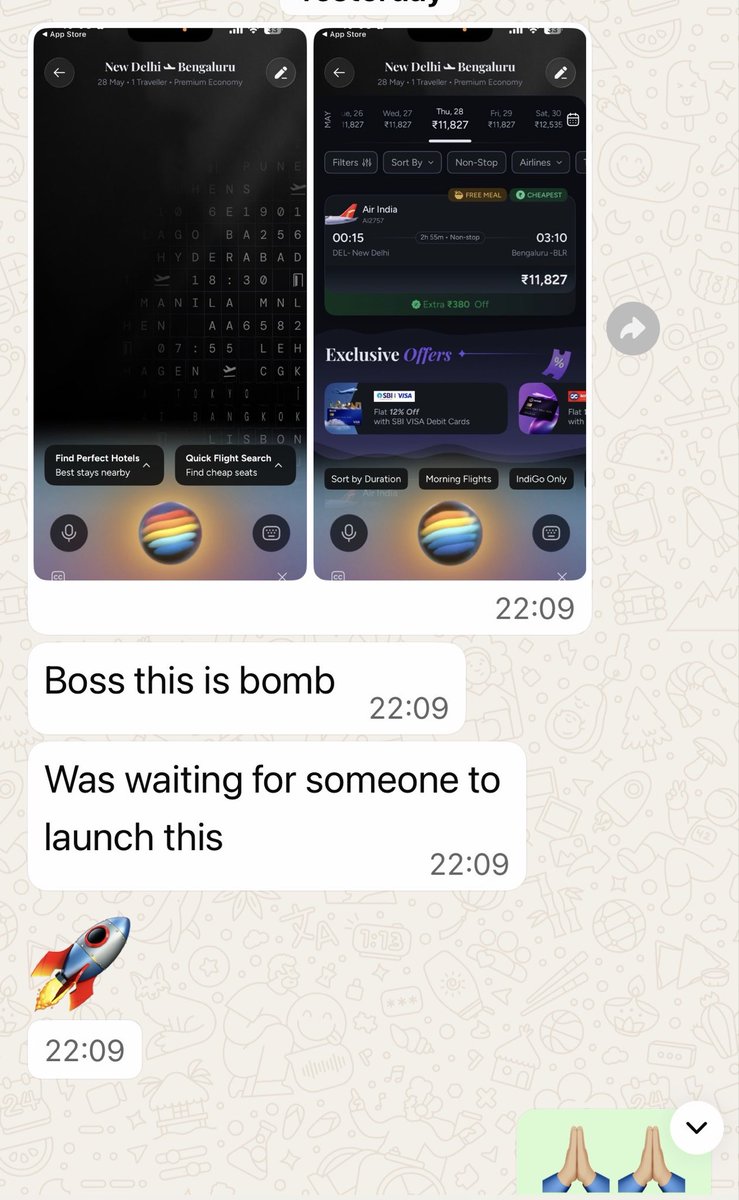
The kind of love ixigo NEXT is getting from folks in the ecosystem is another level 🚀
Proud of our team for shipping a world class first of its kind AI Native app experience ! @rajnishkumar
English
I remember a lot a lot of e-commerce companies, coming to us back in 2018-19, asking if they could do the entire buying experience on chat.
I always used to be like - Do you want to buy t-shirts over a chat interface? No, right?
Chat is not the best experience for everything.
Chat is a really, really beautiful interface for a lot of use cases, but for e-commerce it's definitely not the best interface.
You could possibly do it if you have a very small number of SKUs, but if you have anything more than ten SKUs, chat is probably not the best medium.
TBPN@tbpn
"I do not think a chatbot is the right interface for travel or e-commerce." - @bchesky "I think the future is not apps. The future is agents, but I don't think they're going to be text-forward. I think they're going to be really rich user interfaces." "Imagine using iMessage to do everything, when in fact every other app has a unique interface." "With e-commerce, you want a very rich user interface. It would be agentic. You can have a conversation with it, but the point is that it has to be more visual."
English

I have been doing this myself for GTM functions for the last couple of months and can see that this could be a dedicated role in itself.
Expecting everyone in the team to be on claude code or build agents with all the context seems unrealistic.
Aaron Levie@levie
Starting to hire and retrain for new agent engineering roles for *internal* functions to help get more powerful agents working well on critical business processes. I expect this type of role to be a very big deal over time at Box and other companies. It looks something like an internal FDE, whose job it is to wire up internal systems and get agents working with them effectively. The person will be extremely technical and capable of building secure, governed agents for internal workflows that connect to business systems (like Box, Salesforce, Workday, etc.), and codify workflows in skills. In some cases this person may understand the business process well enough to do it fully, but in most cases I expect them to work with the business directly in an embedded fashion. Ironically, that may introduce another new role on the business side that is more akin to agent product management for internal processes. The key is that you need technical + process people that can span multiple teams or functions in an organization. It’s not about brining automation to a job, but bringing automation to a process. This is going to be a very big trend in most companies going forward. Fun to watch the early innings of what this will look like.
English

AI rate limit is just the universe telling you to go watch the sunset

English
Ish Jindal retweetledi

One more game made talking to my @openclaw bot on @telegram. Here you go, try it: games.vinitagrawal.com/road-dodge-run…




English
Ish Jindal retweetledi

Fatherhood changes your priorities in ways you can't understand until it happens.
Here's what I mean:
BEFORE KIDS:
Success = How much money I make
Free time = Whatever I want to do
Weekends = Sleeping in, doing nothing
My body = Doesn't really matter
Patience = Not something I thought about
AFTER KIDS:
Success = Being the dad they brag about
Free time = Playing with them on the living room floor
Weekends = Pancakes at 7 AM, park trips, exhaustion
My body = The tool I use to keep up with them
Patience = The most important skill I'm building
Before: I worked out to look good.
After: I work out so I can throw my kids in the air without getting winded.
Before: Sleep was negotiable.
After: 7 hours is non-negotiable because they need me present, not exhausted.
Before: My time was mine.
After: Their childhood is happening right now, and I can't get it back.
The shift isn't instant. It's gradual.
One day you realize:
That promotion you were chasing? Doesn't matter if you miss their childhood getting it.
That extra hour of sleep? Not worth missing breakfast with them.
That workout you skipped? You felt it when they asked you to play and you were too tired.
Fatherhood doesn't make you soft. It makes you focused.
Suddenly, everything has to pass through one filter:
"Is this helping me be the father they deserve?"
If the answer is no, it's gone.
That's not sacrifice. That's clarity.
The things that used to matter (impressing people, keeping up appearances, chasing status) just... don't anymore.
What matters now:
• Can I keep up with my kids?
• Am I patient when they're not?
• Am I present or distracted?
• Am I modeling the man I want them to become?
• Will they remember me as someone who showed up?
That's it. That's the list.
Fatherhood didn't change my priorities.
It revealed what they should have been all along.
English
@tankots I was showing Wispr to my dad just today.
Congratulations on the raise, crazy good product.
English

we just raised another $25M after 10x'ing our ARR in 5 months. the crazy part is this almost never happened.
17 years ago, I watched Iron Man as a 10-year-old kid in Delhi. that night, I pulled my first all-nighter teaching myself to code. not because I wanted to build apps or make money.
because I wanted to build Jarvis.
my parents gave me 1 hour of screen time per day. so I coded in secret, sleeping every alternate night through middle school and high school. built 50+ apps. got a cease and desist from Google at age 12.
all for this one obsession: making computers understand us like humans do.
fast forward to today:
- we've raised $81M total to build the voice operating system
- growing revenue 40% month-over-month this year
- 70% user retention after one year (unheard of in consumer)
- teams at 270 of the Fortune 500 use Wispr Flow daily
our Series A2 was led by @hanstung at @notablecap (who was an early investor in five companies that made it to $100B valuation like Slack, Tiktok, and Airbnb). we also brought on @StevenBartlett as an investor and partner.
but here's what matters more than the money:
we cracked voice input. not transcription - actual understanding. our users hit "send" in under 0.5 seconds without checking. they trust it blindly. that's never existed before.
in a recent benchmark, Wispr came out as 3-4x more accurate than OpenAI, ElevenLabs, and Siri.
and we're just getting started. voice input was step one. now we're building the assistant that actually does things for you.
to my co-founder @SahajGarg6 - there's no one else I'd rather build Jarvis with than my college roommate and closest friend.
to our team pulling all-nighters and shipping magic - you're the reason that 10-year-old kid's dream is becoming real.
we're hiring cracked engineers and growth marketers who want to build the future of human-computer interaction.
the keyboard had a good 150-year run.
time to build what comes next.
PS: like, retweet, and bookmark to get wispr flow for free for 3 months ❤️
— Written with @WisprFlow
English
@shubhmx @OpenAI @AnthropicAI @vercel @Cloudflare @NotionHQ @LumaHQ Agree, just attended an event at AGI house today without registering for it in advance.
English

in san francisco, it’s different.
you apply to an event from @OpenAI , @AnthropicAI @vercel @Cloudflare @NotionHQ from @LumaHQ and even if it’s full or you aint approved, just show up, they’ll still let you in.
doors stay open, people are generous, and curiosity gets you further than approval.
Zaid@zaidmukaddam
nvm @openai
English
Ish Jindal retweetledi
Ish Jindal retweetledi

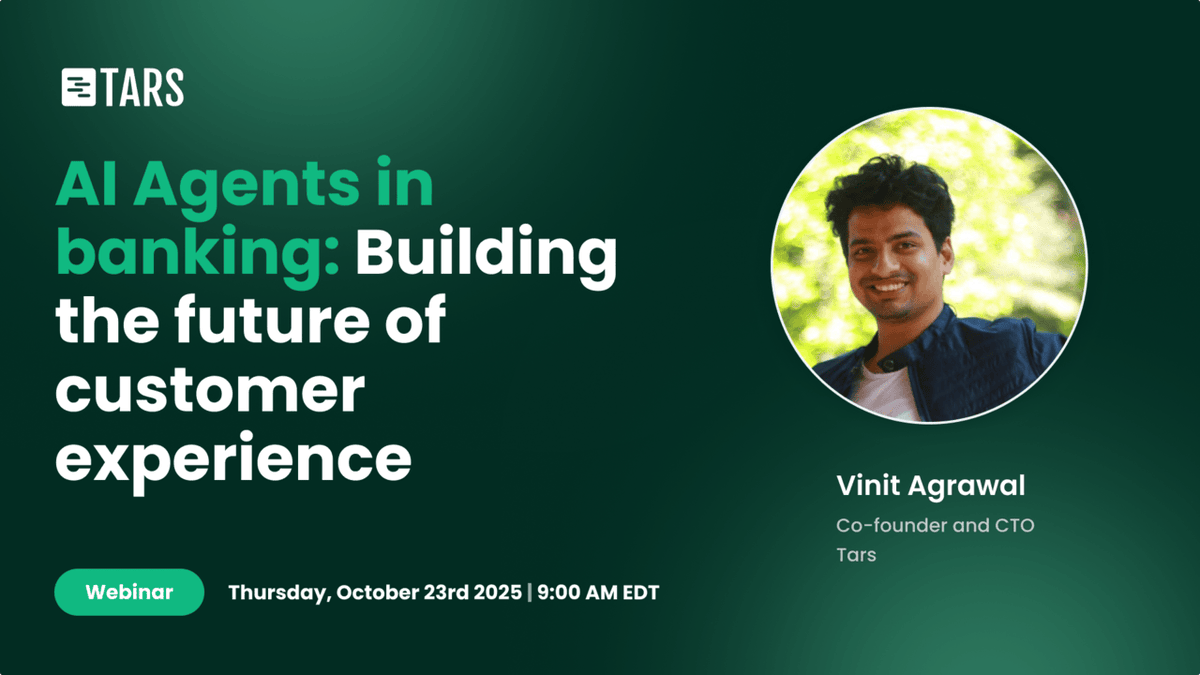
We're hosting a webinar with our CTO @vinit_agr, on how banks are actually using AI Agents today.
Not future vision. Real implementations solving real problems.
Join us on 23rd October at 9 AM EDT
Register: us02web.zoom.us/webinar/regist…
#AI #Banking

English
Ish Jindal retweetledi
Join @vinit_agr, CTO of Tars, on 23rd October at 9 AM EDT for an exclusive session on how AI Agents are changing commercial banking.
We'll examine real-world applications and demonstrate what's possible today.
Register here: us02web.zoom.us/webinar/regist…
#BankingSolutions #AI
English
What we have been building with Tars 2.0
Weaviate AI Database@weaviate_io
Most AI agent platforms are built for engineers. TARS is built for everyone else. Meet 𝗧𝗔𝗥𝗦, built by @vinit_agr and @jindalish, a conversational AI platform that's making intelligent agents accessible to everyone, not just AI engineers. What makes this different from your typical chatbot? TARS combines three powerful components: 🧠 𝗔𝗴𝗲𝗻𝘁: The brain that orchestrates decisions and planning 📚 𝗞𝗻𝗼𝘄𝗹𝗲𝗱𝗴𝗲: RAG-powered retrieval using vector search for accurate, contextual responses 🔧 𝗧𝗼𝗼𝗹𝘀: 300+ integrations including Google Sheets, Notion, and CRMs The platform uses Weaviate as its vector database backbone for semantic and hybrid search capabilities, allowing agents to retrieve relevant information from your business documents, websites, and PDFs with impressive accuracy. But here's the really cool part - ✨𝘁𝗵𝗲 𝗮𝘂𝘁𝗼-𝗽𝗿𝗼𝗺𝗽𝘁 𝗴𝗲𝗻𝗲𝗿𝗮𝘁𝗶𝗼𝗻 𝗳𝗲𝗮𝘁𝘂𝗿𝗲✨. We all know writing effective prompts is super challenging, so TARS automatically generates optimized prompts and welcome messages based on your high-level instructions. Real-world applications we're seeing: • Documentation assistants that can answer complex technical questions • Lead capture systems that seamlessly integrate with your CRM • Customer support agents with access to your knowledge base • Multi-modal agents that can handle text, images, and more The live demo showcases an agent trained on Weaviate documentation that could both answer technical questions and capture lead information to Google Sheets - all within a single conversational flow. This is exactly the kind of innovation that's making AI agents accessible to businesses without requiring a team of ML engineers 💚 Huge congrats to the TARS team for showcasing this at AWS Demo Night! Check out TARS at hellotars.com and start building your own conversational agents today. Watch the full AI Engineer Spotlight video: youtu.be/lpZ8tKpqaC8
English
Ish Jindal retweetledi

Most AI agent platforms are built for engineers.
TARS is built for everyone else.
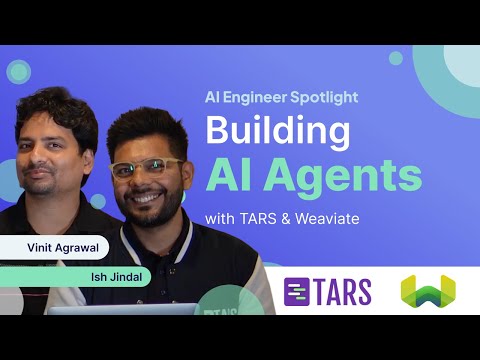
Meet 𝗧𝗔𝗥𝗦, built by @vinit_agr and @jindalish, a conversational AI platform that's making intelligent agents accessible to everyone, not just AI engineers.
What makes this different from your typical chatbot? TARS combines three powerful components:
🧠 𝗔𝗴𝗲𝗻𝘁: The brain that orchestrates decisions and planning
📚 𝗞𝗻𝗼𝘄𝗹𝗲𝗱𝗴𝗲: RAG-powered retrieval using vector search for accurate, contextual responses
🔧 𝗧𝗼𝗼𝗹𝘀: 300+ integrations including Google Sheets, Notion, and CRMs
The platform uses Weaviate as its vector database backbone for semantic and hybrid search capabilities, allowing agents to retrieve relevant information from your business documents, websites, and PDFs with impressive accuracy.
But here's the really cool part - ✨𝘁𝗵𝗲 𝗮𝘂𝘁𝗼-𝗽𝗿𝗼𝗺𝗽𝘁 𝗴𝗲𝗻𝗲𝗿𝗮𝘁𝗶𝗼𝗻 𝗳𝗲𝗮𝘁𝘂𝗿𝗲✨. We all know writing effective prompts is super challenging, so TARS automatically generates optimized prompts and welcome messages based on your high-level instructions.
Real-world applications we're seeing:
• Documentation assistants that can answer complex technical questions
• Lead capture systems that seamlessly integrate with your CRM
• Customer support agents with access to your knowledge base
• Multi-modal agents that can handle text, images, and more
The live demo showcases an agent trained on Weaviate documentation that could both answer technical questions and capture lead information to Google Sheets - all within a single conversational flow.
This is exactly the kind of innovation that's making AI agents accessible to businesses without requiring a team of ML engineers 💚
Huge congrats to the TARS team for showcasing this at AWS Demo Night!
Check out TARS at hellotars.com and start building your own conversational agents today.
Watch the full AI Engineer Spotlight video: youtu.be/lpZ8tKpqaC8
YouTube
English
Ish Jindal retweetledi

From "can't afford a flight" to $1M+ bootstrapped.
Last week on Startup Strategies, I spoke with @jindalish CEO and co-founder of @hellotars_ai.
Ish skipped his BBC interview 'cause he couldn’t afford the ticket, then spent nine years building Tars.
Watch the full breakdown👇
English

Ish Jindal retweetledi
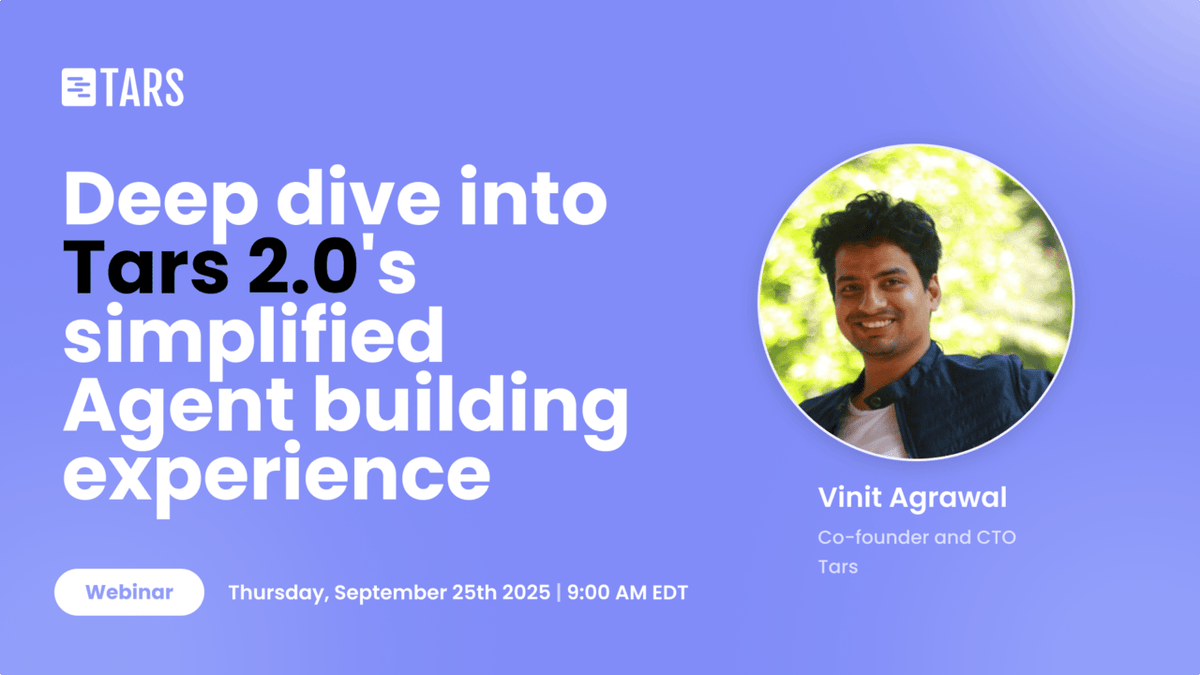
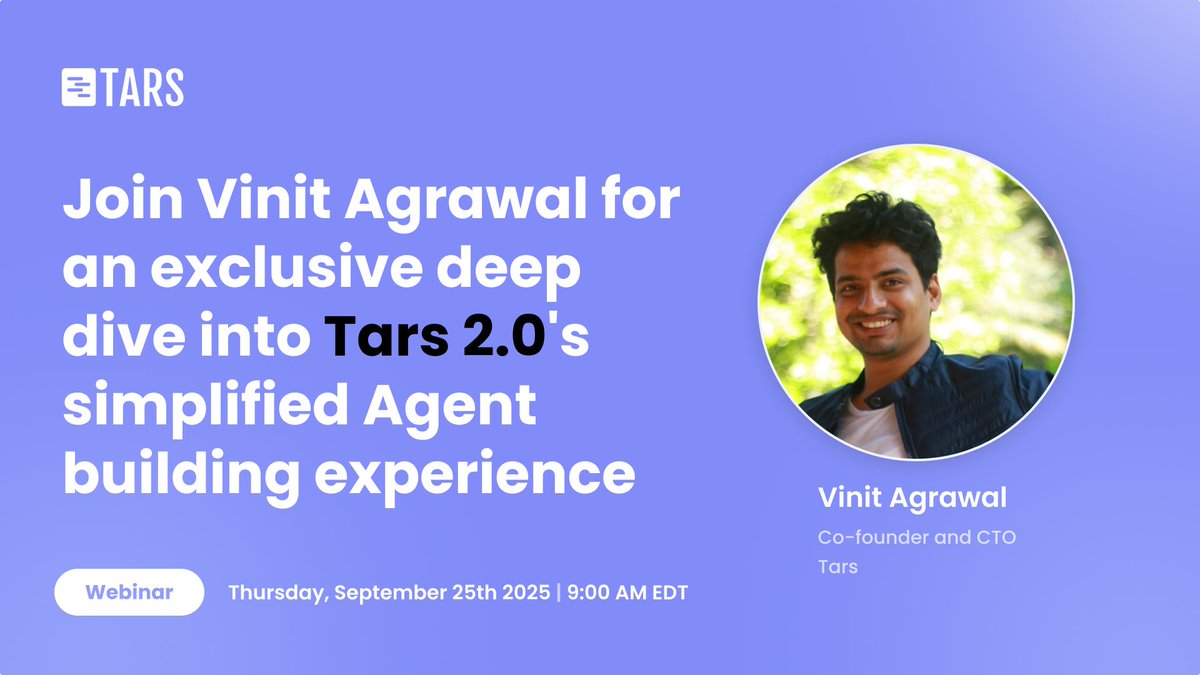
We're pulling back the curtain on Tars 2.0 with our CTO, Vinit, on September 25th at 9:00 AM EDT.
He's bringing the engineering team to showcase the complete transformation of how you can build Conversational AI Agents with Tars 2.0.
Register here: us02web.zoom.us/webinar/regist…
English
Ish Jindal retweetledi
Our CTO, @vinit_agr, and engineering team are demonstrating how Tars 2.0 represents a shift in the Conversational AI space.
Join us on September 25th, 9:00 AM EDT, to understand the latest feature additions and the 'why' behind those.
Register: us02web.zoom.us/webinar/regist…
English