Joaquin

3.2K posts

Joaquin banner
Joaquin

Joaquin

@joakin

Alicante, Spain Katılım Mayıs 2007
185 Takip Edilen176 Takipçiler
Joaquin retweetledi
Nic Barker
Nic Barker@nicbarkeragain·
@ThePrimeagen My happy place when programming these days is when I can go days on a project without having to use the internet once, because I have control over almost everything. When I need something, I figure it out and implement it myself. Feels like when I first started as a kid.
English
2
4
90
1.2K
David Hill
David Hill@iamdavidhill·
we’ve been busy redesigning the desktop app from the ground up the beta taught us a lot most importantly, that left sidebars suck hello tabs 🔊
English
215
41
1.5K
269.2K
Joaquin
Joaquin@joakin·
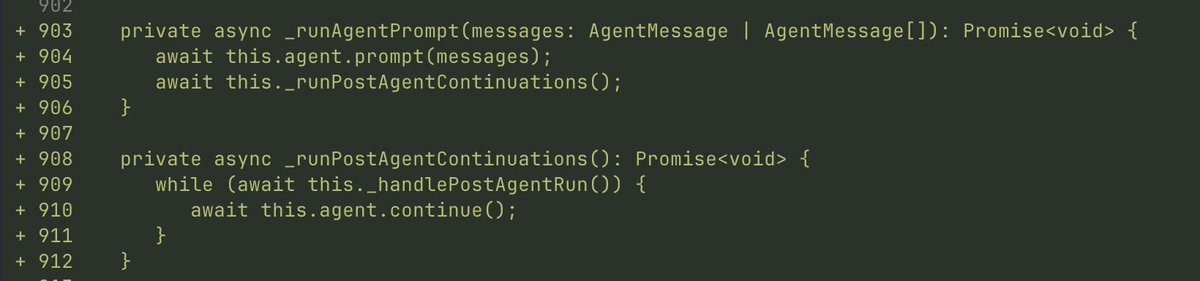
@badlogicgames Is it gpt 5.5? It does love making single use small functions... It's annoying. It's even worse when the fun just wraps one line of code. Like... C'mon!
English
0
0
0
383
Mario Zechner
Mario Zechner@badlogicgames·
i just can't get this moron not to do this. it's infuriating.
Mario Zechner tweet media
English
21
1
99
16.7K
Joaquin retweetledi
Adam
Adam@adamdotdev·
It's 2026 and your CEO just sent you a 2,400 line pull request. You get a cup of coffee and sit down to review it. It's a disaster. A dozen unrelated refactors. Unused methods with names like `convertFromBase10` and `normalizeBeforeSerialization`. You catch a few hardcoded API keys, but that's ok. It's part of the dance. They didn't consider that someone might look at this diff. Here's a comment buddy. They respond in an hour (after Copilot, qodo, CodeRabbit and Greptile finish their reviews) saying we shouldn't worry about "implementation details" anymore, those are relics of the past. Hey let's jump into a room and figure it out. We can't just agree to disagree, this is probably my last job in tech and I can't watch this fucker burn the place to the ground. The PR merges and goes to prod. You feel a shared sense of apathy and dread with Hannah the intern (she has to review his AI generated social media posts ever since Grok got too imaginative). That night you go to sleep and have nightmares of that code. You can still see the shapes of it on the backs of your eyelids. You go to work the next day ready to quit. You no longer understand the system. There is no foundation. Time to use those savings and an SBA loan to buy a liquor store and never login to GitHub again.
staysaasy@staysaasy

It’s 2018 and your coworker just sent you a 400 line pull request. You get a cup of coffee and sit down to review it. It’s beautiful. Elegant micro-refactors. Crispy method names. You catch a few things, but that’s ok. It’s part of the dance. They didn’t consider extensibility on part of their API. Here’s a comment buddy. They respond in an hour saying they think we should do one piece differently than your comment. Hey let’s jump into a room and figure it out. We can’t just agree to disagree, this code is too important. The PR merges and goes to prod. You feel a shared sense of ownership and accomplishment. That night you go to sleep and dream of that code. You can still see the shapes of it on the backs of your eyelids, your IDE syntax highlighting sparking neurons in your reptile brain. You go to work the next day ready to go. You understand the system. N is your foundation. Time to build n+1.

English
94
265
4.4K
395K
Joaquin retweetledi
Mario Zechner
Mario Zechner@badlogicgames·
recommended reading. strongly recommended reading. i really like the pain avoidance angle. slots into my "paon/friction is when you learn" angle. when combined > cognitive debt. larsfaye.com/articles/agent…
English
31
98
997
69.5K
Joaquin
Joaquin@joakin·
@jamwt Would go have been a viable option too?
English
1
0
0
43
Jamie Turner
Jamie Turner@jamwt·
Rust is an enormous pain in the ass. And yet it would’ve been completely infeasible to build Convex without it. 🦀
English
21
2
382
23.1K
Joaquin retweetledi
Nic Barker
Nic Barker@nicbarkeragain·
Like it or not, in the world we live in now, your attention span is one of the most vital resources you have. More important than intelligence IMO. If your attention span is completely wrecked, purposefully improving it will make a huge difference to your quality of life.
English
4
18
260
9.1K
Microsoft Learn
Microsoft Learn@MicrosoftLearn·
Trustworthy AI is built on two pillars: 1️⃣ High-quality data When data is incomplete, biased, or inaccurate, AI outputs can be misleading. 2️⃣ Strong security AI systems are vulnerable when sensitive information is exposed. Getting these basics right makes it much easier to adopt AI in a way that’s safe, responsible, and aligned with your organization’s goals.
English
22
38
269
21.5K
Joaquin retweetledi
Łukasz | Wookash Podcast
Łukasz | Wookash Podcast@wookash_podcast·
Aaaand it's out! The one where @nothings writes a twin stick shooter game from scratch in C, on the spot, in 90min while answering my questions. It's a pure joy to see Sean at work. I was amazed how quickly you can get graphics up on screen with using older OpenGL and sidestepping complexity coming from more modern APIs, when your goal is to get sth visual. Lastly, and most importantly, if you're wondering what is the Sean's keyboard, that's the one you can see hanging on the wall behind him lol! youtu.be/nQrzB5P5NPE
YouTube video
YouTube
English
5
45
492
61.6K
Joaquin retweetledi
Gergely Orosz
Gergely Orosz@GergelyOrosz·
In an age of slop AI content everywhere, doing >> consuming: "Remind yourself entertainment is not learning. Instead of scroll, like, scroll: read long books, try to replicate that tutorial you bookmarked, or maybe spend some time in the docs. Push yourself to DO, not consume."
claire vo 🖤@clairevo

x.com/i/article/2035…

English
13
29
261
28.7K
Joaquin
Joaquin@joakin·
@thdxr I use handy a bunch with parakeet 3 and it's very good but it struggles sometimes when doing code things like file names or function names using the proper casing. The Codex app has added a global shortcut to use the open AI dictation from anywhere, that one does even better
English
0
0
1
93
dax
dax@thdxr·
i'm not really a big "one secret that makes ai good" guy but i will say it does so much better when your prompts are longer and it's so much easier to produce long prompts with voice, completely changed things for me
English
134
36
1.8K
72.7K
Joaquin
Joaquin@joakin·
@SebAaltonen Personally it's more about the obligation than the design itself. If they are so good why not let people decide on them. I hate them and I hate that I can't choose alternative designs or the old ones. I've never in my life lost a cap from a bottle, it's never been an issue
English
0
0
0
9
Sebastian Aaltonen
Sebastian Aaltonen@SebAaltonen·
Most Europeans actually like the new bottle caps. It's convenient that you don't need to hold the cap in your other hand. And you can't lose it. There were some first-gen bottles with badly designed caps, but most manufacturers have fixed their initial design flaws now.
Rodney@_ChanFace

Why were Europeans so whiney about the attached bottle caps?? Regardless of environmental reasons, it does not interfere with drinking at all and it’s actually super convenient to not need to hold on the cap! 10/10 Canada should adopt!

English
137
12
502
46.6K
Joaquin retweetledi
Nic Barker
Nic Barker@nicbarkeragain·
To be a little less vague, I suspect that we're likely (not certain, but likely) to be entering into a period of unprecedented software degradation, and we're going to be seeing an increasing frequency of outages like this across many high profile products. But IMO the cause is actually not just the-one-thing-that-everyone-is-always-talking-about, it's a number of things that have all been bubbling away at just below critical levels for a long time. Some of the things off the top of my head: - Poorly designed / optimised software has been getting a free ride on hardware improvements pretty much since the invention of the computer. That chapter is now coming to an end, and will only be worsened by the enormous industry-wide pivot to producing & innovating on AI specific hardware, rather than general purpose CPUs etc. - The ZIRP era created a temporary suspension of reality in our industry, and now that it's ended we need to deal with the hangover. Companies that spent years making no profit, paying extravagant compensation to employees / shareholders and giving away server time for free are now pivoting into extraction mode, which is putting further pressure on their low quality software. QA is being laid off, hardware budgets are being reduced, timelines for shipping features are becoming more aggressive, etc. - The enormous amount of free money incentivised too many new people to join the industry too quickly. This has led to an abundance of poor quality education programs (bootcamps, uncertified colleges etc) and an influx of people into the industry who frankly aren't interested in programming. If you compared the average person in the industry now to 20 years ago, I suspect the difference in motivations would be stark. I'm not saying it's these people's fault necessarily, it's simply an inevitable result of the absurd compensation / performance expectations ratio that our industry has enjoyed for the last 15+ years. Working for a tech company has also become socially prestigious, which further adds to the problem. - Because computer programming was once an incredibly niche area of interest, many of our fundamental systems are built on trust. We're now starting to see that if systems like open source, public supply chain, discussion spaces, education etc become flooded with bad actors, we have no real mechanisms to deal with them. - Our hiring / recruitment pipeline has totally misaligned incentives. Even before the AI resume / AI HR-filtering arms race disaster that we're experiencing now, the widespread adoption of the leetcode style interviews IMO selected for a very narrow personality type, and filtered candidates that would have made great contributions to the industry long term. - The pivot from purchasing long term stable releases of software, to paying a subscription for constantly updating software has done huge damage to software quality as a whole. Companies have lost their incentive to get their software "right" because they can just "fix it later", and for the consumer - you can't just go back to the version of github that still works because the new one has problems. This was all happening well before AI entered the picture. I won't belabor the point because there has been endless discussion about it. But to me personally, there are two additional and deeply worrying problems with AI code generation. - It's undeniable at this point that it negatively affects the people who use it. It stops juniors from getting better, and it burns seniors out and makes them hate their jobs. Like it or not, humans are still the core of this industry, and I don't see this ending well. - It's completely unfit for purpose in the most important, high-stakes situations. One of the reasons that we excuse all the small errors it makes, is because it's low effort to type "do it again and fix this bug". That kind of thing doesn't fly when you only get one attempt because a mistake results in data loss or an outage. The damage is done. All the above has led to a silent exodus of many of our most experienced and impactful people. There are so many amazing programmers who made enough through stock options / compensation that they didn't need to work anymore, and were only doing it because they enjoyed it. Many of these people have just quit the industry and switched to doing hobby projects in the last 5 years. These are the types of people who have the experience and foresight to prevent the types of outages that we're seeing at github today. It's very easy to assume that the proverbial straw that broke the camel's back is entirely to blame here. But I think it's a reckoning that has been on the horizon for a very long time.
English
37
215
1.4K
46.4K
Joaquin retweetledi
Simon
Simon@iced_coffee_dev·
Hyped about AI? Hate AI? Have literally no opinion on AI? I made a video about AI & agentic coding, and what it might mean for you as a developer. youtu.be/2dTENijF30c
YouTube video
YouTube
Simon tweet media
English
0
3
20
2.9K
Joaquin retweetledi
staysaasy
staysaasy@staysaasy·
“Everyone can code now!” Dude, no one can code now.
English
204
1.3K
20.6K
335K
Joaquin retweetledi
Mo
Mo@atmoio·
there’s a dude on youtube making a video with a burst blood vessel in his eye. the title is “software developer driven to insanity by 2026 job market” and he’s pointing at his eye as evidence of the stress he’s going through. garrett’s a rather normal dude and there were no obvious tells as to why this guy has not been able to find a job for 9 months since he was laid off in july. but there was a hint. at one point he describes how he went really far in an interview process, and he was absolutely sure he was gonna get the job. they hire someone else and the dude is incredulous. he asks them wtf!? they show him the winning candidate entry. garrett used 50% ai and 50% manual coding. he was sitting there being thoughtful and deliberate and properly naming functions and variables and designing modular architectures. meanwhile the winning application was a dude who used 100% ai and his app had a shit ton more features. and he delivered it faster. so, that’s the kind of dude being hired now. garrett didn’t get the job. but someone else did. so the job is there. the job was open. just not for you. the thing getting you hired in 2019, like obsessing over code quality and maintainability and best practices, will get you fired in 2026. the market has spoken. if you want to land a dev job, make more slop. they want more features done faster at a lower cost. your job is not to argue. it is to provide the thing they are seeking. pick 3 companies you really wanna work for, then build their entire app in a weekend as your cover letter. applying to doordash? build their 3-sided market place in 2 hours. applying to google? build your own search engine that does a 2-hour web crawl. reading code is a dead thing. no one reads their own code anymore, let alone yours. they will run your app. and they’ll judge you off that. build more slop. build a slop empire. imagine more slop. be the slop. slop slop slop. get the job. make money. give your boss the slop he wants. don’t argue. slop is peace. slop is strength. inhale the slop. exhale it. oh you wanna be an artist? cute. go code on a city street like a bucket drummer. you code by hand for tips now. otherwise, off to the slop factory. enjoy it! enjoy the sloppagaden! make a little money!
Mo tweet media
English
114
81
1.4K
272.3K
Joaquin
Joaquin@joakin·
@valigo Seriously. I've been using them for a while to relearn C and low level programming and the handmade way and that have helped me tremendously. Grill them with questions, have them explain code, explore tradeoffs, ... Always keep your brain on. Don't let them do the work to learn
English
0
0
2
216
Valentin Ignatev
Valentin Ignatev@valigo·
It was never easier to learn new things. LLMs will answer every stupid question, they rarely mess up beginner info, and you can ask them to provide human-made sources. Please take this opportunity to learn fundamentals.
English
23
12
281
10.2K
Joaquin
Joaquin@joakin·
I'm grateful we have a model of this caliber open source. Kimi 2.5 is a very good model, this looks even better
Artificial Analysis@ArtificialAnlys

Moonshot’s Kimi K2.6 is the new leading open weights model. Kimi K2.6 lands at #4 on the Artificial Analysis Intelligence Index (54) behind only Anthropic, Google, and OpenAI (all 57) Key takeaways: ➤ Increase in performance on agentic tasks: @Kimi_Moonshot's Kimi K2.6 achieves an Elo of 1520 on our GDPval-AA evaluation, which is a marked improvement over Kimi K2.5’s Elo of 1309. GDPval-AA is our leading metric for general agentic performance, measuring the performance on knowledge work tasks such as preparing presentations and analysis. Models are given code execution and web browsing tools in an agentic loop via our open source reference agentic harness called Stirrup. This continues Kimi K2.6’s strength in tool use, maintaining a 96% score on τ²-Bench Telecom, placing it among other frontier models in this category. ➤ Low hallucination rate: Kimi K2.5 scores 6 on the AA-Omniscience Index, our knowledge evaluation measuring both accuracy and hallucination rate. This score is primarily driven by a comparatively low hallucination rate of 39% (reduced from Kimi K2.5’s 65%), indicating a greater capability to abstain rather than fabricate knowledge when the model is uncertain. Kimi K2.6’s low hallucination rate places it similarly to other models such as Claude Opus 4.7 (36%) and MiniMax-M2.7 (34%) ➤ High token usage: Kimi K2.6 demonstrates high token usage, but is in line with other frontier models in the same intelligence tier. To run the full Artificial Analysis Intelligence Index, Kimi K2.6 used ~160M reasoning tokens. This is slightly lower than Claude Sonnet 4.6 (~190M reasoning tokens) but much higher than GPT 5.4 (~110M reasoning tokens). ➤ Open weights: Kimi K2.6 is a Mixture-of-Experts (MoE) model with 1T total parameters and 32B active, same as the previous two generations of models Kimi K2 Thinking and Kimi K2.5. Kimi K2.6 again pushes the open weights frontier in intelligence. ➤ Third Party Access: Kimi K2.6 is accessible through Moonshot’s First Party API as well as third party API providers Novita, Baseten, Fireworks, and Parasail ➤ Multimodality: Kimi K2.6 supports Image and Video input and text output natively. The model’s max context length remains 256k. Further analysis in the threads below.

English
0
0
0
17