Joe Pankowski
40 posts


Inbox: @GovRonDeSantis will be holding a press conference in Tallahassee today right near the entrance of the Tallahassee airport. Hearing he plans to sign the bill that would put up a designation sign naming the airport after former @FloridaState coach Bobby Bowden.
English

@Genetics56 FSU and Ga Tech to the B1G in the near-term would make a ton of sense, especially with Florida State on track for AAU acceptance. Miami's use of NIL and tampering with players (one being a Wisconsin athlete) certainly doesn't make the Canes look like FSU's future travel partner.
English

Florida State has been on Big Ten's offical expansion target list since Kevin Warren. They first came onto the list when Maryland joined the Big Ten. Back when Georgia Tech's leadership at that time said no to the Big Ten (what a mistake thatwas to say no).
FSU Bagman🍢🍢🍢@unconqnole
@Genetics56 You think it’s the Big Ten?
English

@Genetics56 ...you fail to note the networks' role here. Fox/NBC/CBS need much better content for their Saturday windows and will pay up to get FSU and a travel partner into the B1G. When combined with Petitti's wish for a truly national conference, FSU should be in by the Fall of '27.
English

For an ACC school school to buy their way into the Big Ten, it will cost over $350M by the time 2030 comes around and that doesn't include the cost of leaving the ACC.
Thus, a move to the Big Ten for an ACC school by buying their way in isn't likely to be affordable unless a billionaire wants to pay for it or if a state funds the cost.
And that is just to get an invite, not including any half-shares or anything like that for multiple years.
Just an FYI.
English

@Genetics56 The football breakaway into a 40-team super league is clearly on the drawing board. By keeping Olympic sports regionalized, for example, you could regenerate the PAC and allow FSU's non-football programs to return to the ACC if the Noles join the B1G in the near-term. Win-win.
English

Conference realignment in college football is evolving beyond the outdated model of schools simply switching from one conference to another conference and being funded by TV subscription revenue.
In the coming years, the landscape will be shaped by new dynamics: brand vs. brand matchups, media rights optimization (does school A increase the median for Conference B), regional shifts for Olympic sports, the financial impacts of the House settlement, revenue sharing, and the potential consolidation of the sport’s elite into a 40-team Super League. And we may get a new division in college athletics.
Here’s what this transformation may look like and what it means for the future of college football.
The Shift to Brand vs. Brand
The days of regional rivalries dictating conference alignment are fading. Instead, realignment will prioritize pitting the biggest brands—think Ohio State vs. Texas or LSU vs. Michigan—against each other to maximize viewership and revenue. These marquee matchups aren’t just games; they’re media events designed to draw national audiences and boost sponsorship deals. Conferences will increasingly resemble professional leagues, grouping schools based on their marketability rather than geography, creating a product that transcends traditional college football boundaries.
Media Rights: The Financial Engine
Media rights deals will remain the primary driver of realignment. Schools will align with conferences offering the most lucrative TV and streaming contracts, as seen with the Big Ten’s annual billion-dollar agreements with Fox, CBS and NBC. The focus will be on which schools lift the median value of a conference’s media rights package—powerhouses like Alabama or USC add more dollars per game than smaller programs.
Olympic Sports Go Regional
While football chases national brand power, Olympic sports (like track, swimming, and wrestling) may shift back to regional conferences. The high cost of travel for these non-revenue sports, combined with new financial pressures from revenue sharing, will push schools to compete closer to home. This could create a split system: football in national, brand-driven leagues, and Olympic sports in regional alignments to cut costs and preserve traditional rivalries.
Hint: N. IL already follows that model.
House Settlement and Revenue Sharing
The House v. NCAA settlement introduces a game-changing financial obligation: schools opting in would share up to $20.5 million annually with athletes in year one of the settlement. Not every program can afford this, and opt-outs may struggle to keep pace. This revenue-sharing model will strain budgets, favoring wealthy schools with robust donor bases and TV revenue. Conferences might also set base investment requirements—minimum financial thresholds for membership—further consolidating power among the elite and creating a tiered system where only the richest thrive.
A 40-Team Super League
At the top, college football could consolidate into a 40-team Super League, split into two conferences akin to the NFL’s AFC and NFC. This structure would feature the sport’s biggest brands—Alabama, Ohio State, Texas, etc.—competing regularly to maximize media rights revenue. It’s a professionalized vision: centralized governance, revenue sharing, and a focus on profitability. Smaller programs would be excluded, left to compete in lower tiers or regional leagues, while the Super League dominates the spotlight.
What This Means
This realignment prioritizes financial gain over tradition. High-profile brand matchups and massive media deals will enrich the top programs,
The Bottom Line
In the coming years, conference realignment will transform college football into a more professional, NFL-like entity. A Super League of 40 top brands, split into two conferences, will chase media riches, while Olympic sports revert to regional roots. The House settlement, NIL, and revenue sharing will entrench the elite, with conferences setting financial bars only the wealthiest can clear. It’s a future of bigger profits for the few, but it risks leaving smaller programs and cherished traditions behind.
And don't be surprised if we have sport specific conferences. Hint: Google Sportico's Men's Soccer News.
English

@PatrickBoren2 @flugempire FSU's gone to the B1G in the Fall of '26. Write it down.
English

@flugempire I believe today is the first day schools can now have first party talks from the ACC to other conferences?
English

@Genetics56 Great post, @Genetics56 . Florida State will be a great addition to the B1G and I expect that to occur in the fall of '26. There are simply too many synergies between the B1G and FSU for either party to allow the SEC to come in and steal the NATIONAL goals of both entities.
English

We know Florida State is a national brand. But what makes Florida State a national brand? Why does this matter for a possible Big Ten membership?
When I make posts like this, there is usually a specific targeted audience that I am speaking to. That is once again the case with this post.
While the 2024 Nielsen viewership data is not included in this post, there is enough data to understand how Florida State's football program impacts the viewership draw of other ACC football programs. It simply doesn't matter if people are hate watching or not, the viewership means the same in the end no matter the reason for watching. I'd argue the more hate watchers a football program has means they are a stronger national brand than not having hate watchers.
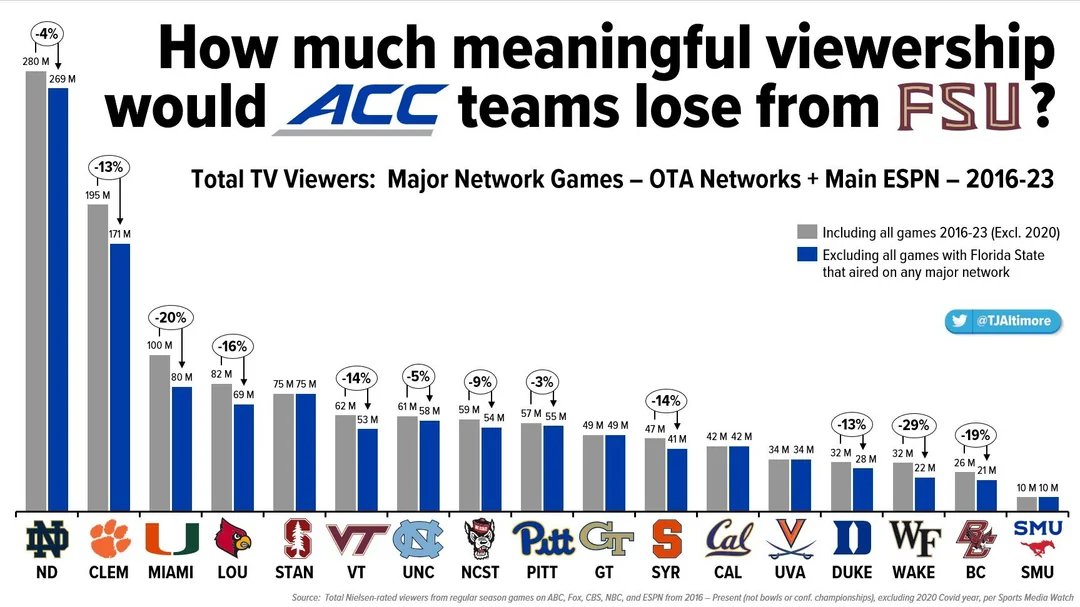
The image, from @TJAltimore , provides viewership data for Florida State and how things would be impacted if Florida State was no longer a member of the ACC. On the flip side, for membership in the Big Ten, over the last decade or so for viewership draw, Florida State would be in the Top 4. That means Florida State is not a negative addition from a viewership perspective and that matters for AD rates and media rights value.
As such,the data on the TV viewership for ACC teams, comparing their total TV viewers for major network games (OTA networks + main ESPN) is from 2016 to 2023. To help others understand the data, there are numbers for each team: one including all games (gray bars) and one excluding games against Florida State (blue bars). The percentage drop in viewership when Florida State games are excluded is also indicated.
I'll break this down to understand the impact of Florida State on TV ratings for other ACC teams and what this implies about Florida State’s role in the conference’s TV draw.
The chart lists 17 te and shows the following:
Notre Dame (ND):
Including Florida State: 280 million viewers
Excluding Florida State: 269 million viewers
Drop: 4% (11 million viewers)
Clemson:
Including Florida State: 195 million viewers
Excluding Florida State: 171 million viewers
Drop: 13% (24 million viewers)
Miami:
Including Florida State: 100 million viewers
Excluding Florida State: 80 million viewers
Drop: 20% (20 million viewers)
Louisville (LOU):
Including Florida State: 82 million viewers
Excluding Florida State: 69 million viewers
Drop: 16% (13 million viewers)
Virginia Tech (VT):
Including Florida State: 62 million viewers
Excluding Florida State: 53 million viewers
Drop: 14% (9 million viewers)
North Carolina (UNC):
Including Florida State: 61 million viewers
Excluding Florida State: 58 million viewers
Drop: 5% (3 million viewers)
NC State (NC ST):
Including Florida State: 59 million viewers
Excluding Florida State: 54 million viewers
Drop: 9% (5 million viewers)
Pitt:
Including Florida State: 57 million viewers
Excluding Florida State: 55 million viewers
Drop: 3% (2 million viewers)
Georgia Tech (GT):
Including Florida State: 49 million viewers
Excluding Florida State: 49 million viewers
Drop: 0% (no change)
Syracuse (SYR):
Including Florida State: 47 million viewers
Excluding Florida State: 41 million viewers
Drop: 13% (6 million viewers)
Virginia (UVA):
Including Florida State: 32 million viewers
Excluding Florida State: 28 million viewers
Drop: 14% (4 million viewers)
Duke:
Including Florida State: 42 million viewers
Excluding Florida State: 42 million viewers
Drop: 0% (no change)
Wake Forest (WAKE):
Including Florida State: 34 million viewers
Excluding Florida State: 32 million viewers
Drop: 6% (2 million viewers)
Boston College (BC):
Including Florida State: 26 million viewers
Excluding Florida State: 21 million viewers
Drop: 19% (5 million viewers)
While the chart shows Stanford, California and SMU, there is no historic data to correctly analyze the impact for those three schools for this analysis. Thus, they should technically not be included, and as such, I didn't include them in the above data.
Key Observations
Significant Drops in Viewership:
Teams like Miami (20%), Boston College (19%), Louisville (16%), Virginia Tech (14%), Virginia (14%), Clemson (13%), and Syracuse (13%) experience notable drops in viewership when their games against Florida State are excluded. This indicates that games involving Florida State significantly boost their TV ratings. Or worded another way, they are watching the mentioned teams because they are playing Florida State and when they don't play Florida State they lack stickiness.
Absolute Numbers:
In terms of raw numbers, Clemson loses the most viewers (24 million), followed by Miami (20 million), and Notre Dame (11 million). Even smaller programs like Boston College and Syracuse lose 5-6 million viewers, which is significant for their scale.
Conclusion: Florida State as a TV Ratings Pull
The data clearly shows that Florida State is a major driver of TV ratings for ACC teams.
Here’s why:
Consistent Viewership Boost: For most teams, games against Florida State increase their total viewership by a significant margin. Miami, for example, loses 20% of its viewership without Florida State games, and even a powerhouse like Clemson sees a 13% drop. This indicates that Florida State draws a large audience, due to its national brand, historical success, and fanbase. And hate watching.
Impact Across the Board: The effect is not limited to one or two teams but is seen across many ACC programs, from larger brands like Clemson and Miami to smaller ones like Boston College and Syracuse. This suggests that Florida State’s appeal is broad and not just tied to specific rivalries.
Implication of Losing Florida State: If Florida State were to leave the ACC, the remaining teams would likely see a decrease in their TV draw. The data shows that without Florida State, the average ACC team’s viewership drops by a double-digit percentage in many cases. But with the brand value distribution, schools will still be able to compete for the full fund allotment possible even without Florida State as an ACC member.
In recent data there has been news about Florida State and a new hospital. Over the weekend I got information about this development. It was sent to me because there is a purpose and reason for why this news matters.
Therefore, I took the information that was provided to me and summarized the information to help make easy sense of what is happening.
FSU’s plan, as detailed in the provided announcement, involves constructing a new acute care hospital in Panama City Beach under the FSU Health brand.
Key elements include:
Hospital: A facility starting with up to 180 beds, offering emergency medicine, general surgery, diagnostic imaging, and specialized services like cardiac care, neurology, and orthopedics. It’s part of a broader medical campus that includes a recently opened Medical Office Building (July 2024), with construction set to begin soon and an opening targeted for 2028.
Medical School: FSU already has an established College of Medicine, founded in 2000, which trains physicians and supports clinical education across multiple regional campuses (e.g., Tallahassee, Panama City, Orlando). The new hospital will integrate with this through an Academic Clinical Collaboration Agreement, enhancing graduate medical education and clinical research opportunities.
Pharmacy School: FSU does not currently have a standalone pharmacy school or a Doctor of Pharmacy (PharmD) program, unlike some Big Ten institutions. Therefore, there is still room for growth in this area.
Medical Research Buildings: The FSU Health initiative includes an academic health center under construction on the Tallahassee Memorial HealthCare (TMH) campus, set to open in 2026, which will focus on research and clinical education. The Panama City Beach hospital will also support research, particularly in fields like aging and digital health, leveraging partnerships with TMH and The St. Joe Company.
The above matters because the closer the Florida State profile is to a Big Ten university profile, the more like-minded, goal-orientend, and mission-ortiened the alignment will be with Florida State and the Big Ten.
As a result of becoming more aligned with the Big Ten university profile the more national the school becomes. Why? Professionals. National recruiting. National pull. National interest. PhD's, master degrees, and of course undergraduates.
Typical Big Ten Conference Profile
The Big Ten Conference, comprising 18 universities, is known for its strong academic medical infrastructure. A “typical” Big Ten profile for healthcare-related facilities includes:
University Hospital: Most Big Ten schools own and operate their own university hospitals, which serve as teaching hospitals directly affiliated with their medical schools. Examples include the University of Michigan Health System, Ohio State University Wexner Medical Center, and University of Iowa Hospitals and Clinics. These are large, comprehensive facilities often exceeding 500 beds, with a wide range of specialties and advanced care units (e.g., Level I trauma centers, cancer centers).
Medical School: Big Ten universities have well-established medical schools, offering MD programs and often ranked among the top in the U.S. for research and primary care (e.g., University of Michigan Medical School, Northwestern University Feinberg School of Medicine). These schools integrate closely with their university hospitals for clinical training.
Pharmacy School: Many Big Ten institutions have pharmacy schools offering PharmD degrees and conducting pharmaceutical research. Examples include the University of Michigan College of Pharmacy, Purdue University College of Pharmacy, and the University of Minnesota College of Pharmacy. These programs often collaborate with medical and hospital facilities for interdisciplinary education and research.
Medical Research Buildings: Big Ten schools are major research hubs, with dedicated medical research facilities funded by significant NIH grants. For instance, the University of Wisconsin-Madison has the Wisconsin Institutes for Medical Research, and Penn State has the Hershey Medical Center research complexes. These facilities support cutting-edge biomedical research, often linked to both medical and pharmacy schools.
Integration and Scale: The Big Ten model typically features a fully integrated academic health system where the university owns the hospital, medical school, and research infrastructure, fostering a seamless pipeline from education to patient care to research. These systems are often centralized on or near the main campus and serve as regional healthcare leaders.
Comparison
FSU: The FSU Health hospital in Panama City Beach (180 beds initially)will provide a community healthcare system. This similarizes with the Big Ten norm of university hospitals. FSU’s approach decentralizes its hospital presence (Panama City Beach is ~100 miles from Tallahassee). But extends it's regional reach and influence, which Big Ten schools are known for in their own states, such as the University of Wisconsin having research and healthcare hubs across the state.
Medical School:
FSU: FSU’s College of Medicine is robust, with a distributed model of clinical training across regional campuses, including the new Panama City Beach site. This aligns with Big Ten schools in having a medical school and also aligns with community based training. For example, in the state of Wisconsin residents will travel the state.
Medical Research Buildings:
FSU: The academic health center in Tallahassee (opening 2026) and research opportunities at the Panama City Beach hospital indicate a growing research presence, supported by partnerships. FSU’s research is expanding and surpasses some current Big Ten members.
Big Ten: Features extensive, well-funded research complexes tied directly to their medical schools and hospitals, often leading national rankings in NIH funding (e.g., University of Michigan, Northwestern
FSU’s, FSU Health initiative, including the Panama City Beach hospital, positions it as an emerging player in academic medicine. Over time, as FSU Health grows (e.g., potential expansion to 600 beds in Panama City Beach), it will approach a "Big Ten profile" to the Big Ten model.
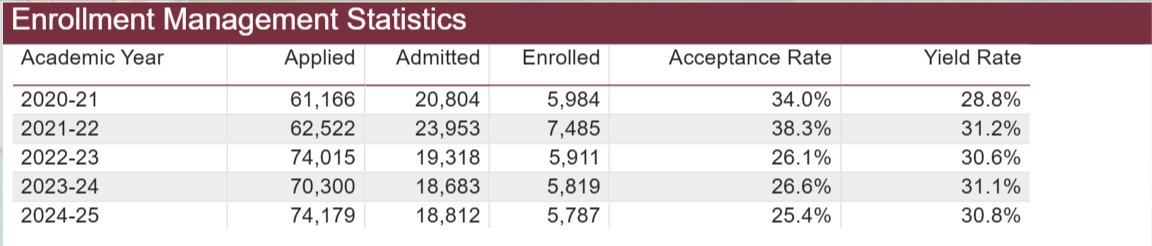
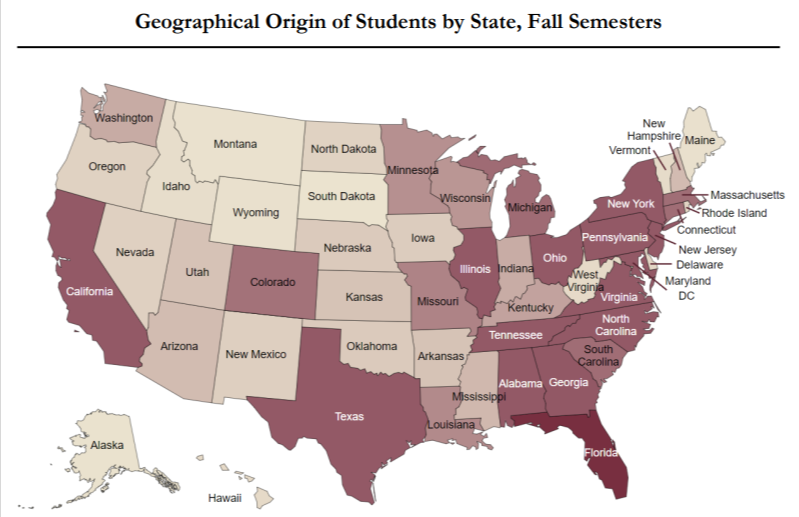
I've also included data from Florida State showing where undergraduate students are from. As you can see, Florida State draws a presence within most of the Big Ten footprint.
As time passes, clues and dots will connect on a more public level, but for now, Florida State, like other universities, are making sure they are positioned well for the future of not just athletics, but also community medicine, education, research, and growth.
Note - the image with light brown, green and red in it is from the University of Oregon showing their domestic, international, and in-state enrollment. You can compare and contrast the date of Oregon vs FSU and note that FSU has a bigger national enrollment. Whether that is state impacted or not, it is still relevant data.


English

@TheWildUte Good stuff, brother. The matchups would be insanely great for ratings, especially during Seminole Saturday Nights in Doak. The OTA networks would simply love prime time games vs. Ohio State, Michigan, Penn State, USC, etc.
English

Florida State would be the CROWN JEWEL of realignment for Big Ten football.
- Alters the 🏈 power dynamic (Big Ten > SEC)
- Plucks a massive brand from the heart of SEC Country
- Opens lush recruiting in Florida
- Explosive TV ratings multiplier for Big Ten schools
UTAH NOLE 🍢@Utah_Nole
.@TheWildUte believes that FSU to the B1G is the CROWN JEWEL of College Football - even bigger than Notre Dame would be. He says the growth potential of FSU in the B1G is astronomical. FSU being much more valuable to the Big 10 than any other team. What do you think?
English

@Genetics56 ...you're missing two obvious points:
a) FSU is on the verge of AAU status with its new medical school; &
b) Fox, CBS and NBC will kick-in $$$ to equalize B1G members for FSU's helmet value.
Look for FSU's announcement this year and beginning play in the B1G in the Fall of '26.
English

Who is still out there that is a football powerhouse that is AAU? ND you could argue is the only one, as of today. Miami has been 158-106 since joining the ACC fwiw.
The Big Ten doesn't need to any anone anymore as they, along with the SEC, are the Super League.
If AAU was so important and research dollars were so important for adding another member to the Big Ten, then schools would have taken less money to add Cal and Stanford. But that did not happen because they are not willing to lose money.
💚🤍 🐊🐊 ✌️@SpartyOn21
@Genetics56 Explain how Big Ten can continue pushing AAU narrative going into a Super League? Other than lying scumbag Nebraska, all members are AAU. But AAU status doesn’t equate to on field success.

English

@Genetics56 ...not sure why all the newfound-hate for FSU, @Genetics56 . The CFP Committee sucked out our soul on 12/3/23 and the Noles are on the rebound as we head to the P2 in the near-term. Hopefully, we'll join you in the B1G...
English

@Genetics56 you know it, @Genetics56 . The ACC should be working a deal with FSU and Clemson on one side and ESPN on the other. Bring on UConn and USF as the replacements for the Noles and Tigers and call it a day. Keeping UNC and UVa in the fold should be the goal at this point...
English

@Genetics56 assume FSU exits before 8/15 and is available for the Fall of '25. Surely it is in the B1G's interest to negotiate a deal with Florida State, with payments tied to the finalization of the litigation with the ACC. Otherwise, the B1G risks the boys in Birmingham swooping in...
English

@Genetics56 ...yet another sign Florida State and Clemson are heading for the B1G in '25 or '26. The next few weeks are going to be quite interesting.....
English

@Brett_McMurphy @ActionNetworkHQ ..your "sources" are off. "Adding FSU makes no financial sense" to Fox/CBS/NBC and the B1G? Please. Imagine the ratings for FSU's games against Michigan, Ohio State, Penn State, USC, Oregon, Washington, etc. The Noles are a money-making machine and the networks & B1G know it.
English

Big Ten, SEC unlikely to add Florida State if it leaves ACC & ACC survives, sources told @ActionNetworkHQ. Big Ten & SEC don’t want FSU because adding FSU doesn’t make financial sense, no desire to expand & “they’ve been a disruptive partner,” sources said actionnetwork.com/ncaaf/big-ten-…
English

@dennisdoddcbs Oh, Dennis. You'll need to fall on your knees at the foot of the Unconquered statue and beg #FSUTwitter for forgiveness when Florida State gets its invite to the B1G or SEC. Only then will Nole fans allow you to atone for all of your wrongheaded conference realignment garbage.
English

@Seminoles @CalAthletics @SMUMustangs @GoStanford @theACC ...playing nice today, leaving by 8/15. Cue the ACC: "You left me here on your way to paradise.
You pulled the rug right out from under my life.
I know where you goin' to, I knew when you came home last night.
'Cause your eyes had a mist from the smoke of a distant fire..."
English

@BudElliott3 You can spill it. FSU out of the ACC and headed to the B1G....
English

@Genetics56 The Aggies were pissed when the SEC broke their deal to never invite Texas. Now salt has been poured in their wounds thanks to the Horns grabbing their baseball coach the day after losing a Nattie. Could FSU be #19; A&M #20 in the B1G, with Clemson replacing A&M in the SEC?
English

@HMardenborough @Genetics56 The ACC has the ability to drag this case on for years, no doubt. However, that does not prevent FSU from leaving the conference (likely by 6/30). The B1G will accept the ongoing litigation as the price for scoring the Florida eyeballs & recruiting grounds it strongly desires.
English

@Genetics56 All of the tea leaves suggest that FSU is bound for the B1G in '25. FSU officials wouldn't have taken all of these steps since August if that wasn't the case. Could the SEC intervene at the last second? Sure. Yet, that's unlikely given that FSU is far more valuable to the B1G.
English

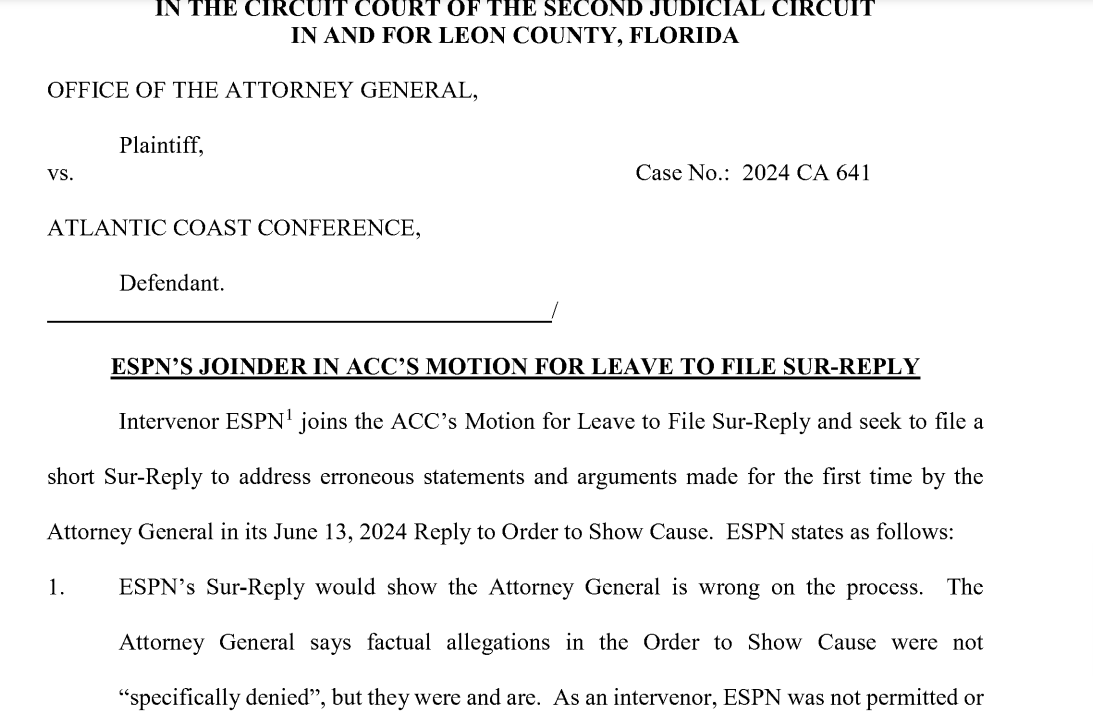
@Genetics56 ESPN wants to keep its ACC documentation out of the public eye, so will push the boys in Charlotte to settle ahead of the June 18 hearing in Tallahassee. Fla St's Board of Trustees meets on June 20, followed by Mr. Collins's speech on the 24th. B1G things happening for FSU...
English