

John Orlando 🇺🇸🇮🇹
4K posts
John Orlando 🇺🇸🇮🇹
@johnurs89
John 3:16. Husband to amazing wife. Pastor of a great church: Olive Street PCA, link below. Philly sports fan. U.S. Air Force (Ret). Italian food.
Coatesville, PA Katılım Temmuz 2022
438 Takip Edilen463 Takipçiler


English

The #PCAGA grassroots are the healthiest they have been in a decade! Large numbers of overtures, podcast, sustained GA turnout, floor nominees & resignation of key prog coordinators all indicate healthy grassroots!
Attempts by @a4mrofficial folx to stymie grassroots verify this!

Melton L. Duncan@MeltonDuncan
@sassiterian Grass roots PCA is definitely changing. To this point we've been fine to let Howie be the primary amender and to some degree Dave the primary interpreter of the book. We now have an activist grass roots in all parts of the house. Remains to be seen how PCA responds.
English
My point about "smuggling in" someone is that though in good standing, that candidate may not in fact be the best qualified for that particular position (the man was nominated because of name recognition, etc). As one who did the hard work and sifted through hundreds of resumes and letters or recommendations and did as much research as I could, it made little sense for us to go through all of that only to have potentially scores of other names called out from the floor who were never even nominated by their own presbyteries, and then to see them get elected. To me, that raises more red flags than not. If that's our idea of a fair and efficient process, then just do away with the current nominating process altogether and the NC committee and save me/us time, and the PCA money. Just have a free for all on the floor. Done. The recommendation from TE Lucas seems to me to try and navigate between a free-for-all, and one where candidates are nominated at the grass roots level (presbytery) and vetted, etc., and if they weren't nominated by the NC, then those men could be put forward from the floor. Seems entirely reasonable to me, and actually is consistent with grassroots. l just don't understand the objection. Maybe if we talked over a beer and cigar I might understand it better. :)
English

@johnurs89 @RFBWCF @a4mrofficial No one is snuggling anyone. All are officers in good standing in the PCA and well qualified. Who the NC or a given presbytery nominated can depend on who controls them. Last year was a great example of grass roots rejection of that control.
English
Not sure about this one, brothers. As a member of the NC, and all of the work and research we have to do to vet candidates, this suggestion from TE Lucas, if I'm reading it correctly, makes sense. I was personally frustrated last year (my first year on the NC) by the fact that any name could be offered from the floor of GA, and then that candidate could be elected. My sense at the time was that since that's how things are, we just do away with the NC (and save me/us tons of time, and the PCA thousands of dollars in traveling expenses). Requiring that only candidates that were in fact nominated by their presbytery (and thus vetted by them) and submitted to the NC (and vetted by them) does not undermine grassroots, but would seem to protect it. What am I missing, brothers? The other way (random names from the floor) seems to be a great way to “smuggle in” someone without having had any vetting whatsoever—it would perpetuate the very thing you’re concerned about.
English
It's all about power. The NV, OVM, and now A4M strategy was/is to pack presbytery committees so that they controlled nominees, policy, etc. Grassroots waking up derailed/bypassed that strategy to some extent. Now they want to limit commissioners' rights to nominate from the floor, thereby attempting to funnel folks through their strategy. I'm shocked to see the "elites" trying to usurp the rights of the little people. Shocked, I tell you.
English
Excellent:
Wes Huff@WesleyLHuff
Seeing some response to my statement on @MikhailaFuller's podcast about speaking in tongues. Some potentially helpful clarification: First, I am not a cessationist (though I see myself being accused of it). I state in the interview that I believe that the spiritual sign gifts (tongues, prophesy, healing) still take place today, just not normatively like they were in the Apostolic era. Nonetheless, I hold to the standard exegetical position that biblical tongues refer to known languages. In Acts 2, the foundational instance, foreign speakers understood the disciples in their own native languages, establishing the clearest precedent for interpreting the phenomenon throughout Scripture. Secondly, while bliblical specialists and theologians debate whether tongues encompass human languages alone or include angelic speech, the consensus recognizes that a tongue functions as a language -- either immediately intelligible to hearers or requiring interpretation. The requirement that Paul places on interpretation in 1 Corinthians 14 indicates that tongues contain objective, propositional meaning subject to translation, and his statement that “every valid instance of tongues contains intrinsic, propositional meaning" reinforces this understanding. A prominent scholarly argument identifies glossolalia as “the miraculous ability to speak unlearned human and (possibly) divine or angelic languages,” with the most common usage of “tongues” referring to ordinary human languages. The term γλῶσσα throughout the NT carries two primary meanings: the human organ or a human language, and careful word studies demonstrate that it never denotes non-cognitive utterance. However, scholarly consensus isn’t absolute the core agreement across interpretations centers on cognitive content: tongues communicate meaningful, intelligible information rather than incoherent utterance. Third, the early church evidence after the Apostolic era is virtually unanimous: the Early Church Fathers consistently interpreted the gift of tongues as the capacity to speak the many languages used across the earth. Their writings indicate the gift served an evangelistic purpose enabling communication with non-Christian populations. The Patristics universally understood “tongues” in Acts and 1 Corinthians to refer to human languages, and ancient Christians understood the biblical gift of tongues as a miracle involving intelligible human languages. When the fathers described the phenomenon, they used concrete language: John Chrysostom wrote that believers “would suddenly speak in Persian, another in Latin, another in the language of the Indians or of some other people” (Homilies on First Corinthians, Homily 35), and Augustine stated that disciples “spoke in the languages of all the nations” (Sermon 269, Sermo CCLXIX. The most significant, and almost exclusive, early figure associated with ecstatic speech for tongues was Montanus, a 2nd-century prophet whose followers emphasized speaking in tongues; he was actually excommunicated (not necessarily for his position on tongues) around AD 177. By the late 2nd century, ecstatic interpretations of tongues were present but only in context of ecclesiastical concern. One interesting nuance appears with Philastrius in the 4th century, who understood angels as capable of conversing in all languages and believed the apostles received this same ability at Pentecost. However, this doesn’t represent a departure from the “knowable language” framework rather, the Early Church Fathers understood the gift of tongues as the ability to speak all languages spoken by people. The Church Fathers agreed the gift was the ability to speak all languages known to humankind, an ability they ascribed to angels, suggesting the “languages of angels” would not refer to a distinct heavenly language but rather to the capacity to communicate with anyone encountered. The historical record shows no discussion among the fathers of ecstatic utterances, unknown languages, or supernatural unintelligible speech. The gift remained firmly anchored to practical, learnable human languages throughout Patristic interpretation. So if you've stuck around this long, I think my position is both exegetically and historically sound.
Français
And the biggest offenders are those who promote affinity groups within the PCA, yet many remain silent about it, and the well from it comes, CRT. Why is that?
Here's my floor speech last year in response to the well-intentioned yet deficient ARP statement from last year: My GA Speech Opposing the ARP Statement:
"I stand against this well intended statement not because I disagree with it, but because it doesn’t go far enough. It rightly addresses a toxic yet very small and vocal group, what some refer to as the woke right. They are also called Kinists, and are associated with so called Christian Nationalism. My problem with the well intentioned statement is that it ignores the toxic philosophy from the woke left that has had far more devastating effects both in the culture and our churches; that is, Critical Race Theory and similar types of views that arise from that on race and ethnicity. These assume and impute victimhood, or the sin of partiality, simply based on the color of a person's skin or ethnic origin. They view everything through the lens of skin color and ethnicity and form moral judgments of others based on those things, and they promote segregated groups on the basis of skin color and ethnicity within the church itself. This is just as a toxic view as the Kinist view. In fact, it is KINISM: we just use the sanitized phrase “affinity groups.” While it may not be the intention of those who support such things, these groups are promoting racialization, partiality, and have no place in society, much less the church of Jesus Christ. There ought to be a statement that encompasses those things as well. It would be great if we had a statement that talked about how we condemn without distinction any theological, social, or political teaching which posits any superiority, partiality, or segregation based on skin color or ethnicity and calls to repentance any who would promote or associate themselves with such teaching, etc.” Obviously we can’t do that now, but I humbly ask you to consider not approving the recommended statement so that we can craft a fuller statement that is very much needed."
English

Admirably simple and direct; focuses on the church:
"Does Kinism align with the Westminster Standards?
No: It is first and primarily a violation of the communion of the saints (WCF Chapter 26). For Christians to intentionally segregate from other Christians based on ethnicity–in Sunday worship, marriage, schools,etc.–would be to not extend the kind of communion described below to those in Christ to whom that communion rightfully belongs..."
Presbycast@presbycast
The ARP report on kinism and race realism - Monday night with @WVPitt, @demyronhaynes, and @BaldlyObserving - 9:30 PM ET youtube.com/watch?v=rLwx1F…
English
@Svigel In the first point, if you're talking about the music, it's not "leading worship." It's "leading the music."
English

Theology 101: Just to clarify—
It’s “leading worship,” not “performing.”
It’s “the pulpit/table,” not "the stage.”
It’s “the service,” not “the production.”
It’s “the sanctuary,” not “the auditorium.”
It’s “the congregation,” not “the audience.”
English



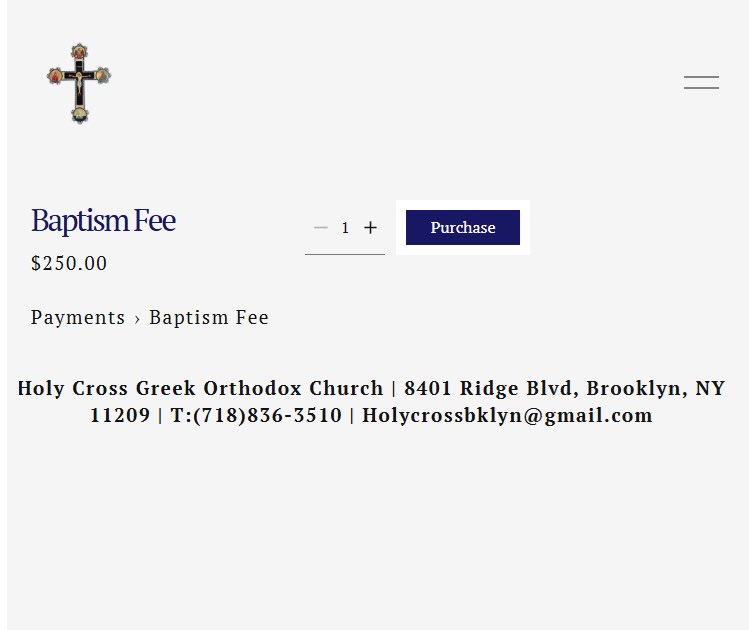
Protestants are making a nothingburger out of a minimal fee many Greek Churches have because baptisms are usually large celebrations, not empty “symbols.” This covers baptismal robe, candles, perhaps icons, and the celebration feast after. Many churches simply ask for a donation. This is nothing, btw, compared to most fundie churches which demand 10% tithe whereas most orthodox churches leave it all voluntary. This is just more ignorant moral gotchas because they have no intellectual arguments for their sects.
English

Last year I got a call from a man at Josh Buice’s church who said he needed to apologize. He'd been told by Buice that I had blown up the churches I planted or some such nonsense and had believed it without ever checking the facts. This was during the time I was speaking against hyper-cessationism & celebrity conferences, and Buice wanted to discredit my arguments by spreading bald-face lies.
More recently, I was told that someone in TX has said I'm not a member of any church. I don’t know the details or whether it's connected to the Buice slander, but I want to go on record:
I am a minister and elder in good standing with Vanguard Presbyterian Church, and I have served on staff at Lubbock Reformed Church for nearly five years, a church I planted and which now has 3 other elders and 4 deacons. In fact, I preached there this past Lord’s Day. So yes, I'm a member of a church. Even though I've been doing more itinerant preaching & evangelism in this season of life, I'm in constant communication with the other elders at Lubbock Reformed Church, usually daily. The other church I planted is doing great, and the church we are currently planting is in a really healthy spot.
I could care less if people slander me, it comes with the territory, but since I've heard this twice now I wanted to set the record straight even though I'm still dumbfounded about its genesis. And while I'm at it, I'm also not a charismatic, lol.
English
@StNickRespecter Thanks for your gracious response, Emilio. While there are qualifications that could be made, I think the fundamental point remains that Rome presents salvation as a process, our Spirit-wrought works contribute to our final salvation, and one can never have assurance of salvation.
English
@johnurs89 @matt_everhard Duty in Hebrews to “obey your leaders” disobedience to that commandment in some cases being grave matter for mortal sin. So in 1 sense there are far fewer and in another sense far more things in the order of salvation
English

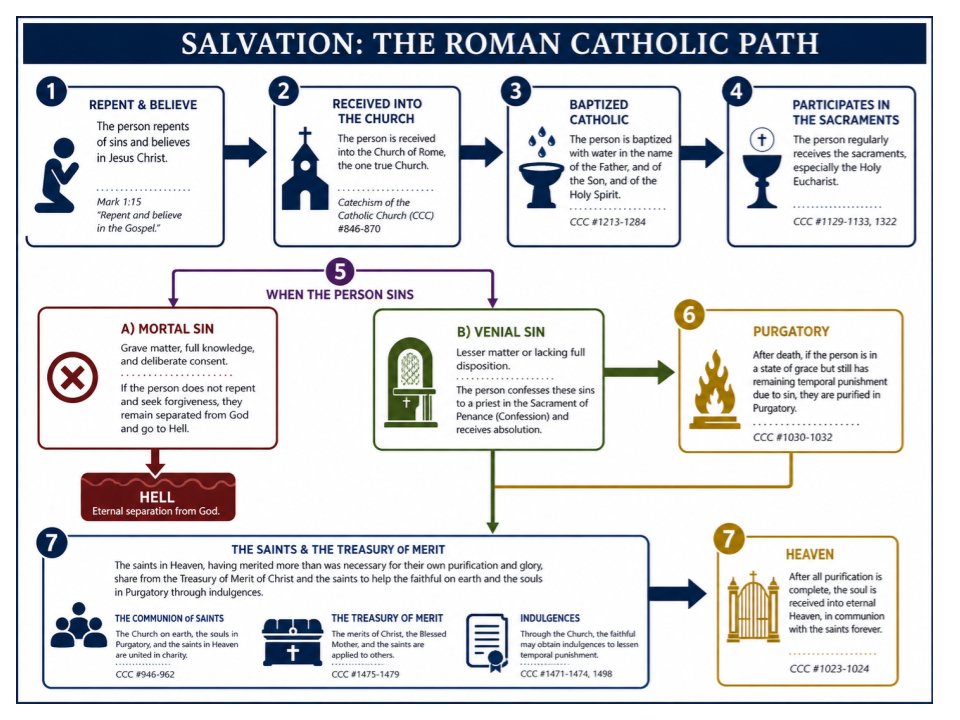
I am trying to create a flowchart that explains simply & FAIRLY the Roman Catholic view of how a person is saved. I want to steelman their view, not strawman. This is best I can come up with. I admit I find it frustrating & confusing as a Prot. Give me feedback, especially RCCs.
English
Thanks, Emilio, for the response. Process meaning things that must happen if the person is to die in a state of grace. If someone refuses to go to confession, that does at least put them in jeopardy (not just mortal sin). Penance and The Lord's Supper are both, it seems to me, about strengthening and also about salvation. For example, the mass is centered on the eucharist and partaking of the true body/blood of Christ apart from which there is generally no salvation. Salvation is a process in Rome that begins in baptism, continues in penance and the sacraments, moves into purgatory, and then finally the beatific vision. So, and I grant I could be wrong, the process is basically baptism --- penance ---- sacraments --- purgatory (unless died in perfected sanctified state) --- treasury of merit ---- beatific vision. If that is not correct, maybe you can provide suggestions to Matthew's graphic. As he alluded to, we want to get the best and most accurate representation. Your feedback is greatly appreciated, Emilio.
English
@johnurs89 @matt_everhard What do you mean by “the process” if you die unconfirmed there is no impediment to salvation. Failing to go to confession is only an issue if you commit a mortal sin.
To your final point, all are about strengthening you, not strictly speaking about salvation (besides baptism)
English
Yes, but, it seems to me that you must do all of those things not merely to be strengthened, but to remain in a state of grace, correct? You can't move on in the "process" unless you are confirmed, so, that's necessary it seems. Also, if you fail to do penance. As for Last rites, they may not be seen as absolutely necessary, but would be part of what ought to be done to prepare for death, so, it seems still part of the process in some sense. Thoughts?
English
@johnurs89 @matt_everhard Most of those things are not strictly necessary for salvation and are mostly about strengthening a Christian. Confirmation is usually received after confession and the Eucharist. Likewise Last Rites are not necessary for salvation
English

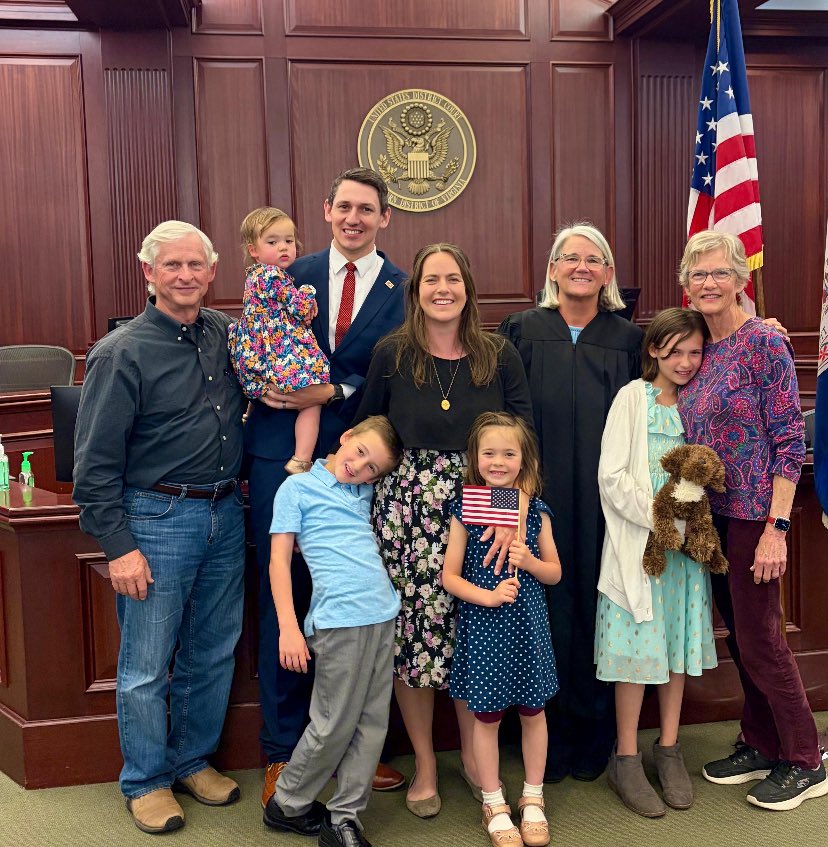
Yesterday I became an American citizen. Grateful for my first citizenship and heritage, thankful for my new citizenship, but forever grateful for my eternal citizenship.
English
I originally read this as saying, "We have it new millstones today. 88 overtures..." Freudian slip of the mind I guess!😀
English

We have hit a new milestone today. 88 overtures have been submitted to the 53rd general assembly. With just 54 days until the assembly, we just need 12 more overtures. Just 12. We can do this.
pcaga.org/resources/
English
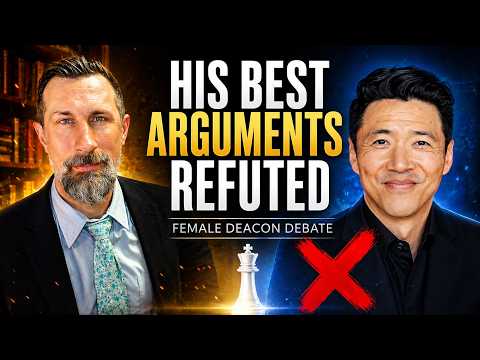
This was a really well done debate, brother, and you both comported yourselves extremely well. It was extremely helpful to hear the best arguments from the other side (TE Choi) presented in a gracious and scholarly manner. Then to hear your gracious and scholarly response was very edifying. I was already convinced of what I would call the traditional/majority view, and came away from the discussion even more solidified in it. Great job, Matt--top level scholarly research, no stone left unturned, and just as important, you did in a Christ-like manner.
English
The "Whereas" Clauses of Overture 37 refuted in ten minutes... Video here: youtu.be/-J9NwS5zfvk
YouTube

English
I don't think explaining views with the same level of acumen is the issue, brother. The issue is subscribing (good faith) to the doctrinal standards of the church. To have officers in the church who do not do so creates great danger for the church. Not only is it contrary to common sense, it is contrary--at the very least by strong inference--with the biblical requirements for office. We cannot have officers in the church that reject the system of doctrine of the church, right? And how do we determine that? Well, working through the Standards in our training of REs and Deacons, and then requiring them to read the Standards and cite their exceptions. Requiring all officers to subscribe to the system of doctrine of the church does not in any way flatten the offices into one, but protects and ensures the doctrinal integrity of the church and its offices.
English

I'm not wholly against Item 5, but I'd argue that it aligns with a desire to flatten the PCA into a one-office denomination.
IMO, Pastors should be able to explain their view with a different level of clarity than ruling elders, and Elders generally should be able to communicate their views at a level beyond what is expected of deacons.
Sean McGowan@irishpresby
All this talk about the exceptions PCA Teaching Elders are granted makes me wonder about the kind of differences #PCA Ruling Elders and Deacons have to the Standards. Item 5 must pass.
English
Yes, you both hold to the supreme authority of Scripture, but which view comports with what Scripture teaches? You believe that yours does, while Ken Ham (with whom I agree) believe that our view does. BTW: while I disagree with your view, I nevertheless have appreciated your position and especially the manner in which you present it, and I count you as a brother in Christ.
English

@johnurs89 @ericmetaxas @EricMetaxasShow It is not a matter of a biblical view. We both uphold the supreme authority of Scripture.
English
Today on the @EricMetaxasShow I talk with @RTB_HRoss about the Ken Ham controversy, biblical inerrancy, the age of the earth, fine tuning, Noah’s flood, and why modern science keeps pointing to the handiwork of God. We also break down why so many Christians misunderstand Genesis, and why these debates should not be treated like attacks on the core truths of the faith.
⭐ PRE-ORDER TODAY: Revolution: The Birth of the Greatest Nation in the History of the World 📕: a.co/d/0ir3Nlap
English
mi piace la prima ministra, ma... Politics: Power and political survival for the purpose of keeping and gaining even more power (and money) get the best of many.
Vince Langman@LangmanVince
In the back of my mind Politicians like Marjorie Traitor Greene always gave me red flags. But I had to admit that Giorgia Meloni had me completely fooled!
English
@LangmanVince Politics: Power and political survival for the purpose of keeping and gaining even more power (and money) get the best of many.
English
In the back of my mind Politicians like Marjorie Traitor Greene always gave me red flags.
But I had to admit that Giorgia Meloni had me completely fooled!

English