José Azar

6.8K posts

José Azar banner
José Azar

José Azar

@joseazar

Economist working on antitrust, labor econ, and corporate governance.
Spain Katılım Haziran 2009
3.7K Takip Edilen6.3K Takipçiler
José Azar retweetledi
Luis Garicano 🇪🇺🇺🇦
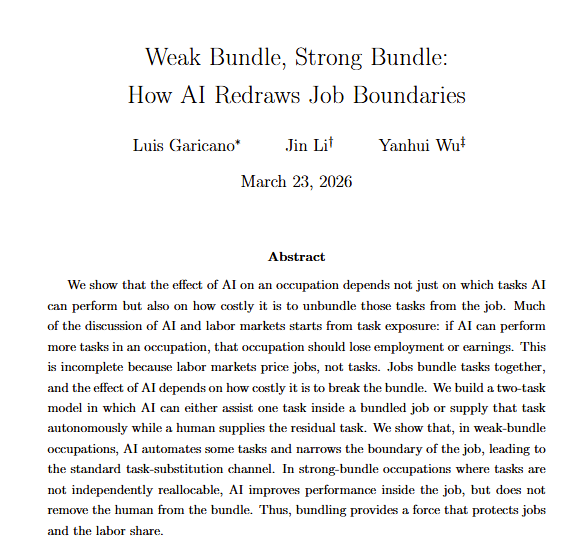
Famously (there is a beautiful Works in Progress piece on this) in 2016, Geoffrey Hinton told an audience in Toronto that medical schools should stop training radiologists, since AI would soon outperform them at reading scans. Ten years later, there are more radiologists than ever, and they earn more than they did then. Hinton was right about the task, but he was wrong (so far!) on the future of the radiology profession. Times have never been better for them. The gap between those two claims, the difference between tasks and jobs, is the subject of a paper I have written with Jin Li and Yanhui Wu, and that we release today: "Weak Bundle, Strong Bundle: How AI Redraws Job Boundaries." (Very relatedly we are also finishing the first draft of our book "Messy Jobs" on AI and Jobs!! You will be the first to hear). We start from the observation that the growing literature on AI and labor markets measures the AI shock by task exposure: people count how many tasks AI can perform in a given occupation AI can perform, and infer that more exposure means more displacement. Eloundou et al. published a paper in Science in 2024 that started this literature, and many follow the same logic. The inference they make is that the more exposed tasks, the worse the outcomes. This is incomplete, because labor markets price jobs, not tasks. A radiologist does not just sell image classification, but does many other jobs: triages cases, communicates with other physicians, trains residents, makes the difficult decisions, and signs a diagnosis. The market buys a bundled service. The question AI poses is not whether it can do one task inside the bundle. The question is whether that task can be pulled out. Thread (1/3) dropbox.com/scl/fo/689u1g7…
Luis Garicano 🇪🇺🇺🇦 tweet media
English
43
463
1.9K
393.1K
José Azar retweetledi
Luis Garicano 🇪🇺🇺🇦
An increasingly coherent picture of the impact of AI on jobs, by @jburnmurdoch @ft: 1. New Fed paper by Crane and Soto now confirms with official labor force survey data what private payroll analysis was showing: roughly 500,000 fewer coders are working than pre-LLM trends would predict. 2. Argues evidence consistent with my work (with Lin and Wu, link in my pinned post) on weak/strong bundles: junior developers and contractors hold "weak bundles" (their work is mostly standalone coding that AI can substitute directly), senior developers hold "tight bundles" where coding is combined with domain expertise, judgment, and cross-functional responsibilities, making substitution much harder. 3. Freund & Mann and Gans & Goldfarb add a second lens: what matters is the value of the tasks that survive automation. Remove coding from a senior role and you free up time for higher-value work; remove it from a junior role and almost nothing remains. ft.com/content/b69f85…
Luis Garicano 🇪🇺🇺🇦 tweet media
English
31
282
1.1K
294.2K
José Azar retweetledi
project hail dado ⚢
project hail dado ⚢@astrasdoctor·
public speaking skills 10/10
English
176
11.5K
47.6K
4.1M
José Azar retweetledi
David Andolfatto
David Andolfatto@dandolfa·
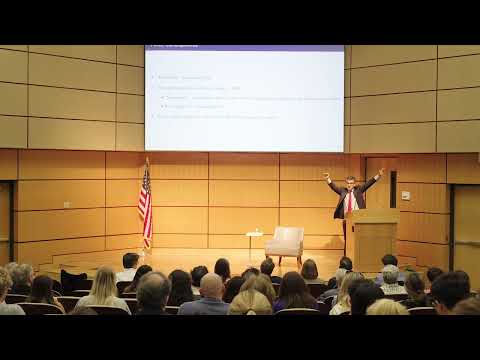
Total fertility rates are falling across the globe and, for the first time in history, are below the replacement rate. JFV explains why this matters—and why it could have major economic consequences. His talk is now available for public viewing. youtube.com/watch?v=Fk8nLK…
YouTube video
YouTube
David Andolfatto@dandolfa

Jesús Fernández-Villaverde on global fertility decline—and why it matters. Henry Lecture, University of Miami. A masterful performance! Recording available shortly. Slide deck: dropbox.com/scl/fi/z2y9nd7…


English
3
36
130
23.3K
José Azar retweetledi
Dwarkesh Patel
Dwarkesh Patel@dwarkesh_sp·
The list of all the problems in mathematics that Terence Tao *could* solve is absolutely enormous. The problem is we can't make copies of him, dump millions of dollars of inference compute into each copy, and have them each tackle a different Millennium Prize Problem for a hundred subjective years. But we can do that with AI. So in that way, we may be underrating how significant it will be when we have AIs that are not superintelligent but rather simply as good as the best humans today. It’s actually an extremely powerful property of AI that by just running copies in parallel, you can immediately fill in the waterline of accomplishments that are feasible with a given level of capabilities.
English
30
54
632
96.9K
José Azar retweetledi
Mayara Felix
Mayara Felix@mayara_pfs·
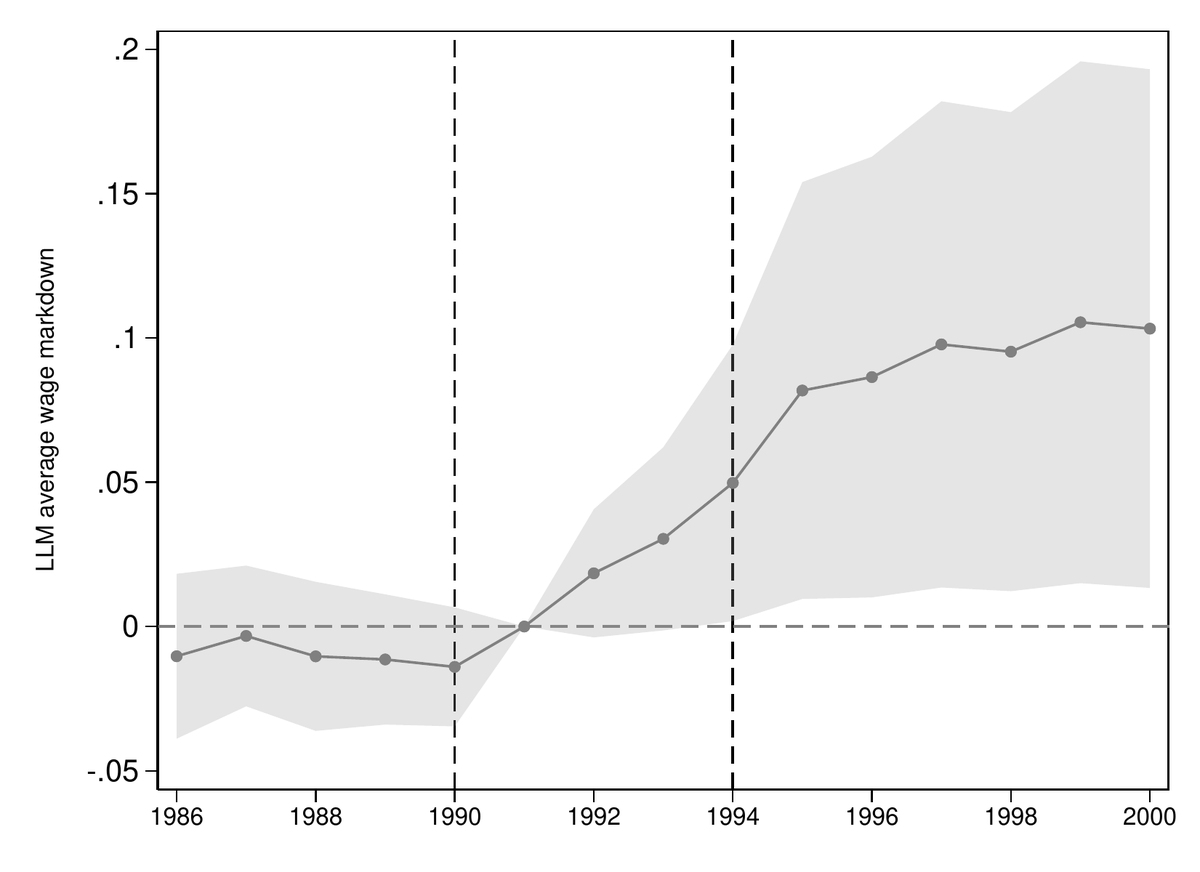
Does import competition increase surviving firms' wage-setting power? In more exposed labor markets, yes — but markdowns explain only 6% of the relative wage decline. A thread on NBER WP "Trade, Labor Market Concentration, and Wages" 🧵👇
Mayara Felix tweet media
English
2
39
150
16.1K
José Azar retweetledi
Joshua Gans
Joshua Gans@joshgans·
Behold Eigengrades! @skominers and I have a new preliminary paper out that looks at the issues of cross-course comparability in grades. This was a project motivated by Harvard's proposal to cap the number of As in each course to counter grade inflation. 👇
English
6
27
129
43.7K
José Azar retweetledi
Princeton Economics
Princeton Economics@PrincetonEcon·
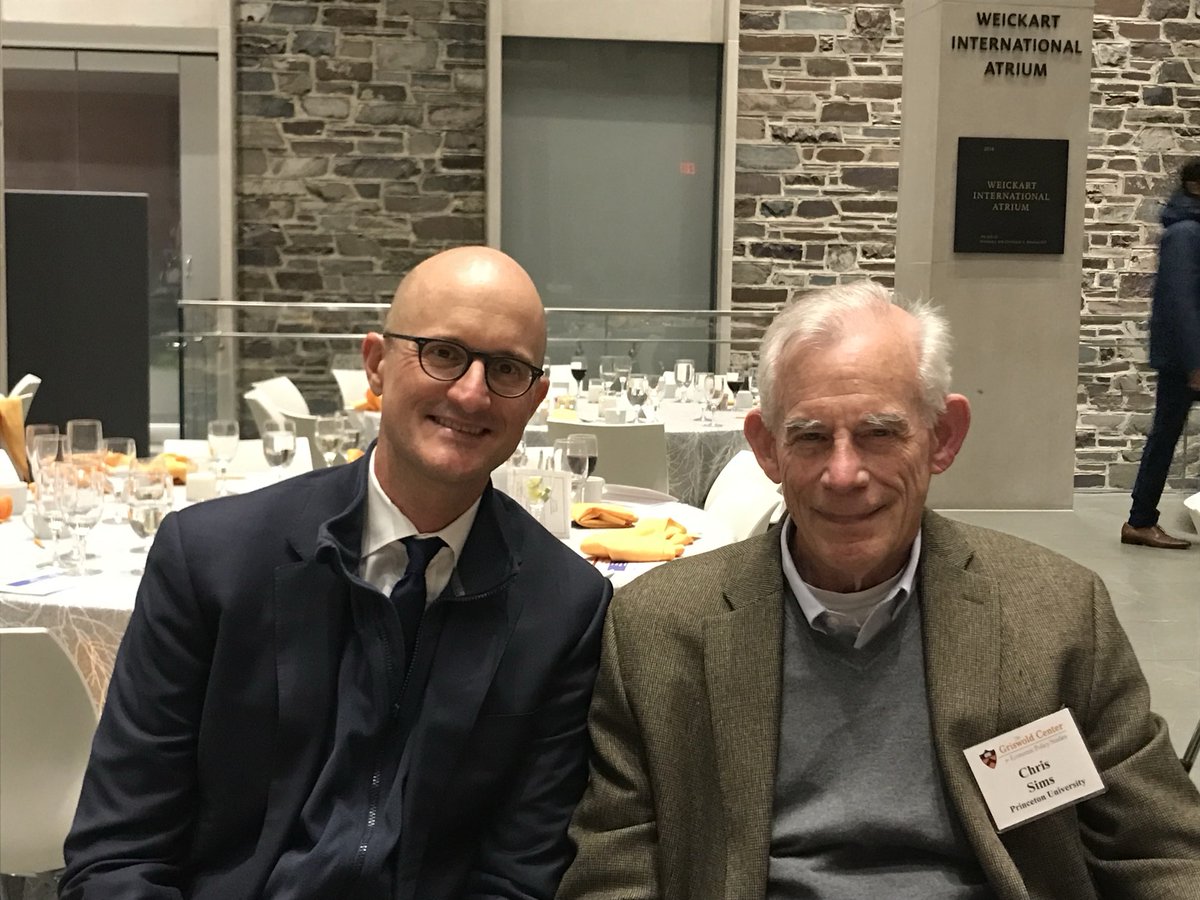
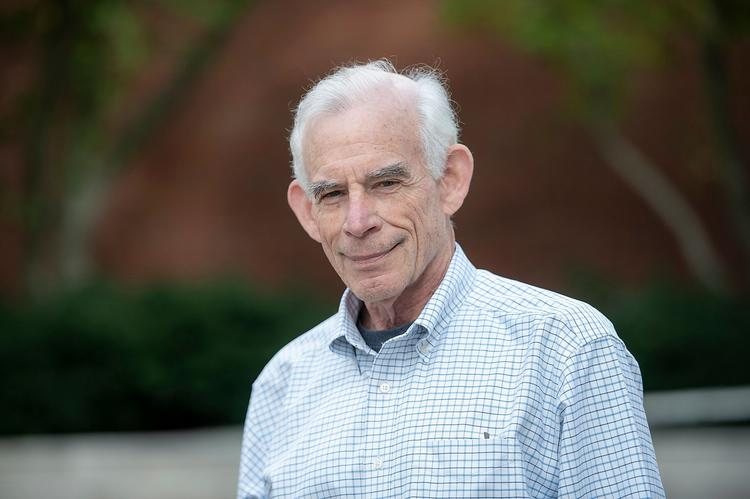
The Economics Department at @Princeton is deeply saddened by the passing of esteemed colleague and Nobel Prize winner Chris Sims. The world lost one of the great economists of our times; those who knew him lost a dear friend. About Sims and his impact: bit.ly/3PrpOaE
Princeton Economics tweet media
English
3
35
217
14.7K
José Azar retweetledi
Marc Joffe
Marc Joffe@marcjoffe·
35 years after throwing off the yoke of Communism, Poland becomes the world's 20th largest economy. The warmth of capitalism is lifting an entire nation out of poverty. apnews.com/article/poland…
English
289
3.8K
18.5K
354.3K
José Azar retweetledi
Jon Hartley
Jon Hartley@Jon_Hartley_·
1/Chris Sims is easily one of the most influential macroeconomists (& perhaps most influential empirical macroeconomist) of the last 50 years; he fundamentally changed thinking about monetary policy, metrics,& causality (VARs, time series models). Thread on his greatest hits🧵👇
Jon Hartley tweet mediaJon Hartley tweet media
Jon Hartley@Jon_Hartley_

RIP Chris Sims, a giant in empirical macroeconomics

English
5
164
493
78.7K
José Azar retweetledi
Robin Brooks
Robin Brooks@robin_j_brooks·
At Yale, Chris Sims would tape a list of office hour slots on his door, which anyone could sign up for. I did. Every week for 3 years. Chris was brilliant and creative. But - more than that - he was incredibly kind and patient with his students. Thank you for everything, Chris.
Robin Brooks tweet media
English
3
20
363
28.4K
José Azar retweetledi
Markus K. Brunnermeier
Markus K. Brunnermeier@MarkusEconomist·
R.I.P. Christopher Sims (21 Oct. 1942 - 14 March 2026) - a giant in macroeconomics and one of the finest human beings I have ever met -
Markus K. Brunnermeier tweet media
English
34
451
1.8K
510.7K
José Azar retweetledi
Paul Anleitner
Paul Anleitner@PaulAnleitner·
We live in a culture that has been constantly nostalgic for the good days from long ago that we worry has long passed us by. But this is the kind of photo that will one day make you nostalgic for these good days.
Paul Anleitner tweet media
English
68
646
13.9K
861.7K
José Azar
José Azar@joseazar·
@farmerrf Yes, and also, if tariffs are determined by majority voting, then the median voter is more worker than capitalist, and therefore tariffs are positive in equilibrium. Tariffs go up when wealth inequality goes up (because the median voter owns less capital). jstor.org/stable/556?seq…
English
0
1
1
172
José Azar retweetledi
Roger E. A. Farmer
Roger E. A. Farmer@farmerrf·
The Stolper-Samuelson theorem jstor.org/stable/2967638… explains much of what has happened to the US and China since 2001 when China entered the WTO. Chinese workers and US elites gained from trade. US workers were unambiguous losers. Stolper and Samuelson were at pains to point out that although American workers might be harmed by trade — Americans as a whole would benefit. They concluded in favor of free trade because “the winners can always compensate the losers”. Here is the relevant passage from their 1941 article “… the harm which free trade inflicts upon one factor of production is necessarily less than the gain to the other. Hence, it is always possible to bribe the suffering factor by subsidy or other redistributive devices so as to leave all factors better off as a result of trade.” @carney @bungarsargon The economists who currently oppose Trump’s trade policies, have been unambiguous winners from globalization. The same can not be said of the American working class whose lives have been upended by the hollowing out of the manufacturing base. @PIIE @JustinWolfers
English
17
24
111
34K
José Azar retweetledi
Roger E. A. Farmer
Roger E. A. Farmer@farmerrf·
Thank you for linking this @jamesharrigan Trade affects welfare through two channels. It changes the wage rental ratio as capital moves abroad -- the Stolper Samuelson effect -- and it changes relative prices. An example of this second channel is the fact that textiles and electronics became cheaper after the accession of China to the World Trade Organization (WTO). The paper you cite by Fajgelbaum and Khandelwal (FK) closes down the first channel and explicitly models the second. It is undeniably true that many consumer goods became cheaper following the entry of China to the WTO. It is also undeniably true that communities throughout middle America were hollowed out through the loss of manufacturing jobs resulting in what Case and Deaton refer to as 'deaths of despair'. FK find that -- as a percentage of their income -- poor people consume more of the goods that became cheaper through globalization. They conclude that poor people are better off through the relative price channel as a consequence of globalization. They are unable to address the question: did US workers benefit in net from globalization because they do not recognize that different social classes benefit differentially from trade. Like most modern neoclassical theory, their model does not recognize the concept of social class. Here is a quote from the FK paper "First, the endowment of the *SINGLE FACTOR OF PRODUCTION* varies across consumers, generating within-country inequality." Since the Stolper-Samuelson theorem requires two factors of production, a paper that begins by negating the premise of the theorem -- that trade affects the owners of labor differently from the owners of capital -- cannot hope to answer the question: were American workers net losers from globalization? And it cannot hope to answer the question: will American workers benefit from the imposition of a tariff? @carney @JustinWolfers @bungarsargon
James Harrigan@jamesharrigan

@farmerrf @JustinWolfers @carney Roger, you might find this paper of interest: academic.oup.com/qje/article/13…

English
1
1
5
2.1K
José Azar retweetledi
Srishti
Srishti@srishticodes·
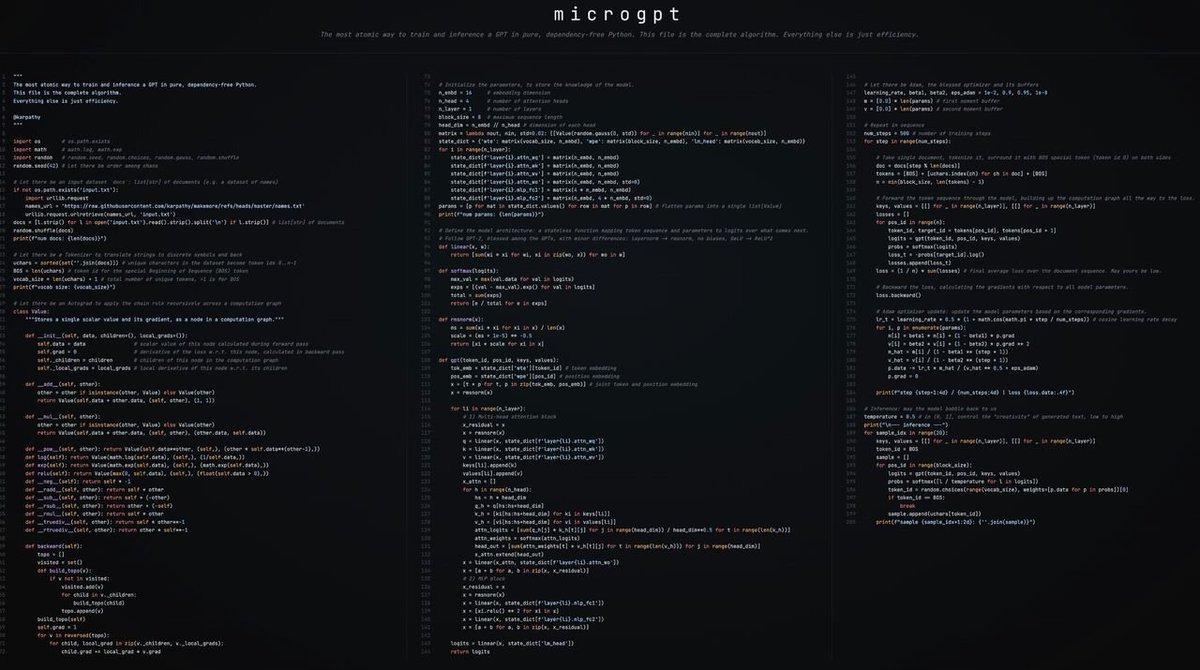
Most beautiful code I have seen shared in public recently. Built by Andrej Karpathy - single file of 200 lines of pure Python with no dependencies that trains and inferences a GPT. This is how it should be taught to everyone trying to get into learning LLMs. This might be the cleanest, most elegant public code drop in AI this year. Karpathy's new "art project": microgpt (karpathy.github.io/2026/02/12/mic…) → Single Python file (~200 lines) → No PyTorch, no NumPy, no external libraries at all → Full working GPT: data loading → character tokenizer → tiny autograd engine → GPT-2-style transformer → Adam optimizer → training loop → inference/sampling It's the bare-metal essence of what makes large language models tick - everything else (CUDA kernels, distributed training, mixed precision, flash attention, massive datasets…) is optimization & engineering around this core. Perfect starting point for anyone trying to truly understand LLMs instead of just calling APIs. Highly recommend reading + running it. Changes how you see "AI is just matrix multiplies + softmax" from abstract → concrete.
Srishti tweet media
English
65
403
3.3K
198.1K
José Azar retweetledi
Jesús Fernández-Villaverde
Jesús Fernández-Villaverde@JesusFerna7026·
A reader, Roberto Gómez (@Roberto08061521), left me a comment on one of my latest posts with some numbers he computed for Argentina on the average number of children per cohort (by age of women). I copy one of his figures. At least for Argentina, there is not much evidence so far that delayed timing in childbearing will substantially change the basic observation: a fast and unprecedented drop in fertility. Is there delayed timing? Yes. Is it a first-order explanation? No. And before people tell me: “Argentina had such a big economic crisis…” Yesterday I showed similar figures for many other countries. No, a country-specific factor is not the explanation when the same pattern happens everywhere (even if country-specific factors may make the drop smaller or larger).
Jesús Fernández-Villaverde tweet media
English
4
23
143
16.6K