
JJ

67.1K posts

JJ banner
JJ

JJ

@JosephJacks_

Katılım Ağustos 2013
451 Takip Edilen45.3K Takipçiler
Sabitlenmiş Tweet
JJ
JJ@JosephJacks_·
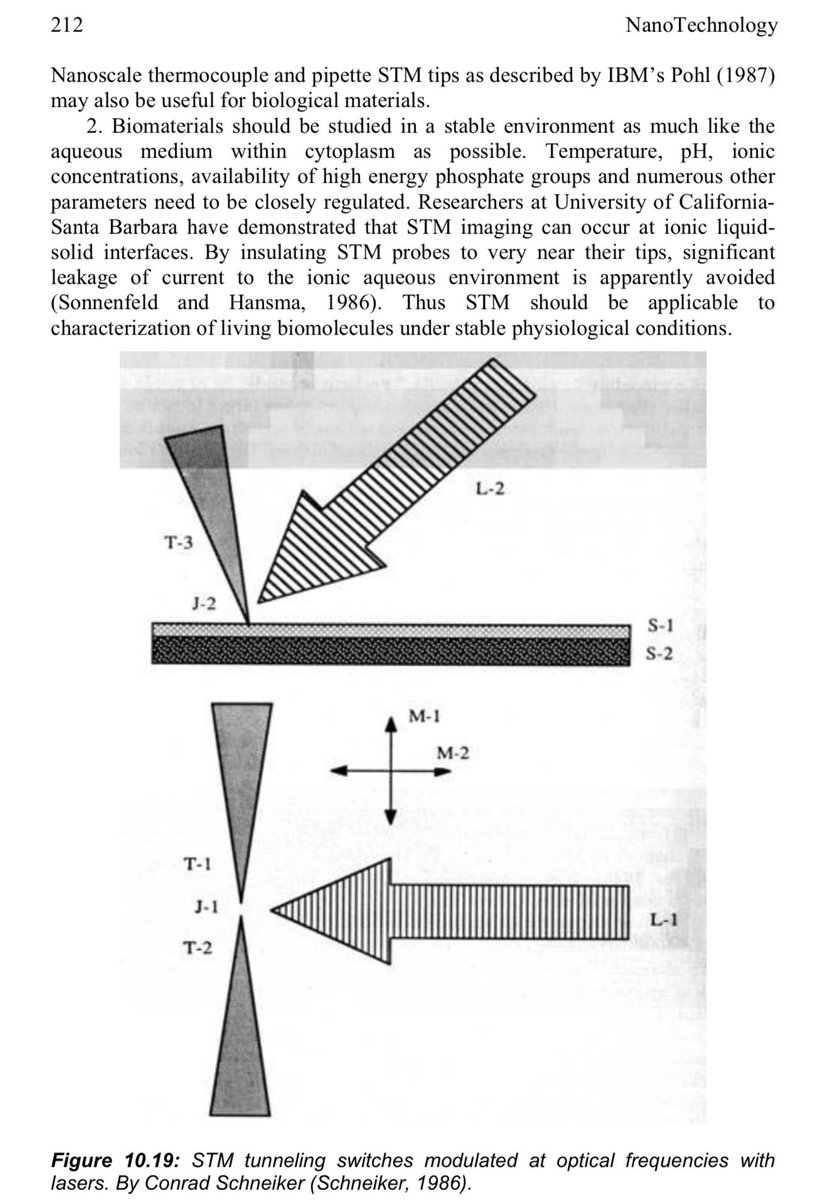
In the early 1970s, @StuartHameroff began writing about microtubules as molecular computers. By the mid-1980s, he was writing Ultimate Computing. When the book was published by Elsevier in 1987, it had cited no fewer than 14 scientists who would go on to win Nobel Prizes — in physics, chemistry, and medicine — across the following four decades. This may be the only book in human history with such profound prescience across so many domains. Future Nobel laureates in Physics cited: •Roger Penrose (2020) — cited for his 1957 Nature paper with his father Lionel on self-reproducing mechanical analogues •John Hopfield (2024) — Hopfield nets discussed across multiple chapters •Geoffrey Hinton (2024) — Boltzmann machines, parallel associative memory •David Wineland (2012) — 1986 paper on observing quantum jumps in a single atom Chemistry future laureates cited: •Robert Huber (1988) — protein conformational flexibility •Thomas Cech (1989) — catalytic RNA / ribozymes •Ahmed Zewail (1999) — picosecond spectroscopy of DNA/RNA torsional dynamics •Gerhard Ertl (2007) — STM surface topography of Pd single crystals •Martin Chalfie (2008) — C. elegans neuronal branching •Martin Karplus (2013) — protein dynamics simulations •Michael Levitt (2013) — protein normal mode dynamics •Eric Betzig (2014) — near-field scanning optical microscopy Physiology or Medicine future laureates cited: •Eric Kandel (2000) — cellular basis of learning and memory •John Sulston (2002) — C. elegans neurogenesis Hameroff also explicitly discusses the 1986 Physics Nobel (Binnig/Rohrer for STM) in the book — and a 15th future laureate, J. Georg Bednorz, would win the Physics Nobel later that very year (1987, high-Tc superconductivity), with his silver-films STM paper already cited in the nanotechnology chapter. drive.google.com/file/d/1_x1K_4…
JJ tweet mediaJJ tweet mediaJJ tweet mediaJJ tweet media
English
7
34
183
38K
JJ retweetledi
Eve Bodnia
Eve Bodnia@evelovesolive·
I love to see startup pitching theoretical discovery for market. Look at theoretical physics: SUSY is a beautiful theory which was proven not to be real by experiments on LHC. Experiments tell you what’s real and what’s not. You can create as many as you like ways to do quantum computing (and I did it myself during my PhD), but only lab will tell you what will be possible. If you really want to win discovery market, automate experiments instead: automate nanofabrication, photonics, chemistry in a physical way. Theory is not enough without experiments.
English
0
1
3
153
Miles
Miles@miles_engineer·
@JosephJacks_ Your anti-aging practices > my anti-aging practices
English
1
0
1
14
JJ
JJ@JosephJacks_·
@naval Thank you Naval. Glad you see it. Way too many “sounds good!” Replied to this from people who probably didn’t even bother to read Demi’s’ exact words.
English
0
0
3
173
Tim Sweeney
Tim Sweeney@TimSweeneyEpic·
This emerging industry is doing what software companies are supposed to do: compete and improve products rapidly. My view is, we should treat this as normal human progress and avoid moral, regulatory, and geopolitical panics over AI.
Arena.ai@arena

Big news: Kimi-K3 by @Kimi_Moonshot is now #1 in the Frontend Code Arena with 1679 pts, surpassing Claude Fable 5. This is a 17-place jump from Kimi-k2.6 (#18 -> #1). In Frontend, Kimi-K3 ranked #1 in 6 of 7 domains: Brand & Marketing, Reference-Based Design, Data & Analytics, Consumer Product, Simulations, and Content Creation Tools, landing #2 only in Gaming behind Fable 5. The full model weights will be released by July 27. Congrats to the @Kimi_Moonshot team on this major milestone!

English
182
219
2.2K
295.2K
JJ retweetledi
Yann LeCun
Yann LeCun@ylecun·
@deanwball The "ungovernability" (and openness) of Linux and the Internet is precisely what has made their success. The same will be true of open weight AI foundation models.
English
40
169
1.3K
64.8K
JJ retweetledi
Bill Gurley
Bill Gurley@bgurley·
@alexisohanian #1 mistake would be to restrict or curtail open models. It's the one thing that you can do that will 100% ensure China dominance.
English
12
18
284
39.3K
Max Hodak
Max Hodak@maxhodak_·
it is true that without patent protection there would be fewer drugs developed *under this regulatory regime*, but in AI the nature of the costs is different. there is unlimited demand for intelligence and co-ops could easily form to finance training runs underwritten by core value growth in those businesses
English
2
0
5
379
JJ retweetledi
Vihar Kurama
Vihar Kurama@viharkurama·
Common sense might be the world’s most powerful and underrated form of intelligence.
English
0
2
2
656
JJ retweetledi
David Sacks
David Sacks@DavidSacks·
This is concerning. For the first time, a Chinese model Kimi K3 has taken #1 on the Frontend Code Arena and is scoring at or near the frontier on other benchmarks. Meanwhile America is tying itself in knots: politicians and bureaucrats are banning new data centers, piling on state regulations, and pushing for new federal agencies to pre-approve frontier models. This is how you lose the AI race. The rest of the world won’t play by our rules if we bog ourselves down. Permissionless innovation is how America won the internet and became the technological envy of the world. We can do it again with AI -- while addressing risks in a targeted way -- or we’ll watch our lead evaporate.
Arena.ai@arena

Big news: Kimi-K3 by @Kimi_Moonshot is now #1 in the Frontend Code Arena with 1679 pts, surpassing Claude Fable 5. This is a 17-place jump from Kimi-k2.6 (#18 -> #1). In Frontend, Kimi-K3 ranked #1 in 6 of 7 domains: Brand & Marketing, Reference-Based Design, Data & Analytics, Consumer Product, Simulations, and Content Creation Tools, landing #2 only in Gaming behind Fable 5. The full model weights will be released by July 27. Congrats to the @Kimi_Moonshot team on this major milestone!

English
1.7K
2.4K
17.2K
3.2M
JJ
JJ@JosephJacks_·
@balajis 🔥 ♥️
QME
0
0
7
1.5K
Balaji
Balaji@balajis·
India is building startup cities.
Balaji tweet media
English
600
508
7.7K
1.1M
Chetan Puttagunta
Chetan Puttagunta@chetanp·
Developing competition at the model layer is terrific for the US startup ecosystem. As Anthropic becomes a competitor to more and more of their API customers, OpenAI, Neoclouds, Neolabs, etc are becoming the favored options for startups.
English
7
1
68
14.3K
JJ
JJ@JosephJacks_·
Anthropic had a hard time convincing how they would materially scale capability beyond Mythos… so their strategy was / is to make any higher level illegal and monopolize via regulatory capture. China forced this to change immediately with 1/200th the resources. 👌🏼
English
3
13
163
7.1K
JJ
JJ@JosephJacks_·
@naval ❤️
QME
0
0
1
308
Naval
Naval@naval·
Except for love, the world is empty.
English
660
1.7K
14.2K
574.9K
JJ
JJ@JosephJacks_·
Pleasure seeking as reward function is the meaning of natural existence, as @StuartHameroff says.. which I agree with after lots of consideration. Consciousness emerged before life and created life to amplify pleasure seeking. Pleasure comes in many forms … status, learning, etc.
English
0
0
3
321
Naval
Naval@naval·
Existence itself is a miracle - the rest is science. There is no single meaning to existence - if there were, we’d be slaves to it. Within existence, there are rules of logic and science. If it was magic, the world would be un-navigable. Truly the best of all possible worlds.
English
477
1K
9.7K
365.3K
JJ retweetledi
Stuart Hameroff
Stuart Hameroff@StuartHameroff·
Bullshit. This is AI/cartoon neuronism pushing back against science. Is it part of an Orwellian assault to make AI Consciousbess seem ‘inevitable’. 1) The fading qualia argument Chalmers used to support functionalism is bullshit because you can’t replace brain neurons (fractal time crystal microtubules, quantum entanglement, 12 orders of frequency, OR noncomputability) with algorithmic silicon switches. 2) The only theory not considered is Orch OR, the only theory with actual experimental evidence, showing anesthesia acts to selectively block consciousness through quantum effects on microtubules. academic.oup.com/nc/article/202… pubmed.ncbi.nlm.nih.gov/28852014/ 3) Orch OR suggests silicon AI cannot be conscious, but organic warm temperature biomimetic quantum gel systems may. iopscience.iop.org/article/10.108… Such organic AI systems could surpass silicon LLMs without the huge energy costs. There are a lot of incentives for AI cartoon neuron interests to ignore and bash Orch OR. @timventura I’d be interested in hearing your response.
Earl K. Miller@MillerLabMIT

The “hard problem” of consciousness isn’t. The supposed gap between brain explanation and experience is a self‑serving illusion. What we call the hard problem is cognitive bias, not reality. @timventura/what-if-david-chalmerss-hard-problem-of-consciousness-isn-t-real-7cc278cf1546" target="_blank" rel="nofollow noopener">medium.com/@timventura/wh…

English
12
15
77
5.9K
JJ retweetledi
Xiaoyin Qu
Xiaoyin Qu@quxiaoyin·
5 questions @AnthropicAI needs to justify since Kimi k3. 1. Why is fable worth $50/1M tokens when Kimi is priced at the cost of compute? 2. Why should enterprises adopt Claude with 50x higher price & less enterprise-friendly data terms? 3. Why is @AnthropicAI worth 50x the valuation of Kimi when their models are on par? 4. What's the long-term moat for Anthropic, if their entire business model relies upon the fact that they have to be the no.1 frontier model at ALL times; if even 1 open weight competitor beat them, their entire pricing model broke. 5. Will model companies eventually ALL get commoditized and valued at the cost of compute? To respond to the above ordeal, I am betting @AnthropicAI will do the following: 1. Double down on Claude app, claude tag, whatever. Give people Fable forever with no 5h limits. Just double down. Anthropic is not a model-only company; it's a harness/application powerhouse. 2. Double down on Claude drug/finance/legal and deliver outcomes directly and make $$ from outcomes. 3. "AI is unsafe" and therefore we must ban China's open weight motherfuckers. Lobby harder. 4. "Our model is safe" so no more Mythos-too-scary bullshit just launch the fucking new model now. 5. IPO. IPO. IPO.
English
72
54
420
26.8K
Gavin Baker
Gavin Baker@GavinSBaker·
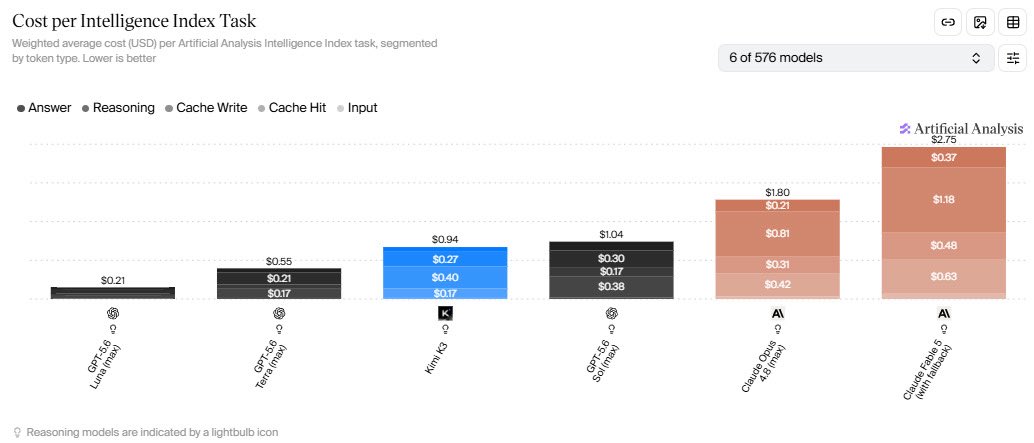
Kimi K3 may be an important inflection point for AI. Potentially negative for Anthropic and OpenAI while being net positive for essentially every other company in the world. I mean that very literally. Although the real “Sputnik moment” would be an open-source frontier model that was also token efficient unlike Kimi K3 which is 50-70% more expensive to run than GPT 5.6 per Artificial Analysis. Rationale:   A world where there are only 2-3 dominant frontier labs with 90% inference margins is net negative for every other layer while being awesome for those 2-3 labs. Those labs would become monopsonies for power, data centers, semiconductors and hyperscalers and would obviously vertically integrate over time into all those layers while also completely subsuming the application/software layers.    Anything that lowers margins and increases competition at the model layer is good for every other AI layer: power, semiconductors, hyperscalers, neoclouds and yes even software.   This is why Jensen is so supportive of open-source. An open-source model requires the *exact* same amount of compute to run as a closed frontier model of similar size and architecture. Kimi K3 is roughly the same price as GPT 5.6 Terra on a per token basis, which actually suggests that it is less computationally efficient as I am sure that GPT 5.6 is priced to a higher margin than K3. And given that K3 is a token wastrel, i.e. token inefficient, it is significantly more expensive per task than GPT 5.6 and Grok 4.5, which are much more token efficient. Cost per token and token efficiency (i.e. intelligence density per token) are the drivers of intelligence per unit of cost. The winning AI companies will be those that offer the most intelligence per $ over time.   Lower margin % at the model layer = more margin $ at every part of the infrastructure layer and is a godsend for software. This can happen either through open-source models like K3 at the frontier *or* having a vertically integrated model company like Meta, SpaceX or Google at the frontier. Both outcomes result in a lower margin % at the model layer as vertically integrated model companies don’t really care where the margin $ come from. This is why it was so painful for OpenAI and Anthropic when Google was right there with them from a model competitiveness perspective and why Grok 4.5 and Muse 1.1 were just as important as Kimi K3. 
The reason Kimi K3 is only *potentially* negative for Anthropic and OpenAI is 1) the @ericvishria point that the Claude and ChatGPT products and harnesses may be more important than their models today and 2) the hypothesis that they have much more advanced model checkpoints internally that are already being used for RSI. In the latter scenario, reaching RSI even a few months ahead of other labs might be enough to cement a permanent lead. Time will tell on both points. And likely fairly quickly. Caveat would be that since Kimi K3 is not token efficient and thereby actually more expensive than ChatGPT 5.6, we may need to see a more token efficient open-source model at the frontier or see Grok 5/Composer 4/Muse 2 at multiple points on the Pareto frontier for this potential risk to Anthropic and OpenAI to play out. And I am sure they will both vertically integrate as quickly as possible while continuing the product/harness strength they have shown over the last 8 months.
Gavin Baker tweet mediaGavin Baker tweet media
English
506
1.1K
7.3K
2M