Jay Krause

47K posts

Jay Krause

Jay Krause

@jtkrause2

Advocate for individual liberty and crypto.

Denver, CO Katılım Mart 2013
707 Takip Edilen387 Takipçiler
Jay Krause retweetledi
Martyr Made
Martyr Made@martyrmade·
1 million downloads! The first episode of Enemy: The Germans’ War, has just passed 1 million downloads across all platforms! Episode 2 is out now for Substack paid subscribers. I don’t accept advertisers; the show is 100% listener-funded. Thank you!
Martyr Made@martyrmade

*NEW Martyr Made Podcast* Enemy: The Germans’ War, pt. 2 - The Work of the Men As the Allies toast their victory in the Great War, the starving, exhausted German soldier returns to find his home besieged by a new enemy more terrible than any he faced in the trenches.

English
58
80
1.1K
22.2K
Jay Krause retweetledi
Rich Baris THE PEOPLE'S PUNDIT
Ben Shapiro keeps making fun of the "comedian" Dave Smith who allegedly doesn't do either jokes or politics well for a living. But the reality is Dave has a much better grasp on the politics and what the future looks like. So, maybe Ben should learn how to tell jokes.
Piers Morgan Uncensored@PiersUncensored

“This will tank Trump’s presidency… he will lose the House and the Senate to the Democrats!” Dave Smith says the Republican coalition has “been destroyed” by America’s involvement in the Iran War. 📺youtu.be/m_BQNhEPkYo @piersmorgan | @sostalksmoney | @ComicDaveSmith

English
8
47
507
17.3K
Jay Krause retweetledi
Auron MacIntyre
Auron MacIntyre@AuronMacintyre·
Shameless doesn’t even begin to describe it
Auron MacIntyre tweet media
English
169
216
2.5K
52.4K
Jay Krause retweetledi
Scott Horton
Scott Horton@scotthortonshow·
@mtracey The neoconservatives were always closer to Netanyahu and Sharon got on board soon anyway, just demanding Syria and Iran be next. He even manufactured fake intel in English to help lie us into it. See Borger and Dreyfuss here, for two: x.com/scotthortonsho…
Scott Horton@scotthortonshow

How the neoconservatives lied us into war with Iraq 20 years ago, a thread of the very best articles on it: First: Our Hijacked Foreign Policy – Neocons take Washington, Baghdad is next by Justin Raimondo antiwar.com/justin/j032502… #Raimondo20yearsago

English
6
16
248
3.9K
Jay Krause retweetledi
Policy Tensor
Policy Tensor@policytensor·
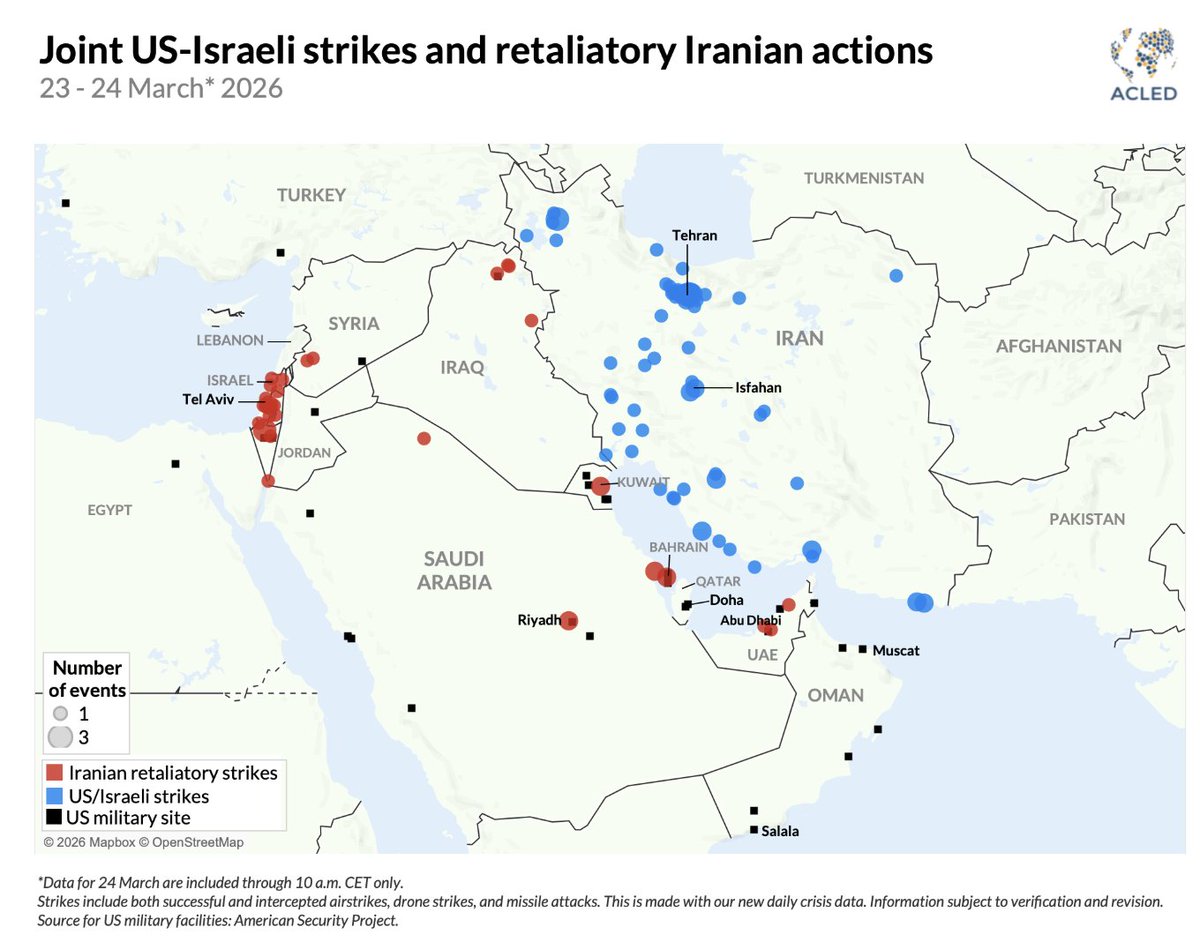
Seconded for the most part. Let me add a few notes. — There are three theories of air power. We know Douhetist terror bombing has never destroyed the will of the enemy to fight. Decapitation has now failed. As long as the US remains ‘up in the air’ there is only one path to avoiding strategic defeat: winning the interdiction war to disarm Iran. — The interdiction theory of victory is ‘analytically attractive’ because it empirically testable in real time. If Iranian strike tempo is dwindling to zero, the US is winning; otherwise it is losing outright. — The all-important interdiction war is going very poorly. I look at the attached map every day from ACLED, the gold standard of conflict data (acleddata.com/iran-crisis-li…). Iranian strike tempo shows no sign of dwindling. To the contrary, depletion of interceptor inventories and the use of heavier missiles has dramatically increased the effectiveness of Iranian missile strikes, as we are seeing in the strikes on Israel. — The Iranians’ interdiction/counterforce campaign has been surprisingly successful. At least 10 radars have been destroyed, partially blinding US forces and interceptor systems. US bases in the region have been largely evacuated, forcing the US to use European bases. — There have been some big kills. Two dozen heavy drones and a half a dozen manned aircraft have been lost to Iranian fire/accidents, not clear which, including an F-35. A mighty carrier group has been put out of business. — Iran enjoys escalation dominance. This was confirmed when Trump had to walk back his ultimatum. Iran has a very powerful threat at the top of the escalation ladder: the O&G infrastructure and water desalinization systems in the gulf are both under Iranian fire control. — Iran holds horizontal escalation options in reserve. The Houthis have their ‘fingers on the trigger.’ That is a deterrent to keep the Saudis out of the war, and may be used at any time to expand the war and impose greater costs on the West. — Iran retains a firm grip on the Hormuz weapon. No serious military option to retake Hormuz exists as long as the interdiction war is not won. No matter where you land the marines, they will be fully exposed to Iranian fire, including artillery fire. US force protection requirements, ultimately a function of casualty intolerance, mean that the Kharg idea etc are just not going to fly. — The United States is at a crossroads. Either it swallows this military humiliation and accepts a ceasefire largely on Iranian terms, or it must send in ground forces to in a bid to retake Hormuz and restore US military prestige. — If the US chooses a negotiated ceasefire, Iran will emerge as a regional hegemon with the Hormuz weapon firmly in its hands; and, having defeated the US in a high-intensity conventional war, as a great power in the international system. — If the US chooses to escalate to a ground war, the war will last for years. This is because both force protection and the overriding objective of fire suppression will drive ever greater commitment of ground forces. But the US cannot win the ground war under any circumstances because the division math (x.com/policytensor/s…) is even more forbidding than the drone math (x.com/policytensor/s…). This means that the choice facing the aggressor is between accepting strategic defeat now at limited costs, or later at far, far higher costs. — So the United States has already suffered a catastrophic military defeat. The multipolar world was a hypothesis until last month. Now it is a demonstrated military fact. It has obtained due to the diffusion of military technology (x.com/policytensor/s…). The US monopoly in precision-strike is now gone. Deterrence in Asia is now dead. This cannot but fail to have far-reaching geopolitical consequences, which I will lay out in detail in a forthcoming interview on @MultipolarPod with @admcollingwood later today.
Policy Tensor tweet media
Rosemary Kelanic@RKelanic

Wars reveal information about countries' relative military capabilities and interests. That's one of the most important insights from the bargaining model of war. Iran believed before the war that fighting the U.S. would strengthen its bargaining position -- and Iran was correct. This war has revealed that Iran wouldn't topple after Khamenei's death, that Iran is highly resolved, and it can inflict damage across the Gulf at low cost, indefinitely. It revealed that Iran can gain massive leverage -- and perhaps even collect "tolls" -- from controlling shipping through the Strait of Hormuz. By contrast, the war has *hurt* U.S. & Israeli bargaining power compared to where it was before the Geneva talks in February. That means we'll get worse terms now than if we'd accepted Iran's proposal then. Why is the U.S./Israel position worse? Decapitation strikes failed to induce Iran to surrender (always an unlikely prospect), nullifying the U.S./Israeli theory of victory by day 3. No new plausible theory of victory has emerged, and it's doubtful one will. That hurts the U.S. position. Trump has proven highly sensitive to oil market swings, and even *removed sanctions* on Iranian oil. As @edwardfishman noted, Iran gained more sanctions relief from closing Hormuz than through any diplomatic means, including the JCPOA. The disruption to oil markets, and Trump's concern about them, also hurts the U.S. position. Now that the war has bogged down into an attrition battle, where Iran can impose costs with cheap means like drones and missiles and Israeli interceptors seem to be running low, the U.S. and Israel are on the losing end of the damage and casualties curve. Costs and casualties will get worse, not better, over time, and that further hurts U.S./Israeli bargaining leverage. Trump is now considering, frankly, foolhardy military gambits, potentially to seize Kharg, islands in Hormuz, or perhaps the highly enriched uranium trapped somewhere under rubble in Iran. These would be significant escalations putting U.S. troops on the ground. None are likely to end the war, and all would likely cause U.S. casualties. In the business lingo, Trump's BATNA (best alternative to a negotiated agreement) is way worse -- not least because of the shadow of Afghanistan. The U.S. forces being surged to the Middle East (2 MEUs plus some airborne units) are comparable to what George W. Bush used to invade Afghanistan in the autumn 2001. What started out as a limited mission to topple the Taliban and capture Osama bin Laden, who instead escaped through the Tora Bora mountains, evolved into a ground campaign that eventually ballooned to over 100k U.S. troops in 2011. The clear imperative here is for Trump to deescalate, credibility costs be damned. This war is existential for Iran but not for the United States, Iran will keep fighting with cheap means like drones, and it will eventually outlast the U.S. just like the Taliban did in Afghanistan. That, or Iran could fracture into chaos, creating refugee flows and breeding terrorism for decades to come. (Terrorism isn't an existential threat to the U.S., but we shouldn't be creating the conditions for it.) Trump doesn't like backing down, but that is what needs to happen here, and stat, before ill-fated escalation leads to more needless deaths. @defpriorities

English
54
591
2K
204.7K
Jay Krause retweetledi
Auron MacIntyre
Auron MacIntyre@AuronMacintyre·
Not a single person complaining about podcasters and conspiracy theories will condemn this podcaster pushing conspiracy theories The outrage is fake, nakedly opportunistic, and entirely performative
English
32
36
776
10.6K
Jay Krause retweetledi
Auron MacIntyre
Auron MacIntyre@AuronMacintyre·
Hammer complains about the prevalence of conspiracy theories while insisting, with no other evidence than "someone said they heard," that Tusli Gabbard is secretly running an "antisemitic" fifth column inside the administration
Shadow of Ezra@ShadowofEzra

Josh Hammer says “anonymous sources” have informed him that Tulsi Gabbard is running a shadow operation that he views as antisemitic. He says Tulsi Gabbard is directly involved in an “antisemitic influencer operation” that involves creating certain narratives. “She’s personally very antisemitic.”

English
109
224
2.2K
57K
Jay Krause retweetledi
Scott Horton
Scott Horton@scotthortonshow·
America First? No, anybody but you instead.
Scott Horton tweet media
English
31
53
307
5.7K
Jay Krause retweetledi
Tom Woods
Tom Woods@ThomasEWoods·
Saying hello draws anti-Semitism charges from Ted Cruz
Tom Woods tweet media
English
9
30
495
11.2K
Jay Krause retweetledi
Rosemary Kelanic
Rosemary Kelanic@RKelanic·
Wars reveal information about countries' relative military capabilities and interests. That's one of the most important insights from the bargaining model of war. Iran believed before the war that fighting the U.S. would strengthen its bargaining position -- and Iran was correct. This war has revealed that Iran wouldn't topple after Khamenei's death, that Iran is highly resolved, and it can inflict damage across the Gulf at low cost, indefinitely. It revealed that Iran can gain massive leverage -- and perhaps even collect "tolls" -- from controlling shipping through the Strait of Hormuz. By contrast, the war has *hurt* U.S. & Israeli bargaining power compared to where it was before the Geneva talks in February. That means we'll get worse terms now than if we'd accepted Iran's proposal then. Why is the U.S./Israel position worse? Decapitation strikes failed to induce Iran to surrender (always an unlikely prospect), nullifying the U.S./Israeli theory of victory by day 3. No new plausible theory of victory has emerged, and it's doubtful one will. That hurts the U.S. position. Trump has proven highly sensitive to oil market swings, and even *removed sanctions* on Iranian oil. As @edwardfishman noted, Iran gained more sanctions relief from closing Hormuz than through any diplomatic means, including the JCPOA. The disruption to oil markets, and Trump's concern about them, also hurts the U.S. position. Now that the war has bogged down into an attrition battle, where Iran can impose costs with cheap means like drones and missiles and Israeli interceptors seem to be running low, the U.S. and Israel are on the losing end of the damage and casualties curve. Costs and casualties will get worse, not better, over time, and that further hurts U.S./Israeli bargaining leverage. Trump is now considering, frankly, foolhardy military gambits, potentially to seize Kharg, islands in Hormuz, or perhaps the highly enriched uranium trapped somewhere under rubble in Iran. These would be significant escalations putting U.S. troops on the ground. None are likely to end the war, and all would likely cause U.S. casualties. In the business lingo, Trump's BATNA (best alternative to a negotiated agreement) is way worse -- not least because of the shadow of Afghanistan. The U.S. forces being surged to the Middle East (2 MEUs plus some airborne units) are comparable to what George W. Bush used to invade Afghanistan in the autumn 2001. What started out as a limited mission to topple the Taliban and capture Osama bin Laden, who instead escaped through the Tora Bora mountains, evolved into a ground campaign that eventually ballooned to over 100k U.S. troops in 2011. The clear imperative here is for Trump to deescalate, credibility costs be damned. This war is existential for Iran but not for the United States, Iran will keep fighting with cheap means like drones, and it will eventually outlast the U.S. just like the Taliban did in Afghanistan. That, or Iran could fracture into chaos, creating refugee flows and breeding terrorism for decades to come. (Terrorism isn't an existential threat to the U.S., but we shouldn't be creating the conditions for it.) Trump doesn't like backing down, but that is what needs to happen here, and stat, before ill-fated escalation leads to more needless deaths. @defpriorities
Idrees Ali@idreesali114

Iran's negotiating posture has hardened sharply since the war began, with the IRGC exerting growing influence over decision-making, and it will demand significant concessions from the U.S. if mediation efforts lead to serious negotiations, three senior sources in Tehran said.

English
53
236
836
253.7K
Eyal Yakoby
Eyal Yakoby@EYakoby·
Tucker Carlson: “Sharia Law has made Islamic societies more advanced than the West.” Do I need to even add a further caption?
English
2.4K
1.6K
8.8K
1.5M
Jay Krause retweetledi
S2 Underground
S2 Underground@s2_underground·
These days, there is a huge trend going around to be aware of. Accounts will post a fake quote, that allegedly came from an interview, but in reality, it's completely made up. In this case, Carlson never said the claimed quote about Sharia Law. If you watch the cited clip or the full interview he never actually says these words (he only parenthetically mentions Sharia at one point). Quotation marks are supposed to be used to convey direct quotes. Not general ideas or interpretation. In fact, for the younger crowd, quotation marks are so powerful to get exactly correct, that we often use the word [sic] to describe literally exactly what was stated, even if it was a misspelled word. That's how important it is to quote someone's words correctly. But now, a lot of people are using quotation marks to *summarize* an argument (often incorrectly), which is not only a complete mockery of the English language, but is also gaslighting of the highest degree. This has become a huge trend, and we have to call out this manipulation directly whenever we see it, regardless of who the person is. We can disagree with a person, to be sure, but we cannot falsely attribute to anyone words they never actually said. Fake quotes can absolutely have dire consequences, especially during a time of war.
Breaking911@Breaking911

TUCKER: "There's not a single Western city thats thriving" "Sharia Law has made Islamic societies more advanced than the West."

English
76
301
2.3K
54.1K
Jay Krause retweetledi
Andrew Day
Andrew Day@AKDay89·
Another example of that high-value intelligence we get from Israel, I guess. The CIA doubted that a war would quickly lead to a democratic uprising against the Iranian regime. But Israel's Mossad was optimistic it could spur regime change. Trump listened to the Israelis.
Edward Wong@ewong

NEW from @nytimes: Netanyahu embraced a plan by the Mossad chief to ignite a regime change uprising in Iran for a quick victory. He used it to help convince Trump to start the war — despite doubts among some senior US and Israeli officials. It was a critical flaw in war plans.

English
25
76
322
27.1K