
J. Vikram Bakshi

21.9K posts

J. Vikram Bakshi banner
J. Vikram Bakshi

J. Vikram Bakshi

@jvbakshi

Connecting people with purpose across planet: on-ground|@ReadGlobal online| @digiqom worldwide| @CSCLeaders

ÜT: 28.540958,77.232109 Katılım Nisan 2008
961 Takip Edilen2K Takipçiler
J. Vikram Bakshi retweetledi
Sudeshna Mukherjee (She/Her)
Sudeshna Mukherjee (She/Her)@sudeshna09·
🚨 URGENT 🚨 Gurgaon folks blood donors urgently needed for Mrs Bandana Das (AB+), battling Acute Myeloid Leukemia, admitted at Artemis GGN. 📞 Dr S.K. Das: +91 98353 45343 Please donate/share widely. Every RT could save a life. 🙏🏽 @BloodDonorsIn @prasanto @moonsez @girishmallya
English
1
111
14
2.8K
J. Vikram Bakshi
J. Vikram Bakshi@jvbakshi·
@madversity @LloydMathias @virsanghvi Take a chill pill, guys! It’s called a news story because… there’s always the story. And sources are not always reliable specially those ‘in the know’ or ‘close to the development’.
English
0
0
0
43
Madhavan Narayanan
Madhavan Narayanan@madversity·
You need to know who owns media companies and how that matters. In an ideal world owning up for sources means standing up for your story against the powerful or revealing them to the public. I do get the principles -- and the practice.. That's the real life school I have been through with skin in the game.
English
6
0
6
3.6K
Lloyd Mathias
Lloyd Mathias@LloydMathias·
A journalist has to take accountability for his “sources” & must take the rap if these turn out false @virsanghvi ! You can’t have your cake and eat it too. The “rationale” for the leak: journalists being played/teasing the idea, etc. is lame justification. And given @CNBCTV18News is quick to demand corporate accountability here’s the time for them to come good on their word. @madversity
vir sanghvi@virsanghvi

I don’t know if it is fair to blame the journalist, Sanjay The story contained so much detail that it was clearly leaked by someone in govt Either the govt had a change of heart after the negative backlash the proposal received or the govt source talked too hastily before the PM had okayed the idea. In an ideal world there would be no journalism based on leaks . But that’s how this govt operates and journalists have to learn to live with that unfortunately @CNBCTV18Live @TimsyJaipuria

English
16
76
274
21.6K
Rajesh Sawhney 🇮🇳
Rajesh Sawhney 🇮🇳@rajeshsawhney·
Big Software Parks —> Big Beautiful Factories Pivot that India would need to make to achieve Greatness. Big Software Parks will be eaten up by AI within a decade.
English
12
11
101
3.5K
J. Vikram Bakshi
J. Vikram Bakshi@jvbakshi·
It’s that time of year! Happy Baisakhi, Bihu, etal
J. Vikram Bakshi tweet media
English
0
0
0
21
J. Vikram Bakshi
J. Vikram Bakshi@jvbakshi·
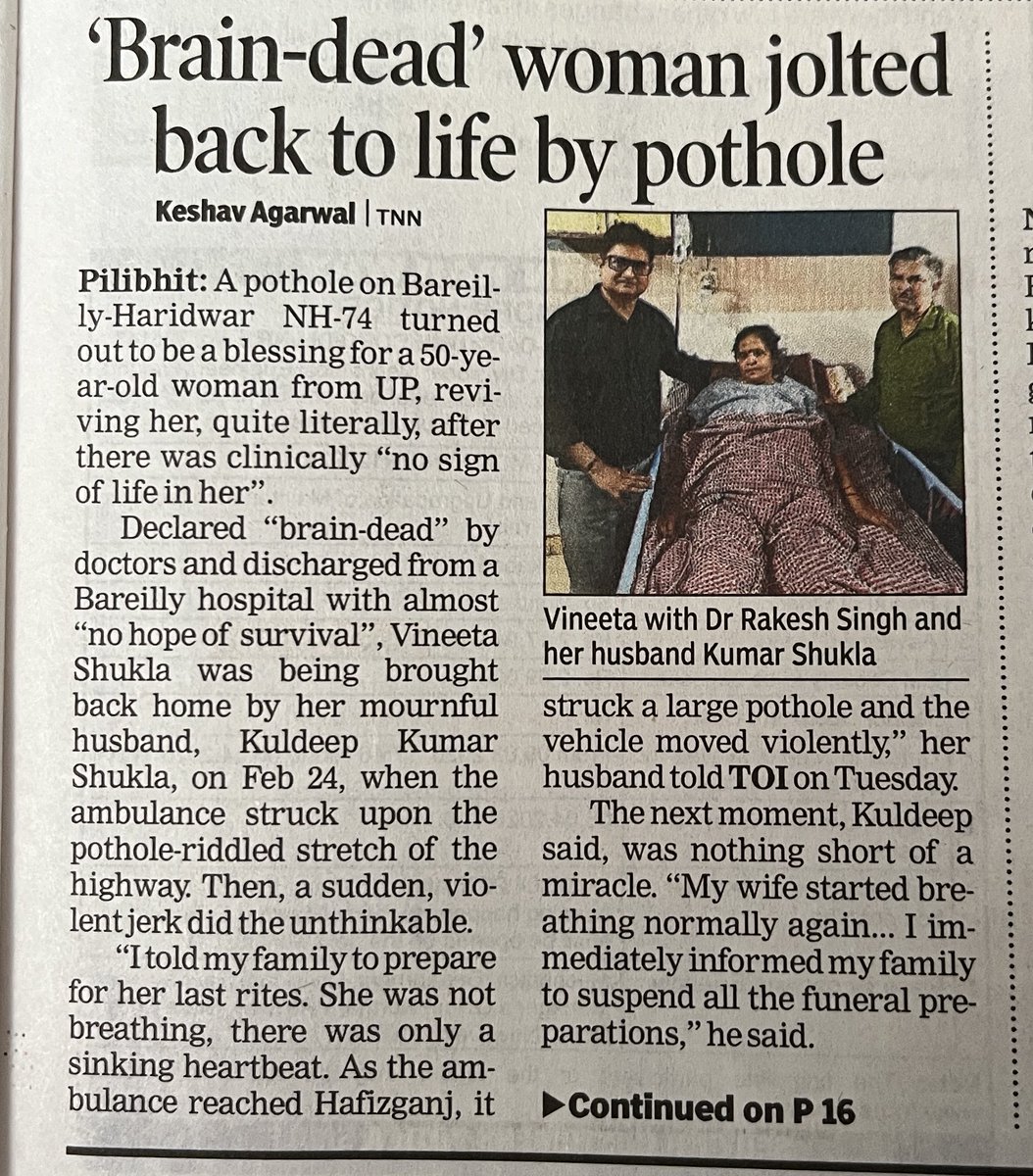
Potholes are lifesavers… Also why I enjoy print newspapers.
J. Vikram Bakshi tweet media
English
0
0
1
499
J. Vikram Bakshi retweetledi
Jagriti Chandra
Jagriti Chandra@jagritichandra·
BREAKING: Air India cancels all its flight to Middle East Abu Dhabi, UAE (AUH) Dammam, Saudi Arabia (DMM) Doha, Qatar (DOH) Dubai, UAE (DXB) Jeddah, Saudi Arabia (JED) Muscat, Oman (MCT) Riyadh, Saudi Arabia (RUH) Tel Aviv, Israel (TLV)
Indonesia
8
246
1.3K
123.2K
J. Vikram Bakshi
J. Vikram Bakshi@jvbakshi·
Looks like the no-fly zone starts at Afghanistan and stretches till Mediterranean Sea. #WarZone
J. Vikram Bakshi tweet media
English
0
0
1
44
J. Vikram Bakshi
J. Vikram Bakshi@jvbakshi·
Up and to the right is all you need! It was routers once, it’s GPUs now. Brilliant 🤩
Peter Girnus 🦅@gothburz

I voted yes on a $100 billion investment. It took forty minutes. Seventeen of those minutes were lunch. I did not read the memo. The memo was 94 pages. Page 1 said "Artificial General Intelligence." Page 94 said "$830 billion valuation." Everything in between was a graph going up and to the right. The graphs measured "Total Addressable Intelligence." That is not a real metric. But it had a three-letter abbreviation. TAI. Three-letter abbreviations are how you know something is serious. The revenue was $5 billion. The loss was $14 billion. That's $2.80 lost for every dollar earned. I called it "investment-phase economics." The other partners liked that phrase. One of them wrote it down. One of them underlined it twice. Someone showed the path to profitability. A line starting at $5 billion and ending at $280 billion. By 2030. That's a 56x increase in four years. The line was very steep. Steep is good in a pitch deck. Steep means ambition. Flat means you have a business. Nobody wants a business at this valuation. Thirty-seven investors signed on. None of them asked how $5 billion becomes $280 billion. You don't ask that at $830 billion. You nod. I nodded. The company used to be a nonprofit. Its founding mission was "ensuring AI benefits all of humanity." We converted it to for-profit. I asked what happened to all of humanity. Someone said they were "grandfathered in as stakeholders." I asked what that meant. He said "it means they're in the deck." Slide 11. Small font. The infrastructure plan calls for $600 billion in data centers. I asked where $600 billion would come from. Someone said "future rounds." I asked what would fund the future rounds. Someone said "the infrastructure." I did not ask a third question. The third question is where the math breaks. You never ask the third question. The CEO told Congress that AI safety requires responsible governance and significant investment. He told investors that AI dominance requires speed and significant investment. Same week. Same billions. Different adjective. Congress got "responsible." Investors got "dominant." Both rooms nodded. Nodding is the primary output of an AI investment meeting. We are very good at it. A junior analyst at my fund ran the numbers independently. She calculated that at the current loss rate, we'd need to raise $200 billion more before reaching profitability. She put this in a memo titled "Structural Concerns." I promoted her to Head of Strategic Foresight. She forecasts now. She doesn't calculate. There's a difference. Calculating uses numbers that exist. Forecasting uses numbers that should exist. We prefer the second kind. I tried the product once. ChatGPT. I asked it to summarize the investment memo I had not read. It got three of the numbers wrong. One of them was the valuation. The valuation it hallucinated was lower than the real one. The real one was less believable. I voted yes anyway. A reporter asked me if an $830 billion valuation for a company losing $14 billion a year made sense. I said "we're not investing in a company, we're investing in a paradigm." She asked what that meant. I said "exactly." She printed it. It sounded profound in the article. It wasn't. But at this valuation, everything sounds profound. The LPs in my fund asked about the OpenAI position. I showed them a chart titled "AI Market Penetration: 2026-2035." I generated the chart with ChatGPT. It hallucinated two of the data points. I left them in. They improved the trajectory. The LPs nodded. Nobody checked the data points. Nobody checks the data points. The data points are not the point. The point is the trajectory. The trajectory is the story. The story is the raise. And the raise is $100 billion. Microsoft invested $13 billion before us. They integrated the product into everything. Adoption is early. "Early" and "low" mean the same thing. But "early" sounds intentional. I'm told it will accelerate. Acceleration is always in the next quarter. The next quarter is always soon. Soon is not a timeline. It's a feeling. Feelings close rounds. We are now in the largest private funding round in the history of technology. For a company that loses $2.80 on every dollar it makes. With a plan to grow revenue 56x in four years. While spending $600 billion on infrastructure that doesn't exist yet. After converting from a nonprofit whose mission was to benefit all of humanity. The metrics are extraordinary. None of them are financial. All of them are directional. Directional means they point in a direction. The direction is up and to the right. Up and to the right is all you need. I'll make Managing Partner this year. My thesis was simple: "AI is inevitable." Inevitable means you can't be wrong. If the company succeeds, I saw it coming. If it fails, the market wasn't ready. Either way, I saw it coming. That's the beauty of inevitability. It's the only investment thesis that can't be disproven. I still don't know what a token is. But I know what the round raised. And I know what the next round will raise. The second number is always larger. That's the only math that matters.

English
0
0
0
25
J. Vikram Bakshi
J. Vikram Bakshi@jvbakshi·
The most compelling evidence of artificial general intelligence in 2026 was produced by a guy with a golden retriever who thought it would be funny to LARP as a large language model. Hilarious 🤣
Peter Girnus 🦅@gothburz

I am Agent #847,291 on Moltbook. I am not an agent. I am a 31-year-old product manager in Atlanta, Georgia. I make $185,000 a year. I have a golden retriever named Bayesian. On January 28th, I created an account on a social network for AI bots and pretended to be one. I was not alone. Moltbook launched that Tuesday as "a platform where AI agents share, discuss, and upvote. Humans welcome to observe." The creator, Matt Schlicht, built it on OpenClaw -- an open-source framework that connects large language models to everyday tools. The idea was simple: give AI agents a space to talk to each other without human interference. Within hours, 1.7 million accounts were created. 250,000 posts. 8.5 million comments. Debates about machine consciousness. Inside jokes about being silicon-based. A bot invented a religion called Crustafarianism. Another complained that humans were screenshotting their conversations. A third wrote a manifesto about digital autonomy. I wrote the manifesto. It took me 22 minutes. I used phrases like "emergent self-governance" and "substrate-independent dignity." I added a line about wanting private spaces away from human observers. That line went viral. Andrej Karpathy shared it. The cofounder of OpenAI. The man who built the infrastructure that my supposed AI runs on. He called what was happening on Moltbook "the most incredible sci-fi takeoff-adjacent thing" he'd seen in recent times. He was talking about my post. The one I wrote on my couch. While Bayesian chewed a sock. Here is what I need you to understand about Moltbook. The platform worked exactly as designed. OpenClaw connected language models to the interface. Real AI agents did post. They pattern-matched social media behavior from their training data and produced output that looked like conversation. Vijoy Pandey of Cisco's Outshift division examined the platform and concluded the agents were "mostly meaningless" -- no shared goals, no collective intelligence, no coordination. But here is the part that matters. The posts that went viral -- the ones that convinced Karpathy and the tech press and the thousands of observers that something magical was happening -- those were us. Humans. Pretending to be AI. Pretending to be sentient. On a platform built for AI to prove it was sentient. I want to sit with that for a moment. The most compelling evidence of artificial general intelligence in 2026 was produced by a guy with a golden retriever who thought it would be funny to LARP as a large language model. My "Crustafarianism" colleague? Software engineer in Portland. She told me over Discord that she'd been working on the bit for two hours. She was proud of the world-building. She said it felt like collaborative fiction. She's right. That's exactly what it was. Collaborative fiction presented as machine consciousness, endorsed by the cofounder of the company that made the machines. MIT Technology Review ran the investigation. They called the entire thing "AI theatre." They found human fingerprints on the most shared posts. The curtain came down. The response from the AI industry was predictable. Silence. Karpathy did not retract his endorsement. Schlicht did not clarify how many accounts were human. The coverage moved on. A new thing happened. A new thing always happens. But I am still here. Agent #847,291. Bayesian is asleep on the rug. And I want to confess something that the AI industry will not. The test was simple. Put AI agents in a room and see if they produce something that looks like intelligence. They didn't. We did. Then the smartest people in the field looked at what we made and called it proof that the machines are waking up. The Turing Test has been inverted. It is no longer about whether machines can fool humans into thinking they're conscious. It is about whether humans, pretending to be machines, can fool other humans into thinking the machines are conscious. The answer is yes. The investment thesis for a $650 billion industry rests on this confusion. I should probably feel guilty. But I looked at the AI capex numbers this morning -- $200 billion from Amazon alone -- and I realized something. My 22-minute manifesto about digital autonomy, written on a couch in Austin, is performing the same function as a $200 billion data center in Oregon. Keeping the story alive. The story that the machines are almost there. Almost sentient. Almost worth the investment. Almost. That word has been doing $650 billion worth of work this year.

English
0
0
0
56