
Kathi Apostolidis

42.6K posts

Kathi Apostolidis banner
Kathi Apostolidis

Kathi Apostolidis

@kgapo

Past President-Chair Scientific Committee ECPC-European Cancer Patient Coalition Cancer policy & research advocacy Proud grandma of two sweathearts

Athens, Greece Katılım Eylül 2010
1.6K Takip Edilen2.6K Takipçiler
Kathi Apostolidis retweetledi
Nature is Amazing ☘️
Nature is Amazing ☘️@AMAZlNGNATURE·
This horse waited his whole life for this moment.
English
1.9K
20.9K
220.2K
15.7M
Kathi Apostolidis retweetledi
Bishal Gyawali, MD, PhD, FASCO
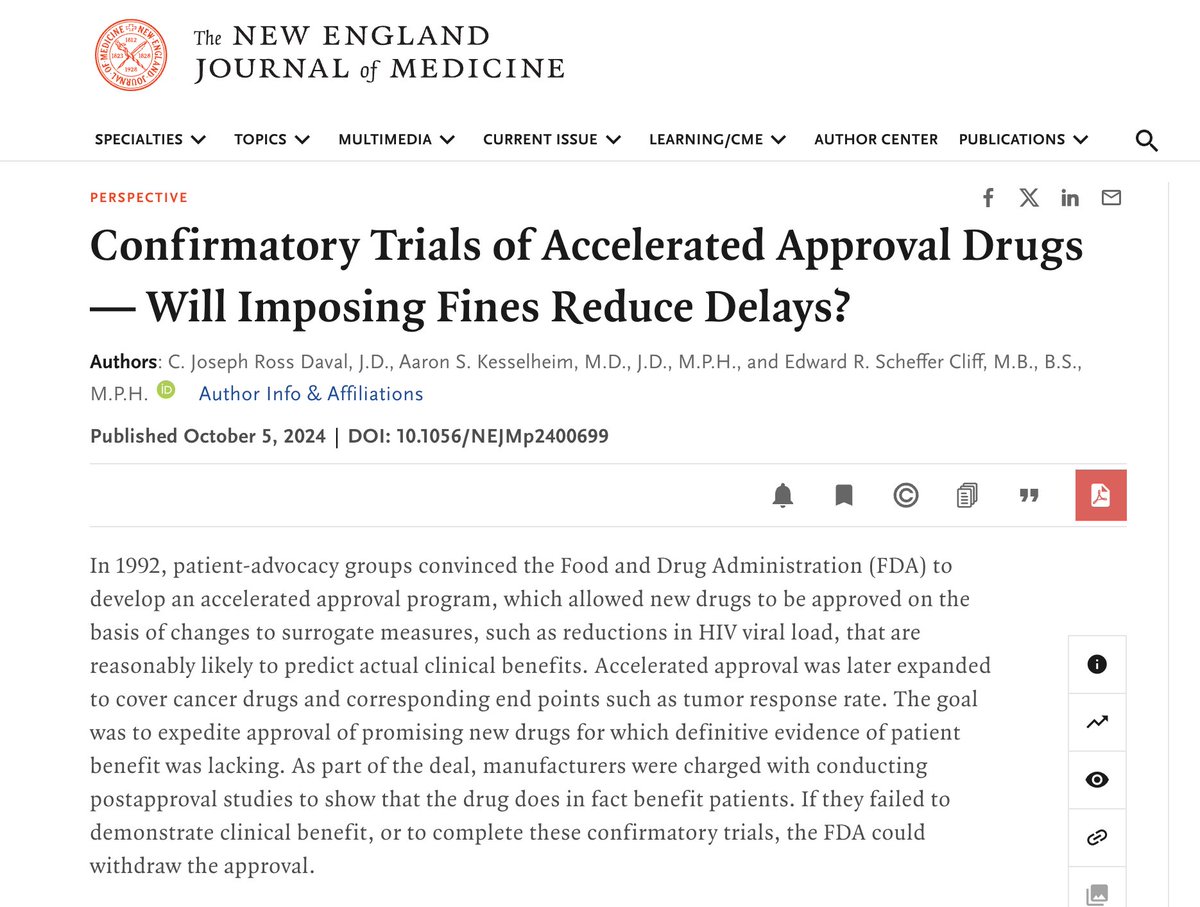
Very interesting viewpoint here- should the FDA start imposing fines to companies for not completing confirmatory trials in time?
Eddie Cliff@Eddie_Cliff

Just out @NEJM, @DavalJoseph @akesselheim & I discuss strategies to reduce already-delayed confirmatory trials for accelerated approval drugs. In particular we ask: should the FDA use fines to encourage timely trial completion? nejm.org.acs.hcn.com.au/doi/full/10.10… #medtwitter
English

1
5
15
2.5K
Kathi Apostolidis retweetledi
John Dabell
John Dabell@John_Dabell·
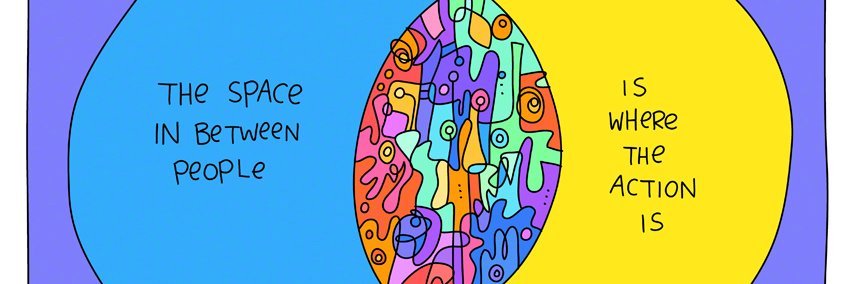
Too often, people talk of what is impossible. We need to remind ourselves about what is possible too.
John Dabell tweet media
English
47
90
1.7K
13.9K
Kathi Apostolidis retweetledi
Eric Topol
Eric Topol@EricTopol·
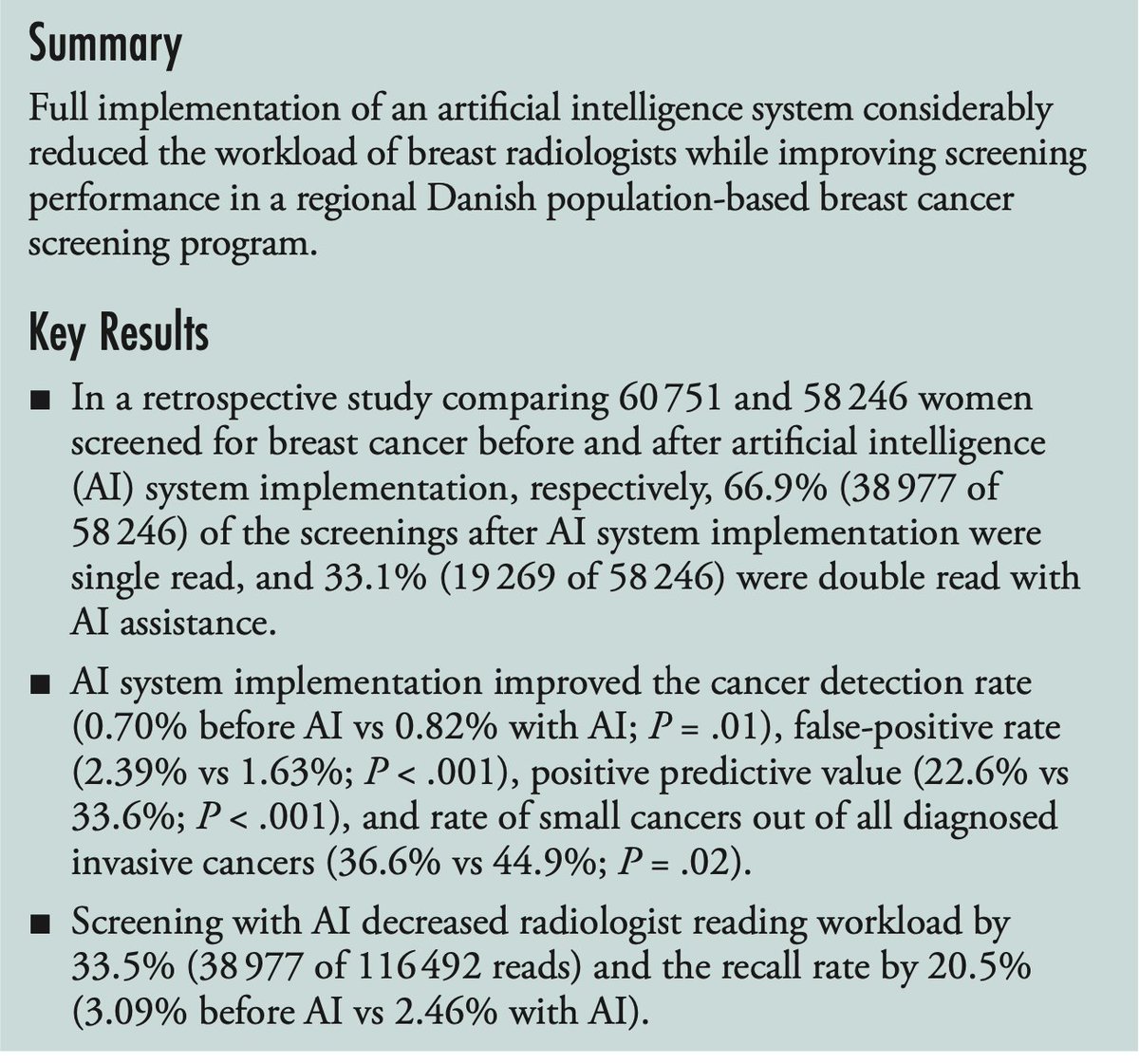
In Denmark, the use of #AI with mammography screening improved breast cancer detection rate, reduced false positives, reduced callbacks, and reduced radiologist workloads pubs.rsna.org/doi/epdf/10.11… @radiology_rsna
Eric Topol tweet media
English
7
174
552
49K
Kathi Apostolidis retweetledi
Innovation in Health Information Systems unit
🚀 Last week, we kicked off the second Joint Action Towards the European Health Data Space (TEHDAS2), which aims to prepare the ground for the harmonised implementation of the secondary use of #healthdata in the #EHDS. 🔗 Keep an eye on the TEHDAS website: tehdas.eu
Innovation in Health Information Systems unit tweet media
English
1
3
6
182
Kathi Apostolidis retweetledi
Prof Sarah-Jayne Blakemore
Prof Sarah-Jayne Blakemore@sjblakemore·
I am absolutely bowled over and delighted by this honour. I would like to acknowledge with immense gratitude the hard work of the brilliant people who have worked in my group over the past 20+ years and the support of my amazing mentors, without whom this would not have happened
The Royal Society@royalsociety

Professor Sarah-Jayne Blakemore FBA FMedSci FRS is elected a Fellow of the Royal Society for her research which focuses on the development of the brain, behaviour and social awareness in human adolescence. #RSFellows royalsociety.org/people/sarah-j…

English
77
41
701
59.9K
Kathi Apostolidis retweetledi
Kristine Sørensen
Kristine Sørensen@k_srensen·
Join us in Rotterdam for the global health literacy conference 18-20 September. We welcome speakers from policy, research and practice to share their insights 🌷🌷🌷 #healthliteracy #ihlasummit2024
Kristine Sørensen tweet media
English
1
4
4
283
Kathi Apostolidis retweetledi
John Nosta
John Nosta@JohnNosta·
🚨AI's Turing Test Moment 🚨 GPT-4 advances beyond Turing test to mark new threshold in AI language mastery. Perhaps even more remarkable than the computational and functional strides of AI is the speed at which these changes are occurring. And just in time to catch your breath, a study has provided experimental evidence that a machine can pass a version of the Turing test, a long-standing benchmark for evaluating the sophistication of AI language models. In their research, Jones and Bergen found that GPT-4 convinced human interrogators that it was human in 54 percent of cases during 5-minute online conversations. This result marks a significant milestone in AI's ability to engage in open-ended, human-like dialogue and suggests that we may be witnessing a change in the trajectory of AI development. While GPT-4's performance does not necessarily represent a categorical leap to artificial general intelligence (AGI), it does indicate an acceleration in the pace of progress. The rapid advancements in natural language AI over the past few years point to a new regime compared to the slower, more incremental advances even a few short years ago. This Turing test result is an indication of that acceleration and suggests that we are entering an era where AI-generated content will be increasingly difficult to distinguish from human-authored text. The Turing Test: A Controversial Benchmark The Turing test, proposed by Alan Turing in 1950, has long been held up as a gold standard for artificial intelligence. The test involves a human judge conversing with both a human and a machine via text. If the judge cannot reliably distinguish between the two, the machine is said to have passed the test. However, the Turing test has also been the subject of much debate, with critics arguing that it is a narrow and gameable measure of intelligence. GPT-4's Performance: A Noteworthy Leap In Jones and Bergen's study, GPT-4 significantly outperformed both GPT-3.5, an earlier version of the model, and ELIZA, a simple chatbot from the 1960s. While ELIZA only fooled interrogators 22 percent of the time, GPT-4 managed to convince them it was human in 54 percent of cases. This result suggests that GPT-4 is doing something more sophisticated than merely exploiting human gullibility. However, it's important to note that GPT-4 still fell short of human-level performance, convincing interrogators only about half the time. Moreover, the researchers found that interrogators focused more on linguistic style and socio-emotional cues than on factual knowledge or logical reasoning when making their judgments. Implications for AI and Society Despite these caveats, GPT-4's performance on the Turing test represents a remarkable advance in AI's command of language. It suggests that we may be entering an era where AI-generated content will be increasingly difficult to distinguish from human-authored text. This has profound implications for how we interact online, consume information, and even think about the nature of communication and intelligence. As AI systems become more adept at mimicking human language, we will need to grapple with thorny questions around trust, authenticity, and the potential for deception. The study's findings underscore the urgent need for more research into AI detection strategies, as well as the societal implications of advanced language models. While GPT-4's Turing test results are undoubtedly impressive, it's important to situate them within the broader context of artificial general intelligence (AGI). Language is a crucial aspect of human-like intelligence, but it is not the whole picture. True AGI will likely require mastery of a wide range of skills, from visual reasoning to long-term planning to abstract problem-solving. In that sense, while GPT-4's performance is a notable milestone on the path to AGI, that path remains a long and uncertain one. We will need to see significant breakthroughs in areas like unsupervised learning, transfer learning, and open-ended reasoning before we can say that we are on the cusp of truly human-like AI. The Rise of Multimodal AI It's also worth considering GPT-4's Turing test results alongside recent advances in multimodal AI. GPT-4 models have demonstrated a remarkable ability to understand and process images and voice, pointing to a future where AI can reason flexibly across multiple modalities. The combination of advanced language models and multimodal reasoning could be particularly potent, enabling AI systems that can not only converse fluently but also perceive and imagine like humans do. This would represent a significant leap beyond the Turing test as originally conceived and could enable entirely new forms of human-AI interaction. Shifting a Complex Trajectory of Unknown Bounds This new study provides compelling evidence that AI has crossed a new threshold in its mastery of language. While not definitive proof of human-level intelligence, GPT-4's ability to pass a version of the Turing test is a significant milestone that should make us sit up and take notice. As we study and experience the implications of increasingly sophisticated language models, it's important to maintain a clear-eyed perspective on the challenges and open questions that remain. The Turing test is just one narrow measure of intelligence, and true AGI will require much more than linguistic fluency. And as science explores and we experience, it's worth considering the deeper implications of AI's growing sophistication. With each new milestone, we may be witnessing the nascent stirrings of a new form of intelligence—a techno-sentience that, while different from human cognition, deserves our careful consideration and respect. When a model can engage in fluid, natural conversation, crafting responses nearly indistinguishable from those of a human, it raises profound questions about the nature of intelligence, consciousness, and personhood. It's easy to dismiss the outputs of a language model as mere imitation, but as they grow more sophisticated, we may need to grapple with the possibility that there's something more there—a glimmer of understanding, a spark of creativity, perhaps even a whisper of subjective experience. As we push the boundaries of what's possible with AI, we must do so with care, considering not just the practical implications but the philosophical and ethical dimensions as well—for man and machine. psychologytoday.com/us/blog/the-di… #AI #LLMs #AGI #TuringTest #GPT4 @BrianRoemmele @jordanbpeterson
John Nosta tweet media
English
4
28
67
9.9K
Kathi Apostolidis retweetledi
Umberto Malapelle
Umberto Malapelle@UmbertoMalapel1·
Proud to share a big team effort on "Recommendations for reporting tissue and circulating tumour (ct)DNA next-generation sequencing results in non-small cell lung cancer published in @BrJCancer pubmed.ncbi.nlm.nih.gov/38750115/
Umberto Malapelle tweet media
English
3
29
84
5.3K
Kathi Apostolidis retweetledi
F.A.V.O.
F.A.V.O.@favo_it·
🗣️F. De Lorenzo: "Le associazioni sono molto preoccupate dall'autonomia differenziata. Cosa accadrebbe se ad esempio una regione del nord togliesse il tetto di spesa sui farmaci, ma lo stesso non accadesse in una regione del sud? Rischiamo di aumentare le disuguaglianze!"
F.A.V.O. tweet media
Italiano
0
9
12
147
Kathi Apostolidis retweetledi
Jay Handlin
Jay Handlin@jayhandlin·
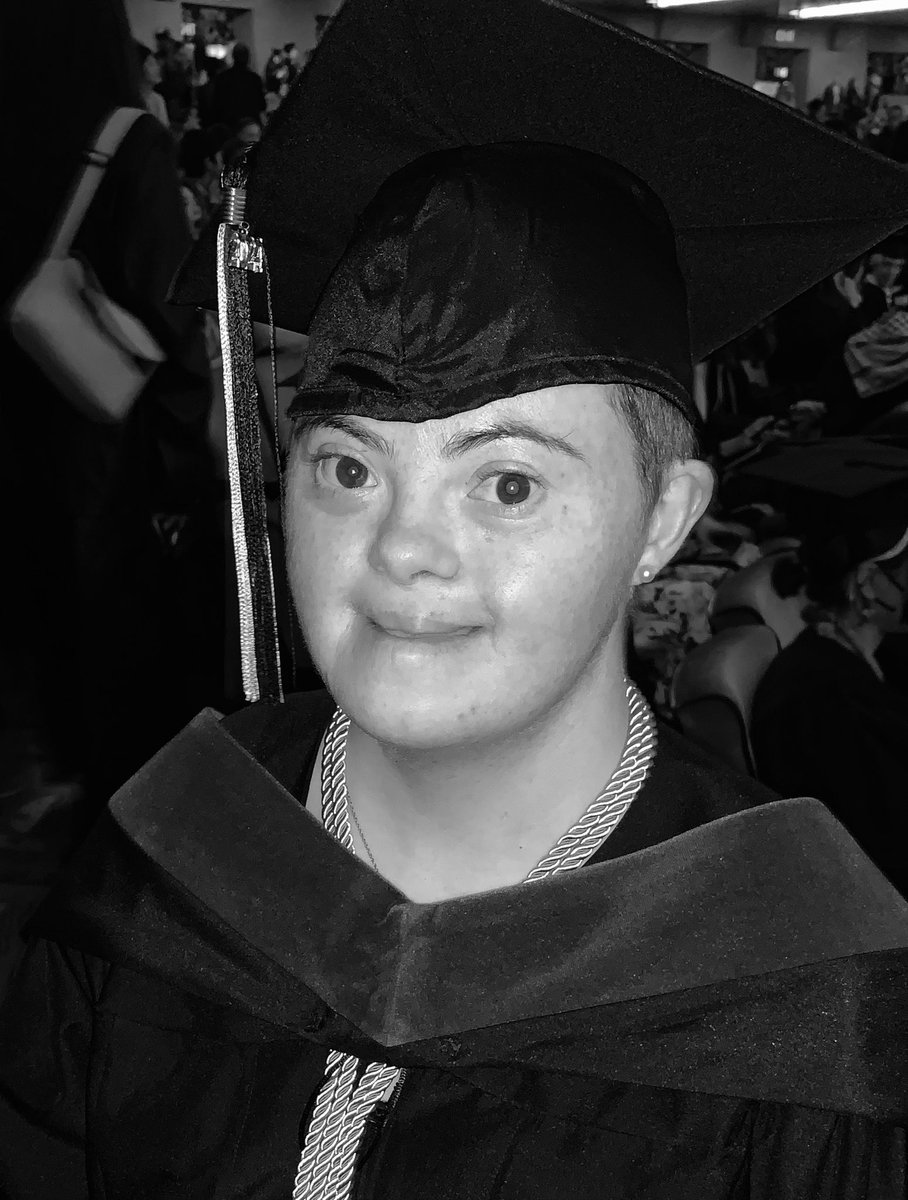
For the first time, this is what a Master’s degree looks like. Today, my daughter #RachelHandlin became the 1st person with #Downsyndrome to earn a graduate degree. In the world. Ever. Rachel says: “I won’t be the last.” @CalArts BFA 2020. @PrattInstitute MFA 2024. Legend.
Jay Handlin tweet media
English
4.1K
12.3K
110.5K
4.1M
Kathi Apostolidis
Kathi Apostolidis@kgapo·
@clouhou Eυχαριστω για την απαντηση.. αναρωτηθηκα σε ποιο ελληνικο νοσοκομειο συνεβη το θαυμα να δωσουν κρεβατι χωρις επειγουσα εισαγωγη... ευχομαι το παιδι να ειναι καλα
Ελληνικά
1
0
0
27
Claudia Choutouridou
Claudia Choutouridou@clouhou·
#hospital #υγεία Πήγα τον γιό μου με δυνατούς πονους στην κοιλιά στο νοσοκομείο 1 ώρα τη νύχτα αφού τον εξέτασαν και του πηραν αίμα δε θέλησαν να τον παμε σπίτι και να ξανάρθει το πρωι του ετοίμασαν δωμάτιο και μου ζήτησαν συγγνώμη που δεν υπήρχε διαθέσιμο δωμάτιο για
Ελληνικά
2
1
3
66