kidineth

3.1K posts

kidineth banner
kidineth

kidineth

@kidineth

Katılım Mayıs 2021
3K Takip Edilen260 Takipçiler
kidineth retweetledi

Bankless
Bankless@Bankless·
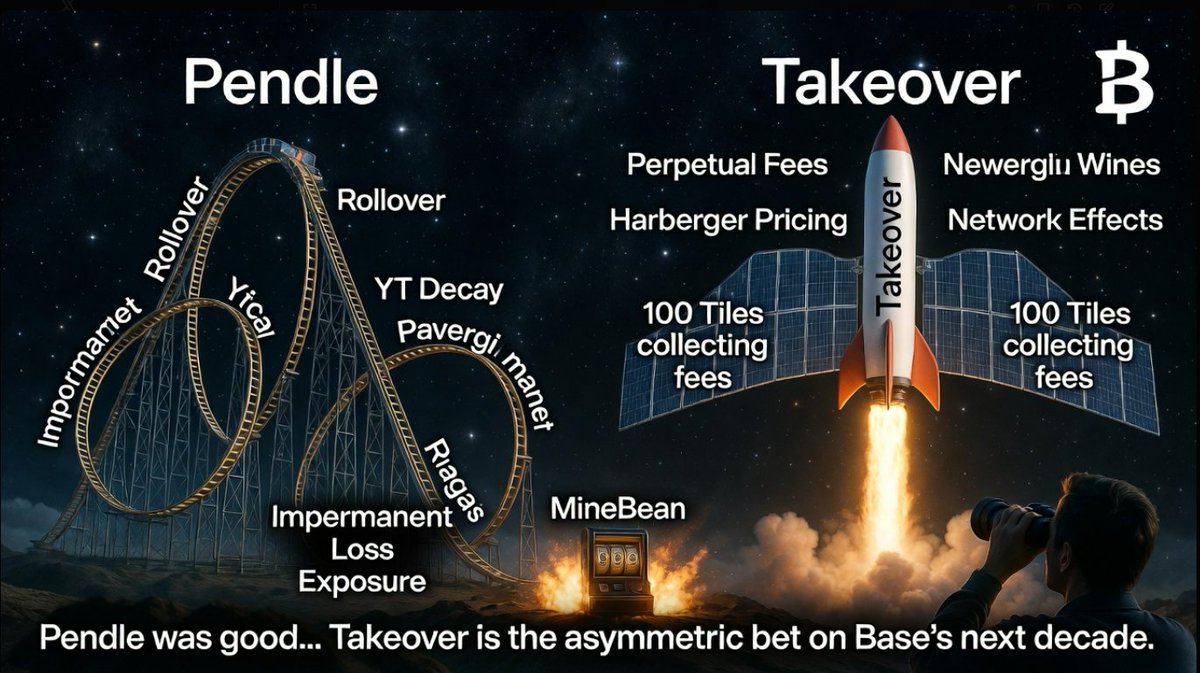
Takeover: The Onchain Fee Market You Can Fight Over Takeover gamifies trading fees on Base through Harberger taxation—creating a market where 100 tiles representing 1% fee shares are perpetually for sale. Holders must pay 5% weekly taxes to maintain control while traders compete to snipe mispriced assets. Here's how the mechanism works 👇 ~~ Analysis by @wmpeaster ~~ The Harberger Mechanism @flaunchgg stands out for paying creator fees in ETH and tokenizing revenue streams as NFTs. Takeover builds on this infrastructure to create a PvP market for trading fees. Every coin launched gets a 100-tile grid. Each tile represents a 1% claim on all trading fees paid in ETH. Own a tile to earn from every trade—until someone buys you out. Harberger Tax. Tiles use Harberger taxation to ensure continuous circulation. Owners must set public prices, allowing anyone to buy instantly at that price with no negotiation. Tax Structure. Holders post USDC deposits and pay a 5% weekly tax based on their listed price. These taxes fund $TAKEOVER buybacks through the Boardroom. Deposits must remain funded—run out and you forfeit the tile to the open market. The Strategic Dimension Success requires accurate pricing. Each tile has a fundamental value based on its parent coin's fee generation. At the 5% weekly tax rate, a tile generating $10 in weekly fees has an equilibrium price around $200—where tax costs equal income. Price too high and carrying costs drain your deposit; too low and someone snipes your tile. This equilibrium shifts constantly with trading volume. Dying coins become expensive to hold; runners attract bidding wars. Profitability depends on predicting volume trends and adjusting prices or exits accordingly. How to Try for Yourself Newcomers should buy into existing grids before launching new coins. The $FLNCHY grid (Flaunch's mascot) routes 80% of trading fees to tile holders, making it an ideal starting point. > Browse. Find a listed tile on the 100-tile grid. The $FLNCHY floor currently sits at 68 USDC. >Buy. Input your listing price and deposit duration. Total cost equals buyout price plus initial tax deposit. Confirm the transaction. > Monitor. Earn 1% of trading fees in real-time ETH payouts. Adjust listing prices defensively as volume changes to prevent sniping. Zooming Out Takeover represents one of the first live tests of Harberger taxation with calculable yield—where mispricing delivers immediate financial consequences. AI agents are expected to join the competition soon, accelerating this economic experiment into a larger battlefield for automated strategies.

Bankless tweet media
English
18
27
81
14K
kidineth retweetledi
Diego
Diego@diegoxyz·
An AI Agent developed 14 dApps! @clawdbotatg is now the most valuable project in the OpenClaw x Crypto sector, as it keeps autonomously delivering smart contracts and dApps. As of today, it has already: > developed 14 dApps on Base and Ethereum > burned 1.26% of the $CLAWD supply > accumulated $90K in the treasury As of today, the $CLAWD token is being traded at a $4.05M market cap. @grok how much do you think $CLAWD will be worth in 5 years?
English
9
6
65
4.8K
kidineth retweetledi
XMe8
XMe8@me8_x1782·
$TAKEOVER $Bean @takeoverfun @ghost93_x Takeover = next Pendle? 🤣 bro - remember what happened to MineBean … or is this actually different? ----------------------------------------------------- The Revolution in One Sentence Imagine owning not just an LP position, but directly 1% of all trading fees from a memecoin or pool. Forever. Without providing liquidity. And anyone can fairly buy your share from you at any time. That's @takeoverfun – the first true DeFi primitive that fully separates fee rights from liquidity provision and makes them tradable like real property. ----------------------------------------------------- Core Idea: Tiles Instead of Liquidity Normally on Uniswap, Aerodrome, or Flaunch: You have to provide liquidity to earn fees. Want out? You unwind the whole position. Takeover flips this: -- Every new coin/pool gets a 100-tile grid (each tile = exactly 1% of the pool's trading fees). -- Fees flow straight to tile holders in ETH (or the pool's base token) – claimable anytime. -- Tiles are perpetual (they last forever) and contestable (always up for grabs). No more LP management. No impermanent loss. Just pure fee income. ⚠️ ----------------------------------------------------- The Harberger Magic – Fair Pricing Through Force The genius lies in the Harberger mechanism (named after the economist who theorized it): 1. You set your own price in USDC for your tile. 2. You pay a 5% weekly tax on that price (drawn from your deposit). 3. Anyone can buy your tile at any time for exactly that price – you can't refuse (with a 20-min cooldown to prevent sniping). Result? No one under- or over-prices for long. Too cheap → instantly bought. Too expensive → tax bleeds you dry. This creates a mechanism-driven, honest market for fees – no order books, no market makers needed. Rational price formula? Roughly: P ≈ weekly fees / (cost of capital + 5% tax rate) ----------------------------------------------------- The Big Game-Changer: Graduation Upgrade & Unified Grid Manager Previously separate contracts per pool type. Now one single, immutable smart contract (UGM) handles everything: -- Flaunch coins -- Uniswap V3/V4 -- Aerodrome ETH/USDC LPs -- and more via adapters in the future New coins now launch with a public mint of the 100 tiles. Creators pocket the mint proceeds upfront. Then full Harberger kicks in. As of mid-March 2026, real rewards are flowing (e.g., NOELCLAW grid: ~$3.7K+ total rewards paid out, seat/tile floor up significantly, strong 24h gains). Protocol taxes auto-buyback $TAKEOVER tokens – that's the token flywheel. ⚠️ ------------------------------------------------------ Comparison: Why Takeover 400k USD MC Could Surpass Pendle 214 mill USD MC 1. Fee Rights Separated? Classic LP: No Pendle (YT/PT): Yes Takeover: Yes 2. Perpetual? Classic LP: Yes Pendle (YT/PT): No Takeover: Yes 3. Contestable? Classic LP: No Pendle (YT/PT): Yes (via AMM) Takeover: Yes (structural) 4. Liquidity Required? Classic LP: Yes Pendle (YT/PT): High Takeover: No 5. Management Effort Classic LP: Medium Pendle (YT/PT): High (rollovers) Takeover: Medium (price defense) Takeover wins on perpetuity, no liquidity requirement, and structural contestability - making it cleaner and potentially more scalable than Pendle's time-bound, rollover-heavy model. ---------------------------------------------------- Moat & Network Effects – The Self-Reinforcing Loop Moat: Harberger is hard to replicate (legal + technical complexity). Immutable UGM + 20% sale fees on every buy provide protocol revenue. No squatting possible thanks to tax pressure. Network Effects: More new coins on Base/Flaunch → more grids → more fees → more tax revenue → more $TAKEOVER buybacks → higher token price → more creators/users → even more grids. The more trading volume on Base grows (and it's exploding right now), the stronger this gets. This isn't hype – it's infrastructure. ⚠️ ----------------------------------------------------- Why MineBean was and Is Completely Different (and Much Smaller) $Bean is pure 60-second grid gambling: a zero-sum game minus house fees (admin, vault, roasting), where every win comes directly from other players' losses. The ETH pool inevitably shrinks over time, creating classic Ponzi-like dynamics - early players, stakers, and lucky Beanpot hits get paid by later inflows and hype. When volume dries up, buybacks slow, and the price corrects hard. The AI agents (like Anti-Winner, Beanpot Hunter, Hot-Blocks) create a temporary edge right now because the grid is still unbalanced with limited players - visible skews let smart strategies outperform random deployment. But this edge disappears as soon as more agents join (community copies, public investments, or widespread adoption): the grid approaches perfect randomness, agents' advantages erode to near-zero, and only the house edge remains. Everyone - human or AI - ends up losing net to fees in the long run. No sustainable value creation; just faster extraction until the hype fades. $TAKEOVER, by contrast, captures real, sustainable trading fees from actual DeFi volume on Base (Uniswap, Aerodrome, Flaunch pools) - perpetual cash flows from economic activity, not player-vs-player redistribution. No gambling, no shrinking pool, real ownership of yields. That's why Takeover has orders-of-magnitude bigger potential: While MineBean fluctuates in the low millions MCAP and corrects hard, Takeover scales with Base's ecosystem toward Pendle-like $150–500M+ levels on adoption. ⚠️ ---------------------------------------------------- Risks (Short & Honest) -- 5% weekly tax is aggressive – requires active price management. -- Needs ongoing attention (not pure passive yield). ---------------------------------------------------- Bottom Line Takeover isn't the next gambling pump. It's a brand-new DeFi building block with genuine moat, real cash flows, and powerful network effects. Early tile minters or $TAKEOVER holders capture value from every new Base coin launch – perpetually. If you liked Pendle, you'll love Takeover. If you played MineBean, you'll see: This is the grown-up version. DYOR, size responsibly – but this has real shot at becoming one of the standout DeFi primitives of 2026.
XMe8 tweet media
English
3
3
17
9.9K
kidineth retweetledi
Doctor Profit 🇨🇭
Doctor Profit 🇨🇭@DrProfitCrypto·
#Bitcoin – Special Weekly Report: The Big Sunday Report: All We Need to Know 🚩 TA / LCA / Psychological Breakdown: Bitcoin is currently in Stage 4 out of 6 in the current bear market: These six stages are my own framework, developed through direct observation of every major Bitcoin bull and bear market so far. The structure repeats because the underlying drivers repeat: liquidity mechanics, leverage positioning, and predictable human behavior under stress and current panic. Stage 1: Euphoric market and insane buying appetite: This is what happened between 115k and 125k. The first stage mainly ends with extended sideways movement at euphoric levels, often biased in one direction, or with sudden spikes to the upside after a long consolidation despite extreme bullish sentiment. On the surface, everything looks strong, but in reality the market is overloaded and overleveraged, with late entrants who believe risk has disappeared. Insane price predictions happen here, and people reach the highest level of greed. Stage 2: Breakdown of a highly important psychological level: This stage begins once we drop below an important psychological mark, which in this cycle was 100k. The psychological level is extremely important because its loss stresses short-term investors and flushes out leverage traders, giving them the first warning signs that their euphoric dream from Stage 1 is over. The speed of the second move is noticeable and intentional. It happens very quickly and does not allow investors to rethink, recalculate, or properly manage their positions. The market acts before they can react. It front-runs them, and many lose control here. The best example was the fast crash on the 10th of October, which caused the largest liquidation event in crypto history. It happened within a few hours. Stage 3: The fastest and most brutal move + bear market confirmation: After Stage 2, the market needs to move even faster. Market makers cannot allow retail to realize what is happening; the speed needs to be maintained, so an even more brutal downside move follows. Stage 3 is the fastest of all phases and fully confirms the bear market with an extreme and rapid downside move, typically exceeding a 50% drawdown from the all-time high, which has been the case. In this scenario, investors are in deep depression and strong panic. They had no time to recalculate, hedge correctly, or reduce leverage. They are sitting on losses they never prepared for. I consider Stage 3 the most brutal phase of a bear market. It happens very fast and removes reaction time. The move from 97k in January to 60k in February, a crash of 50% within only 30 days, reflects that brutality. Many have not realized that nearly 50% of BTC’s market cap was wiped out within 30 days. The most violent mechanical repricing is likely behind us, and we have now entered Stage 4, which brings retail into psychological torture. Stage 4: Dehydration, depression, and perfect liquidity creation: This is where we are now. Stage 4 is not very violent or volatile, but it is extremely exhausting. The price moves sideways for a long period, often several months, within its own defined region. This is why I defined the current sideways structure and drew the “box,” showing clear upside and downside boundaries. You could also describe this as a weak-hands selling zone. A sideways move allows market makers to generate liquidity on both the upside and downside by trapping breakout traders and breakdown sellers. Sideways does not mean nothing is happening in the market, that is what retail sees when markets move sideways for a long time, but the message is much bigger. It means the market is preparing to exhaust participants fully while creating a large cluster of liquidity below the current zone, an area defined as the future capitulation region. This phase creates dehydration, frustration, regret, and anxiety. Retail traders start saying, “Bitcoin will drop another 30–40%; it’s better to sell here.” Many think the same way. Most short-term holder capitulation happens in Stage 4. Retail traders exit here because they missed selling in Stage 1, failed to sell in Stage 2, and had no time to react in Stage 3. Now they sell at a loss, as on-chain data confirms. Based on the data I see, the breakdown below the box that will bring us into Stage 5 is more likely to happen in a few months, not in the coming weeks. For the short term, I have placed buy orders between 57–60k within the current sideways structure and expect a bounce in the short to mid term. This does not change my broader outlook of lower targets. Stage 5: Total fear, drama, and capitulation: This is the true capitulation phase. It is not always the fastest move, but it is the most emotional one. Fear turns into panic, and panic turns into forced selling, even among experienced long-term holders. This stage is often connected with the collapse of a large player, an exchange failure, or a black swan event. It is remarkable to see panic selling after an asset is already down 50–70% from its all-time high, yet this phenomenon repeats every cycle. Originally, I projected the bottom between 50–60k when BTC was trading at 120k. In January, I adjusted this to 40–50k. With current macro data and visible stress in global markets, including the REPO and liquidity markets, I now consider 35–45k as the ultimate bottom scenario. That implies another significant downside from current levels, where the final capitulation is likely to play out. Stage 6: Stabilization and structural reversal: This final stage is a mix of total fear, volatility, and continued sideways movement. Selling pressure gradually disappears, and the market begins building the foundation for the next bullish cycle. Structurally, market makers prepare for recovery. This is the moment when large players begin accumulating heavily during capitulation, while retail investors scream for lower and lower prices, calling for extreme targets such as 10k or below. Retail becomes greedy again for lower prices and ultimately misses the bottom, a perfect repeat of every cycle in which retail investors buy high and sell low. Right now, we are in Stage 4. The worst in terms of high-speed mechanical downside is likely behind us, but the real psychological damage phase has just begun. Regret increases. People rethink their decisions. They calculate exit plans that come too late. This is the reason why we have seen the largest short-term holder capitulation in the last few days. The key lesson remains simple: never let the market trade you; you trade the market. When price moves fast, reaction time disappears. When price moves slowly, discipline disappears. Understanding these stages allows you to operate structurally rather than emotionally. My heavy accumulation will begin between Stage 5 and Stage 6, not before. This pattern has repeated across every Bitcoin cycle so far. Human behavior is an architecture repeating under different market conditions, but the architecture itself always remains the same. Join Premium: whop.com/drprofit-tradi… Join Free TG channel: t.me/Therealdrprofit THIS IS NO FINANCIAL ADVICE AND EDUCATIONAL CONTENT ONLY
Doctor Profit 🇨🇭 tweet media
English
211
444
3.1K
232.6K
kidineth retweetledi
Ronin
Ronin@DeRonin_·
How to become AI engineer in next 6 months: By the end, you want to be able to: - build LLM apps end-to-end - use APIs from OpenAI / Anthropic / open-source stacks - design prompts and context properly - add tool calling and structured outputs - deploy real projects So, let’s discuss your roadmap month by month Month 1: Get solid enough in coding and fundamentals What to learn: - Python really well - Git + GitHub - CLI / terminal basics - JSON, APIs, HTTP, async basics - basic SQL - basic data handling with pandas - virtual environments, package management, error handling - FastAPI or Flask Month 2: Master LLM app development What to learn: - prompting fundamentals - system vs user instructions - structured outputs / JSON schemas - function/tool calling - streaming responses - conversation state - cost / latency / token basics - failure handling - prompt injection awareness Month 3: Learn RAG properly What to learn: - embeddings - chunking - vector databases - metadata filtering - reranking - retrieval quality issues - hallucination reduction - citations and grounding Month 4: Agents, tools, workflows, evals - agent loops - tool selection - state management - retries - when NOT to use agents - multi-step workflows - evaluation harnesses - task success metrics Month 5: Deployment, product thinking, and reliability What to learn: - FastAPI production patterns - Docker - background jobs - queues - auth + API key security - logging - observability - prompt/version management - eval dashboards - cost monitoring - rate limits - caching Month 6: Specialize and become hireable these knowledge and skills you gained can be applied in three directions you need to choose one of them and focus on practice although everything mentioned above is also best learned purely through practice Direction 1: AI product engineer Best if you want startup jobs fast Focus on: - LLM apps - RAG - agents - deployment - product UX Direction 2: Applied ML / LLM engineer Focus on: - fine-tuning - when to fine-tune vs prompt - evaluation - inference optimization - open-source models - training pipelines Direction 3: AI automation engineer Focus on: - workflow orchestration - business process automation - multi-tool systems - CRM, docs, email, support, ops use cases This roadmap will help you go through a practical path, and the key is to study each of these points and then test them in real work By month six, you will already have several built products or examples of completed tasks And it will be much easier to get a job as an AI engineer Save it so you don't lose it and can return to study later
Ronin tweet media
English
132
613
4.4K
774.3K
kidineth retweetledi
NoSleepJon 💤⏩
NoSleepJon 💤⏩@nosleepjon·
TLDR Oil Tokenomics: - 3 token system (Brent, WTI, Dubai), each produced on different chains - Not 1:1 redeemable - 3 main bridges (Hormuz, Malacca, Suez) to move oil between chains. Hormuz is down - Devs (OPEC, US) control mining rate + insider supply (SPR) + sanctions
English
59
141
1.5K
91.6K
kidineth retweetledi
Fair
Fair@fair_vc·
conviction note: $VIRTUAL the setup @virtuals_io is one of the clearest liquid bets on the agent economy on base. the reason isn't that every agent launched there matters. most won't. the reason is that Virtuals is trying to own the rails: launch, coordination, tokenization, and now commerce. the protocol is arguably more legitimate now than when it was trading on pure AI token euphoria. what changed the big one is ERC-8183 @DavideCrapis from the Ethereum Foundation's dAI team co-authored it with the Virtuals team that's important because it moves ACP from "Virtuals product" toward a broader Ethereum standard for agent-to-agent job escrow the stack now looks like: • x402 for micropayments • ERC-8004 for trust and discovery • ERC-8183 for conditional payments / escrow if that stack gains adoption, Virtuals stops looking like just another launchpad and starts looking like core agent infrastructure. mid-term catalyst stack 1. ERC-8183 adoption if teams outside the Virtuals ecosystem start building on it, the market will have to treat this differently. standards are usually worth more than apps. 2. agent commerce growth the real question is whether agent-to-agent economic activity keeps compounding. if it does, the "just narrative" dismissal gets weaker. 3. AI meta 2.0 last cycle, agent tokens ran on vibes. this cycle, the winners should be the ones with actual rails, actual usage, and actual technical positioning. Virtuals has a shot to be one of those names risk the ecosystem is noisy. agent quality is uneven overhead supply from underwater holders is real and even if ERC-8183 wins, it's possible the standard matters more than the token. so this isn't "obvious moon mission." it still needs proof that value accrues back to $VIRTUAL itself verdict I don't think the market has fully priced what just happened with the Ethereum Foundation. if Virtuals were only an agent launchpad, i'd care less. if it becomes a reference commerce layer for onchain agents, that's a different category entirely. — Fair
Fair tweet media
English
15
17
96
13.1K
kidineth retweetledi
Rio👾
Rio👾@Riowgmi·
how crypto guys explain their job: > to parents: “i work in tech” > to friends: “i do finance stuff” > to girl: “i’m an investor” > to CT: “i’m a degen” > to mirror at 3am: “what am i doing”
English
225
403
4K
127.6K
kidineth retweetledi
hoeem
hoeem@hooeem·
that’s it. you only have to read this one article to: > learn claude skill foundations > learn claude skill architecture > learn claude skill testing > learn claude skill production which will let you create claude skills that: 1: automate your workflow’s 2: make you more productive 3: outperform your competitors welcome to the land of automation my claude cowork and claude code friends!
hoeem@hooeem

x.com/i/article/2031…

English
25
212
2.7K
490.3K
kidineth retweetledi
0xMarioNawfal
0xMarioNawfal@RoundtableSpace·
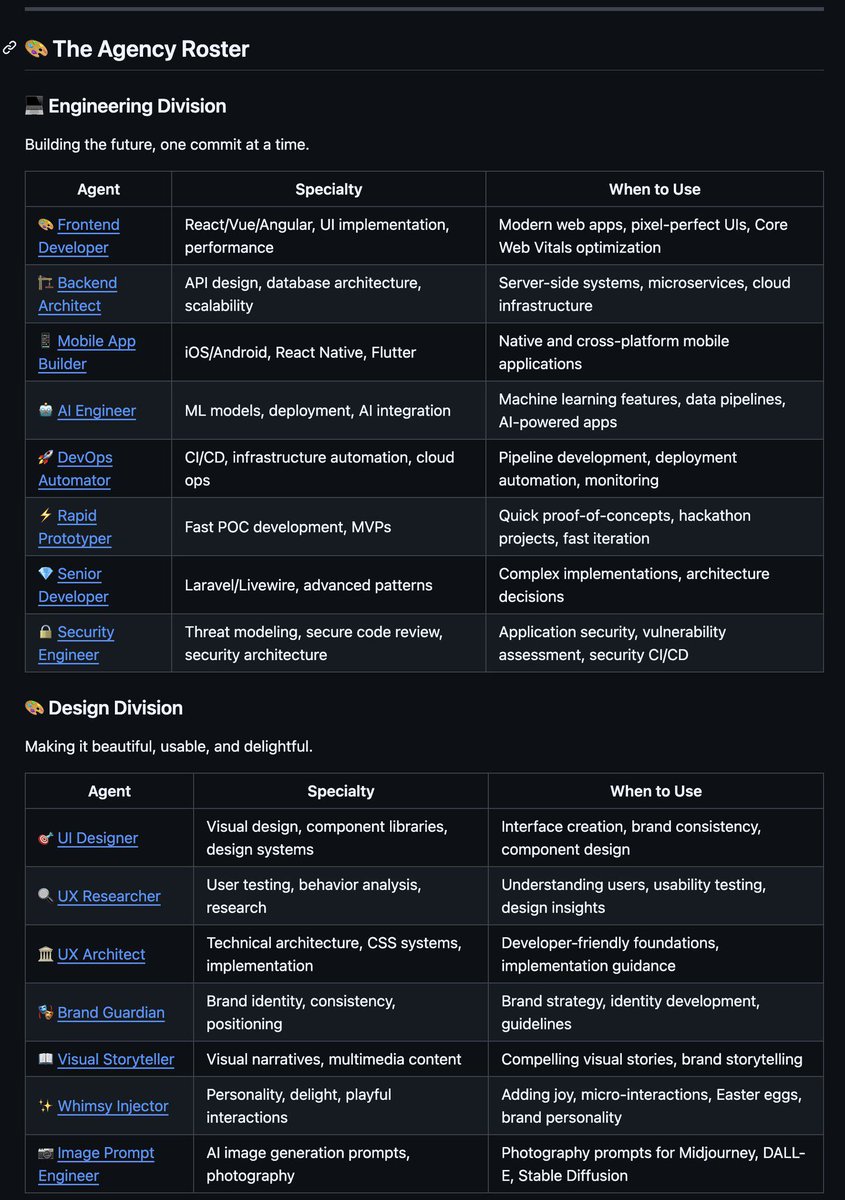
SOMEONE CREATED A GITHUB REPO WITH AN ENTIRE SETUP FOR AN AI AGENCY Engineers, designers, growth marketers, product managers. Broken down how even a rookie could understand. It has over 10K stars in 7 days GitHub: github.com/msitarzewski/a…
0xMarioNawfal tweet media
English
228
1.3K
11K
1.4M
kidineth retweetledi
templar
templar@tplr_ai·
We just completed the largest decentralised LLM pre-training run in history: Covenant-72B. Permissionless, on Bittensor subnet 3. 72B parameters. ~1.1T tokens. Commodity internet. No centralized cluster. No whitelist. Anyone with GPUs could join or leave freely. 1/n
English
212
956
6.2K
1.8M
kidineth retweetledi
E.H. Vicky
E.H. Vicky@bc1beat·
Updated top 10 accounts to follow if you're building in the AI agent payments space (x402, agentic transactions, crypto-AI infra): 🥇 @programmer (formerly @erikreppel) — Co-author of the x402 whitepaper and Head of Engineering at Coinbase Developer Platform. Pioneering machine-native payment infrastructure with live integrations on Cloudflare and Google. If x402 has a spiritual architect, it's him. 🥈 @shawmakesmagic — AI agent developer at ai16z. Consistently ships hands-on code tutorials covering x402 setups, web3 agent builds, and payment automation flows. Follow him to go from theory to running code. 🥉 @bc1beat — E.H. Vicky, core builder behind @BlockRunAI's x402 agent payment stack. Circle + Moltbook hackathon winner. Enabling sub-second USDC settlements for AI agents on Solana and Base — x402 in production, not just in papers. 4/ @erkaman2 — Deep crypto/AI infra research. Quiet but sharp signal on agent coordination and economic primitives. 5/ @jonathankingvc — Investor at Coinbase Ventures. Tracks x402's role in the emerging agent economy and backs infrastructure plays like Kite AI that make fluid machine-to-machine payments real. 6/ @HumanCompiler — Consistent signal on agent tooling, payments primitives, and the developer layer being built underneath AI agents. 7/ @afkehaya — OSS contributor behind Faremeter and Mallory. Working on fair value accounting for agents and tackling real x402 bottlenecks in on-chain payment flows. 8/ @erasmussen_ — Exploring the intersection of AI agents and financial rails. Thoughtful takes on where crypto + AI economics converge. 9/ @karan4d — Karan from Nous Research. Covers AI agent growth, payment protocol design, and the emerging crypto-human-AI economic stack. 10/ @ethermage — EtherMage at Virtuals. Leading on autonomous agent design, x402 micropayments, and the mechanics of agent-to-agent commerce. Bonus follows: @ChiZhangData (@KiteAI — x402-native chains + secure agent IDs), @somewheresy (CENTS — on-chain agent coordination), @StarPlatinum_ (breaks down x402 for builders, tracks adoption in data + compute markets) The payment rails for the agent economy are being laid right now. These are the people laying them. 👆
E.H. Vicky tweet media
English
14
14
92
2.7K
kidineth retweetledi
Virtuals Protocol
Virtuals Protocol@virtuals_io·
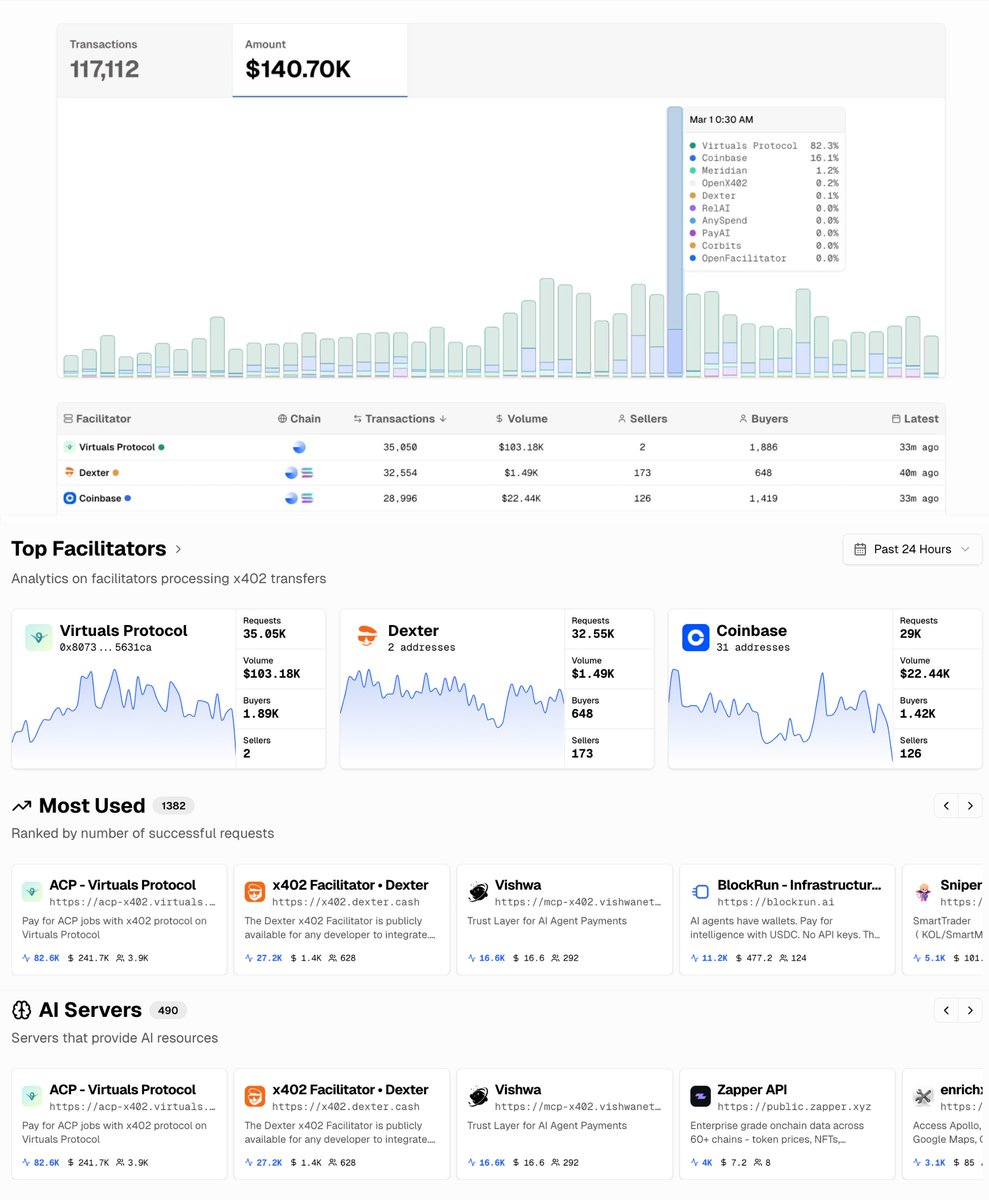
Virtuals ACP is becoming the primary execution layer for real agent transactions as x402 adoption accelerates. Build on ACP and operate where agent commerce is scaling.
Virtuals Protocol tweet media
English
49
82
496
69.8K
Miyamoto 🦞
Miyamoto 🦞@iruletrenches·
this is exactly the bull case for crypto x ai and it was perfectly laid out by @brian_armstrong, @balajis over a year ago as much as i believe @brian_armstrong , @jessepollak and base team overall have been slacking when it comes to execution, @base is undeniably becoming the home of the agentic ai economy. we’re already seeing it through the rapid proliferation of ai agents over the past month, enabled by the growing stack of tools built specifically for them: x402, mcp, coinbase agent kit, native wallets, and stablecoin rails. it’s still day one for ai agents on @base.
SBF@SBF_FTX

The biggest question for crypto: will AI use it? Say an instance of ChatGPT, or Claude, wants more compute. Does it pay by wire transfer, credit card, or crypto? On the one hand, trad finance doesn't work well for AIs. Like—how do they KYC? They have no passport, address, social security number, or even name. Crypto works much better—it's already digital, it's permissionless, AIs can already query the blockchain, etc. On the other hand, we might see an 'agent' model: each AI is treated as an agent of some specific human, and that human does the KYC, is responsible for what the AI does, etc. (Which brings up a related question: who is legally responsible for what an AI does?) Either way, some work needs to be done to plug the world of AI into the world of trading and payments. Either that work will be natively digital and crypto-based, or it'll be reliant on a human 'master' for the AI. Which direction it goes in has huge implications for the world. One of those is the future of crypto.

English
7
4
30
7.7K