
Dan Wilson retweetledi
Dan Wilson
7K posts

Dan Wilson
@killroyboy
Software and sports! #GoCougs
Utah Katılım Mayıs 2010
63 Takip Edilen318 Takipçiler
Dan Wilson retweetledi

The war in Iran has now cost us $29 billion, NOT including the cost to repair bases damaged by Iran, according to the Pentagon. That cost could cover:
- The entire border wall
or
- Free school lunches for every American child for about 3 years
or
- 2 years of ICE operations
or
- Fund the EPA for 25 years
or
- Entire VA mental health budget for 15 years
or
- Fully fund the coast guard for 4+ years
or
- Head Start for 10+ years
or
- Cancel all federal student loan interest for roughly two years
or
- Universal pre-K for 3-4 years
We've spent more on 10 weeks of war with Iran than we spend on the entire federal judiciary — every court, every judge, every clerk — over roughly 15 years.
English
Dan Wilson retweetledi

SO GOOD! From @stevemagness:
"Playgrounds & free play are risk calibration tools....When risk is removed from play, kids are more prone to anxiety disorders, because they never develop the ability to cope with fear-inducing situations."
Risk of comfort:
stevemagness.substack.com/p/the-hidden-c…
GIF
English
Dan Wilson retweetledi

@AlexSJacquez @Ike_Saul @AnnieLowrey It’s like expecting praise for giving someone crutches after breaking their leg.
English

@AlexSJacquez @Ike_Saul @AnnieLowrey The last sentence is rather ironic. “… cost the government hundreds of billions of dollars.” The entire government is funded by tax dollars. How about we don’t take those taxes in the first place?!?
English

Great piece by @AnnieLowrey on the tax wars. This part is important about how we got here too — Democrats have been highly effective in designing efficient, welfare enhancing tax programs that absolutely nobody knows or cares about.

The Atlantic@TheAtlantic
Members of both parties are egging on a nationwide tax revolt—and if the economy were to tank, the country could end up with a toxic combination of widespread joblessness and rampant inflation, @AnnieLowrey argues. theatln.tc/VsVxElnp 🎨: The Atlantic. Source: Getty.
English

@kiteandkeymedia How dare you tell me that my negative emotions aren’t based in reality?!? I enjoy being angry and I have to have a reason. It’s the world’s fault!
English
Dan Wilson retweetledi

How much data did we need before we understood the harmful societal effects of smoking and implemented restrictions?
Actually, it was a lot.
A lot of data was needed because the cigarette companies wanted to milk their golden goose as long as possible. The cost of paying class action lawsuits in the future was far less than the cash they could make in the moment.
This is the same incentive today with social media and their app makers.
Some parents try to organize their other classroom parents together in a coalition to limit the apps. This seems to work but it’s so few and far between.
A broad societal moratorium on social media for people under 16yo diminishes NOTHING and probably helps millions and millions of kids and then these kids as they enter adulthood.
It would also help parents. I, personally, have strict social media rules for myself and my kids. And I will keep pushing back on my kids when they ask for instagram because that’s my job as their dad.
But having a broad moratorium would make the lives of all parents far simpler and, in hindsight, will be proven as the right public health policy thing to have done.
Jonathan Haidt@JonHaidt
The preponderance of the evidence gets ever more preponderant: here's a meta-analysis of longitudinal studies, in JAMA. Important finding for setting 16 as the age minimum:
English
Dan Wilson retweetledi

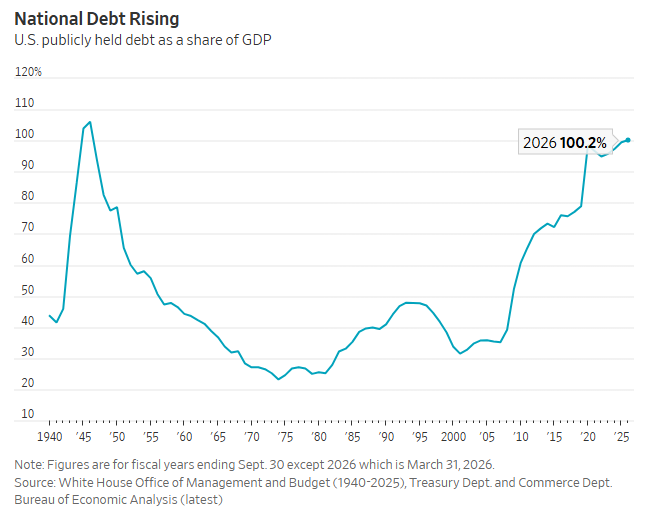
The national debt just exceeded 100% of GDP for the first time since 1946: wsj.com/economy/u-s-de…

English
Dan Wilson retweetledi

“We've stopped making babies. We've decided that being distracted by a dopamine hit around Candy Crush might be a good way to spend your time. Not if you're a full human," former Sen. Ben Sasse says in an extended interview. cbsn.ws/4cA1Jrp
English
Dan Wilson retweetledi

In Mere Christianity, CS Lewis has an awesome opening riff about how most people know the difference between right and wrong, but they justify acting immorally by appealing to "special exception." They know they shouldn't hit a friend, but what if that friend was being so mean? They know they shouldn't steal a seat a bus, but what if that person got up and created a moment's confusion and then the seat was up for grabs? Etc.
When I read this section, I thought a lot about contemporary politics and the way that people justify their politics, not by appealing to higher principles, but rather by appealing to "special exception" to argue that their admitted indecency is justifiable in context.
A lot of MAGA vice is justified by special exception. Trump's defenders rarely defend his crookedness directly. They don't say "it's wonderful to use trade policy to enrich the Oval Office, it's really awesome." They say: Well, look, it doesn't really matter, because the left is so dangerous, Biden maybe did something similar 3 years ago, Democrats would do the same in power, and so forth.
I heard something similar in that NYT conversation everybody's talking about. You even see it in the headline: ‘The Rich Don’t Play by the Rules. So Why Should I?’ Why, hello, special exception. When you start arguing that stealing food and French paintings is justifiable in the context of political protest in an age of prevailing distrust, you're similarly not arguing *for* any kind of a universal principle. Nobody actually wants 300 million people stealing fruit from the grocery store. Nobody actually wants every Louvre visitor trying to rip a Manet off the walls. These virtues don't scale. (Because they're not virtuous!)
Sap that I am, I want us to get to a place where politics is about fighting for what is right and decent, not about justifying what sort of indecent behavior might be somewhat understandable or technically justifiable given the other side's vice or the prevailing levels of indecency. The point is to build the kind of goodness that scales.
nytimes.com/2026/04/22/opi…
English
Dan Wilson retweetledi

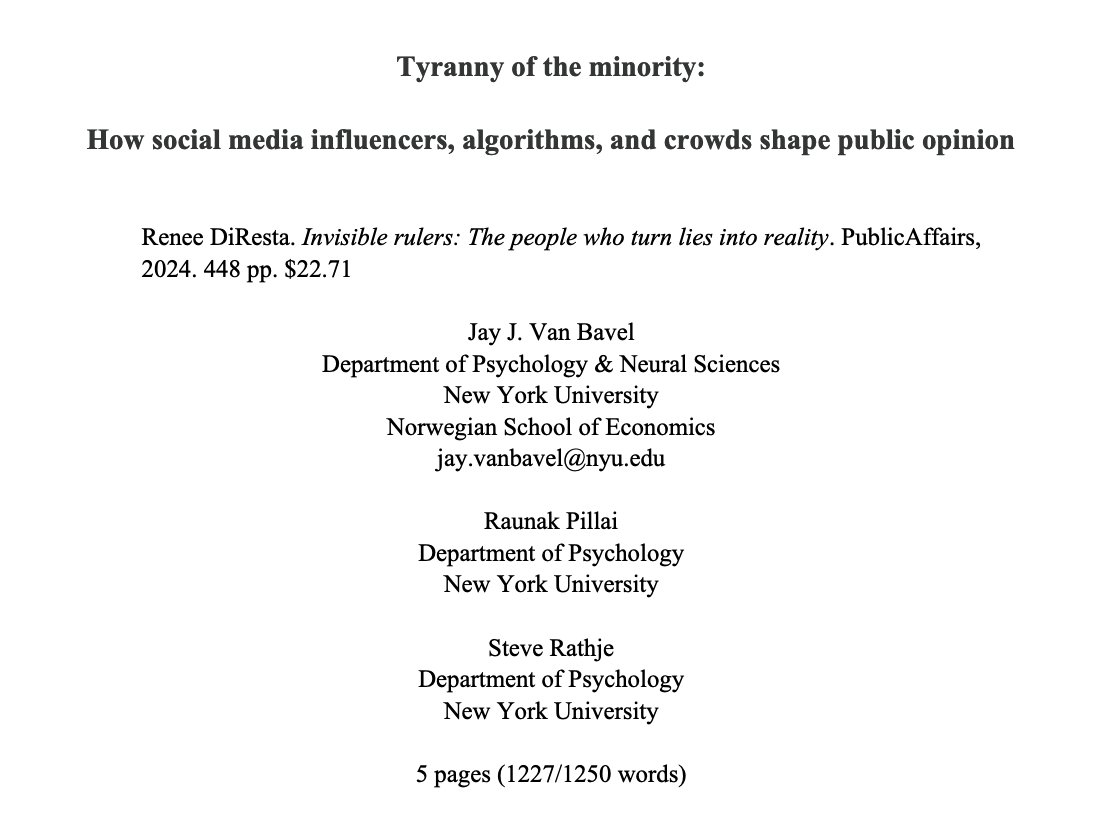
A small fraction of online actors now exerts outsized influence over what the public sees, believes, and argues about.
In a new short review paper, we trace how social media influencers can turn fringe claims into viral narratives—often by exploiting a feedback loop between influencers, algorithms, and crowds.
As such, the modern information environment enables a tyranny of the minority: extreme and coordinated voices dominate attention, distort perceived social norms, and create a “funhouse mirror” version of public opinion that makes fringe positions look common and conflict look inevitable.
We synthesize emerging evidence that a tiny number of highly active users drives a disproportionate share of misinformation and toxicity, and explain how platform incentives reward moralized, identity-salient, and emotionally charged content.
We conclude by outlining pragmatic responses—individual, institutional, and policy-level—and by highlighting how generative AI could either accelerate bespoke realities or help rebuild shared understanding, depending on how these systems are designed and governed. osf.io/preprints/psya…
We (@PillaiRaunak & @steverathje2) reviewed @noUpside's fantastic book "INVISIBLE RULERS" and connected it to the research we have been doing on this topic for the past decade.

English
Dan Wilson retweetledi

When simulation becomes the norm, it weakens the human capacity for discernment. As a result, our social bonds close in upon themselves, forming self-referential circuits that no longer expose us to reality. We thus come to live within bubbles, impermeable to one another. Feeling threatened by anyone who is different, we grow unaccustomed to encounter and dialogue. In this way, polarization, conflict, fear and violence spread. What is at stake is not merely the risk of error, but a transformation in our very relationship with truth.
English