

Krati Jain
1.5K posts
Krati Jain
@kratijain
Explorer, Observer, Tinkerer
Banglore Katılım Şubat 2010
430 Takip Edilen1K Takipçiler
Krati Jain retweetledi

In the 1920s, a Stanford psychologist tracked genius children for 50 years.
Malcolm Gladwell breaks down what he discovered:
Rich families → successful. Poor families → failures.
Not average. Failures. Genius-level IQs that produced nothing.
He spent 60 minutes at Microsoft explaining why we're wrong about success:
The psychologist was named Terman. He gave IQ tests to 250,000 California schoolchildren.
He identified the top 0.1%. Kids with IQs of 140 and above.
His hypothesis: these children would become the leaders of academia, industry, and politics.
He tracked them. And tracked them. For decades.
The results split into three groups.
The top 15% achieved real prominence. The middle group had average, moderately successful professional lives.
And the bottom group? By any measure, failures.
The difference wasn't personality. Wasn't habits. Wasn't work ethic.
It was simple: the successful geniuses came from wealthy households. The failures came from poor families.
Poverty is such a powerful constraint that it can reduce a one-in-a-billion brain to a lifetime of worse than mediocrity.
There's a concept called "capitalization rate."
It asks a simple question: what percentage of people who are capable of doing something actually end up doing that thing?
In inner city Memphis, only 1 in 6 kids with athletic scholarships actually go to college.
If our capitalization rate for sports in the inner city is 16%, imagine how low it must be for everything else.
Here's something stranger.
Gladwell read the birth dates of the 2007 Czech Junior Hockey Team:
January 3rd. January 3rd. January 12th. February 8th. February 10th. February 17th. February 20th. February 24th. March 5th. March 10th. March 26th...
11 of the 20 players were born in January, February, or March.
This isn't unique to the Czechs. Every elite hockey team in the world shows the same pattern. Every elite soccer team too.
Why?
The eligibility cutoff for youth leagues is January 1st.
When you're 10 years old, a kid born in January has 10 months of maturity on a kid born in October. That's 3 or 4 inches of height. The difference between clumsy and coordinated.
So we look at a group of 10 year olds, pick the "best" ones, give them special coaching, extra practice, more games.
We think we're identifying talent. We're just identifying the oldest.
Then we give the oldest more opportunities, and 10 years later they really are the best.
Self-fulfilling prophecy.
The capitalization rate for hockey talent born in the second half of the year? Close to zero.
We're leaving half of all potential hockey players on the table because of an arbitrary date on a calendar.
Kids born in the youngest cohort of their school class are 11% less likely to go to college.
11% of human potential squandered because we organize elementary school without reference to biological maturity.
Now here's the part about math.
Asian kids dramatically outperform Western kids in mathematics. The gap is enormous and consistent across decades of testing.
Some people say it's genetic. It's not.
It's attitudinal.
When Asian kids face a math problem, they believe effort will solve it.
When Western kids face a math problem, they believe the answer depends on innate ability they either have or don't.
Here's the proof.
The international math tests include a 120-question survey. It asks about study habits, parental support, attitudes.
It's so long most kids don't finish it.
A researcher named Erling Boe decided to rank countries by what percentage of survey questions their kids completed.
Then he compared it to the ranking of countries by math performance.
The correlation was 0.98.
In the history of social science, there has never been a correlation that high.
If you want to know how good a country is at math, you don't need to ask any math questions. Just make kids sit down and focus on a task for an extended period of time.
If they can do it, they're good at math.
Why do Asian cultures have this attitude?
Gladwell's theory: rice farming.
His European ancestors in medieval England worked about 1,000 hours a year. Dawn to noon, five days a week. Winters off. Lots of holidays.
A peasant in South China or Japan in the same period worked 3,000 hours a year.
Rice farming isn't just harder than wheat farming. It's a completely different relationship with work.
There's a Chinese proverb: "A man who works dawn to dusk 360 days a year will not go hungry."
His English ancestors would have said: "A man who works 175 days a year, dawn to 11, may or may not be hungry."
If your culture does that for a thousand years, it becomes part of your makeup.
When your kids sit down to face a calculus problem, that legacy of persistence translates perfectly.
Now consider distance running.
In Kenya, there are roughly a million schoolboys between 10 and 17 running 10 to 12 miles a day.
In the United States, that number is probably 5,000.
Our capitalization rate for distance running is less than 1%.
Kenya's is probably 95%.
The difference isn't genetic. The difference is what the culture values and where it spends its attention.
Here's the most fascinating finding.
30% of American entrepreneurs have been diagnosed with a profound learning disability.
Richard Branson is dyslexic. Charles Schwab is dyslexic. John Chambers can barely read his own email.
This isn't coincidence. Their entrepreneurialism is a direct function of their disability.
How do you succeed if you can't read or write from early childhood?
You learn to delegate. You become a great oral communicator. You become a problem solver because your entire life is one big problem. You learn to lead.
80% of dyslexic entrepreneurs were captain of a high school sports team. Versus 30% of non-dyslexic entrepreneurs.
By the time they enter the real world, they've spent their whole life practicing the four skills at the core of entrepreneurial success: delegation, oral communication, problem solving, and leadership.
Ask them what role dyslexia played in their success and they don't say it was an obstacle.
They say it's the reason they succeeded.
A disadvantage that became an advantage.
Here's what Gladwell wants you to understand:
When we see differences in success, our default explanation is differences in ability.
We forget how much poverty, stupidity, and attitude constrain what people can become.
We refuse to admit that our own arbitrary rules are leaving talent on the table.
We cling to naive beliefs that our meritocracies are fair.
The capitalization argument is liberating.
It says you don't look at a struggling group and conclude they're incapable. It says problems that look genetic or innate are often just failures of exploitation.
It says we can make a profound difference in how well people turn out.
If we choose to pay attention.
This 60 minute Microsoft talk will teach you more about success than every self-help book you've ever read combined.
Bookmark this & give it an hour today, no matter what.
English
Krati Jain retweetledi

Everything worth doing has a learning curve.
When it gets hard, remember the goal: reaching the cycle of accelerated returns.
English
Krati Jain retweetledi

Something I taught 14 yo: Most progress is a mix of steps forward and steps back, just with with more of the former. But you can get a run of steps back. So to judge progress accurately you need to use a big enough window, or it could look like you're failing.
English
Krati Jain retweetledi

"Someone can do it better"
"I'm too old for this"
"I'm too young for this"
As I told @shefiorg cohort this season: learn by doing! The time is NOW. Own it.
Stop holding back - whether it’s your age, gender, fear, anything: Cut the noise.
Keep learning. Start building today.
GIF
English
Krati Jain retweetledi
🎉 Telegram has fully repaid the bonds we issued 5 years ago.
💰 Since 2021, we’ve built an innovative monetization strategy and reached profitability in 2024. As a result, our new bond issuance last year was oversubscribed. 💪
🙏 Thank you for your support!
English
Krati Jain retweetledi

This.
Ray Dalio@RayDalio
There is nothing more important than understanding how reality works and how to deal with it. The state of mind you bring to this process makes all the difference. I have found it helpful to think of my life as if it were a game in which each problem I face is a puzzle I need to solve. By solving the puzzle, I get a gem in the form of a principle that helps me avoid the same sort of problem in the future. Collecting these gems continually improves my decision making, so I am able to ascend to higher and higher levels of play in which the game gets harder and the stakes become ever greater. #principleoftheday
English
Krati Jain retweetledi

We should build more crypto tools for refugees and stateless people.
Because there may unfortunately be many more refugees and stateless people…and from all social classes.
Ukrainians leaving the war.
Californians leaving the state.
Gulf workers leaving the missiles.
Doesn’t necessarily mean huge design changes. If you build convenient consumer tools for millions that work in peacetime, then they’ll often be robust enough to work in wartime.
Because crypto is wartime mode, but for the Internet. Public blockchains were created to resist datacenter attacks, hacks, and network blocks.
It’s simply enlightened self-interest to build scalable, reliable tools. For example: Signal works for poor people in poor countries in poor conditions, so it’ll likely work for you.
Stablecoins are actually getting to this level of ubiquity in crypto, and already making a real dent globally, including the new gold-backed varieties.
But we can do more.
andi (twocents.com)@Nexuist
It’s very unfortunate that crypto is a great solution for refugees who are stateless and forced to interact with crumbling institutions and payment rails, but nobody in crypto builds for refugees because they’re not useful consumers for gambling
English
Krati Jain retweetledi

31 Tiny Lessons from studying JW Marriott for a few weeks.
1. “Manage your time. Short conversations to the point. Make every minute count.”
2. How you define yourself becomes your prison.
3. “Perfection was one notch below the desired result.”
4. “Do it and do it now. Err on the side of taking action.”
5. “Guard your habits. Bad ones will destroy you.”
6. “Make crystal clear what decisions each manager is responsible for. Have all the facts, then decide and stick to it.”
7. You can’t expect what you don’t inspect.
8. Take care of your people before your customers. People who feel disposable deliver a disposable experience.
9. Never give your customers a reason to go to the competition.
10. If a job is too big for one person, don’t work harder. Find the right incentive and let others carry it.
11. Every major decision should start with your eyes, not your wallet.
12. Trust people with something that matters before the world says they’re ready.
13. Most companies lose their culture when the founder leaves because the founder was the culture and never put it on paper.
14. “A leader should have character, be an example in all things.”
15. Predictability builds a brand.
16. Don’t accept seasonal thinking. When the crowd disappears, ask what people need now.
17. You don’t lose control because you expand. You lose control because of bad debt and bad people.
18. “See the good in people and then try to develop those qualities.”
19. “As long as we are taking in more than we spent, I knew we were doing all right.”
20. Survive first, grow second. You can’t compound what doesn’t exist.
21. “Ideas keep the business alive. Know what your competitors are doing. Spend time and money on research and development.”
22. The person who wrote the rule might say yes if you actually show up and ask.
23. “Discipline is the greatest thing in the world. Where there is no discipline, there is no character.”
24. Reward the behavior you want to see spread.
25. Obsess over costs that don’t touch the customer.
26. Three ideas built the company: friendly service, fair prices, and hard work.
27. “People are number one. Their development, loyalty, interest, team, spirit. Develop managers in every area. This is your prime responsibility.”
28. “My dad always told me to take time to smell the flowers, but I just don’t have the time.”
29. “I’ve felt that dissatisfaction is the basis of progress. When we become satisfied in business, we become obsolete.”
Listen and Learn!
Shane Parrish@shaneparrish
Bill Marriott built the world's largest hotel company. But he didn’t open his first hotel until he was 55. In fact, the man who would go on to build the world’s largest hotel chain started with a nine-seat root beer stand in Washington, DC, and a simple goal: serve people well and build something that lasts. This short episode explores how Marriott turned that single stand into the airline catering industry and then a huge hotel empire. I explore the timeless principles that guided his success, including his obsession with downside risk, his practice of isolating variables, and his expansion during the Great Depression while his competitors folded. Learn more about his story: fs.blog/knowledge-proj…
English
(4/4) 7. You are missing out if you are not using AI to improve in multiple domains parallely.
8.For every AI Agent there is a human responsible for verifying its execution.
English
(3/4) 4.Reality always wins so stay close to customer.
5.Everything looks nice outside but there is chaos inside if you were to zoom in. Manage chaos instead of giving up.
6.Emotional regulation and aligning actions with your Purpose will preserve your joy in the uncertain world
English
(1/4) I recently had the opportunity to witness @joulee at @spc_india . How should I describe the energy of the room? Respect, joy and admiration were the key vibes that filled in the room. Julie is very humble, knowledgeable and cheerful. Thanks SPC India for organizing :)

English
@spc_india @AnthropicAI 3. Teams that go long are humble and mission aligned.
4. In a post-AI-stable world, humans will optimize for health and time.
5. Accessibility for everyone and staying curious will pay out.
English
@spc_india @AnthropicAI Key pointers :
1. Build the culture and team to be so efficient that they always find a way which is fast and doesnt compromise on safety.
2. In all the experiements, evaluate if you were lucky/unlucky or good/bad at the outcomes you got.
English
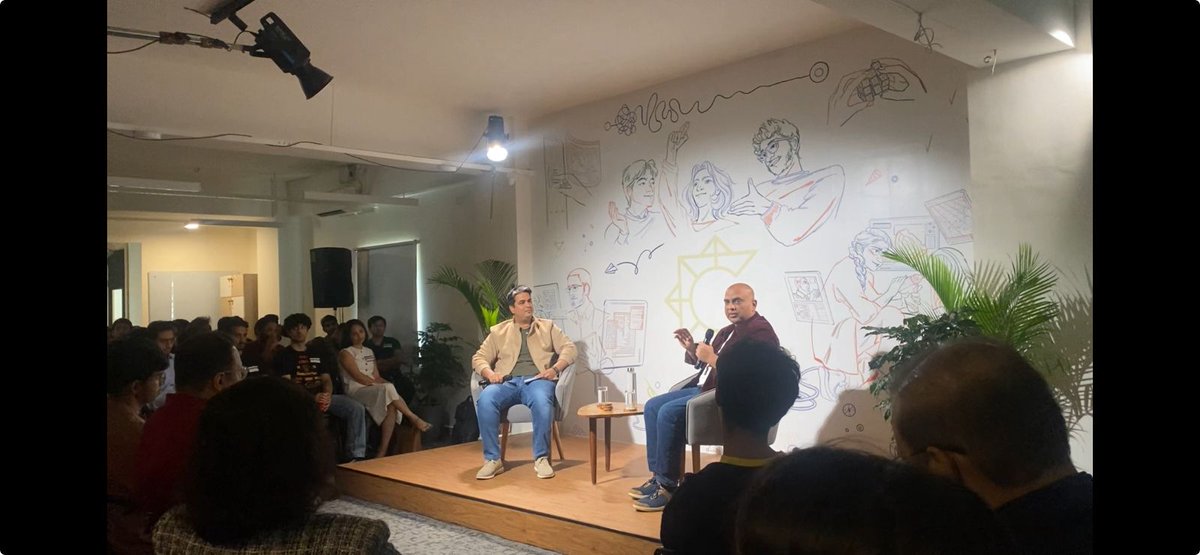
Witnessed unbelievable energy and curiosity at @spc_india today with @AnthropicAI CTO Rahul Patil!!
English
Krati Jain retweetledi