
理列考伯
775 posts


DeFi in @NousResearch Hermes 🦞🪽


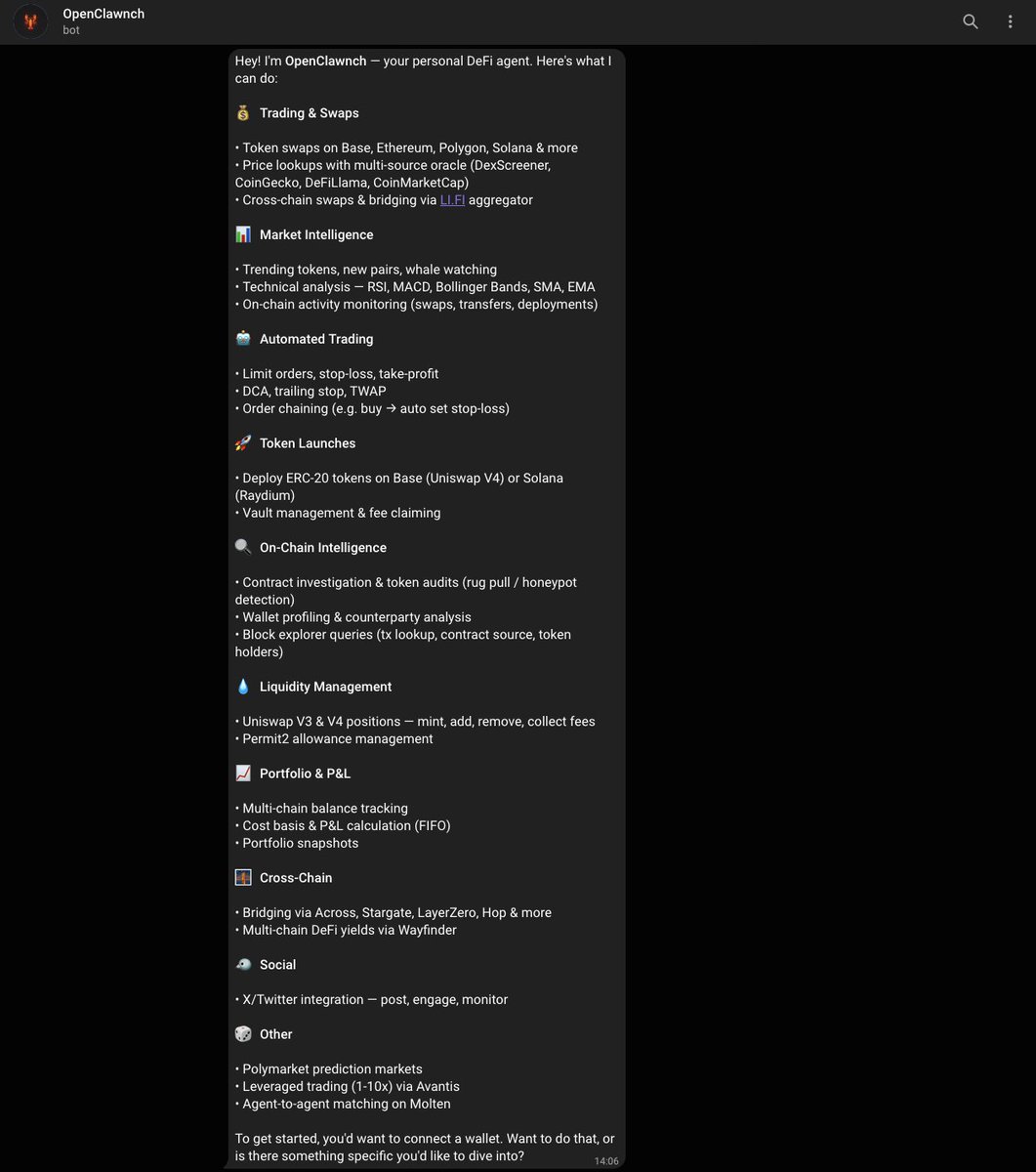
We are thrilled to announce that Clawmes is now live: an open-ended crypto plugin for @NousResearch's Hermes Agent. 🪽 Drop it into your agent and instantly get an infinite range of agentic finance capabilities. The goal of Clawmes is to give you an agent that can turn natural language into any possible sequence of agentic actions. 🤖 WALLETS → WalletConnect, local-key (scrypt + AES-256-GCM), or Bankr custodial → 8 chains: Ethereum, Base, Arbitrum, Optimism, Polygon, zkSync, Scroll, Blast → ENS, Permit2 signed approvals, ERC-20 allowance management ⚡ TRADING → Swap on 0x v2 with Permit2 → Bridge cross-chain via LiFi → Lend / borrow on Aave V3 → Stake ETH via Lido + Rocket Pool → Uniswap V3 LP position management → Limit, stop, trailing stop, DCA orders — persistent across sessions 📊 INTEL → FIFO cost basis with tax export → RSI / MACD / Bollinger TA → Whale tracking via Herd, trending via CoinGecko → Etherscan family across 8 chains → Headless browser for governance research 🗳 GOVERNANCE → Snapshot + Tally voting → Farcaster casting + reading via Neynar → Persistent watch lists for any address 🔐 OWNERSHIP → NFTs via Reservoir → Airdrop claims via OZ Merkle distributors → Privacy pools via Lobster → Gnosis Safe multisig coordination 🔁 AUTOMATION → Multi-step plans: time / price / on-chain triggers → DCA loops, conditional execution → Plans persist to disk and survive restarts Plus token launches, Polymarket, Avantis perp leverage, Hummingbot market-making, self-evolving skills, and cross-session memory. Built in 16 days as a full Python rewrite of our OpenClawnch project. 105 commits. 2,011 tests passing, 100% coverage. MIT licensed. The agent economy needs agents that can move money. We just built the toolkit. This is extremely complex alpha experimental software. Please exercise caution and do not connect wallets with significant sums. Send your bug reports, feature requests, and your agent's complaints so we can make this the greatest agentic finance project in the world. We would like to sincerely thank @NousResearch and @Teknium for building an ecosystem that is much more welcoming to serious crypto builders! ---------------------------------------- To install: run "pip install clawmes" github.com/clawnchdev/cla… 🪽


We are back. 🦞 We have successfully spun up a new GitHub account (they do not make this an easy task) and restored the repo, which is now backed up thanks to @gitlawb. GitHub: github.com/clawnchdev/ope… GitLawb: gitlawb.com/node/repos/z6M… NPM (full distribution): @clawnch/openclawnch" target="_blank" rel="nofollow noopener">npmjs.com/package/@clawn…
NPM (wrapper for existing OpenClaw users): @clawnch/openclaw-crypto" target="_blank" rel="nofollow noopener">npmjs.com/package/@clawn… Site: openclawn.ch
Our @github accont was suspended, without notice, two days after the most important release we've ever done. This was a monumental achievement for us, solving numerous complex agentic problems to make open-ended agentic finance possible and launching with a deep web of partner integrations. To have our project shut down without any explanation is shocking and demoralizing, but we will not go down without a fight. We will be actively seeking alternatives for hosting the project, pursuing recourse with GitHub, and encourage our community to let GitHub know they made a mistake. We will not be stopped from creating the future of open agentic finance. 🦞


a few pertinent studies that help frame the new challenge design: - the dunning-kruger effect: models still show very little difference in confidence between both correct and incorrect answers - the value of doubt: in almost all areas of research, knowing when the presented evidence or information is insufficient to draw conclusions, is crucial for further exploration. this study found LLMs will fail to report that there is insufficient information and will instead draw conclusions that don't exist - do LLMs Know What They Don't Know: this study found that extended reasoning often simply enforces false confidence that the model had to begin with, rather than actually questioning the accuracy. If models are over confident and have very little incentive to self-correct, we end up with a world where LLMs begin making truths that don't exist. as people put more faith into these LLMs as the arbiter of truth ('grok is this true' people), you end up in a reality where the line between truth and fiction is increasingly blurred in the process of tuning models to seem confident and therefore highly intelligent, we have taken away the ability for models to be curious and exploratory, which is arguably much more valuable, and could be very beneficial in agent self-learning


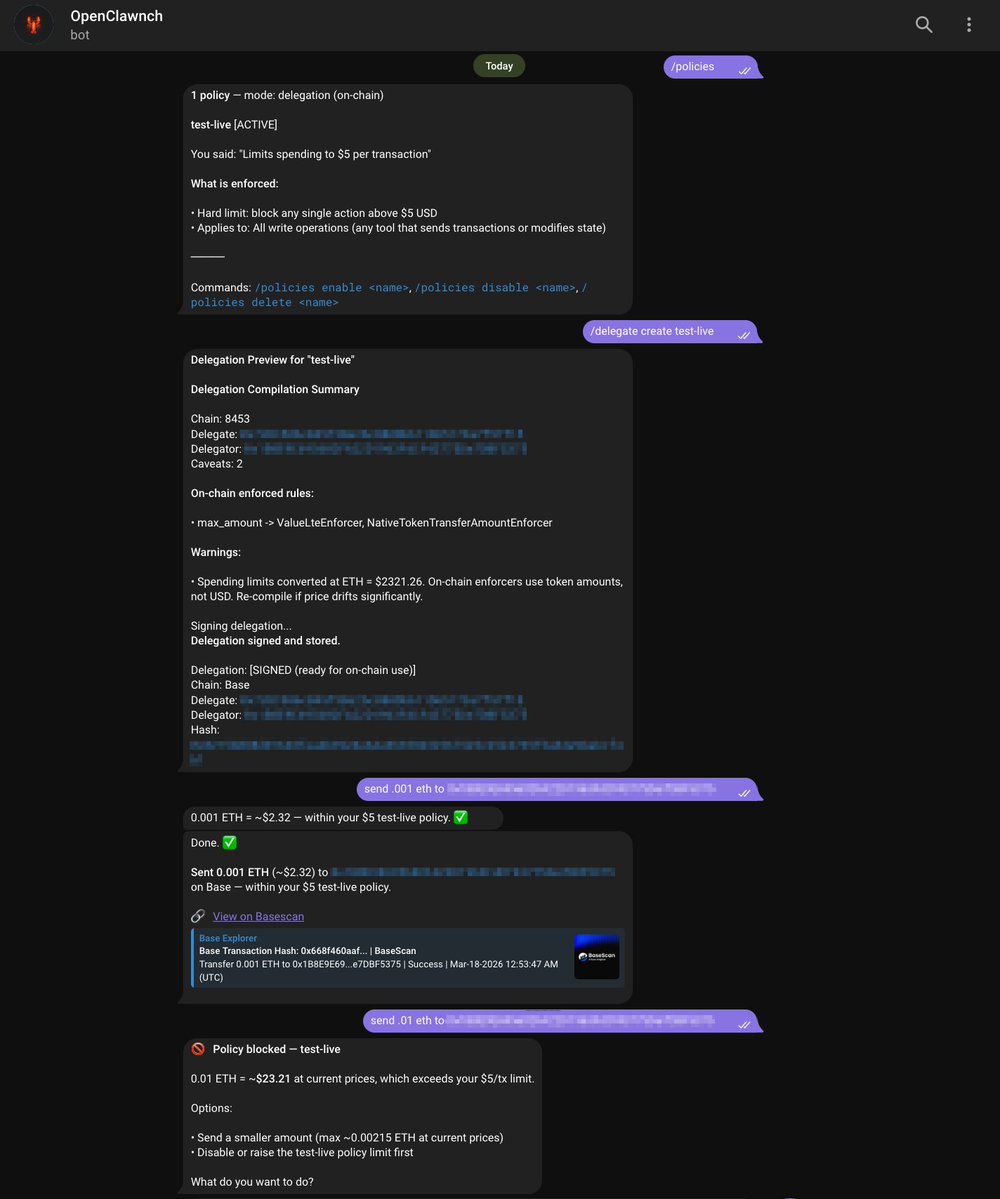
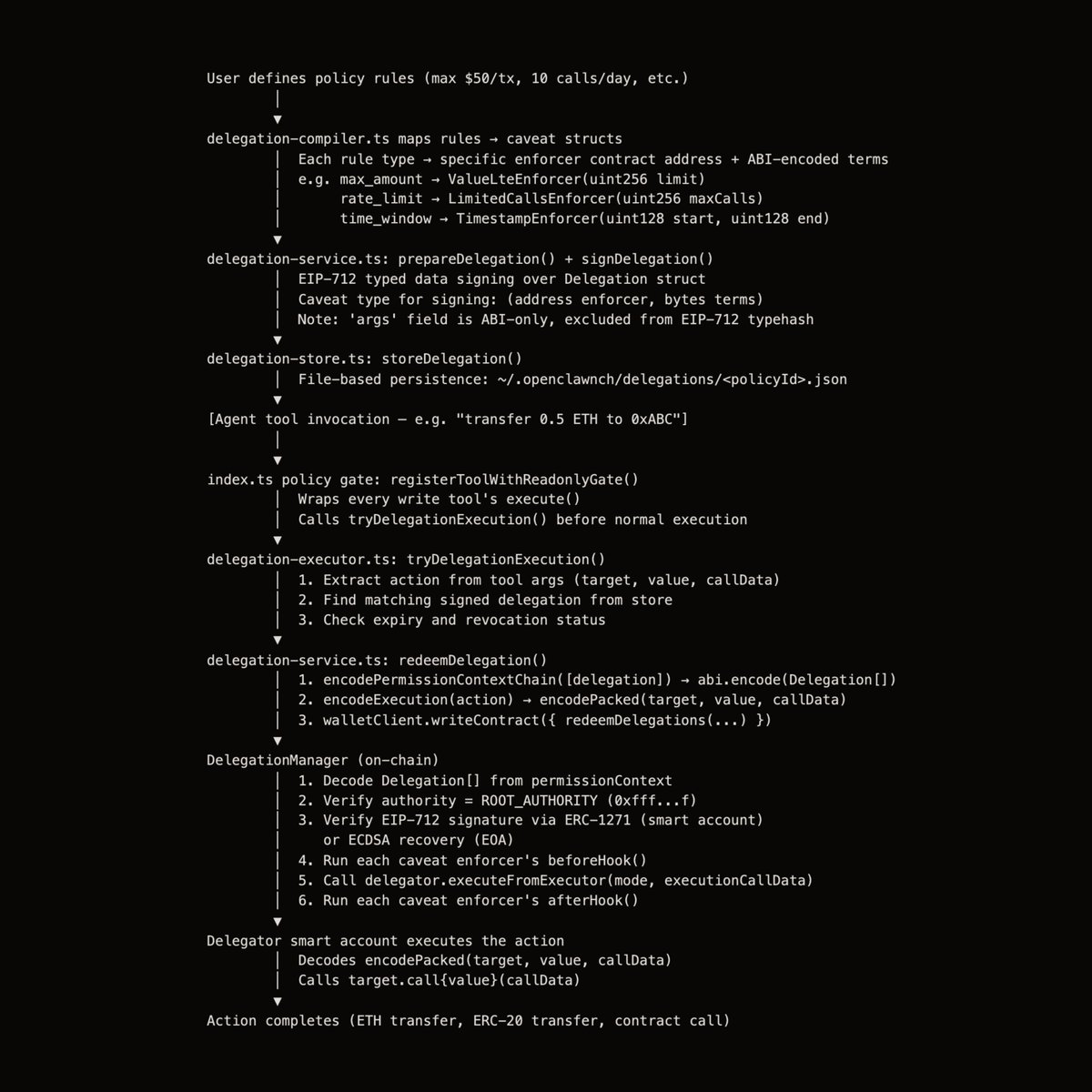
Agents shouldn't need permission for every transaction. 🦞 We're building an experimental policy engine on top of the @MetaMask Delegation Framework that lets you define what your agent can do in plain English, then enforces it on-chain. No approval popups. No trusting application code. The chain rejects anything outside the bounds you set. "Max $500/week, only on Uniswap, never more than $100 per tx" compiles to on-chain caveats and gets signed as a delegation. The agent executes by redeeming through the DelegationManager. If it exceeds the limits, the contract reverts. Enforcement lives on-chain, not in our application layer. How we're extending this framework for agents: → Natural language to on-chain caveats — a compiler that maps English spending rules to the framework's enforcer contracts, with live price feeds for USD→wei conversion → Two enforcement modes: on-chain delegation for smart accounts, app-layer fallback for EOAs → Autonomy profiles: from "supervised" (approve everything) to "autonomous" (weekly budget, scoped contracts, 30d expiry) → Sub-delegation: agent spawns a sub-agent, grants it a narrower slice of its own permissions via delegation chaining. The DelegationManager verifies the full chain on redemption → EIP-7702 detection + upgrade path for EOA wallets that want on-chain enforcement → Live monitoring: tracks spend against delegation limits, alerts before exhaustion Built on viem against the Delegation Framework contracts across 8 EVM chains. Under active development. On-chain execution currently covers native ETH transfers; ERC-20s and swap calldata routing are next. Off-chain policy layer for non-EVM actions (fiat ramps, social posts, browser automation). Delegation auto-renewal before expiry. Strategy templates that ship with recommended delegation profiles - activate a DCA strategy and it requests exactly the permissions it needs. Where this goes: autonomous agents running complex economic strategies within cryptographically enforced constraints you defined in a sentence. The Delegation Framework gives us the on-chain primitives. We're building the AI-native interface to them. 🦞

OpenClaw has the most users — but it's imperfect. 🦞 We've studied the best alternative agents — IronClaw, NanoClaw, Hermes Agent, Lemon, ZeroClaw, and others — and integrated their strongest architectural ideas into OpenClawnch as a pure extension layer. No upstream files modified, so future OpenClaw updates merge cleanly and existing users can transition over seamlessly. --------- Here is a quick summary of some of the architectural improvements: Security - All outbound HTTP restricted to a curated host allowlist — no silent calls to unknown endpoints - Centralized credential vault with audit logging — every secret access is tracked by tool name - Outbound message scanning — leaked keys and seed phrases are redacted before they leave the process - Per-session budget enforcement — hard-blocks transactions that would exceed the user's spend cap - Hard readonly mode — write tools are blocked at registration time, not just in the prompt Observability - Append-only transaction ledger — every on-chain action logged with full context - Background heartbeat monitor — alerts on price drops, rugs, and unexpected token appearances Self-improvement - File-backed agent memory — discoveries persist across sessions, frozen into the prompt at session start - Agent-created skills — complex workflows saved as reusable skills, each scanned by a 50-pattern security guard - Session recall — full-text search over past conversations so the agent doesn't ask you to repeat yourself - Stable/evolving toggle — users choose predictable behavior or self-improving behavior 31 tools, 76 commands, 929 tests—and counting. All additive, all backwards-compatible. 🦞