
kuty

1.4K posts

kuty banner
kuty

kuty

@kuty

CEO @lumnalta, non-profit founder @alpehbeta, entrepreneurs are creating the future. Love self-help, fantasy, philosophy and nature

New York, NY Katılım Temmuz 2007
141 Takip Edilen1.4K Takipçiler
kuty retweetledi
Shane Parrish
Shane Parrish@shaneparrish·
All week people have emailed me telling me that Alpha School selects for the top 1%. While I can't speak to Alpha School's application process, I can say my kids test similarly to theirs on standardized tests like the PSAT when it comes to math ... and it's 100% because they use/d AI tutors and the tech stack we talk about in this episode (Prodigy/Synthesis Tutor/Math Academy/Physics Graph). I realize it's uncomfortable to ask why AI improves results over teachers. And it's worth exploring. Some of my thoughts ... The "problem" with grades 4-12 of Math, is that most teachers "teach the grade" and math is cumulative. So, if you didn't learn something from grade 6, you're in a lot of trouble by the time you get to grade 8. With very few exceptions, your grade 8 teacher is not going to teach you (or the entire class) grade 6 math and as a student in grade 8, you'll resist it if you know it's grade 6. One of the primary reasons that AI is better is that it simply teaches you what you need to know, regardless of your grade level. It says you don't know X, and you need to know X to do this problem, so let's learn X. And it never tells you that it's grade 6 and you should have learned this years ago, so you just learn X. Another problem is the way maths are taught now. In a lot of schools, including my kids, they never had to "memorize" multiplication tables. And if you don't know them, it's ok. That sounds all fine and dandy, until you realize it takes up a lot of working memory in grades 8-12 -- working memory you need for other things on the problem. We only have so many working memory slots. It sucks but most "improvements" to education over the past 20 years, have had negative impacts on objective learning. The biggest thing we can do in this moment is raise the bar on what we expect from kids, focus on what works based on evidence, and make AI tutors free to the bottom 75% of each math class today. If you're a parent, this is a must listen. (Even if you disagree with the conclusions).
Shane Parrish@shaneparrish

My conversation with @jliemandt on why the future of education is better than you think. 0:00 The current education system 7:01 What makes Alpha School different 11:01 What are the results 23:20 Current classroom struggles 26:40 What does mastery mean? 35:37 Changing the education system 39:19 Teaching through AI 44:27 How do you solve motivation? 57:01 What makes a good teacher? 1:01:04 Coaching 1:05:17 What life skills matter? 1:08:18 Doing hard things 1:13:25 AI Monitoring 1:21:08 Effort vs. IQ 1:24:40 What happens after Alpha School? 1:38:21 The Genius of Jack Welch 1:45:49 Trilogy IPO: the choice to not go public 1:51:40 Physical vs. virtual learning 2:03:18 Does Paying Kids To Learn work? 2:11:01 What Is Success For You? (Includes paid partnerships)


English
24
59
578
131.5K
kuty retweetledi
John LeFevre
John LeFevre@JohnLeFevre·
Advice for my 16-year-old self (in today's world): 1. Your first job (16) should be as a waiter Developing soft skills, dealing with difficult customers, and working with immigrants, convicts, dropouts, addicts, single moms, and people who don't even have passports will teach you more than you could ever learn at an Ivy League school. Your second job (18) should be as a bartender. Successfully navigating the drunk and entitled will teach you lifelong skills, and your results are measured nightly in the form of tips. And it’s more fun.
English
62
132
1.5K
292.7K
kuty retweetledi
Alex Vacca
Alex Vacca@itsalexvacca·
Before AWS existed, one company ran the servers for Twitter, LinkedIn, and Facebook's entire app ecosystem. They owned Node.js, invented containers 8 years before Docker, and Peter Thiel even backed them. Then something happened...
English
243
2.3K
20.1K
3.3M
kuty
kuty@kuty·
Loved this. Thanks @shaanpuri69 Missions are the best I hope to never run dry Same lesson my grandmother taught me Never have idle hands So many doilies...
kuty tweet media
English
1
0
1
642
kuty retweetledi
John Ocasio-Rodham Nolte
John Ocasio-Rodham Nolte@NolteNC·
Last week, we had to move my mom out of assisted living and into specialized care… In the middle of this exhausting move, the following happened. This is an actual conversation I had with my mother’s new nursing home… NURSING HOME LADY: You can’t remove our furniture. It has to stay in your mom’s room. ***She didn’t even introduce herself, and behind her was another sour-faced lady. ME: What? NHL: Our furniture has to stay in the room. It’s fire-rated. It meets the fire code. Removing it violates the fire code. ME: So I have to throw all my mom’s furniture out? NHL: No, her furniture can stay, but you must keep ours in the room because of fire regulations. ME: That doesn’t make any sense. How does fire-rated furniture make the room any safer inside the room as opposed to not in the room at all? NHL: What do you mean? ME: Unless your furniture has sprinklers built into it, how does removing it make my mom’s room less safe? NHL: Let’s talk to the administrator. ***Now I’m marched down to the administrator’s office. Now it’s three against one. The administrator does not introduce herself. ADMINISTRATOR LADY: You can’t remove our furniture from your mother’s room. It’s fire-rated. ME: I understand that, and if you tell me my mom’s furniture is flammable, I’ll remove it. ADMIN LADY: You can leave your mom’s furniture in there. It’s fine. You just can’t remove ours. ME: But there’s no room for my mom’s stuff if I keep your furniture. ADMIN LADY: We have no place to store it. It has to stay in the room. ME: So it’s not a fire code issue, it’s a storage issue. ADMIN LADY: That room is not for longterm residents who bring their own furniture. It’s for short-term rehab patients. That’s why it’s set up like a hotel room with everything in it. ME: Then why did you put my longterm-resident mother in a short-term room? ADMIN LADY: We didn’t have anyplace else to put her. One of our wings has been shut down. ME: You have an entire wing of rooms that’s empty, that’s not being used? ADMIN LADY: Yes. ME: Well, that sounds like a good place to store some furniture. ADMIN LADY: We can’t. We intend to open it someday. ME: Okay, then it sounds like a good place to store some furniture until someday. ADMIN LADY: I’m trying to work with you here. ME: I don’t think you are. ADMIN LADY: We have no place to store extra furniture. ME: You have plenty of room. There are three big gathering spaces just in my mom's wing, places where an added this or that would not even be noticed. Listen, I understand a fire code issue, but we now know this isn’t about that. What it is about is a lack of flexibility and imagination. And over what—three chairs and two tables? Okay, how does this sound? I’ll buy the furniture from you. ADMIN LADY: Buy it? ME: Then you don’t have to store it. I’ll pay you whatever it will cost to replace it. ADMIN LADY: What would you do with it? ME: Well, what I do with my furniture is my business, but just to enjoy the irony, I’d probably burn it. NHL: We are trying to work with you. ME: No, you’re not. ADMIN LADY: We are. ME: My mom is going to die here—in that room. She still recognizes her belongings, and I want her surrounded by those things. I don’t want her dying in your Motel 6. ADMIN LADY: We understand. ME: Someone who understood would find room for three chairs and two tables. ***At this point, they gave in. And in the week since, they have taken superb care of my mother. Despite an unfriendly start, the decision to move her was a good one.
English
2.4K
2.7K
44K
5.4M
kuty
kuty@kuty·
Whether you are a founder or just interested in a better you. This was fabulous. open.spotify.com/episode/2IWKzz… Learning isn't memorizing, it's changing behavior. And because of it, I decided to share.
English
1
0
0
168
kuty
kuty@kuty·
kuty tweet media
ZXX
0
0
0
336
kuty retweetledi
Boring_Business
Boring_Business@BoringBiz_·
Good times create high EBITDA multiples High EBITDA multiples create bad times Bad times create low EBITDA multiples Low EBITDA multiples create good times
English
8
93
1K
73.8K
kuty
kuty@kuty·
How is Elon Musk so effective? Marc Andreessen answers Tom Bilyeu on Impact Theory simply and believably - Identify the company's bottleneck each week. - Work with engineers to fix it that same week. - Don’t accept any management layers blocking you Here is the 4m snippet share.snipd.com/snip/e75b8bc1-…
English
0
0
0
157
kuty retweetledi
Sherry
Sherry@SchrodingrsBrat·
Sherry tweet media
ZXX
5
174
1.1K
88K
kuty retweetledi
Waqas
Waqas@waqas999·
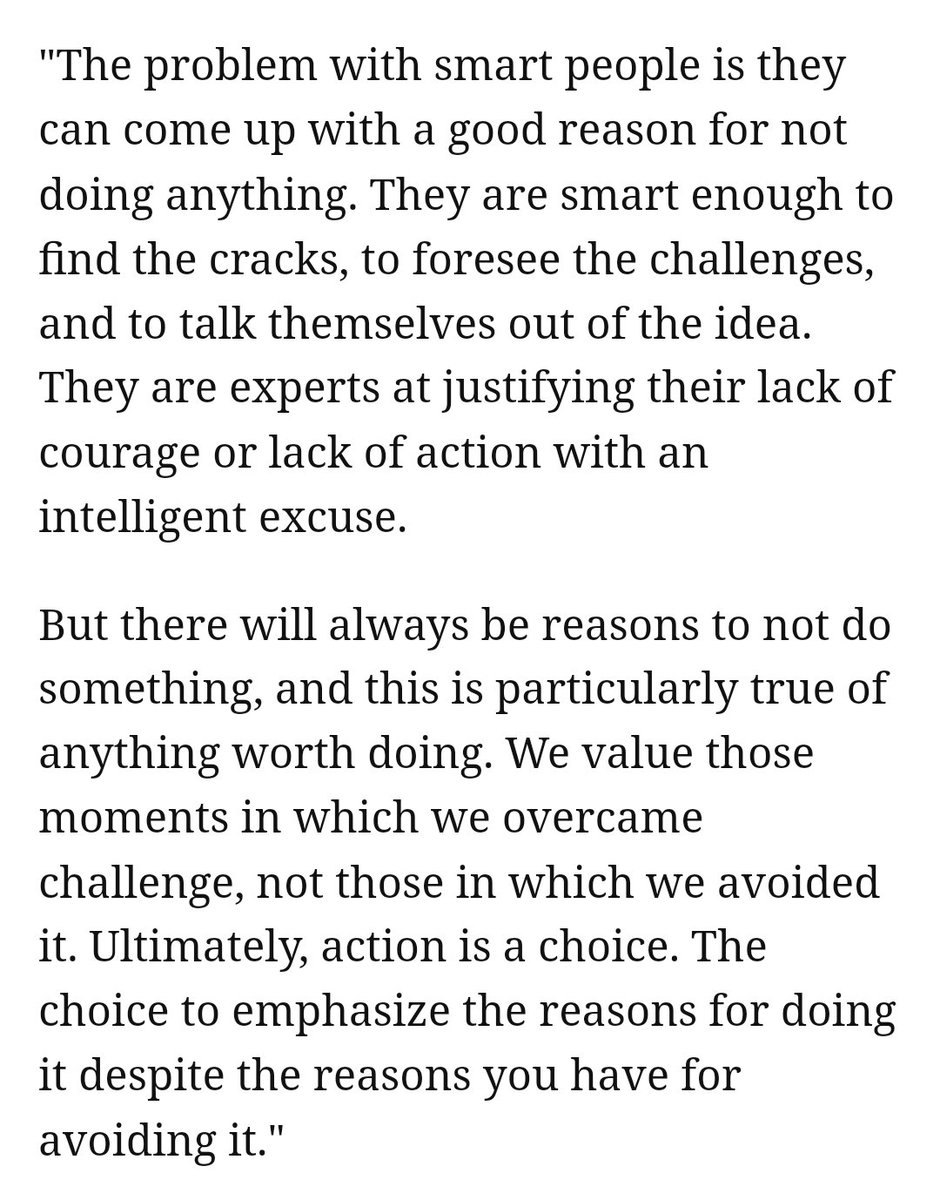
Downside of smartness by @JamesClear
Waqas tweet media
English
11
162
1.1K
139.7K
kuty retweetledi
George Mack
George Mack@george__mack·
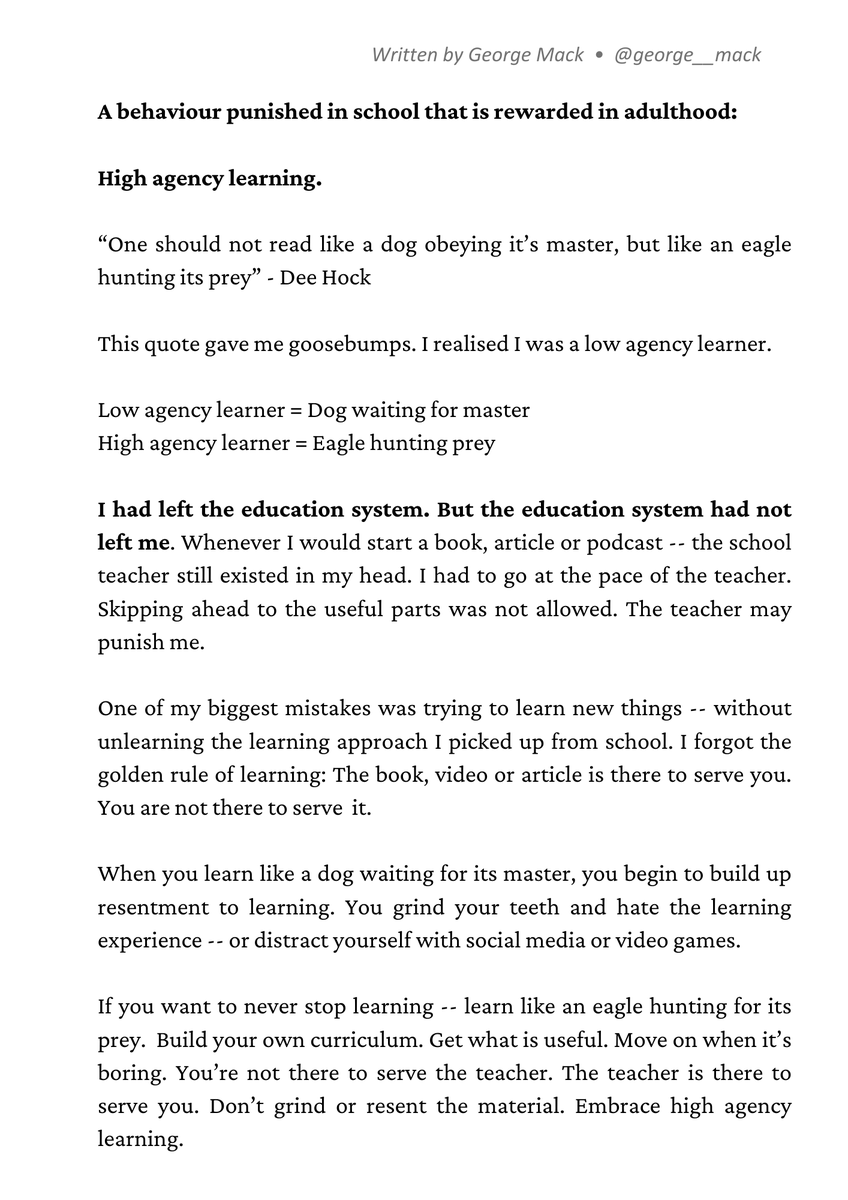
A behaviour punished in school that is rewarded in adulthood: High agency learning.
George Mack tweet media
English
36
275
2.1K
347K
kuty retweetledi
David Perell
David Perell@david_perell·
Some Paradoxes of Modern Life 1. The paradox of reading: The books you read will profoundly change you even though you’ll forget the vast majority of what you read. 2. The paradox of writing: Great writing looks effortless. But because the ideas are so clear, casual readers don't appreciate how much time it took to refine them. 3. The paradox of creativity: Your work is done when it looks so simple that the consumer thinks they could've done it, which means they won't appreciate how hard you worked. 4. The paradox of decision making: It’s better to choose, commit, and get started instead of waiting for the best possible option, so the correct decisions are actually suboptimal. 5. The paradox of originality: Many of history's greatest artists have found their voice by copying others. We discover who we are by imitating others and watching our uniqueness emerge over time. 6. The paradox of news: By telling us to care about everything, the news leads to apathy instead of action. 7. The Productivity Paradox: We keep inventing things that save us time, but it feels like we have less time than ever before. 8. The Paradox of Strategy: The same things that help you achieve outlier success also increase your chances of outlandish failure. For example, investing with leverage increases your chances of risk and reward.
English
45
352
1.6K
180.4K
kuty retweetledi
Bill Ackman
Bill Ackman@BillAckman·
In light of today’s news, I thought I would try to take a step back and provide perspective on what this is really all about. I first became concerned about @Harvard when 34 Harvard student organizations, early on the morning of October 8th before Israel had taken any military actions in Gaza, came out publicly in support of Hamas, a globally recognized terrorist organization, holding Israel ‘solely responsible’ for Hamas’ barbaric and heinous acts. How could this be? I wondered. When I saw President Gay’s initial statement about the massacre, it provided more context (!) for the student groups’ statement of support for terrorism. The protests began as pro-Palestine and then became anti-Israel. Shortly, thereafter, antisemitism exploded on campus as protesters who violated Harvard’s own codes of conduct were emboldened by the lack of enforcement of Harvard’s rules, and kept testing the limits on how aggressive, intimidating, and disruptive they could be to Jewish and Israeli students, and the student body at large. Sadly, antisemitism remains a simmering source of hate even at our best universities among a subset of students. A few weeks later, I went up to campus to see things with my own eyes, and listen and learn from students and faculty. I met with 15 or so members of the faculty and a few hundred students in small and large settings, and a clearer picture began to emerge. I ultimately concluded that antisemitism was not the core of the problem, it was simply a troubling warning sign – it was the “canary in the coal mine” – despite how destructive it was in impacting student life and learning on campus. I came to learn that the root cause of antisemitism at Harvard was an ideology that had been promulgated on campus, an oppressor/oppressed framework, that provided the intellectual bulwark behind the protests, helping to generate anti-Israel and anti-Jewish hate speech and harassment. Then I did more research. The more I learned, the more concerned I became, and the more ignorant I realized I had been about DEI, a powerful movement that has not only pervaded Harvard, but the educational system at large. I came to understand that Diversity, Equity, and Inclusion was not what I had naively thought these words meant. I have always believed that diversity is an important feature of a successful organization, but by diversity I mean diversity in its broadest form: diversity of viewpoints, politics, ethnicity, race, age, religion, experience, socioeconomic background, sexual identity, gender, one’s upbringing, and more. What I learned, however, was that DEI was not about diversity in its purest form, but rather DEI was a political advocacy movement on behalf of certain groups that are deemed oppressed under DEI’s own methodology. Under DEI, one’s degree of oppression is determined based upon where one resides on a so-called intersectional pyramid of oppression where whites, Jews, and Asians are deemed oppressors, and a subset of people of color, LGBTQ people, and/or women are deemed to be oppressed. Under this ideology which is the philosophical underpinning of DEI as advanced by Ibram X. Kendi and others, one is either an anti-racist or a racist. There is no such thing as being “not racist.” Under DEI’s ideology, any policy, program, educational system, economic system, grading system, admission policy, (and even climate change due its disparate impact on geographies and the people that live there), etc. that leads to unequal outcomes among people of different skin colors is deemed racist. As a result, according to DEI, capitalism is racist, Advanced Placement exams are racist, IQ tests are racist, corporations are racist, or in other words, any merit-based program, system, or organization which has or generates outcomes for different races that are at variance with the proportion these different races represent in the population at large is by definition racist under DEI’s ideology. In order to be deemed anti-racist, one must personally take action to reverse any unequal outcomes in society. The DEI movement, which has permeated many universities, corporations, and state, local and federal governments, is designed to be the anti-racist engine to transform society from its currently structurally racist state to an anti-racist one. After the death of George Floyd, the already burgeoning DEI movement took off without any real challenge to its problematic ideology. Why, you might ask, was there so little pushback? The answer is that anyone who dared to raise a question which challenged DEI was deemed a racist, a label which could severely impact one’s employment, social status, reputation and more. Being called a racist got people cancelled, so those concerned about DEI and its societal and legal implications had no choice but to keep quiet in this new climate of fear. The techniques that DEI has used to squelch the opposition are found in the Red Scares and McCarthyism of decades past. If you challenge DEI, “justice” will be swift, and you may find yourself unemployed, shunned by colleagues, cancelled, and/or you will otherwise put your career and acceptance in society at risk. The DEI movement has also taken control of speech. Certain speech is no longer permitted. So-called “microaggressions” are treated like hate speech. “Trigger warnings” are required to protect students. “Safe spaces” are necessary to protect students from the trauma inflicted by words that are challenging to the students’ newly-acquired world views. Campus speakers and faculty with unapproved views are shouted down, shunned, and cancelled. These speech codes have led to self-censorship by students and faculty of views privately held, but no longer shared. There is no commitment to free expression at Harvard other than for DEI-approved views. This has led to the quashing of conservative and other viewpoints from the Harvard campus and faculty, and contributed to Harvard’s having the lowest free speech ranking of 248 universities assessed by the Foundation of Individual Rights and Expression. When one examines DEI and its ideological heritage, it does not take long to understand that the movement is inherently inconsistent with basic American values. Our country since its founding has been about creating and building a democracy with equality of opportunity for all. Millions of people have left behind socialism and communism to come to America to start again, as they have seen the destruction leveled by an equality of outcome society. The E for “equity” in DEI is about equality of outcome, not equality of opportunity. DEI is racist because reverse racism is racism, even if it is against white people (and it is remarkable that I even need to point this out). Racism against white people has become considered acceptable by many not to be racism, or alternatively, it is deemed acceptable racism. While this is, of course, absurd, it has become the prevailing view in many universities around the country. You can say things about white people today in universities, in business or otherwise, that if you switched the word ‘white’ to ‘black,’ the consequences to you would be costly and severe. To state what should otherwise be self-evident, whether or not a statement is racist should not depend upon whether the target of the racism is a group who currently represents a majority or minority of the country or those who have a lighter or darker skin color. Racism against whites is as reprehensible as it is against groups with darker skin colors. Martin Luther King’s most famous words are instructive: “I have a dream that my four little children will one day live in a nation where they will not be judged by the color of their skin but by the content of their character.” But here we are in 2024, being asked and in some cases required to use skin color to effect outcomes in admissions (recently deemed illegal by the Supreme Court), in business (likely illegal yet it happens nonetheless) and in government (also I believe in most cases to be illegal, except apparently in government contracting), rather than the content of one’s character. As such, a meritocracy is an anathema to the DEI movement. DEI is inherently a racist and illegal movement in its implementation even if it purports to work on behalf of the so-called oppressed. And DEI’s definition of oppressed is fundamentally flawed. I have always believed that the most fortunate should help the least fortunate, and that our system should be designed in such a way as to maximize the size of the overall pie so that it will enable us to provide an economic system which can offer quality of life, education, housing, and healthcare for all. America is a rich country and we have made massive progress over the decades toward achieving this goal, but we obviously have much more work to do. Steps taken on the path to socialism – another word for an equality of outcome system – will reverse this progress and ultimately impoverish us all. We have seen this movie many times. Having a darker skin color, a less common sexual identity, and/or being a woman doesn’t make one necessarily oppressed or even disadvantaged. While slavery remains a permanent stain on our country’s history – a fact which is used by DEI to label white people as oppressors – it doesn’t therefore hold that all white people generations after the abolishment of slavery should be held responsible for its evils. Similarly, the fact that Columbus discovered America doesn’t make all modern-day Italians colonialists. An ideology that portrays a bicameral world of oppressors and the oppressed based principally on race or sexual identity is a fundamentally racist ideology that will likely lead to more racism rather than less. A system where one obtains advantages by virtue of one’s skin color is a racist system, and one that will generate resentment and anger among the un-advantaged who will direct their anger at the favored groups. The country has seen burgeoning resentment and anger grow materially over the last few years, and the DEI movement is an important contributor to our growing divisiveness. Resentment is one of the most important drivers of racism. And it is the lack of equity, i.e, fairness, in how DEI operates, that contributes to this resentment. I was accused of being a racist from the President of the NAACP among others when I posted on @X that I had learned that the Harvard President search process excluded candidates that did not meet the DEI criteria. I didn’t say that former President Gay was hired because she was a black woman. I simply said that I had heard that the search process by its design excluded a large percentage of potential candidates due to the DEI limitations. My statement was not a racist one. It was simply the empirical truth about the Harvard search process that led to Gay’s hiring. When former President Gay was hired, I knew little about her, but I was instinctually happy for Harvard and the black community. Every minority community likes to see their representatives recognized in important leadership positions, and it is therefore an important moment for celebration. I too celebrated this achievement. I am inspired and moved by others’ success, and I thought of Gay’s hiring at the pinnacle leadership position at perhaps our most important and iconic university as an important and significant milestone for the black community. I have spent the majority of my life advocating on behalf of and supporting members of disadvantaged communities including by investing several hundreds of millions of dollars of philanthropic assets to help communities in need with economic development, sensible criminal justice reform, poverty reduction, healthcare, education, workforce housing, charter schools, and more. I have done the same at Pershing Square Capital Management when, for example, we completed one of the largest IPOs ever with the substantive assistance of a number of minority-owned, women-owned, and Veteran-owned investment banks. Prior to the Pershing Square Tontine, Ltd. IPO, it was standard practice for big corporations occasionally to name a few minority-owned banks in their equity and bond offerings, have these banks do no work and sell only a de minimis amount of stock or bonds, and allocate to them only 1% or less of the underwriting fees so that the issuers could virtue signal that they were helping minority communities. In our IPO, we invited the smaller banks into the deal from the beginning of the process so they could add real value. As a result, the Tontine IPO was one of the largest and most successful IPOs in history with $12 billion of demand for a $4 billion deal by the second day of the IPO, when we closed the books. The small banks earned their 20% share of the fees for delivering real and substantive value and for selling their share of the stock. Compare this approach to the traditional one where the small banks do effectively nothing to earn their fees – they aren’t given that opportunity – yet, they get a cut of the deal, albeit a tiny one. The traditional approach does not create value for anyone. It only creates resentment, and an uncomfortable feeling from the small banks who get a tiny piece of the deal in a particularly bad form of affirmative action. While I don’t think our approach to working with the smaller banks has yet achieved the significant traction it deserves, it will hopefully happen eventually as the smaller banks build their competencies and continue to earn their fees, and other issuers see the merit of this approach. We are going to need assistance with a large IPO soon so we are looking forward to working with our favored smaller banks. I have always believed in giving disadvantaged groups a helping hand. I signed the Giving Pledge for this reason. My life plan by the time I was 18 was to be successful and then return the favor to those less fortunate. This always seemed to the right thing to do, in particular, for someone as fortunate as I am. All of the above said, it is one thing to give disadvantaged people the opportunities and resources so that they can help themselves. It is another to select a candidate for admission or for a leadership role when they are not qualified to serve in that role. This appears to have been the case with former President Gay’s selection. She did not possess the leadership skills to serve as Harvard’s president, putting aside any questions about her academic credentials. This became apparent shortly after October 7th, but there were many signs before then when she was Dean of the faculty. The result was a disaster for Harvard and for Claudine Gay. The Harvard board should not have run a search process which had a predetermined objective of only hiring a DEI-approved candidate. In any case, there are many incredibly talented black men and women who could have been selected by Harvard to serve as its president so why did the Harvard Corporation board choose Gay? One can only speculate without knowing all of the facts, but it appears Gay’s leadership in the creation of Harvard’s Office of Diversity, Equity, Inclusion and Belonging and the penetration of the DEI ideology into the Corporation board room perhaps made Gay the favored candidate. The search was also done at a time when many other top universities had similar DEI-favored candidate searches underway for their presidents, reducing the number of potential candidates available in light of the increased competition for talent. Unrelated to the DEI issue, as a side note, I would suggest that universities should broaden their searches to include capable business people for the role of president, as a university president requires more business skills than can be gleaned from even the most successful academic career with its hundreds of peer reviewed papers and many books. Universities have a Dean of the Faculty and a bureaucracy to oversee the faculty and academic environment of the university. It therefore does not make sense that the university president has to come through the ranks of academia, with a skill set unprepared for university management. The president’s job – managing thousands of employees, overseeing a $50 billion endowment, raising money, managing expenses, capital allocation, real estate acquisition, disposition, and construction, and reputation management – are responsibilities that few career academics are capable of executing. Broadening the recruitment of candidates to include top business executives would also create more opportunities for diverse talent for the office of the university president. Furthermore, Harvard is a massive business that has been mismanaged for a long time. The cost structure of the University is out of control due in large part to the fact that the administration has grown without bounds. Revenues are below what they should be because the endowment has generated a 4.5% annualized return for the last decade in one of the greatest bull markets in history, and that low return is not due to the endowment taking lower risks as the substantial majority of its assets are invested in illiquid and other high-risk assets. The price of the product, a Harvard education, has risen at a rate well in excess of inflation for decades, (I believe it has grown about 7-8% per annum) and it is now about $320,000 for four years of a liberal arts education at Harvard College. As a result, the only students who can now afford Harvard come from rich families and poor ones. The middle class can’t get enough financial aid other than by borrowing a lot of money, and it is hard to make the economics work in life after college when you graduate with large loan balances, particularly if you also attend graduate school. The best companies in the world grow at high rates over many decades. Harvard has grown at a de minimis rate. Since I graduated 35 years ago, the number of students in the Harvard class has grown by less than 20%. What other successful business do you know that has grown the number of customers it serves by less than 20% in 35 years, and where nearly all revenue growth has come from raising prices? In summary, there is a lot more work to be done to fix Harvard than just replacing its president. That said, the selection of Harvard’s next president is a critically important task, and the individuals principally responsible for that decision do not have a good track record for doing so based on their recent history, nor have they done a good job managing the other problems which I have identified above. The Corporation board led by Penny Pritzker selected the wrong president and did inadequate due diligence about her academic record despite Gay being in leadership roles at the University since 2015 when she became dean of the Social Studies department. The Board failed to create a discrimination-free environment on campus exposing the University to tremendous reputational damage, to large legal and financial liabilities, Congressional investigations and scrutiny, and to the potential loss of Federal funding, all while damaging the learning environment for all students. And when concerns were raised about plagiarism in Gay’s research, the Board said these claims were “demonstrably false” and it threatened the NY Post with “immense” liability if it published a story raising these issues. It was only after getting the story cancelled that the Board secretly launched a cursory, short-form investigation outside of the proper process for evaluating a member of the faculty’s potential plagiarism. When the Board finally publicly acknowledged some of Gay’s plagiarism, it characterized the plagiarism as “unintentional” and invented new euphemisms, i.e., “duplicative language” to describe plagiarism, a belittling of academic integrity that has caused grave damage to Harvard’s academic standards and credibility. The Board’s three-person panel of “political scientist experts” that to this day remain unnamed who evaluated Gay’s work failed to identify many examples of her plagiarism, leading to even greater reputational damage to the University and its reputation for academic integrity as the whistleblower and the media continued to identify additional problems with Gay’s work in the days and weeks thereafter. According to the NY Post, the Board also apparently sought to identify the whistleblower and seek retribution against him or her in contravention to the University’s whistleblower protection policies. Despite all of the above, the Board “unanimously” gave its full support for Gay during this nearly four-month crisis, until eventually being forced to accept her resignation earlier today, a grave and continuing reputational disaster to Harvard and to the Board. In a normal corporate context with the above set of facts, the full board would resign immediately to be replaced by a group nominated by shareholders. In the case of Harvard, however, the Board nominates itself and its new members. There is no shareholder vote mechanism to replace them. So what should happen? The Corporation Board should not remain in their seats protected by the unusual governance structure which enabled them to obtain their seats. The Board Chair, Penny Pritzker, should resign along with the other members of the board who led the campaign to keep Claudine Gay, orchestrated the strategy to threaten the media, bypassed the process for evaluating plagiarism, and otherwise greatly contributed to the damage that has been done. Then new Corporation board members should be identified who bring true diversity, viewpoint and otherwise, to the board. The Board should not be principally comprised of individuals who share the same politics and views about DEI. The new board members should be chosen in a transparent process with the assistance of the 30-person Board of Overseers. There is no reason the Harvard board of 12 independent trustees cannot be comprised of the most impressive, high integrity, intellectually and politically diverse members of our country and globe. We have plenty of remarkable people to choose from, and the job of being a director just got much more interesting and important. It is no longer, nor should it ever have been, an honorary and highly political sinecure. The ODEIB should be shut down, and the staff should be terminated. The ODEIB has already taken down much of the ideology and strategies that were on its website when I and others raised concerns about how the office operates and who it does and does not represent. Taking down portions of the website does not address the fundamentally flawed and racist ideology of this office, and calls into further question the ODEIB’s legitimacy. Why would the ODEIB take down portions of its website when an alum questioned its legitimacy unless the office was doing something fundamentally wrong or indefensible? Harvard must once again become a meritocratic institution which does not discriminate for or against faculty or students based on their skin color, and where diversity is understood in its broadest form so that students can learn in an environment which welcomes diverse viewpoints from faculty and students from truly diverse backgrounds and experiences. Harvard must create an academic environment with real academic freedom and free speech, where self-censoring, speech codes, and cancel culture are forever banished from campus. Harvard should become an environment where all students of all persuasions feel comfortable expressing their views and being themselves. In the business world, we call this creating a great corporate culture, which begins with new leadership and the right tone at the top. It does not require the creation of a massive administrative bureaucracy. These are the minimum changes necessary to begin to repair the damage that has been done. A number of faculty at the University of Pennsylvania have proposed a new constitution which can be found at pennforward.com, which has been signed by more than 1,200 faculty from Penn, Harvard, and other universities. Harvard would do well to adopt Penn’s proposed new constitution or a similar one before seeking to hire its next president. A condition of employment of the new Harvard president should be the requirement that the new president agrees to strictly abide by the new constitution. He or she should take an oath to that effect. Today was an important step forward for the University. It is time we restore Veritas to Harvard and again be an exemplar that graduates well-informed, highly-educated leaders of exemplary moral standing and good judgment who can help bring our country together, advance our democracy, and identify the important new discoveries that will help save us from ourselves. We have a lot more work to do. Let’s get at it.
English
8.8K
18.4K
76.9K
36M
kuty retweetledi
Tiago Forte
Tiago Forte@fortelabs·
End of year = Annual Review time I can summarize the essence of my Annual Reviews as: Discovering what you truly want for your life, again and again, in more subtle shades and deeper layers each time Doing an Annual Review is simple - here’s a few questions to get you going:
English
18
120
921
303.5K