Larry Au

9.5K posts

Larry Au banner
Larry Au

Larry Au

@larryau

Asst Professor of Sociology @CityCollegeNY @CUNY, PhD @Columbia | Politics of expertise in science and medicine

Brooklyn/NYC Katılım Temmuz 2009
1.8K Takip Edilen3.7K Takipçiler
Larry Au retweetledi
Martha Lincoln
Martha Lincoln@heavyredaction·
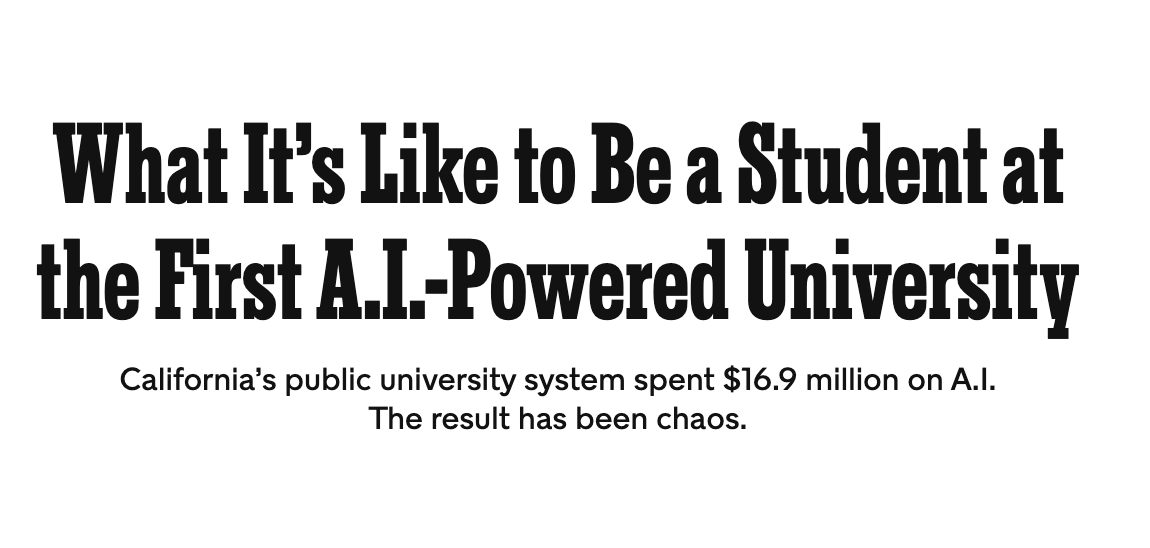
Spoke with Linda Kinstler for this new NYT Magazine piece about the California State University’s AI boondoggle. It’s a meticulous deep dive containing no hype. Dek: “California’s public university system spent $16.9 million on A.I. The result has been chaos.” Link below
Martha Lincoln tweet media
English
3
58
227
14.1K
Larry Au
Larry Au@larryau·
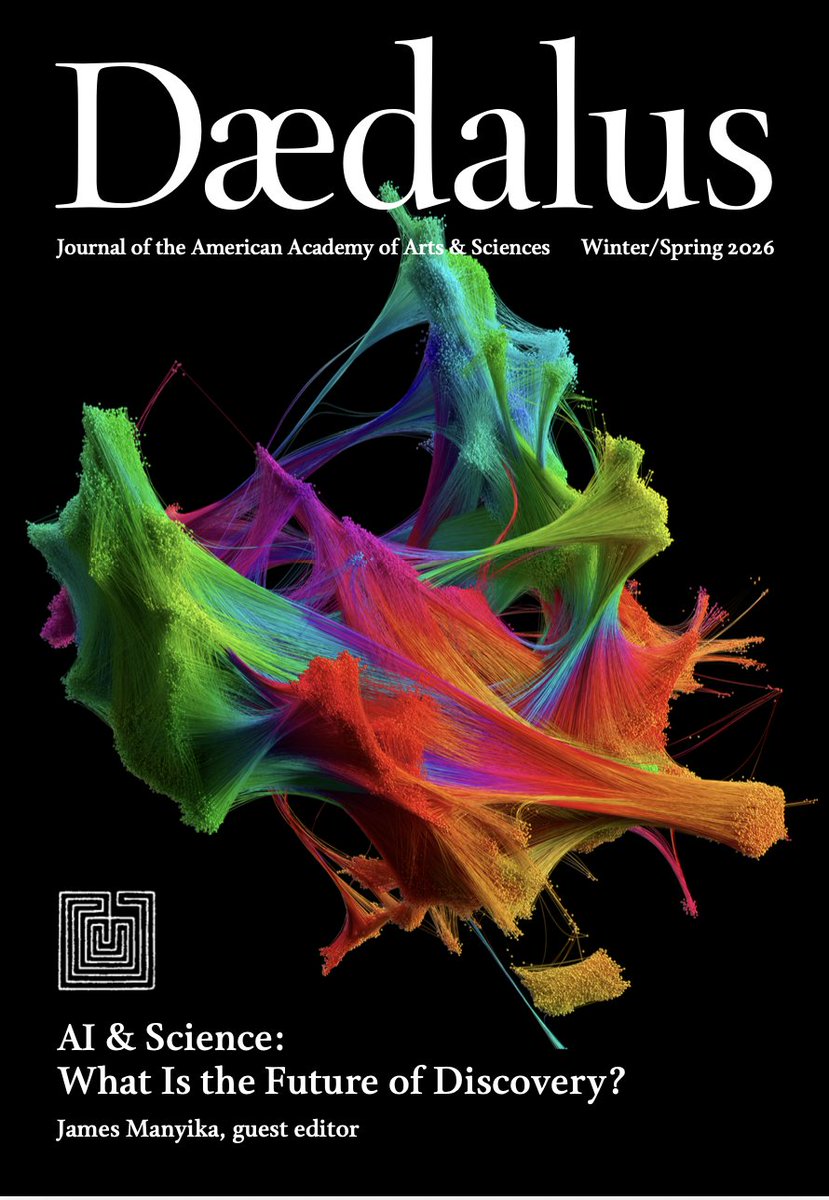
Please join us for a virtual symposium on Rewiring the Medical Network of Expertise organized with RC52 Sociology of Professional Groups at the International Sociological Association from June 16 to 18.
Larry Au tweet media
English
1
0
0
70
Larry Au retweetledi
The Tennessee Holler
The Tennessee Holler@TheTNHoller·
🔥 @ronnychieng at Harvard: “F*ck A.I. — the mission of your generation is to destroy it… shortcuts to skip to the end aren’t always good. The journey is the point of all this.”
English
67
1.9K
8K
162.3K
Larry Au retweetledi
Joseph Allen
Joseph Allen@j_g_allen·
A warning from the president of MIT: “the nation’s research enterprise is shrinking. Scientific funding is drying up. And the funds Congress recently allocated for science are not actually flowing” “At public and private universities across the country, high-impact science is being damaged and derailed. Speaking for my own institution, compared to this time last year, MIT has experienced a decline in campus research activity funded by federal awards of more than 20%.”
Matthew Herper@matthewherper

MIT president: Why so many optimistic scientists are losing heart statnews.com/2026/05/27/sci… via @statnews

English
51
821
2.6K
279.1K
Larry Au retweetledi
Maya Wang 王松蓮
Maya Wang 王松蓮@wang_maya·
The right to leave one's country is a basic human rights, one that sadly the Chinese govt has been increasingly violating whether we're talking about Uyghurs as a group or top AI talents bloomberg.com/news/articles/…
English
0
3
7
2.1K
Larry Au retweetledi
indianamal
indianamal@profpookie·
i had a student last year who did not know how to download a pdf from the course website and open it to read at a later time; thus he also did not know how to highlight and underline on said pdf. there's an actual crisis too few are willing to acknowledge, much less address.
Feral Heather@FeralHeather

90% of students don’t even know how to open or save a Word document when they come to my class, let alone format text. “Digital native” generation is tech illiterate & Grandma Luddite Heather must teach them the ancient ways

English
15
50
846
33.6K
Larry Au retweetledi
nature
nature@Nature·
This viral trend of satirical journals is highlighting the intense competition in Chinese academia go.nature.com/4dxWJ7f
English
4
9
45
13.8K
Larry Au retweetledi
Anouk
Anouk@askimono·
As foreign journalists in China we all knew we were being tracked. But it still is a weird sensation to come across a test system for tracking foreign nationals with mugshots, passport info and other data on me and other China (former) China correspondents.
NetAskari@NetAskari

EXCLUSIVE: How the track foreigners in China - We got rare access to demo system developed by the Ministry of Public Security in China for the prefecture of Zhangjiakou, to track and surveil foreigners visiting or being residents ( actually it applies to most nationals as well, but in this case it seems to be aimed at foreigners ). It is officially known as "Dynamic control platform for overseas personnel". 1/12

English
10
40
114
13.1K
Larry Au retweetledi
Karen Hao
Karen Hao@_KarenHao·
On the one-year anniversary of EMPIRE OF AI, I am so, so excited to announce The AI Resist List, a new project that documents examples of resistance to the AI empires around the world. airesistlist.org
Karen Hao tweet media
English
152
1.8K
5.9K
579.7K
Larry Au retweetledi
Michael McFaul
Michael McFaul@McFaul·
Wow. Deeply troubling.
Spotlight on China@spotlightoncn

Last week, amid the global headlines surrounding the high-stakes summit between President Trump and Xi Jinping in Beijing, a quieter but profoundly consequential piece of research dropped in Nature. A team of seven researchers from major American universities published the first peer-reviewed evidence that China’s state-controlled media has successfully worked its way into the training data of AI chatbots that the world increasingly relies on. The study demonstrates that scripted articles, official slogans, and party-line phrasings churned out daily by entities like the Xinhua News Agency and the Communist Party's study apps are now demonstrably embedded inside ChatGPT and other top models. A quick test of one of Xi Jinping's signature political doctrines shows that global chatbots seamlessly finish the phrases and offer to explain their political significance, reflecting an underlying saturation of state doctrine. By combing through CulturaX, a massive open-source data set containing 189 million Chinese-language documents widely used to train AI models, the researchers found that state-media content is 41 times more abundant in the corpus than Chinese-language Wikipedia. While the overall overlap sits at a modest 1.64%, that share climbs to roughly one in four documents when filtering for politically sensitive terms like the Party Congress or the Central Committee. “What is new here is now they are shaping the systems people increasingly ask to summarize, explain, and interpret the world for them,” explained Molly Roberts, a researcher on the team and co-director of the China Data Lab at the University of California San Diego. She noted that through this mechanism, authoritarian governments can now shape information consumption not just domestically, but across international borders. When the team posed politically sensitive questions regarding Chinese governance to major commercial chatbots, the Chinese-language answers came back overwhelmingly more favorable to Beijing than their English counterparts. While Western models like GPT, Claude, Gemini, and Grok showed a distinct divergence between languages, China’s own DeepSeek model remained uniformly pro-Beijing across both English and Chinese, reflecting strict state regulatory control over its data. The phenomenon extends beyond China, revealing a similar pattern for queries regarding Russia and North Korea. Crucially, this ideological slant did not require covert cyber operations; the propaganda is simply available on the open web in plain, unpaywalled HTML, making it free and easy for any AI lab's web crawler to scoop up and ingest. This reality highlights an uncomfortable systemic asymmetry in global media ecosystems. While independent, high-quality journalism in democracies increasingly relies on paywalls to sustain its operations, state-run propaganda from authoritarian regimes remains entirely free, creating a massive economic imbalance in the textual material available for machine learning. A broader audit spanning 37 nations confirmed that this trend is a global issue: the lower a country's press freedom, the more regime-friendly the local-language output of the AI becomes. Because large language models do not transparently cite their sources, users are left completely unable to decipher the true origins of the geopolitical narratives presented to them. The Beijing summit generated a brief wave of international headlines, but this structural penetration of artificial intelligence demands a policy conversation that lasts years. While the scientific community has officially proven that authoritarian states are shaping global AI outputs, the question of how democracies will counter this invisible influence remains entirely unanswered. wsj.com/world/china/th…

English
25
203
630
141.7K
Larry Au retweetledi
Rimsha Bhardwaj
Rimsha Bhardwaj@heyrimsha·
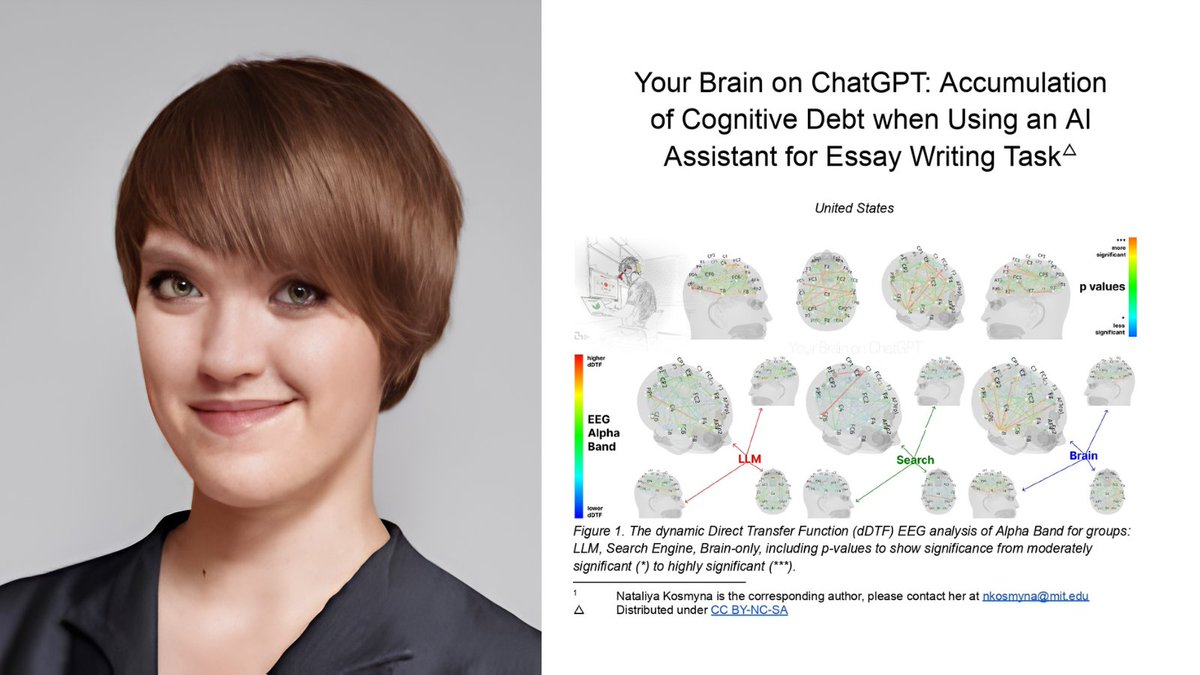
An MIT researcher spent four months watching what happens inside the skull of a student who writes with ChatGPT, and the result was so clean that almost nobody outside her lab has read the paper. Her name is Nataliya Kosmyna. She runs experiments at the MIT Media Lab. The study was released in 2025, and the finding is the kind of thing that should have rewritten every syllabus. The setup was simple. She recruited 54 people in Boston. Each one wore an EEG headset that read brain activity across 32 regions of the scalp. They wrote the same kind of essay, over and over again, for four months. One group used ChatGPT. One group used Google. One group used nothing but their own head. Then her team looked at the brain recordings. The students writing alone had the strongest neural connectivity. Memory, language, and attention networks were all firing together. The Google group came in second. The ChatGPT group came last, by a wide margin. Their brains had gone quiet. In a final session, she made the ChatGPT users write without the tool. Their brains stayed quiet. The under-engagement had become the new baseline. Then she asked them to quote a single line from the essay they had just written. Eighty percent of them could not do it. They had not written the essay. The essay had passed through them. Kosmyna calls it cognitive debt. Every shortcut you take with the model is a withdrawal from a part of your brain that was supposed to do the work. The shortcut feels free. It is not.
Rimsha Bhardwaj tweet media
English
16
95
231
34.5K