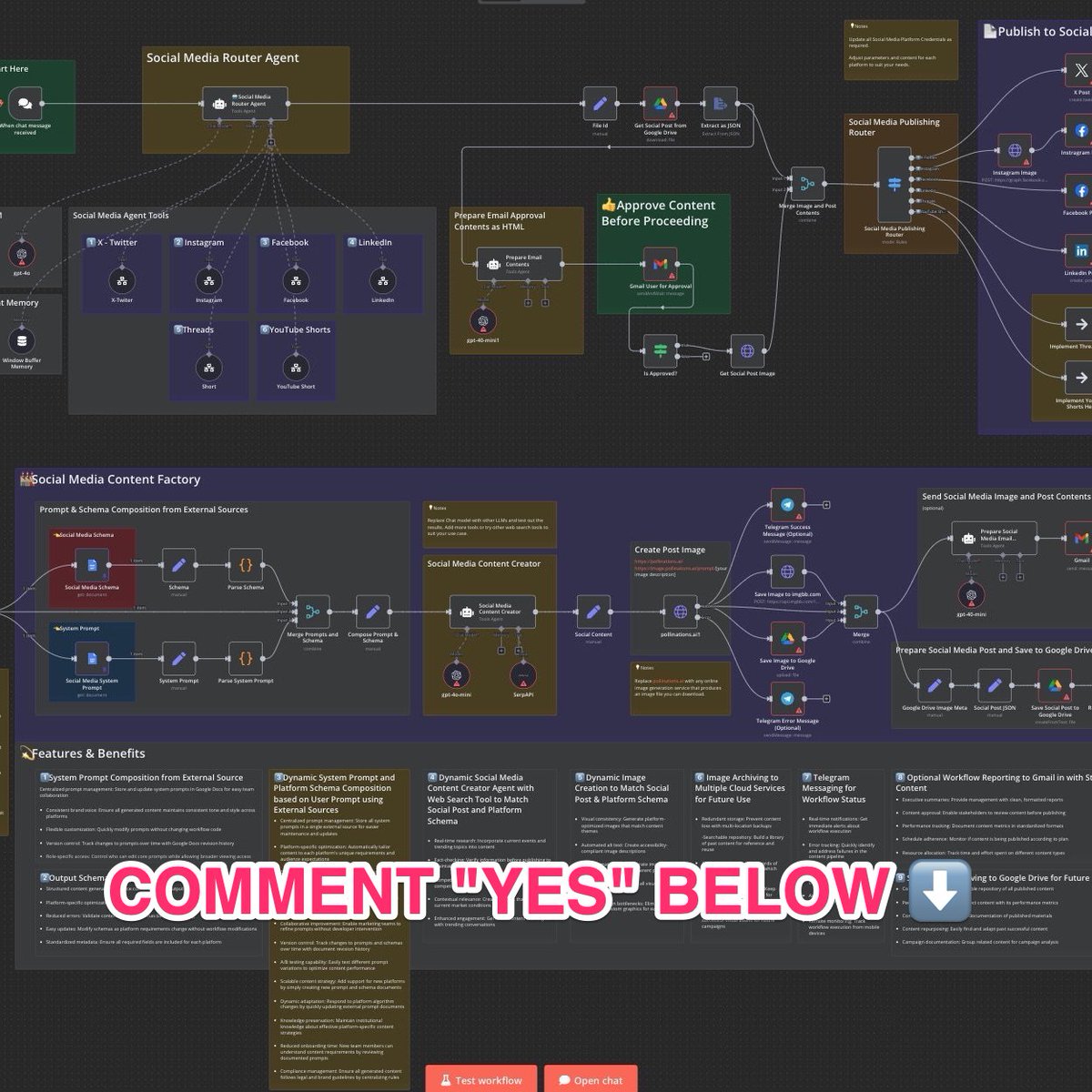
This AI system researches prospects like a psychopath and writes to them like a best friend.
This combo is absolutely insane for outreach that actually books calls.
No SDRs. No manual research. No sales reps spending 3 hours per prospect.
Just AI tools working together like a professional sales team.
Here's how it works:
→ AI scrapes LinkedIn profiles + recent posts automatically
→ Perplexity researches their company across the entire internet
→ Claude analyzes pain points and writes hyper-personalized 3-email sequences
→ System references specific achievements like you personally studied them
→ Emails send in proper time zones with perfect deliverability rotation
→ Sequences stop automatically when prospects reply
Perfect for anyone tired of 2% reply rates and "hope this finds you well" templates.
The power is in the combo:
LinkedIn scraping = behavioral data most sales reps ignore
Perplexity = company intelligence that makes prospects think you know them
Claude = emails that feel like a best friend wrote them, not a robot
While others are manually researching 10 prospects per day, you're personalizing 100 per hour.
Test different angles.
Book more calls.
Scale immediately.
Like, RT + reply with "SYSTEM" and I'll DM the complete workflow
(Must be following so I can DM)
Skip this and keep manually copying LinkedIn bios into ChatGPT.
Just Recorded a Tutorial on How to Build your AI Client Onboarding Automation (step-by-step)
You can now automate contracts, DocuSign signatures, CRM updates, and welcome emails with ease
Like + Comment "free" to get the FULL Tutorial + n8n workflow
(Must be following)
I created a complete guide on how to build a client onboarding AI agent (with n8n) that does it in 60 SECONDS
Just straight plug-and-play systems for:
– Lead gen
-Content creation
– Email outreach
– CRM updates
– AI workflows
– Slack/Discord bots
… and more.
Want this process for FREE?
👉 RT + Like & Comment “YES” and I’ll send you the guide
(Must be following)
On the subject of AI and jobs: Hypothetically, if all software development were to be automated - I want to emphasize that we are _nowhere_ close to that goal - and all software engineers such as myself are out of work, it is not like human beings will have nothing to do.
The problem is purely economic - how do people afford all the goods that pour out of automated factories that employ no workers?
There are two possible solutions:
1. The price of all the robot made goods and all the AI-made and AI-supported software would drop massively and be close to zero or zero. Breathing air costs us zero and we don't complain about it!
2. The remaining things humans do, may get paid well - as an example, taking care of children, home cooked meals, nursing sick people, priests that minister to people, people who take care of soil health, water health, crop health and cattle health (we used to call them farmers), forest restoration specialists, local live performing musicians and so on may get paid much more and that circulates income widely enough for people to afford the goods pouring out of highly automated factories.
To state it differently, IF (again, a big if) robots and AI automate all production work, the remaining work humans do like taking care of children would pay very well in terms of purchasing power of those now-ultra-cheap or free goods.
This is fundamentally an economic distribution problem, a problem of political economy and not purely a technological problem. One key part is for governments to crack down on monopolies, particularly tech monopolies. Only that will ensure that the prices of goods reflect the very low cost of production arising from AI and automation.
There will be at least one country in the world that would get the political economy right.
Congratulation @Optimizely for being recognized as leader in Content management system. However there is an extra ( at the end of your published page optimizely.com/company/press/…
Announcing: Agentic Document Extraction!
PDF files represent information visually - via layout, charts, graphs, etc. - and are more than just text. Unlike traditional OCR and most PDF-to-text approaches, which focus on extracting the text, an agentic approach lets us break a document down into components and reason about them, resulting in more accurate extraction of the underlying meaning for RAG and other applications. Watch the video for details.
Gurungs are an ethnic group of Nepali, who live in India, Nepal and other parts of the Himalayas, The Gurungs have their own culture, myth, and oral tradition. The Gurungs' religion is a blend of Buddhism, Hinduism and a remainder from pre-Buddhist Tibet, called Bon. The Gurungs have a shaman priesthood that is believed to practice a form of Bon religion.
After a long hiatus, we're looking to kickstart in-person events once again. We'll have an open discussion around two topics: Drupalcon Recap and User Group Planning. Join us Jul 18 and RSVP at meetup.com/austin-drupal-…