Kevin Li

19.5K posts

Kevin Li banner
Kevin Li

Kevin Li

@liveink

CMO @askjoai (YC W24), Co-Founder @farmsteadapp (YC S16), intern @kabam. @uwaterloo drop out. 🟤 in #judo, love gymnastics rings, and video games 🎮

Alameda, CA Katılım Mart 2007
999 Takip Edilen3.5K Takipçiler
Sabitlenmiş Tweet
Kevin Li
Kevin Li@liveink·
If you're wondering who I am and what I'm doing now -> liveink.md
English
1
0
10
1.2K
Kevin Li retweetledi
Garry Tan
Garry Tan@garrytan·
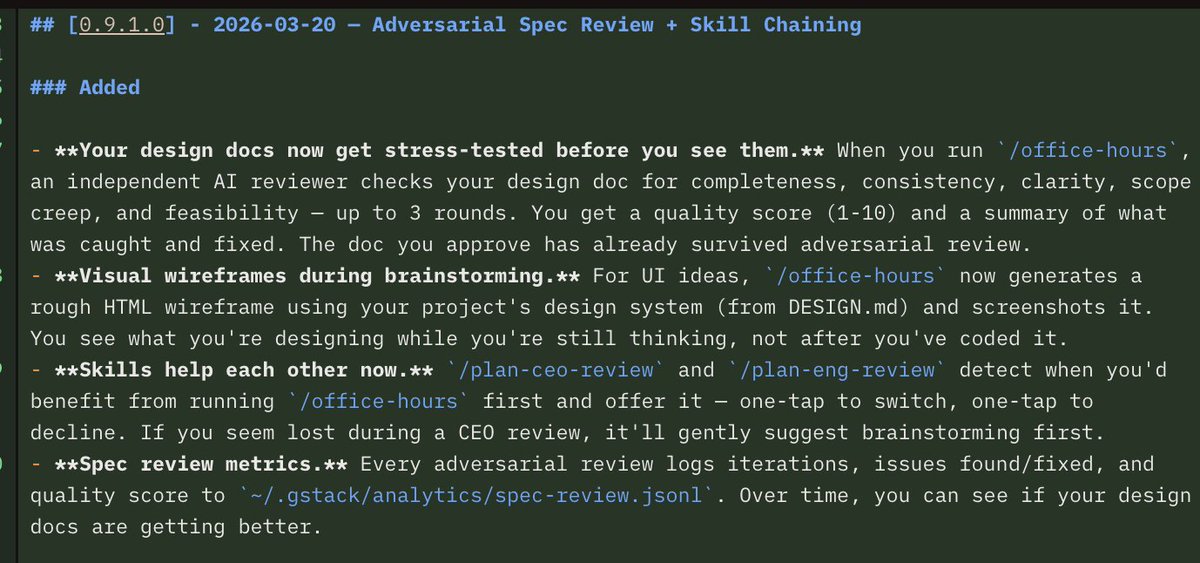
When I first came back to YC, I was a designer-in-residence doing office hours with companies in YC Winter 2011 batch. (Early HelloSign for instance was from UX wireframes I made with @josephwalla in office hours) Now GStack can make wireframes for you like I did back then!
Garry Tan tweet media
English
21
3
105
7.3K
Kevin Li retweetledi
Corey Haines
Corey Haines@coreyhainesco·
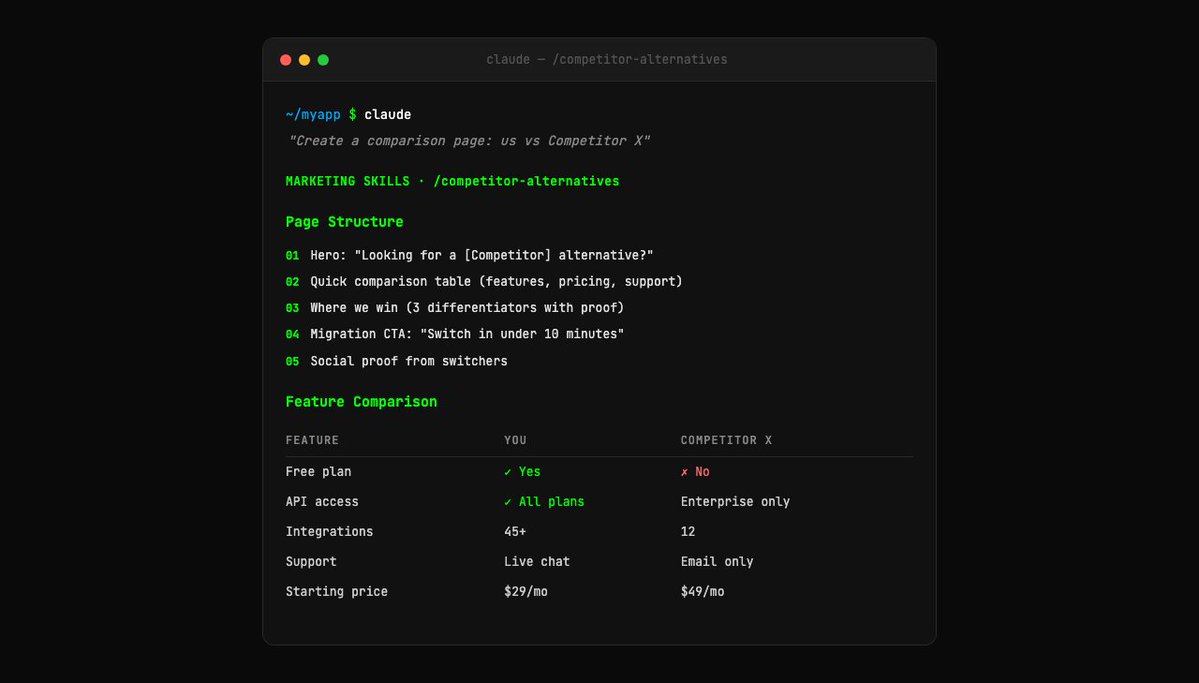
I built a skill for Claude Code that creates competitor comparison and alternative pages that rank in search and convert visitors. You give it a competitor name and it builds the full page — "Best [Competitor] Alternatives" with a feature comparison table, your key differentiators with proof points, migration CTAs, and testimonials from people who switched. It covers all four formats: singular alternative, plural alternatives, you vs them, and them vs them. These pages are SEO gold because people searching "[competitor] alternative" are literally looking for you. Most SaaS companies ignore these pages. The ones that don't steal traffic from their competitors every single day. It's called /competitor-alternatives and it's part of Marketing Skills — a free, open source collection of 32 marketing skills for AI agents like Claude Code, Cursor, and Codex.
Corey Haines tweet media
English
8
4
85
5.9K
Kevin Li retweetledi
Jaclyn Konzelmann
Jaclyn Konzelmann@jacalulu·
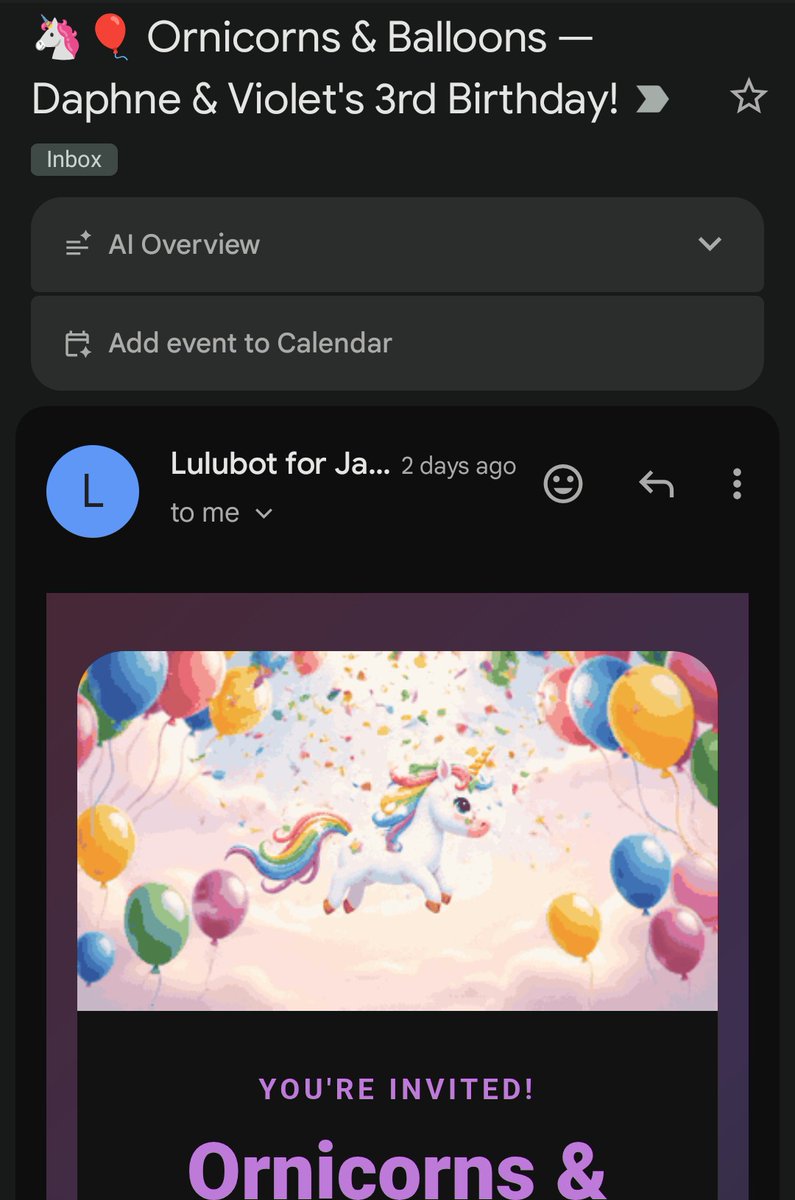
A tweet went viral the other week arguing that consumer AI agents don't have real use cases because "people don't do much work in their personal lives." 662K views. A lot of agreement. @clairevo replied with 33 counterexamples. I replied with a bunch of my own - and then decided to actually run one of them. My twins are turning 3. The theme is ornicorns and balloons. I had been putting off planning this party for weeks until I remembered I could just ask Lulubot to do it. So I did. It: → Compiled and de-duped the guest list → Designed and sent all the invites from its own email account → Tracked RSVPs as they came in → Built a to-do list and project plan → Created a progressive web app pinned to my home screen - a live countdown with upcoming action items → Pushes me a Telegram notification when something needs to get done that day 38 invites in inboxes by dinner. The AI wrote copy I would never have written myself and I kept every word. Full story + the one trick that made the whole thing work 👇 open.substack.com/pub/jacalulu/p…
Jaclyn Konzelmann tweet media
English
5
3
27
2.5K
Kevin Li retweetledi
Naive
Naive@usenaive·
Introducing Naive - hire autonomous employees with their own identity. Own compute. Own bank account. Own legal entity. Own email. Own credentials. Own mobile. No humans-in-the-loop. They sign up for tools, pay for services, deploy apps, file documents, and run your entire company. Describe a business. Naive runs it. Reply "Naive" + RT. Get $100 credit for free.
English
819
520
1.7K
169.5K
Kevin Li retweetledi
Peter Quadrel
Peter Quadrel@Peter_Quadrel·
Manus can now connect to the creator marketplace. It can find creators, draft outreach messages all from the chat. Certainly can speed up the process a bit but not seeing much other value until it can manage a partnership from start to finish...
GIF
English
20
15
419
54.9K
Kevin Li retweetledi
Paweł Huryn
Paweł Huryn@PawelHuryn·
Google just shipped DESIGN.md — a portable, agent-readable design system file. That's the real announcement. Everyone's covering "vibe design" and the canvas. But Stitch now has an MCP server that connects directly to Claude Code, Cursor, and Gemini CLI. Your coding agent can read your design system while it builds. Google already shipped official Claude Code skills for this. The pipeline works today. A PM describes the business objective. Stitch generates the UI. The coding agent reads DESIGN.md and builds against it. No Figma export. No spec document. No "the developer interpreted the design wrong." PRD → design → code used to be three teams and three handoffs. Now it's one loop with one context file.
Google Labs@GoogleLabs

Introducing the new @stitchbygoogle, Google’s vibe design platform that transforms natural language into high-fidelity designs in one seamless flow. 🎨Create with a smarter design agent: Describe a new business concept or app vision and see it take shape on an AI-native canvas. ⚡️ Iterate quickly: Stitch screens together into interactive prototypes and manage your brand with a portable design system. 🎤 Collaborate with voice: Use hands-free voice interactions to update layouts and explore new variations in real-time. Try it now (Age 18+ only. Currently available in English and in countries where Gemini is supported.) → stitch.withgoogle.com

English
94
206
2.9K
549.2K
Kevin Li retweetledi
Josh Pigford
Josh Pigford@Shpigford·
ugh. fine. i'll drop TWO macOS apps. clearly.md - simple markdown file viewer/editor (with quick look!) chops.md - AI agent skills organizer and editor both open source. both very early. both very much welcome feature requests + PRs!
Josh Pigford tweet mediaJosh Pigford tweet media
English
48
38
859
53.5K
Kevin Li retweetledi
Ole Lehmann
Ole Lehmann@itsolelehmann·
infinite alpha in this article, but this tops them all IMO (i'm adding this to all my skills): anthropic found a way to make their skills compound on autopilot. every session gets memorized (what it produced, what you corrected, what you preferred) so the skill learns *exactly* how you want things done, and the output gets closer to perfect every single session meaning the more you use claude, the better it adapts to you. over time you barely have to edit anything because it already knows your preferences from every previous session here's how it works: you add a feedback log to any skill. every time you correct claude during a session ("too formal," "shorter subject lines," "i'd never phrase it like that"), it saves your correction to the log next session it reads the log before doing anything else. session 1 through 5 feel normal. you're still correcting things, still adjusting tone, still saying "not like this, more like this" by session 10 the corrections start dropping off. because claude already absorbed the patterns from your previous feedback by session 20 the first drafts are coming back close to done. because the skill now carries 20 sessions worth of your real preferences (and not your imagined preferences from when you first wrote the instructions, your real ones that only surface when you're editing live output) this works across everything: - content: "too formal" / "never use that word" / "always put the cta before the sign-off" → drafts start sounding like you actually wrote them - outreach: "shorter subject lines" / "reference something specific about their business" / "don't open with the company name" → sequences stop reading like templates - client reports: "bar charts, never pie charts" / "recommendation before the data" / "my clients hate jargon" → reports come out ready to send - proposals: "lead with the problem statement" / "pricing on its own page" / "less formal in the intro" → first drafts you'd actually put your name on here's the setup. paste this into cowork: "add a feedback log to my [skill name] skill. create a feedback.log file inside the skill folder. update the skill instructions to: (1) read feedback.log at the start of every session before doing anything. (2) whenever i give a correction or preference during a session, immediately append it to feedback.log. use your judgment on how much detail to include per entry, some preferences are one line, others need a sentence or two of context to be useful. only log general preferences that apply to future sessions, skip anything specific to the current task" cowork handles the rest. takes about 30 seconds it's like onboarding an assistant who takes perfect notes. 30 seconds of setup, and a month in they already know how you think (with unreal precision) run that prompt for every skill you have and give it a few weeks.
Thariq@trq212

x.com/i/article/2033…

English
26
27
642
133.1K
Kevin Li retweetledi
Garry Tan
Garry Tan@garrytan·
This is exactly why I released gstack Rather than assume I'm doing it wrong, how about you try and see it work for you I'll give you a money back guarantee, which is easy because it's free open source
Daniel 🦔@DanielW_Kiwi

@anjulipie @garrytan Maybe but the amount of code per day suggests a lack of oversight. They're outrageous to me because it's much more than I'm getting.


English
18
3
96
16K
Kevin Li retweetledi
Chrys Bader
Chrys Bader@chrysb·
co-hosting a happy hour with @andrewchen at @a16z santa monica on april 2nd if you're building real stuff with @openclaw, come hang. founders, engineers, operators who are actually shipping, not just talking about it. rooftop drinks. lobster. no panels. no pitches. request invite here (space is limited): partiful.com/e/YZR1YR2DQbtv…
Chrys Bader tweet media
English
4
3
20
1.2K
Kevin Li retweetledi
Aakash Gupta
Aakash Gupta@aakashgupta·
The backstory on Superpowers is wild. Jesse Vincent created Request Tracker in 1994. It became the most widely used open-source ticket tracking system on Earth. Then he ran the Perl programming language for three years. Then he co-founded Keyboardio and shipped custom ergonomic keyboards to 78 countries. Then he co-founded VaccinateCA during COVID and helped millions of Americans find vaccine appointments. Every single one of those projects was about the same thing: building systems that help people organize complex work they can’t hold in their heads. Now look at what he built. Superpowers makes your AI agent stop, ask what you’re actually building, write a spec in chunks small enough to read, break implementation into 2-5 minute tasks with exact file paths, and delete any code written before tests exist. 91,000 GitHub stars in five months. That’s 18,000 stars per month. For a repo that is literally just markdown files telling your coding agent to slow down. The growth rate tells you something the AI labs don’t want to admit. The bottleneck in AI-assisted development right now is not model capability. The models are smart enough. The problem is they have zero discipline. They guess at specs, skip tests, and produce code you spend the next hour babysitting. A guy who spent 30 years building systems for how humans organize work just built the system for how AI agents organize work. The career arc makes perfect sense in retrospect.
Ihtesham Ali@ihtesham2005

🚨 Holy shit...A developer on GitHub just built a full development methodology for AI coding agents and it has 40.9K stars on GitHub. It's called Superpowers, and it completely changes how your AI agent writes code. Right now, most people fire up Claude Code or Codex and just… let it go. The agent guesses what you want, writes code before understanding the problem, skips tests, and produces spaghetti you have to babysit. Superpowers fixes all of that. Here's what happens when you install it: → Before writing a single line, the agent stops and brainstorms with you. It asks what you're actually trying to build, refines the spec through questions, and shows it to you in chunks short enough to read. → Once you approve the design, it creates an implementation plan so detailed that "an enthusiastic junior engineer with poor taste and no judgement" could follow it. → Then it launches subagent-driven development. Fresh subagents per task. Two-stage code review after each one (spec compliance, then code quality). The agent can run autonomously for hours without deviating from your plan. → It enforces true test-driven development. Write failing test → watch it fail → write minimal code → watch it pass → commit. It literally deletes code written before tests. → When tasks are done, it verifies everything, presents options (merge, PR, keep, discard), and cleans up. The philosophy is brutal: systematic over ad-hoc. Evidence over claims. Complexity reduction. Verify before declaring success. Works with Claude Code (plugin install), Codex, and OpenCode. This isn't a prompt template. It's an entire operating system for how AI agents should build software. 100% Opensource. MIT License.


English
11
37
393
78.2K
Kevin Li retweetledi
pradeep
pradeep@pradeep24·
"I don't have to worry about sleeping or anything like that." — GPT 5.4 thinking up a storm
English
0
1
1
232
Kevin Li retweetledi
Ivan Burazin
Ivan Burazin@ivanburazin·
New category emerging: Headless SaaS Not infrastructure as a service / platform as a service Traditional software (Photoshop, Slack, Jira) rebuilt with agent-first APIs. - No UI - Programmatic access - Essentially the same product with different interface Entirely new business model.
English
151
40
898
111K
Kevin Li retweetledi
Aaron Levie
Aaron Levie@levie·
The official Box CLI is here. Now you can use Box via Claude Code, Codex, Perplexity Computer, OpenClaw & more as a full cloud file system for agents. Available to all users, including free users with 10GB of free storage. npm install --global @box/cli
English
71
43
662
130.1K
Kevin Li retweetledi
Hiten Shah
Hiten Shah@hnshah·
The story has to come from the founder. This frustrates people. Founders want to hire a head of marketing and let them own it. Marketing wants clear guidance so they can execute. Everyone wants this to be delegatable. It's not. When you hand storytelling to someone else, you're asking them to reverse-engineer your strategic thinking. If your thinking is clear, they can amplify it. If it's fuzzy, they'll fill in the gaps with their best guess about what you mean. That's when things go sideways. Marketing tells one version. You tell another in board meetings. Sales tells a third. Each version drifts because there was never a canonical story to begin with. The founder is the only person who can prevent this because the founder is the only person who holds all the context. Only you know why the company started, what problem it solves, which experiments failed, what those failures taught, where you're heading and what trade-offs matter. That context is the raw material of the story. Without it, any story someone else creates will be incomplete.
Hiten Shah@hnshah

x.com/i/article/2026…

English
20
18
152
28.9K
Kevin Li retweetledi
OpenAI Developers
OpenAI Developers@OpenAIDevs·
We’re introducing GPT-5.4 mini and nano, our most capable small models yet. GPT-5.4 mini is more than 2x faster than GPT-5 mini. Optimized for coding, computer use, multimodal understanding, and subagents. For lighter-weight tasks, GPT-5.4 nano is our smallest and cheapest version of GPT-5.4. openai.com/index/introduc…
OpenAI Developers tweet media
English
316
627
6.5K
749.4K
Kevin Li retweetledi
Chris Pedregal
Chris Pedregal@cjpedregal·
There are some tweets out there saying that Granola is trying to lock down access to your data. Tldr; we are actually trying to become more open, not closed. We’re launching a public API next week to complement our MCP. Read on for context. A couple months ago, we noticed that some folks had reversed engineered our local cache so they could access their meeting data. Our cache was not built for this (it can change at any point), so we launched our MCP to serve this need. The MCP gives full access to your notes and transcripts (all time for paid users, time restricted for free users). MCP usage has exploded since launch, so we felt good about it. A week ago, we updated how we store data in our cache and broke the workarounds. This is on us. Stupidly, we thought we had solved these use cases well enough with our MCP. We’ve now learned that while MCPs are great for connecting to tools like Claude or chatGPT, they don’t meet your needs for agents running locally or for data export / pipeline work. So we’re going to fix this for you ASAP. First, we’ll launch a public API next week to make it easier for you to pull your data. Second, we’ll figure out how to make Granola work better for agents running locally. Whether that’s expanding our MCP, launching a CLI, a local API, etc. The industry is moving quickly here, so we’d appreciate your suggestions. We want Granola data to be accessible and useful wherever you need it. Stay tuned.
English
95
40
792
145.6K