
लक्ष्य
10.9K posts


लक्ष्य
@lk6nar
I like Finance, Geopolitics, Macro Strategy, Geoeconomics | 100% views are my own
Katılım Nisan 2021
429 Takip Edilen1.9K Takipçiler

लक्ष्य retweetledi

Surprising so few even know about this!
India is moving to Time-of-Day (ToD) electricity tariffs
Power will likely be cheaper in the afternoon (lots of solar!)
And costlier in evening peak hours
The push comes from Central Electricity Regulatory Commission, but rollout depends on states—so timing may vary.
Big users go first, homes follow over the next few years.
Translation: run your washing machine, or charging in the daytime and save money while using greener power
And no, don't believe foreign media. This has nothing to do with the current energy crisis!
English
लक्ष्य retweetledi

लक्ष्य retweetledi

Central Bankers they don’t serve capitalism. They serve their own interests.
If capitalism were their aim, we would have built stronger industries, deeper productive capacity, and a broader class of owners, makers, engineers, farmers, builders and manufacturers.
Instead, the system was selected for deindustrialisation. It rewarded financial extraction over production, asset inflation over wages, imports over national capability, and dependence over sovereignty.
In the 17th century, a serf might work three days for the manor house. Today, many workers spend a similar portion of their lives working for the bank.
The name and firm have changed, but the system is familiar. The modern worker is chained to his shelter by debt, rent, mortgages, fees, inflation and financial claims created by institutions that contribute little to the real economy.
In a systemic sense, they are patristic; sure, they provide capital, though in this cycle, they provided capital to financialise the systems indentured workers.
The banks don't support the economy. Too often, they sit above it. They create credit, expand asset prices, collect interest, and then claim they are the indispensable engine of prosperity.
But when finance grows too large, it stops funding production and starts feeding on it. We stopped funding production decades ago.
Which is the cycle? Every time banks and financial interests overstep, they become too greedy. Every time they become too greedy, they distort the economy. Every time they distort the economy, the political class eventually protects them instead of the public. Then the technocratic class arrives to justify the arrangement with complicated language, models, forecasts and moral lectures.
But the outcome is fewer real industries, fewer independent producers, fewer competitive markets, and more dependence on a narrow class of financial and technological gatekeepers.
Hamilton understood the importance of productive industry. Eisenhower warned against concentrated power and the military-industrial machine. Robert Menzies understood that national strength required more than consumption and financial speculation.
Leaders of the past, whatever their flaws, often understood something many modern leaders have forgotten: liberty is not built on debt, dependence and imports. Freedom rests on the ability of a people to make things, defend themselves, feed themselves, power themselves and not be permanently beholden to foreign suppliers or domestic financiers.
A nation that cannot produce is not truly sovereign. A nation that cannot manufacture becomes strategically weak. A nation that sells off its productive base and calls the result “efficiency” is not modernising, it is dismantling its own state.
When production and finance fall out of balance, rivalry becomes inevitable. Nations that lose their industrial base become insecure. Nations that dominate supply chains become aggressive. Financial elites profit from instability, while ordinary people pay the price through inflation, unemployment, debt and war.
Central banks and financial institutions may not print ammunition directly, but they create the conditions that make conflict more likely. They inflate assets, punish workers, reward speculation, and push nations into dependency. Then, when the imbalance becomes dangerous, the same class that caused the instability presents itself as the only class capable of managing it.
Real capitalism requires competition, productive investment, broad ownership, failure for the incompetent, reward for the capable, and markets that are not permanently rigged in favour of insiders. But most of the modern economy is not that. It is dominated by duopolies, monopolies, cartels, too-big-to-fail banks, captured regulators, and technology platforms that behave more like private governments than companies.
Capitalism exists as an ideal, and at certain points in the economic cycle, it briefly appears. But it rarely remains pure for long. Power concentrates. Finance captures politics. Corporations eliminate competitors. Banks socialise losses and privatise gains. The productive economy gets hollowed out while everyone is told this is progress.
A free society cannot survive on financial engineering, imported goods, inflated property values and digital monopolies. It needs productive strength. It needs industry. It needs skilled workers. It needs competition. It needs national independence. Above all, it needs a system where money serves the real economy, not the other way around.
Once finance becomes the master rather than the servant, liberty begins to disappear. And once a nation forgets how to make things, it eventually forgets how to defend itself.
English
लक्ष्य retweetledi

The government is swapping 124 SqKm of forest in Nicobar with 247 Sqkm of new forest in Haryana and Madhya Pradesh as part of compensatory afforestation.
Basically, government will now plant double the amount of trees it will clear for the Nicobar Project.
Under government guidelines, if the State or Union Territory where the trees are being cut already has more than 75% forest cover, the compensatory afforestation cannot be carried out there.
The Andaman and Nicobar Islands have a forest cover of over 82%.
Therefore, by law, the government had to look outside the islands to fulfill the afforestation mandate.
Why Haryana?
Haryana has the lowest forest cover of any state in India, a mere 3.5%.
Furthermore, the Aravalli mountain range in Haryana has been severely degraded by decades of illegal mining and rapid urbanization.
Afforestation in Haryana would help revive the Aravallis and create a much-needed "green lung" for the highly polluted National Capital Region (NCR).

The_Fourth_Pillar@The_IVPillar
@ISSF_India This one post is good enough to inform readers what is your understanding of the matter. Afforestation in Haryana. This is how you will do strategic studies??
English
लक्ष्य retweetledi
The Great Nicobar Project: India’s Ultimate Maritime Masterstroke 🇮🇳⚓
There is a coordinated PR campaign targeting the ₹72,000 Crore Great Nicobar Island (GNI) project.
Cutting through the political noise, the reality is stark: this is the most critical infrastructure project for India’s survival and dominance in the 21st century.
Here are the hard facts. 🧵👇

English

I paid for ChatGPT Pro, but I don't know what I'm supposed to be using GPT 5.5 Pro for.
Please, people who use it, tell me what I should be using it for, because I'm just giving everything to Codex.
English
लक्ष्य retweetledi

Everyone at and connected with AIIMS Delhi should feel extremely proud
indiatoday.in/information/st…
English
लक्ष्य retweetledi

He is so accurate. Sounds true Even now one can see "hasty and irresolute temperament"...."fear retribution for sins in other lives and make light of what conduct produces in this life"
Kaushlesh Rai@rai_kaushlesh
The 7th century Chinese traveller Xuanzang on the character of Indian people
English
लक्ष्य retweetledi
Gautam Khattar has been granted bail by Goa court. Har har mahadev
English
लक्ष्य retweetledi

लक्ष्य retweetledi
Infinite series were developed first in India --
Why Navier-Stokes Should Be Called Madhava-Stokes youtu.be/VnyT37rB_Zc?si… via @YouTube

YouTube
English

big upgrade for codex today!
try it for non-coding computer work.
English
लक्ष्य retweetledi
A silent pandemic is underway in Indian cities. Far too many couples are opting to not have kids at all. It is the wrong decision. Most will regret it.
NDTV@ndtv
Gurugram Couple Earning Rs 36 Lakh Go DINK Way. Here's Why ndtv.com/offbeat/gurugr…
English
wow y'all love 5.5
we should think of something nice to do to celebrate!
English

Indian family robbed in Manteca, California.
~$80K in gold, silver, and valuables stolen after intruders allegedly followed them, used signal jammers, and broke in during an afternoon function nearby.
Highly targeted. Cameras reportedly disabled.
Family seeking help.
vc credits: NRIsAdda
English
लक्ष्य retweetledi
Once upon a time when Bengal was great, Bengali pride went hand in hand with Indian nationalism. Under western &Marxist influence a deliberate separation happened which was the downfall of Bengal.
English
लक्ष्य retweetledi

🇬🇷🇮🇳 An Indian company is negotiating with the Greek government to acquire the port of Alexandroupoli, a development that would change not only the map of Greek infrastructure but also the entire region - a big advancement in the IMEC project.
greekcitytimes.com/2026/04/28/gre…
English
लक्ष्य retweetledi
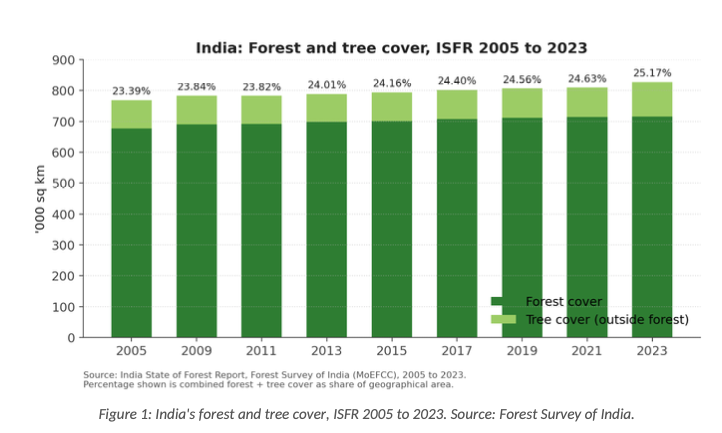
As if poverty porn of 75 years was not enough, we now have weeping tree cutting anti-development porn, which chooses to ignore a quiet fact most Mumbai tree-felling (and India wide) debates ignore: India's forest and tree cover rose from 22% of geographical area in the mid-2000s to over 25% in 2023 (ISFR 2023).
English
लक्ष्य retweetledi

She didn’t choose between History and AI… she mastered both.
From decoding ancient manuscripts to publishing 4 research papers in 18 months, this is Shagun Dwivedi’s story 👇

English