

Luddskunk
127 posts

Can anyone explain to me how I reactivate my Azure account.
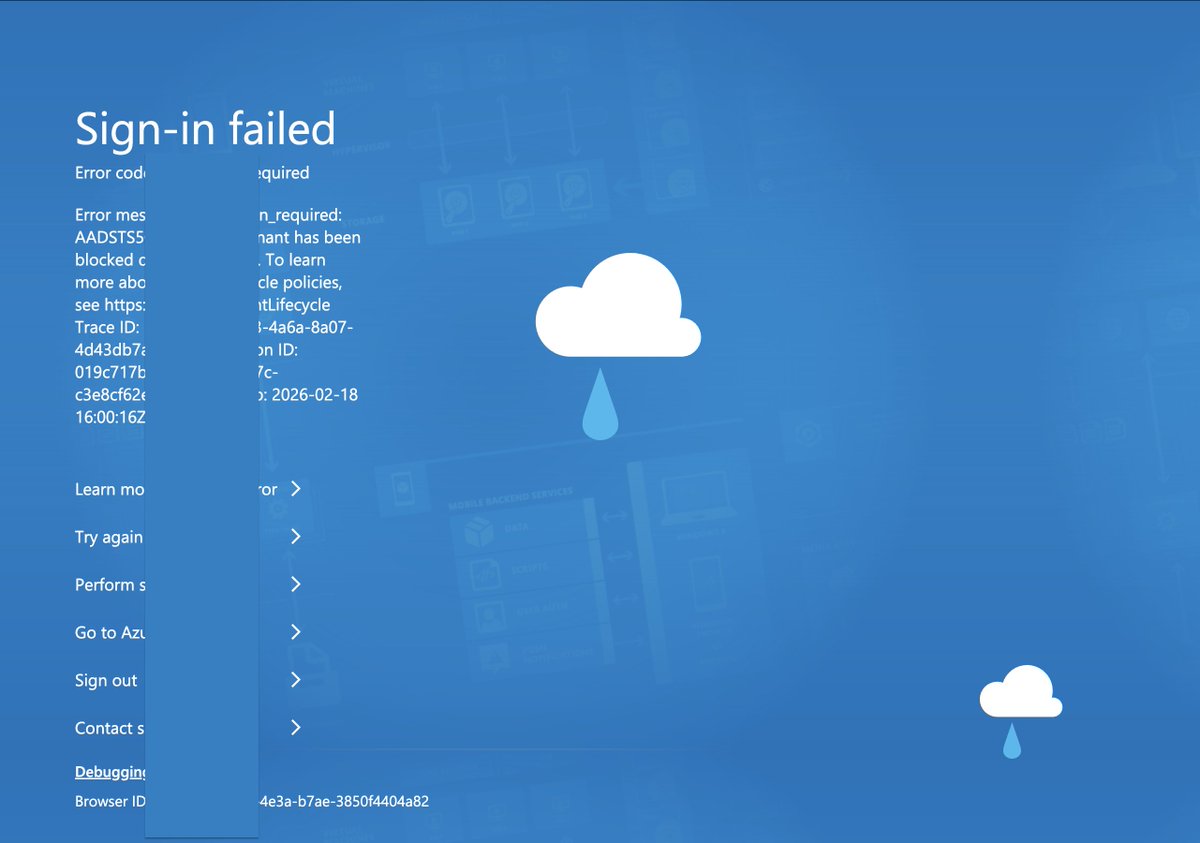
"Blocked due to inactivity"
Fine. but now I´ve even signed up to pay as you go, but whatever I do, I get to this error page.
Any ideas what I can try?
English
I´ve built a project manager bot that now manage all the gruntwork of my repositories.
AI tracks the roadmap
AI closes stale issues
AI updates the short term todos
AI review and merge pull request
AI fixes merge conflicts
AI implements new features from the current todo tasks


English
Luddskunk retweetledi

Every company should create an internal benchmark measuring how hard it is to create a simple regional CRUD service and publish it to production with bare minimal privacy, security, compliance, and observability features in place.
English

I'm looking for some feedback from #OpenTelemetry users and implementers on Trace and baggage propagation in #dotnet...
Are the issues here something you know exist, and do you care?
github.com/open-telemetry…
English
I want a tool that will record (on separate tracks)
* Lots of webcams/video capture
* Desktop/screen
* Cursor
* Audio from Microphones
* Audio from other sources
I get Camtasia does most of it, and I'd pay for it if I could export each as a separate track, in original quality
English
OpenTelemetry and metrics people.
If I were to calculate 95th percentile from a histogram manually.
I can´t just take the last 5% highest values from the series.
I would have to split the series up into time buckets first.
and then do this percentile computation within each bucket?
English
@luddskunk @MartinDotNet Didn´t you and me do exactly this like a year ago? :-)
I have some vague memory of that file
English
Is it possible to debug the reply of an exporter in dotnet? I just send traces, fingers crossed, and nothing shows up. I would like to understand if the grafana cloud env I'm sending towards answer something?
@MartinDotNet @RogerAlsing
English
English
@luddskunk @RogerAlsing martinjt.me/2023/07/14/i-f…
I wrote a post about how to get otel diagnostics into logs.
English
@MartinDotNet @mipsytipsy "Metrics, prometheus' data model requires ordered data, so it needs to be in control of the ordering, and therefore scraping is only way."
Not entirely true as you got prometheus.io/docs/practices…
English
@luddskunk @mipsytipsy Since traces came after, I suspect that there wasn't an easy place for them?
Metrics, prometheus' data model requires ordered data, so it needs to be in control of the ordering, and therefore scraping is only way.
English
Why is the standard to send traces, but scrape logs and metrics?
@mipsytipsy @MartinDotNet
English
@MartinDotNet @mipsytipsy Thanks for a great answer!
#what_about_codestdoutcode" target="_blank" rel="nofollow noopener">honeycomb.io/blog/twelve-fa…
Do I understand your text correctly that you prefer pushing logs over scraping?
English
Luddskunk retweetledi

@Zamboni86 @samwhoo @aantn Running DNS __in the cluster__ was ALWAYS meant to be an example of DNS integration, not a full solution. Like many such cases, there is nothing more durable than a quick hack.
IM(NS)HO, the way GKE does DNS offload to CloudDNS is _much_ better, especially for managed offerings.
English
Luddskunk retweetledi


@davidfowl open.spotify.com/episode/3GB0uB…
@edapted talks about logging in Grafanas Big Tent podcast
English

Hot take of the day: Logging JSON to the console is a really bad way to collect structured logs. Leave the console in a compact human readable format, and use a more efficient format for pushing structured logs out of your services.
English
Luddskunk retweetledi

Let's talk #LoadBalancing in Azure! 🚀
Azure Load Balancing services can be categorized as global or regional, and HTTP(S) or non-HTTP(S). This post will guide you on how to optimize your resource use, maximize throughput, and ensure high availability. Stay tuned! 🚀
Global services distribute traffic across regional back-ends, while regional services distribute traffic within a region.
🌍 Azure #FrontDoor provides global load balancing and site acceleration for web applications. Azure #TrafficManager is a DNS-based load balancer distributing traffic optimally across global Azure regions.
- learn.microsoft.com/en-us/azure/fr…
- learn.microsoft.com/en-us/azure/tr…
🎯 Azure #ApplicationGateway is a web traffic (OSI layer 7) load balancer that enables you to manage traffic to your web applications. Azure #LoadBalancer is a high-performance, ultra-low-latency load balancer for all UDP and TCP protocols.
- learn.microsoft.com/en-us/azure/ap…
- learn.microsoft.com/en-us/azure/lo…
🌐 HTTP(S) services like Azure #ApplicationGateway and Azure #FrontDoor are ideal for web applications, offering features such as SSL offload, web application firewall, and path-based load balancing.
- azure.microsoft.com/en-us/products…
- azure.microsoft.com/en-us/products…
🖥️ Non-HTTP(S) services like Azure #LoadBalancer and Azure #TrafficManager handle non-web traffic. They're recommended for distributing workloads across multiple computing resources, from virtual networks to virtual machines.
- azure.microsoft.com/en-us/products…
- azure.microsoft.com/en-us/products…
In summary, Azure's load-balancing solutions boost performance, manage traffic, and ensure high availability. They're vital in any resilient and scalable cloud-based application architecture. 💪
Thanks for sticking around! If you found this post helpful, please retweet and follow for more insights into #CloudComputing and #Azure. Let's keep learning together! 🔄🚀
🔽 Reference Diagram:
learn.microsoft.com/en-us/azure/ar…
#Azure #Cloud #MicrosoftAzure #MVPBuzz #LoadBalancing #AzureTips

English
Added a cluster member heartbeat status indicator to the @ProtoActor dashboard.
the little heart indicates how long since the last heartbeat from this member.
In the video, we ungracefully stop a node. and watch it time out.
English