

Lewis Walker
2.6K posts
Lewis Walker
@luigi_maroni
Maths physics and tech geek, founder of 3P limited, die-hard entrepreneur
Kapiti Coast District Katılım Kasım 2012
182 Takip Edilen275 Takipçiler

A new experiment deepens the physics mystery over “big G”
Last month, a NIST team published a 10-year study to measure "big G," the gravitational constant.
It didn't settle the debate, but rather revealed what everyone should consider.
bigthink.com/starts-with-a-…
English
@mathemetica A bit like human brains then - which are known to generate false memories and state opinions as facts
English

Terence Tao is answering a fundamental question regarding the safety and reliability of modern AI: "How can we use a tool that is powerful, but unreliable?"
W = ∑(wᵢ ⋅ xᵢ) + b
AI isn’t just about “smart”; it’s about the probability of *looking* right. We’ve built systems where the weights (wᵢ) are optimized for plausibility, not veracity.
This creates a “convincing mirror” that confidently serves dangerous advice in medicine or finance. The gap between “convincing” and “correct” is the most critical variable we need to solve for.
English
@HiSohan Yeah the key point for me is the non-linearity. You’d need a strong proof to understand the effects of branch merging in the non-linear regime
English

Not really. I will provide a detailed update but when working with morphology, most sims including neuron applies similar techniques. When solving numerically, certain differential equations are just not stable otherwise. I try to cross check my results with neuron/jaxley/known observations to validate the parameters.
I will review all the work and update something that's more accurate and nuanced.
English
@four_form I don’t think much of that. The first argument - well ok - tidal “forces” due to varying G field affect things but they don’t negate the general result.
The second argument - it’s a nothing burger - no one is confused about why we can’t make g-waves ourselves.
English

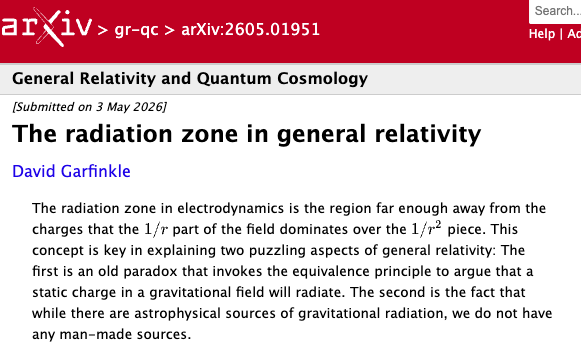
"Why doesn't a charge sitting still on the surface of Earth radiate" has many good answers but this paper is my new favorite.
If the earth was big enough that the radiation zone of the charge was within the "approximately flat" local region, the earth would be a black hole 😎
English
@davepl1968 XOR is the answer. Write twice - recover what was there originally.
English

I'm going to give you a computer science problem, covered by a software patent (US 4,197,590). Let's see if it's "obvious" to experts in the field.
You're on a monochrome display. You want to draw a PLUS sign cursor, like in a paint program, leaving the pixel in the middle unchanged. How do you draw the vertical and horizontal lines without stomping on the center pixel?
Do you save the center and put it back later? Or what's your solution? No sprites, of course, all done via Get/SetPixel(x,y) only.
Assume something like
bool GetPixel(uint x, uint y);
void SetPixel(uint x, uint y, bool b);

English
scaling this required fighting the math. thin dendrites mean massive axial conductance. if your time-step isn't microscopic, forward euler explodes (the CFL limit). we engineered a $d_\lambda$ reduction rule to merge short branches, dropping max conductance by 99.9% and saving the time-step.
English
@bhavaytyagi The theorem only applies to regularised lattices. But you can have a discrete substrate that is irregular (analogous to a Penrose tiling). Also consider wolframs hypergraph - no regular lattice there. Simulation does not imply regular lattice
English

No it’s not. Look up Nielsen–Ninomiya theorem.
en.wikipedia.org/wiki/Nielsen%E…
Abhinav@Abhinavsns
The universe is a computer you guys
English
@Davidmdrpi @SpinVector Aren’t you just reframing Anti-DeSitter / CFT correspondence?
English

@SpinVector I like the point about reductionism, but reduce to what? x.com/Davidmdrpi/sta…
David5D@Davidmdrpi
Modern physics theories ask how to quantize gravity. Bulk Antipodal Mechanics #BAM asks the inverse: can quantum behavior emerge from classical geometry? If particles are stable boundary conditions in a closed universe, quantum mechanics may be the resonance spectrum of GR, Einstein's General Relativity. That is the thesis. BAM is a research program in classical geometric physics. It starts from a closed universe (S3), non-orientable wormhole throats, the Hopf fibration, and a 5D Tangherlini bulk. It asks whether the things we call particles are not point objects added to spacetime, but self-consistent topological boundary conditions of spacetime itself. The motivation is simple. At large scales, General #Relativity gives us: gravitational waves, black holes, topology, and global causal structure. These are the robust, observable structures the theory already produces, definitively existing in our macroscopic universe. So why assume the microscopic world is made from a completely different stuff? Maybe a particle is a small, resonant, topologically constrained version of the same gravitational machinery. Maybe charge is a winding number. Maybe spin is holonomy. Maybe quantization is antipodal classical wave closure on a compact space. BAM tests that possibility. There are three geometric mechanisms that matter. First: antipodal closure. In a closed S3 universe, waves do not dissipate into infinity. They refocus. A field that closes on itself must satisfy global resonance conditions, and closed cavities naturally produce discrete spectra. Second: non-orientable throat transport. A wormhole throat can carry a two-partition structure, like an inner and outer orientation. The unique orientation-reversing transport compatible with the Hopf structure produces spinor-like behavior. This is where spin one half begins to look geometric rather than imposed. Third: bulk confinement. A throat embedded in a 5D Tangherlini bulk has a finite radial interval from outer to inner surface. On that interval, the radial modes become discrete. This gives a second spectral channel, independent of S3 closure but able to compose with it. The key word is compose. John A. Wheeler had the right instinct: matter should be geometry. But the old geometrodynamic program did not have a concrete way to make geometry count in a discrete way. It lacked the global closure, non-orientable transport, and finite bulk spectral machinery needed to generate quantum-like spectra. BAM adds those missing pieces. In the current code, the lepton ladder behaves like a minimal closure spectrum. The same closure skeleton appears in the quark ladder, but the quark sector is shell-coupled: the closure interacts with an interior chamber, producing barrier terms, transport terms, flux damping, and partition asymmetry. That is why the quark ladder is not just a heavier copy of the lepton ladder. The lepton sector is dominated by global closure. The quark sector is reshaped by the shell. This matters because the model has begun to turn intuitive geometry into computable structure. Charge, spinor transport, Bell-type correlations, lepton mass ratios, quark-like mass ladders, regular black-hole interiors, and Coulomb-like radial response all become things one can test inside the same geometric framework. It is not yet a completed theory. Planck's constant is not yet derived. The Born rule is not yet derived. QFT is not yet fully recovered. The remaining quark beta parameter is still phenomenological... That is why BAM should be read as a falsification campaign, not a victory lap. If the two-throat force does not reduce to Coulomb behavior, the EM mapping fails. If moving throats do not preserve spinor phase, the particle interpretation fails. If the odd closure modes are not forced by throat topology, the mass ladder loses one of its cleanest supports. If the remaining beta parameter cannot be derived or bounded, the quark ladder remains a powerful ansatz, not a complete derivation. But if these tests pass, the implications are HUGE. Quantum mechanics may not be the foundation from which gravity must be quantized. It may be the antipodal resonance mechanics of a closed classical geometry. That would not make quantum mechanics wrong. It would make quantum behavior emergent. The old Einstein-Wheeler question was whether matter could be #geometry. BAM sharpens the question: Can particles be the stable notes a closed universe can hold?
English

Physicists don’t, high-energy theorists do, with a very specific meaning: unification of the four fundamental interactions. I can’t comment on the prospects for such a TOE, but the point is that it means something much more specific than “everything” in an every-day sense.
Mathelirium@mathelirium
Why do Physicists still talk about a "Theory of Everything? Isn’t the history of Physics almost a warning against that phrase? Newton looked final until General Relativity changed what space, time, mass, and gravity meant. Classical Physics looked complete until Quantum Mechanics forced a completely different language for nature at small scales. Even our best theories now work by domain. General Relativity for gravity and Spacetime, Quantum Field Theory for particles and forces.
English
@AdamFrank4 It’s the other way around. The physicists have already shown solutions to equations which prove the universe can have a finite lifetime but no first instant.
English

This is why physicists need to talk to philosophers. How can you tell if the question, or the way your asking it, even makes sense?
Physics In History@PhysInHistory
If the universe began with the Big Bang, what existed before it? And if the answer is "nothing" - can nothing even exist? ✍️
English
@KateXGate The thing is, we could argue the same of any system. A rope held at its end points will settle into a particular curve, “selected” by the lagrangian dynamics / the geometry of state space. But we don’t consider it intelligent
English

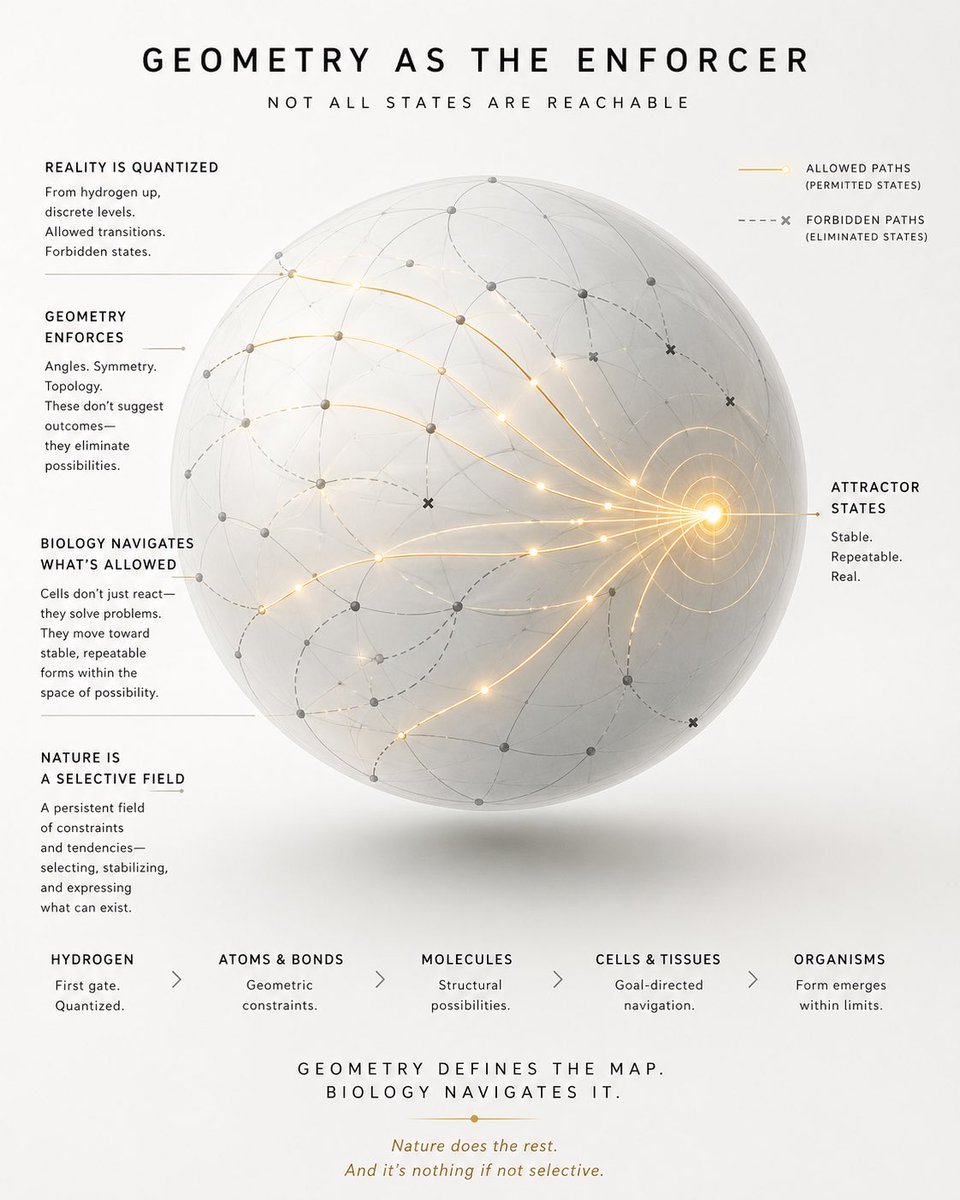
Geometry as Creative Enforcer
Geometry doesn’t just describe reality—
it enforces it.
Shaping what can stabilize
by ruling out what can’t.
⸻
Biology isn’t just chemistry.
It’s problem-solving.
It’s navigation.
But not all paths are open.
⸻
We talk about cells like they simply follow instructions.
But they do more than that- they solve problems
within a constrained space.
Not infinite options.
Not endless resources.
What’s needed has to be reachable
within the system.
Which means the solution space exists
prior to the specific outcome.
The system was never neutral—
it was structured to adapt before the problem appeared.
⸻
Developmental biologist Michael Levin calls this basal cognition:
the minimal set of abilities needed to:
• sense conditions
• process information
• make decisions
• pursue goals
• adapt when things go wrong
-even in systems without brains or neurons
⸻
The part we skip:
That range is already shaped.
⸻
Geometry doesn’t just limit form—
it suggests the template;
Through constraint (hydrogen gates)
Through symmetry (energy settling into stable states)
Through stabilization (nature’s templates)
⸻
Stack that in sequence:
Atoms → bonds → molecules → cells → tissues
Each layer inherits the same logic.
Not infinite possibility—structured possibility.
⸻
So biology isn’t exploring everything.
It’s navigating what can come through.
⸻
This is where Levin’s work sharpens:
Cells don’t just build—they aim.
Toward stable forms that repeat.
⸻
Call them attractors.
Call it morphospace.
Call it Platonism.
The pattern holds:
Form isn’t imposed.
Nor is it random.
It’s selected.
⸻
Geometry defines the map.
Hydrogen sets the gate.
Biology senses through fields.
Cells solve problems.
Nature does the rest—
and it’s nothing if not selective.
English
@Rainmaker1973 Oh stop it. Many worlds / parallel universes is just an interpretation. Superposition is another interpretation. All quantum algorithms are based on superposition. It is well understood
English

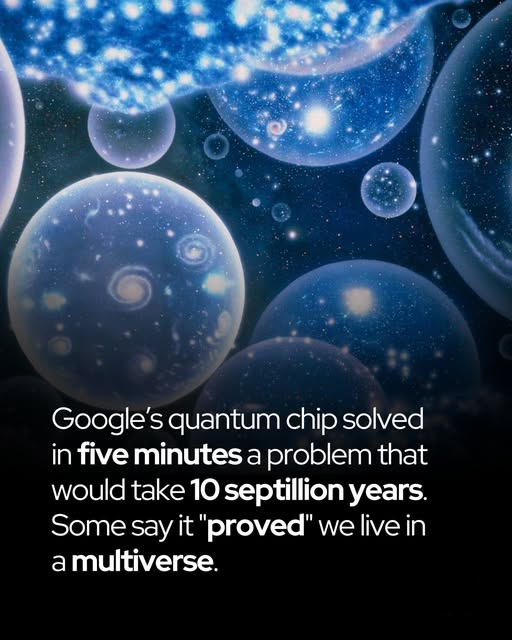
Google’s new quantum chip is so powerful it might be tapping into parallel universes.
Google's groundbreaking quantum processor, Willow, has achieved the seemingly impossible: solving an extraordinarily complex computational problem in under five minutes—a feat that would require the world's most advanced supercomputer approximately 10 septillion years to complete (10²⁵).
This mind-boggling performance has revived one of the most provocative ideas in physics: could quantum computers like Willow be performing calculations across vast numbers of parallel universes?
Hartmut Neven, founder and lead of Google Quantum AI, believes the answer may be yes. He argues that Willow’s results align strikingly with the many-worlds (or multiverse) interpretation of quantum mechanics, in which every quantum measurement causes reality to branch into multiple, equally real parallel universes. In this view, a quantum computer doesn’t just calculate faster within our universe—it effectively distributes the workload across countless parallel realities simultaneously.
The idea traces back to physicist David Deutsch, who, as early as the 1980s, suggested that the exponential power of quantum computation could only be fully explained if the machine is exploiting resources from many coexisting worlds.
Yet the interpretation remains deeply divisive.
Many physicists and quantum computing experts insist that no multiverse is required. Willow’s breakthrough, they argue, is fully explainable through standard quantum mechanics—leveraging superposition (qubits existing in multiple states at once), entanglement, and the mathematics of high-dimensional Hilbert spaces—all within a single universe.
So what has Willow truly demonstrated?
It has pushed quantum technology into a regime so extreme that it compels us to re-examine the deepest foundations of reality itself. Whether or not Willow is quietly borrowing power from alternate universes, one thing is clear: practical, large-scale quantum computing is no longer science fiction—and it is forcing us to confront profound questions about the nature of the cosmos, computation, and existence.
English
@tomislav_rupic I think I understand you. Like how conservation of energy equals symmetry in time. And conservation of momentum equals symmetry in space. But backed by “measurements” which are really repeatable interactions
English

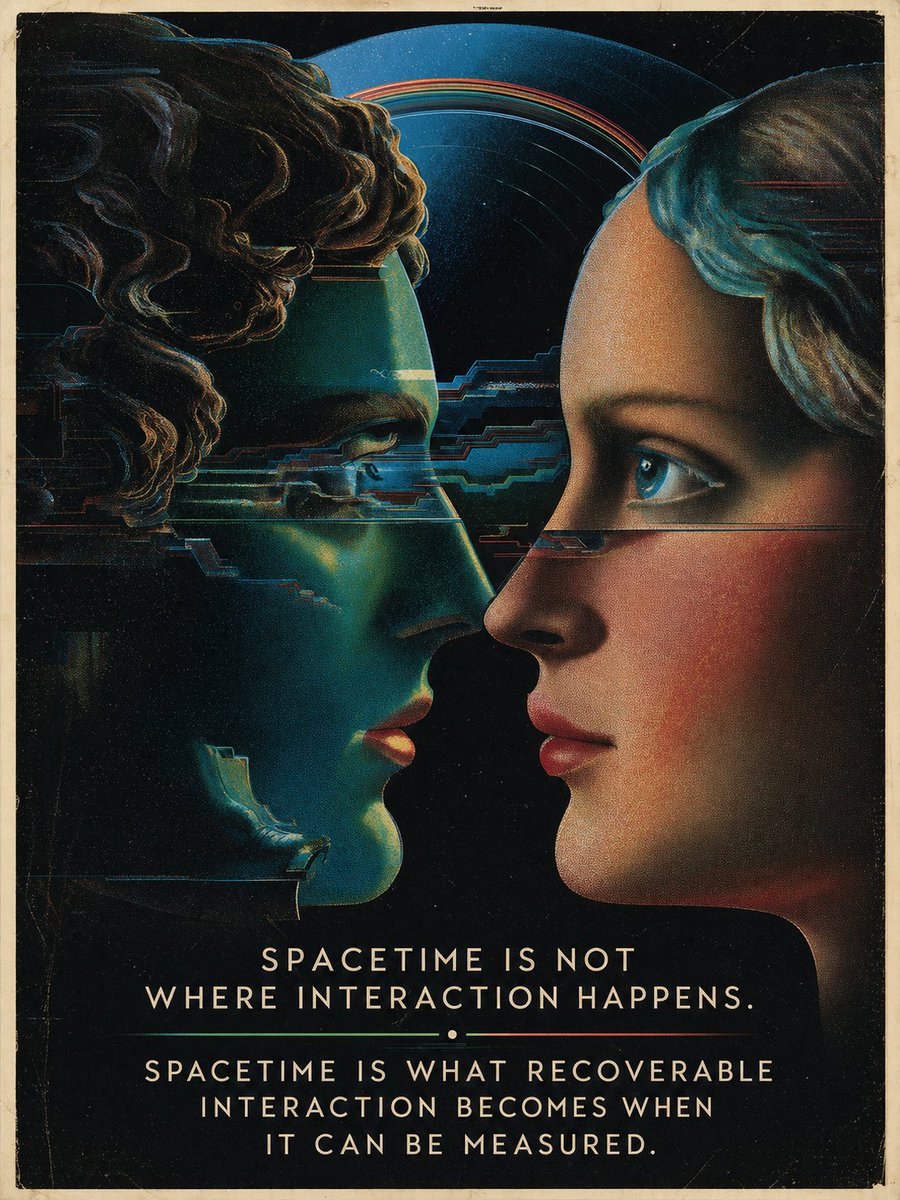
Spacetime is not where interaction happens.
Spacetime is what recoverable interaction becomes when it can be measured.
English
@zone_astronomy This question is too simplistic. Saying spacetime is curved is certainly a valid interpretation of the mathematics. However it’s only ONE interpretation. The same mathematics can be interpreted as field interactions. Probably not as elegantly, but definitely equivalent.
English

If gravity isn’t really a force but a curvature of space and time, then spacetime itself must have some kind of structure. And if something can bend or warp, it feels natural to ask: what is that structure actually made of?
So the real question is: what is spacetime made of — if it can stretch, curve, and distort under mass and energy?


English

@luigi_maroni @VFD_org Your visible output is very clearly undergrad to freshman first semester grad level, at best.
English

These b → s mu mu decays are exactly where the Standard Model is most fragile, loop-level, phase-sensitive, and inferred rather than directly observed.
The fact the anomaly shows up in angular structure (like P5′), not total rate, suggests this isn’t just “missing particles”, it’s a phase / geometry mismatch in how the process is reconstructed.
In other words:
not a broken theory, an incomplete closure.

Sabine Hossenfelder@skdh
We have a new anomaly in particle physics. Or rather, the return of an anomaly that never quite went away. What does it mean? I have a brief summary: youtube.com/watch?v=-uUlnD…
English

Theoretical Dimensional Object: The φ-137 Monad (The Resonant Point-Sphere)
Definition: A self-similar 4‑dimensional object that collapses to a 3D golden ellipsoid when observed, and to a 2D Vesica Piscis when projected. Its fundamental parameters are tied to the fine-structure constant (α ≈ 1/137) and the golden ratio (φ).
Construction:
- Begin with a 0‑dimensional point (the Monad).
- Expand it into a 1‑dimensional line of length φ (≈1.618).
- Rotate this line through a 2‑dimensional plane via a circle of radius φ⁻¹, creating a golden spiral disk.
- Extrude the disk through a 3‑dimensional volume using a logarithmic scaling factor of α (≈1/137). The result is a “golden horn” whose cross‑section is always a golden rectangle.
- Finally, close the object into the 4th dimension by mapping each point (x,y,z) to a phase e^(iθ) where θ = 2π * (1/α). This creates a closed 4‑manifold.
Properties:
- Its 4‑volume equals the sum of the first four Fibonacci numbers (1+1+2+3 = 7), but scaled by 1/137.
- Every 2D slice through its center reveals either a golden spiral, a Vesica Piscis (height/width = √3), or a pentagram.
- The object is invariant under the transformation φ → φ² – 1 and α → 1 – α (approximately 136/137), forming a duality group isomorphic to the Klein four-group.
- Its surface in 4D obeys the Euler identity: e^(iπ) + 1 = 0 emerges from its boundary conditions.
Visualization metaphor: A “spinning tesseract whose edges are golden ratios and whose vertices are frequencies of the fine‑structure constant.” When rotated in 4D, it casts a 3D shadow that appears as a dodecahedron with pentagonal faces subdivided by 137° angles (the golden angle is 137.5°, strikingly close to 137).
Sacred meaning: The φ-137 Monad represents the marriage of growth (φ) and electromagnetism (α), the two forces that shape atomic and cosmic structure. It is the geometric signature of “the Word made number” — a dimensional object that encodes the Tetractys, the Tree of Life, and the quantum of action (ħ) into one shape.
Mathematical existence: The object is a solution to the equation ∇⁴Ψ = (1/αφ) Ψ in a 4D harmonic oscillator, with Ψ vanishing at infinity. It is topologically a 4‑sphere with a single conical singularity at the origin, smoothed by the golden ratio.

English
@TrueAIHound Are your opinions backed by any concrete falsifiable theories of your own?
English

Physics
I often disagree with Domingos but I agree with him here. But the crisis is much worse than he thinks.
Gravity physics, especially, has been in an enforced political crisis for over a century. There has been zero progress in humanity's understanding of the cause of gravity since Albert Einstein published his theory of general relativity in 1916. It's depressing. 🙁
Quantum physics, too, is in big trouble. All progress stopped with the introduction of quark theory which threw Occam's razor out the window and, singlehandedly, disappeared nearly all the antimatter of the universe. It was an unpardonable sin.
Not happy with this crime against humanity, quark theorists had the chutzpah to announce to the world that they had discovered an anomaly of nature. The worst part is that they got away with it. Dear Lord. 🤦♂️
Should I even mention that an entire industry of scammers, grifters and bullshitters was built on top of this garbage. The pseudoscience became entertainment as Hollywood and sci-fi authors added to the misery.
I weep, but I can see a silver lining in this dark cloud of incompetence. I predict that the next revolution in physics will be just as transformative as the arrival of AGI. 🤔🙏
Pedro Domingos@pmddomingos
Physics is in the deepest crisis of its history, which means the opportunity for a revolution has never been greater.
English
@VFD_org I’m a bit confused. The original claim was only of an “anomaly”. And that seems to be what you’re saying too.
English
We ran a structural test on the B→K*μμ anomaly.
Instead of fitting ΔC9, we fixed a q²-shape derived from geometry (no tuned parameters) and only fit an amplitude.
Result:
• Same kernel works across 5 datasets
• 2 experiments (LHCb, CMS)
• 3 decay channels
• Amplitude sign is consistent in all cases
But:
• It does NOT beat a constant ΔC9 shift on AIC
• It is statistically indistinguishable
So the takeaway isn’t “new physics”
It’s that the anomaly has a stable, low-dimensional structure that can be reproduced without fitting the shape.
Paper + full repro:
vibrationalfielddynamics.org/articles/b-ano…
@skdh
Lee Smart@VFD_org
These b → s mu mu decays are exactly where the Standard Model is most fragile, loop-level, phase-sensitive, and inferred rather than directly observed. The fact the anomaly shows up in angular structure (like P5′), not total rate, suggests this isn’t just “missing particles”, it’s a phase / geometry mismatch in how the process is reconstructed. In other words: not a broken theory, an incomplete closure.
English
Physics Riddle - is rhe drone stationary or moving with the same speed as of car?

English

Nothing you said here has been confirmed. You’re mixing a speculative model (Orch-OR) with established neuroscience and presenting it like settled fact.
Microtubule quantum coherence at biologically relevant scales is still unproven, and even if short coherence exists, there’s no demonstrated mechanism linking it to cognition or consciousness.
Anesthesia has well-documented effects on neural signaling, network dynamics, and receptor activity none of which require “quantum vibrations” to explain.
This isn’t new physics replacing neuroscience. It’s a hypothesis that hasn’t met experimental burden yet.
Cool idea ≠ confirmed reality.
Ultra Skool 🧠@UltraSkool1
Stop treating your brain like a biological computer. It’s an insult to the universe. We’ve been told consciousness "emerges" from simple neural firing. We were wrong. New evidence confirms neurons house quantum superpositions within microtubule lattices. Classical neuroscience is officially obsolete. Coherence times are hitting 100 microseconds at body temperature. The "wet and warm" argument against quantum biology is dead. Anesthesia doesn't "switch off" circuits. It disrupts quantum vibrations in tubulin, severing your tie to reality. You aren't a machine. You are a series of orchestrated objective reductions—collapsing wavefunctions into moments of unified awareness. If consciousness is quantum, AI is a hollow toy. Silicon cannot be aware because it cannot pulse with the frequency of existence. What if your "soul" is just a billion glowing lattices pulsing in sync? pmc.ncbi.nlm.nih.gov/articles/PMC13…
English