

Luis Valdez
42 posts
Luis Valdez
@luismvmf
developers developers developers developers developers developers
London, UK Katılım Şubat 2022
79 Takip Edilen14 Takipçiler
Question for @RepoPrompt , i'll ask it publicly.
Opus 4.6 + /rp-review (w codex) an enormously powerful workflow. With a good engineer at the wheel and this workflow, it's possible to ship quality.
My question is now:
Is /rp-build an upgrade to this workflow? If so, why?
English


Introducing Rork Max
AI that one-shots almost any app for iPhone, Watch, iPad, TV & Vision Pro. Even Pokémon Go with AR & 3D.
Max is a website that replaces Xcode. Install on device in 1 click. Publish to App Store in 2 clicks.
Powered by Swift, Claude Code & Opus 4.6.
English
@ryolu_ Someone will create a skil out of this and have claude code come up with the system guardrails and guidelines
English

software is still about thinking
software has always been about taking ambiguous human needs and crystallizing them into precise, interlocking systems. the craft is in the breakdown: which abstractions to create, where boundaries should live, how pieces communicate.
coding with ai today creates a new trap: the illusion of speed without structure. you can generate code fast, but without clear system architecture – the real boundaries, the actual invariants, the core abstractions – you end up with a pile that works until it doesn't. it's slop because there's no coherent mental model underneath.
ai doesn't replace systems thinking – it amplifies the cost of not doing it. if you don't know what you want structurally, ai fills gaps with whatever pattern it's seen most. you get generic solutions to specific problems. coupled code where you needed clean boundaries. three different ways of doing the same thing because you never specified the one way.
as Cursor handles longer tasks, the gap between "vaguely right direction" and "precisely understood system" compounds exponentially. when agents execute 100 steps instead of 10, your role becomes more important, not less.
the skill shifts from "writing every line" to "holding the system in your head and communicating its essence":
- define boundaries – what are the core abstractions? what should this component know? where does state live?
- specify invariants – what must always be true? what are the constants and defaults that make the system work?
- guide decomposition – how should this break down? what's the natural structure? what's stable vs likely to change?
- maintain coherence – as ai generates more code, you ensure it fits the mental model, follows patterns, respects boundaries.
this is what great architects and designers do: they don't write every line, but they hold the system design and guide toward coherence. agents are just very fast, very literal team members.
the danger is skipping the thinking because ai makes it feel optional. people prompt their way into codebases they don't understand. can't debug because they never designed it. can't extend because there's no structure, just accumulated features.
people who think deeply about systems can now move 100x faster. you spend time on the hard problem – understanding what you're building and why – and ai handles mechanical translation. you're not bogged down in syntax, so you stay in the architectural layer longer.
the future isn't "ai replaces programmers" or "everyone can code now." it's "people who think clearly about systems build incredibly fast, and people who don't generate slop at scale."
the skill becomes: holding complexity, breaking it down cleanly, communicating structure precisely. less syntax, more systems. less implementation, more architecture. less writing code, more designing coherence.
humans are great at seeing patterns, understanding tradeoffs, making judgment calls about how things should fit together.
ai can't save you from unclear thinking – it just makes unclear thinking run faster.
English
Create eslint rule that on big files (500 lines plus) outputs it as a warning and recommends using vercel composition patterns skill (or equivalent for your stack)
English
@antirez @RepoPrompt does this but better. Promise you won't regret it
English

If you explain how to do it, Claude Code is able to use Codex when it is incapable of solving certain issues. This way you have the best of both worlds.
Here is the skill file that lets Claude use Codex.
gist.github.com/antirez/2e0772…

English
@spsbuilds @vercel My slash command? I use my slash command to initialise my AGENTS.md based on this article. I tell it what skills I want compressed, he does it and creates the AGENTS.md index. Works well
English


We're experimenting with ways to keep AI agents in sync with the exact framework versions in your projects. Skills, 𝙲𝙻𝙰𝚄𝙳𝙴.𝚖𝚍, and more.
But one approach scored 100% on our Next.js evals:
vercel.com/blog/agents-md…
English
@spsbuilds @vercel you create a doc index. It's written in the article. I've created a slash command to do this for whatever skills I want for a particular project
English
@solidoxx @RepoPrompt i just give it my suspicions sometimes but not always
English

@luismvmf @RepoPrompt Did you preload any specific files (code) in the context before the prompt? Or did it do its own codebase navigation?
English
Sharing because good tools deserve sharing
6 prompts in claude code and it couldn't find the bug.
1 prompt with /rp-investigate-cli (@RepoPrompt ) and bug is gone. That's the power of having an AI prompt another AI that has a clean context window and a targeted problem to solve
English
@pvncher @kr0der @RepoPrompt It does that extremely well. Targeted prompts with clean context windows perform so much better. I've stopped using claude code to code and its much more acting as my conductor for RepoPrompt's MCP
English

@luismvmf @kr0der @RepoPrompt I still think RP can be better because it separates the context windows for research + implementation.
You can dedicate a maximum of reasoning tokens to just thinking through the problem, without any tool calls interfering.
English

Codex v0.91.0 has plan mode, and it's really thorough.
this one plan took 27% of its context. if you've used Codex you know that 27% is a lot which means it's thoroughly searching before creating plans - no rushing/taking shortcuts.
try it out by adding 'collaboration_modes = true' to your config.toml

English
Just released @RepoPrompt 1.6.0
Deep Code Reviews
- Context Builder now analyzes your code with full codebase context.
- New /rp-review for comprehensive reviews and /rp-refactor for finding refactoring opportunities.
Probably the best code reviews around
English
Luis Valdez retweetledi
Compaction is death
@RepoPrompt turns deep orientation and planning into a single tool call, so your agent can ship complete features in one context window
And when compaction does hit, Context Builder re-anchors them efficiently
Big updates soon, but here's how it works today
English
@pvncher @lucasmeijer @RepoPrompt Yeah makes sense. Nothing quite compares to pro in intelligence so I guess for now I will be copy pasting
English
@luismvmf @lucasmeijer @RepoPrompt Well without browser automation, you have to paste into 5.2 pro. With browser automation, you can automatically export the prompt and give it to chatgpt to skip the copy pasting, but youre on your own doing that part.
English
When you run /rp-build with @RepoPrompt, all 3 steps are executed sequentially
1. Context builder does research and forms a dense context prompt clarifying the task and all required files
2. That prompt is handed to the plan model to formulate architecture
3. Agent builds
Der.dev 🔥🛠️@erd0xbc
workflow for coding agents
English
@pvncher @lucasmeijer @RepoPrompt But with just chatgpt pro subscription (and without breaking TOS), i guess that's not possible right?
English
That’s not outdated!
The thing this gives you is more automation.
When you paste your prompt to 5.2 pro, you get a plan returned to you, that you can then feed to a coding agent.
When you use rp-build, what happens is that the prompt you would feed 5.2 pro, is instead fed to an api model, so that the plan is automatically generated and fed back to the coding agent with the simplicity of a tool call.
It’s really just letting your agent do work you’d be doing manually.
English
@pvncher @lucasmeijer @RepoPrompt I think it's not very clear what this workflow gives you @pvncher . It's getting harder to keep up with RepoPrompt so I keep defaulting to basic of context builder and pasting into gpt 5.2 pro . Is that outdated?
English
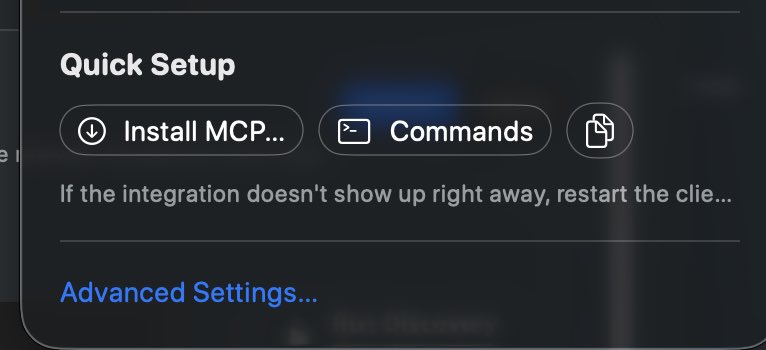
@lucasmeijer @RepoPrompt I haven’t made a video yet, but the command is automatically added to Claude code when the mcp is installed, and it’ll just work after running the rec engine.
For codex you can add it via the commands button. There’s also a cli if you don’t want to keep the mcp installed.


English
GPT 5.2 codex medium refuses to acknowledge he was wrong when debugging an issue that Opus 4.5 got right first time
Opus and Codex work well together until gpt’s personality overpowers opus
English
@pvncher I see lots of people struggling to grasp this concept Eric, a quick screen share might be useful
English
It feels really nice working with Opus 4.5 and GPT 5.1 via the Repo Prompt MCP
I just have Claude constantly plan with 5.1 and validate ideas as we go. Claude translates my rambles into coherent prompts, and 5.1 has a birds eye view of context and responds very quickly!
English