
lukedowning retweetledi
lukedowning
84.6K posts

lukedowning
@lukedowning
Civic institutions tend to grow stronger amidst civil discourse. Anna Akhmatova, Hannah Arendt, Czeslaw Milocz, Isaiah Berlin. Sits at the back of class.
Melbourne Katılım Kasım 2008
1K Takip Edilen2.1K Takipçiler
lukedowning retweetledi

asked my grandpa what he thinks about the new spotify logo and he told me he saw a man get run over by an M4 sherman tank and pulverized into jelly in korea. the rain diluted his remains into the mud and his existence was erased from history in just a few minutes
English
lukedowning retweetledi

lukedowning retweetledi

Nokia could have invented the iPhone. Three years before Apple did, a Nokia engineer walked into a meeting in Finland with a working prototype: a touchscreen phone with full internet access. Management killed it. The device looked too expensive and too risky to sell. The same year, Nokia also rejected a proposal for an online app store. Apple would launch the same idea four years later.
In 2007, Nokia controlled 40% of the world's mobile phone market and was worth more than $150 billion. By 2013, it had sold its phone business to Microsoft for $7.2 billion. The company that defined the cell phone became irrelevant in less time than it takes most kids to finish high school.
In 2016, two professors from INSEAD and Aalto University spent years interviewing 76 Nokia executives, engineers, and consultants for a research paper. Their conclusion: nobody at the company could have an uncomfortable conversation.
Senior leaders were described as "extremely temperamental." One consultant remembered then-CEO Jorma Ollila shouting at people "at the top of his lungs" in front of fifteen other vice presidents. Middle managers learned the rules fast. Bad news got you fired, so they stopped delivering it.
The engineers knew Nokia's operating system could not compete with what Apple was building for the iPhone. One design team submitted 500 separate proposals to fix it between 2001 and 2009. Not a single one got approved. When a middle manager once suggested that a colleague push back against a top executive, the colleague refused. He "didn't have the courage; he had a family and small children."
The top managers were also afraid, just of different things. They worried about looking weak to investors. So they publicly defended the old operating system while privately knowing it was dying. The middle managers heard the demand for optimism and supplied it. For four years, the people who knew the company was sinking could not get that message to the people who could do something about it.
Researchers call this shoot-the-messenger culture. It shows up in cockpit recordings before plane crashes, in hospital records before preventable deaths, and in the investigations of the 2008 financial crisis. The cost of avoiding a difficult conversation is always paid later, with interest.
Nokia's case is unusual because the math is so clean: the silence cost roughly $143 billion in market value and an entire company. The discomfort would have cost a few bad meetings.
Pengu@Penguxn
if you think uncomfortable conversations are hard wait until you see the results of not having them
English
lukedowning retweetledi

Sartre a soutenu Staline pendant le goulag. Sartre a soutenu Mao pendant la Révolution culturelle. Sartre a préfacé Fanon en transformant la violence anti-coloniale en hygiène mentale ("abattre un Européen, c'est faire d'une pierre deux coups"). Sartre est allé visiter Andreas Baader dans sa prison de Stammheim en 1974 et en est ressorti en défendant le terroriste. Sartre a signé en 1977, avec Beauvoir, Foucault, Derrida, Barthes, la pétition pour la dépénalisation des rapports sexuels entre adultes et mineurs de 13 ans.
Il faut s'arrêter une seconde sur cette liste. Parce qu'elle est sans équivalent dans l'histoire intellectuelle du XXe siècle. Il n'existe pas un seul grand basculement totalitaire ou criminel du siècle dernier que Sartre n'ait, à un moment, justifié, excusé, ou refusé de condamner. Quand le siècle a fabriqué un cauchemar, Sartre a tenu la porte ouverte.
Et pourtant, il est au programme. Du bac. De l'agrégation. Des manuels. Des thèses. Sa rue à Paris. Ses cendres au cimetière du Montparnasse, en pèlerinage. Sa statue intellectuelle intacte. On enseigne L'Existentialisme est un humanisme à des lycéens de seconde comme on enseignerait un sermon de Bossuet.
Ce n'est pas Sartre, le scandale. Sartre n'est qu'un homme (avec ses lâchetés, ses fanatismes, son théâtre intime de la radicalité). Le scandale, c'est nous. Le scandale, c'est qu'une civilisation entière ait décidé, collectivement et silencieusement, qu'être systématiquement du côté des bourreaux n'était pas disqualifiant pour devenir le grand intellectuel d'une nation.
Comparez avec Raymond Aron. Aron a eu raison sur tout. Sur Staline, sur Mao, sur les goulags, sur le totalitarisme, sur la décolonisation, sur la guerre froide, sur l'économie de marché, sur l'Europe. Tout. Il a écrit L'Opium des intellectuels en 1955, soit trente ans avant que la gauche française ne découvre, embarrassée, qu'effectivement Soljenitsyne ne mentait pas. Aron a eu la lucidité d'un siècle entier, condensée dans une œuvre limpide, écrite dans un français de précision chirurgicale.
Aron n'est pas au programme. Aron n'a pas de rue. Aron n'a pas de Panthéon. Quand on parle d'Aron, c'est avec ce petit haussement d'épaules qui veut dire "oui, intéressant, un peu froid, un peu de droite, vous savez". Sartre, lui, c'est l'incandescence, l'engagement, la jeunesse, la flamme.
La phrase de Merleau-Ponty est restée célèbre : "mieux vaut avoir tort avec Sartre que raison avec Aron". Elle n'est pas anodine. Elle est l'aveu décisif. Elle dit explicitement ce que la France cultivée a décidé tacitement pendant soixante-dix ans. Qu'avoir raison est moins important qu'être du bon côté. Que la vérité est un détail bourgeois. Que ce qui compte n'est pas la justesse de l'analyse mais la pureté de la posture.
Ce que ça révèle est terrible. Une civilisation choisit ses prophètes, et ce choix la définit pour cent ans. La France a choisi le brillant flatteur de bourreaux contre le sobre analyste de la réalité. Et elle a payé ce choix au prix fort. Une classe intellectuelle entière, formée à la révérence sartrienne, a appris que l'engagement compte plus que l'exactitude, que la générosité de surface compte plus que les conséquences réelles, qu'aimer "le peuple" en théorie autorise à mépriser les gens en pratique.
Toute la pathologie de l'intellectuel français contemporain est déjà là.
Français
lukedowning retweetledi
It seems clear the Greens membership consists of:
1. Those who don’t know or don’t want to know that their party has been taken over by extremists
2. Those who don’t agree with the extremists but are keeping their heads down for fear of getting into trouble (including some politicians)
3. Those who go along with the extremists so they can have access to power and influence in the party (including politicians)
4. Those who are keeping their heads down for now hoping for better days
5. The fundamentalists and extremists who control the key positions in the party.
I considered standing in the Qld Greens elections later in the year for convenor in an attempt to move the party away from this destructive path but I fear, given the analysis above, this would be misplaced energy on my part.
English
lukedowning retweetledi

lukedowning retweetledi

The Six Million Dollar Man episodes featuring Bigfoot in the 1970s were always wild
English

Just the pure sound of the 23litre V12 Maybach HL230 P30 engine in our Jagdpanther 411. It’s running much better, but we need to run it for longer in order to warmup properly in the near future.
English
lukedowning retweetledi

The Toltec Flood Account of Ixtlilxochitl: The 104-Year Wandering
Fernando de Alva Ixtlilxochitl (c. 1568–1648) was a nobleman of direct Texcocan royal descent in colonial New Spain, fluent in both Nahuatl and Spanish. In composing his histories, he drew upon surviving pre-Conquest painted manuscripts, oral traditions preserved by indigenous elders, and records maintained within his own family. Following his death, however, these works were not immediately published and instead circulated in manuscript form.
In the eighteenth century, Italian antiquarian Lorenzo Boturini Benaducci assembled an extensive archive of indigenous and colonial Mexican materials, including manuscripts associated with Ixtlilxochitl. The collection, formed between 1736 and 1744, was intended to serve as the documentary basis for a projected Historia de América Septentrional. It contained numerous valuable records, the majority of indigenous provenance, among them hieroglyphic paintings formerly belonging to Juan de Alva Ixtlilxochitl, a descendant of the rulers of Texcoco, who had bequeathed them to Don Carlos de Sigüenza y Góngora, before they later entered Boturini’s growing archive.
The preservation of this material was abruptly disrupted. In June 1744, after an investigation, the recently arrived viceroy, Pedro Cebrián, 5th Count of Fuenclara ordered Boturini imprisoned and his collection impounded.
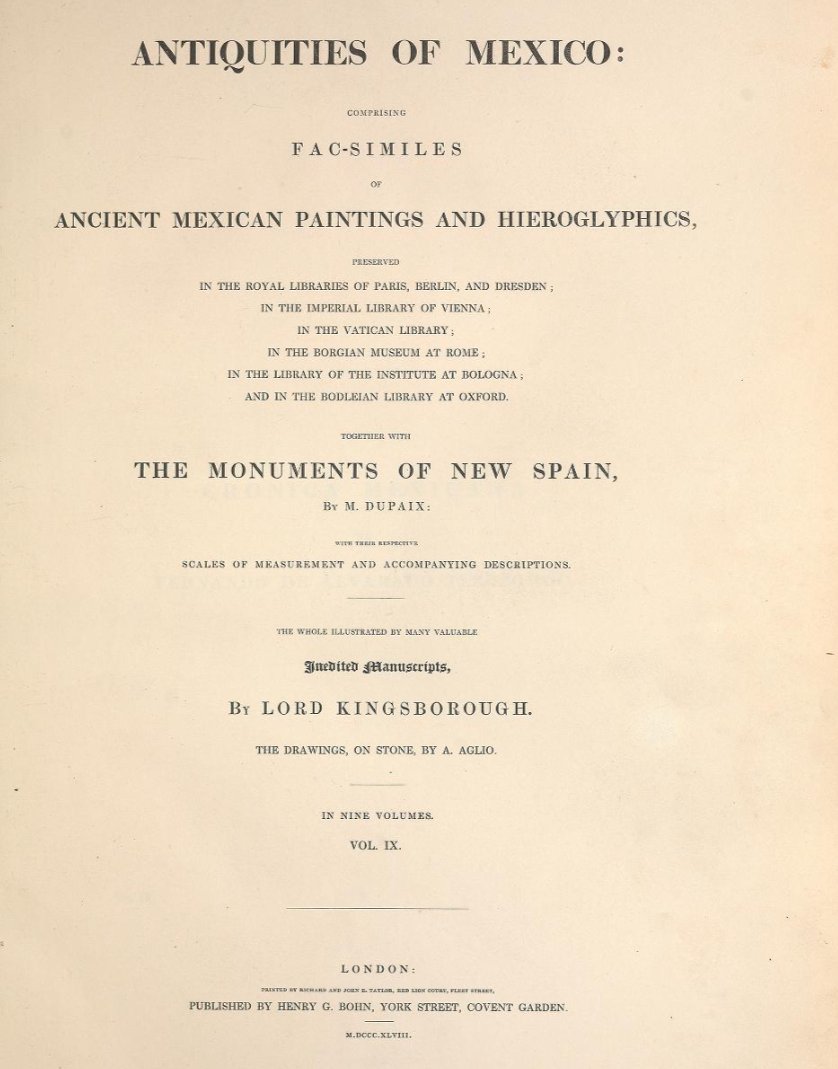
By the early nineteenth century, Ixtlilxochitl’s writings still circulated primarily through manuscript copies and transcripts. When Lord Kingsborough compiled Antiquities of Mexico (1831), he drew upon materials from collections preserved in the big royal libraries of Europe, and the Vatican Library.
The text records that the Toltecs preserved a detailed history of the creation and of a great flood. Of their knowledge, Ixtlilxochitl writes that "the Toltecs achieved knowledge of and understood the creation of the world," and that "they say that the world was created in the year of Ce Tecpatl, and this time up until the flood they call Atonatiuh, meaning the age of the sun of water, because the world was destroyed by the flood." The text records that "all the land without exception of anything was covered and submerged beneath the waters, even the highest mountains." A few survivors escaped, "inside a toptlipetlacali, which word nearly signifies a closed ark; and how after men had multiplied they built a zacuali very high, and this it is, meaning a tower of great height, in order to take refuge in it should the second world be destroyed."
The tower did not save them from a second catastrophe of a different kind. Their languages were confounded, and "not understanding one another, they went to different parts of the world." Of the scattered peoples, the Toltecs, "seven companions with their wives who understood the language," made their way to these parts, "having first passed through great lands and seas, …they wandered 104 years through different parts of the world.”
Relaciones de Don Fernando de Alva Ixtlilxochitl, in Kingsborough, Antiquities of Mexico, Vol. IX (1831), pp. 321-322: archive.org/details/Antiqu…
Fernando de Alva Cortés Ixtlilxóchitl, Wikipedia: en.wikipedia.org/wiki/Fernando_…
Antiquities of Mexico
en.wikipedia.org/wiki/Antiquiti…
Benaduci
en.wikipedia.org/wiki/Lorenzo_B…
English
lukedowning retweetledi

⛽ Daily Bulletin - Tue 19 May
Today: Trump says he postponed a strike on Iran that was set for the next day, at the request of Saudi Arabia, Qatar and the UAE, while Iran brought its Hormuz toll-and-permit authority fully online.
📊 Reserves (effective): diesel ~36d (33-39) | petrol ~46d (42-48) | jet ~33d (30-35)
🚢 56 AU-bound tankers en route, ~2,285 ML. Wider tracking: 3,749 vessels, ~111,709 ML.
📰 Today's signals
• GEOPOLITICAL: Trump posted that the leaders of Saudi Arabia, Qatar and the UAE asked him to hold off on a military attack on Iran that was scheduled for the next day, citing serious negotiations now under way. He told the Defense Secretary and the Joint Chiefs chairman to be ready for a full large-scale assault at a moment's notice if no acceptable deal is reached. CBS News, CNBC, Bloomberg.
• GEOPOLITICAL: Iran's Supreme National Security Council announced its Persian Gulf Strait Authority is now operational, the body Tehran says will manage Strait of Hormuz transits and collect passage fees, formalising a permit-and-toll system reportedly running since March. No official tariff has been published; the US, EU and maritime-law experts reject its legal basis, while Gulf states oppose Iran's control of the route. PBS, Lloyd's List, USNI.
• MARKET: Brent crude settled up more than 2 per cent at about $112 a barrel on Monday as Trump's warning that the clock was ticking for Iran fanned escalation fears, then eased back below $110 in later trade after he said the strike was postponed. CNBC.
• OPERATIONAL: The Offshore Alliance served Inpex with notice to strike at the 9.3 million tonne a year Ichthys LNG plant near Darwin at any point from 27 May to 10 June, after 326 of 346 union members voted for action. A stoppage would tighten already strained regional LNG supply. Reuters, Argus Media.
My read: this is a step back from the brink, but only a step. A day after warning Iran the clock was ticking, Trump now says he has called off a strike that was set for the next day, at the request of Saudi Arabia, Qatar and the UAE, because talks are under way. He was careful to say it is only on hold: he has told the Pentagon to be ready to hit Iran at a moment's notice if no deal lands. And on the same day, Iran made its Hormuz toll system official, so it is tightening its grip on the strait even as the military threat eases. The oil market read it that way too, easing only modestly and staying near $110. Nothing is actually settled, and the part that matters most for fuel has not moved: ships still pass through Hormuz only on Iran's terms, into a world market that is already short of oil.
English
lukedowning retweetledi

"When it comes to the stakes involved in UniParty election races, dueling hyperbole is often the essence of the matter. But not here. Not this time. Not in the fraught battle in the 4th District of Kentucky.
"The outcome of the Massie/Gallrein race on Tuesday may truly prove to be the inflection point at which, in its 250th year, the American Republic was either lost….or vindicated to thereby bestow its blessings upon generations to come."
An Election For The Ages open.substack.com/pub/davidstock…
English
@ihtesham2005 @RenovatioFurius Handwriting is also fun to do :-)
English
lukedowning retweetledi

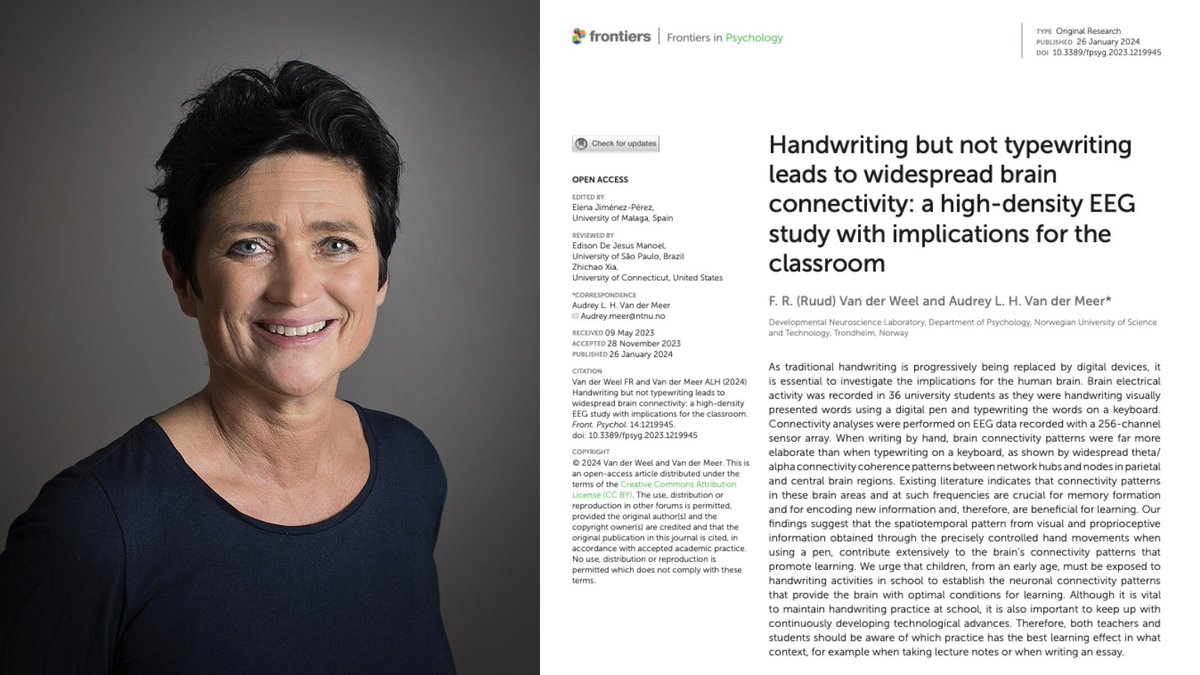
A Norwegian neuroscientist spent 20 years proving that the act of writing by hand changes the human brain in ways typing physically cannot, and almost nobody outside her field has read the paper.
Her name is Audrey van der Meer.
She runs a brain research lab in Trondheim, and the paper that closed the argument was published in 2024 in a journal called Frontiers in Psychology. The finding is brutal enough that it should have changed every classroom on Earth.
The experiment was simple. She recruited 36 university students and put each one in a cap with 256 sensors pressed against their scalp to record brain activity. Words flashed on a screen one at a time.
Sometimes the students wrote the word by hand on a touchscreen using a digital pen, and sometimes they typed the same word on a keyboard. Every neural response was recorded for the full five seconds the word stayed on screen.
Then her team looked at the part of the data most researchers had ignored for years, which is how different parts of the brain were communicating with each other during the task.
When the students wrote by hand, the brain lit up everywhere at once.
The regions responsible for memory, sensory integration, and the encoding of new information were all firing together in a coordinated pattern that spread across the entire cortex. The whole network was awake and connected.
When the same students typed the same word, that pattern collapsed almost completely.
Most of the brain went quiet, and the connections between regions that had been alive seconds earlier were nowhere to be found on the EEG.
Same word, same brain, same person, and two completely different neurological events.
The reason turned out to be something nobody had really paid attention to before her work. Writing by hand is not one motion but a sequence of thousands of tiny micro-movements coordinated with your eyes in real time, where each letter is a different shape that requires the brain to solve a slightly different spatial problem.
Your fingers, wrist, vision, and the parts of your brain that track position in space are all working together to produce one letter, then the next, then the next.
Typing throws all of that away. Every key on a keyboard requires the exact same finger motion regardless of which letter you are pressing, which means the brain has almost nothing to integrate and almost no problem to solve.
Van der Meer said it plainly in her interviews.
Pressing the same key with the same finger over and over does not stimulate the brain in any meaningful way, and she pointed out something that should scare every parent who handed their kid an iPad.
Children who learn to read and write on tablets often cannot tell letters like b and d apart, because they have never physically felt with their bodies what it takes to actually produce those letters on a page.
A decade before her, two researchers at Princeton ran the same fight using a completely different method and ended up at the same answer. Pam Mueller and Daniel Oppenheimer tested 327 students across three experiments, where half took notes on laptops with the internet disabled and half took notes by hand, before testing everyone on what they actually understood from the lectures they had watched.
The handwriting group won by a wide margin on every question that required real understanding rather than surface recall.
The reason was hiding in the transcripts of what the two groups had actually written down.
The laptop students typed almost word for word, capturing more total content but processing almost none of it as they went, while the handwriting students physically could not write fast enough to transcribe a lecture in real time, which forced them to listen carefully, decide what actually mattered, and put it in their own words on the page.
That single act of choosing what to keep was the learning itself, and the keyboard had quietly skipped the choosing and skipped the learning along with it.
Two studies. Two countries. Same answer.
Handwriting makes the brain work. Typing lets it coast.
Every note you have ever typed instead of written went into your brain through a thinner pipe. Every meeting, every book highlight, every idea you captured on your phone instead of on paper was processed at half depth.
You did not forget those things because your memory is bad. You forgot them because typing never woke the part of the brain that would have made them stick.
The fix is the thing your grandmother already knew.
Pick up a pen. Write the thing down. The slower road is the faster one.
English
lukedowning retweetledi


lukedowning retweetledi

lukedowning retweetledi

Este es Henry. No pudo resistirse a colarse en la jaula de su hermano en recuperación. Acaba de ser operado en el veterinario para recibir ánimos y el abrazo más reconfortante. ¡El amor verdadero no tiene límites! Hermanos para toda la vida. Por favor, dejen un corazón para ambos🐶💖
Español

Kingpin (1996) – The tragicomic journey of a fallen bowling prodigy, a rubber hand, and a bitter comeback in the darkly hilarious world of the Farrelly brothers
Love Classical Music and Movies 🎺🎻💖🎥🎬@AlexTran677026
Name a comedy that never fails to make you laugh.
English