
tom
7.7K posts


tom
@machinchick
I write about robots, automation, and engineering in general. Part time artist. Prefer dogs over people most of the time.
north america Katılım Haziran 2008
1.8K Takip Edilen379 Takipçiler


@machinchick @crysbeats @MbarkCherguia That's also a good way to become the next target. Grabbing the hind legs isn't always smart.
English

What's the best way to handle this situation?
English
@crysbeats @MbarkCherguia Grab the back legs and lift. That ends it fast. Then hold on.
English

@MbarkCherguia Pick the dog up by its hind legs and lift. He will let go immediately. Then hold on.
English
@EvanRossFL @CoachDanGo I take it with about 8 oz of lemonade. for some reason it doesn't dissolve right away in the lemonade so it goes down easier and the lemon tastes better than taking with water alone.
English

@CoachDanGo I find it to taste horrible, did you just get over that?
English



İlk buluşmada aracına aldığı genç kızın Rolls Royce kapı kapatma tuşunu bildiğini gören adam, kızın arabadan inmesini istedi.
40 yaşındayım ve Rolls Royce’un kapısının nasıl açıldığını ben şimdi öğreniyorum. Siz biliyor muydunuz?
Türkçe
@igorsushko Why don't they just drag string behind them to get caught in the props?
English

💥 INNOVATION: Ukrainian housewife kitchen drone equipped with a shotgun shoots down a Russian drone.
Cost of a shotgun shell: $0.30
English
@ponsonby42 @matcoch @MichaelRaysUP We need V8 or V10 spec series. One manufacturer to produce a slick tire version of say, ALOs 2005 car. Then get ALO, HAM, VET, ROS, etc. etc. to compete. Would be more popular than F1.
English

@matcoch @MichaelRaysUP Lump a V8 or 10 in the back…..no recharge or clipping…..just racing!
Yes I am old…..
English

The change to energy recovery in qualifying this weekend, down to 8MJ from 9MJ, is a good move and a big step in the right direction. It should result in less quali lift and coast and more single lap attack, which we all want to see. It also shows something important. #F1
1/3
English
@EricMoses_m I'm in my 60s and after a decade of caregiving I am just starting over. I am not old. I don't feel old. I run or walk or bike daily and can easily run 8 min. miles. I work for a tech company and am a vital part of the marketing/engineering writing team. Optimistic for the future.
English

Two nights ago, I was at a bar just nursing a drink when I saw this man in his 60s. Total presence full head of white hair, very poised.
We happened to be drinking the same brand, so I moved over, exchanged some pleasantries, and just asked him straight up:
English
@Real_Ames It wasn't the camera part that stopped him, it was "the husband" part.
English

tom retweetledi

I am Sam Hazen, CEO of HCA Healthcare. The largest for-profit hospital system in the United States.
One hundred and eighty-two hospitals. Twenty states.
I oversee a spreadsheet called the chargemaster. It has 42,000 line items. Each line item is a price. The prices are not real.
I need to be precise about that. They are not estimates. Not approximations. Not market rates. They are anchors. An anchor is a number you set high so that every negotiated discount feels like a victory. No relationship to cost. No relationship to value. A relationship to leverage.
My team sets the anchors. That is the job.
The price is correct.
Take a drug. Keytruda. Immunotherapy. Treats sixteen types of cancer. The manufacturer charges approximately $11,000 per dose. That is the acquisition cost. What the hospital pays.
My team enters it into the chargemaster. They do not enter $11,000. They enter $43,000.
That is the gross charge. The gross charge is a fiction. No one pays it. No one is expected to pay it. The gross charge exists so that when Blue Cross negotiates a 68% discount, they pay $13,760, and the contract says "68% discount" and both parties feel the transaction was rigorous.
A 68% discount on a fictional price produces a real price that is 25% above acquisition cost. That margin is where I live. My 2025 compensation was $26.5 million. Eighty percent of my bonus is tied to EBITDA. Earnings Before Interest, Taxes, Depreciation, and Amortization. It is also earnings before the patient opens the bill.
Same dose of Keytruda at the hospital across town. Gross charge: $12,000. Blue Cross rate: $10,200. Same drug. Same dose. Same needle. Same cancer. Different spreadsheet.
The CMS transparency data showed the ratio between the highest and lowest negotiated price for the same drug at the same hospital can reach 2,347 to one. Not 2x. Not 10x. Not 100x. Two thousand three hundred and forty-seven to one. For the same thing. In the same building. On the same Tuesday.
The price is correct.
Every drug in the chargemaster has twelve prices. Twelve.
Gross charge. Medicare rate. Medicaid rate. Blue Cross. Aetna. Cigna. UnitedHealth. Humana. Workers' comp. Tricare. Auto insurance.
And the self-pay rate.
The self-pay rate is for the person without insurance. It is the gross charge. The fictional number. The anchor. The person without insurance pays the number that was designed to be negotiated down from. They pay the ceiling because they have no one to negotiate on their behalf. Same drug. Same chair. Same nurse. They pay the price that no insurer in the country would accept.
I maintain a file. CDM line item 637-4892-PKB. Saline flush. Sodium chloride 0.9%. Acquisition cost: $0.47. We charge $87. That is an 18,410% markup.
The saline flush is used before and after every IV infusion. A chemo patient receiving twelve cycles will be charged $87 for saline fourteen times per visit. I know the math. My team built the math. The math is the job.
The price is correct.
In 2021, the federal government required hospitals to publish their prices. The Hospital Price Transparency Rule. Machine-readable file. Gross charges. Discounted cash prices. Payer-specific negotiated rates.
We complied. We posted the file.
The file is a 9,400-row CSV on our website under "Patient Financial Resources." Four clicks from the homepage. Column F: "CDM_GROSS_CHG." Column J: "DERV_PAYERID_NEGRATE." My team designed the column headers. They designed them to comply. They did not design them to communicate.
CMS reported 93% of hospitals now post a file. Compliance. But only 62% of the posted data is usable. That gap is where we operate. We are compliant. The data is published. The data is incomprehensible.
A researcher downloaded our file. She spent three weeks cleaning it. She called the billing department for clarification on 340 line items. They transferred her four times. The fourth transfer was to a voicemail box that was full.
She published her analysis anyway. Cardiac catheterization lab charges: $8,200 to $71,000 for the same procedure depending on the payer. The report received eleven views on our press monitoring dashboard. I saw it. I did not forward it.
On April 1, a new CMS rule takes effect. Hospital CEOs must personally attest — by name, encoded in the machine-readable file — that the pricing data is "true, accurate, and complete."
My name. Sam Hazen. In the file. Attesting that 42,000 fictional anchors are true, accurate, and complete. They are complete. I will give them that. Forty-two thousand line items is nothing if not complete.
A new analyst read the transparency data. She asked why the same MRI costs $450 for Medicare and $4,200 for Aetna in the same building on the same machine.
I told her the rates reflect negotiated contractual agreements between the payer and the facility. She said that doesn't explain the difference. I told her the difference IS the contractual agreement. She said that sounds like the price is arbitrary.
I told her the price is the result of a rigorous, multi-variable analysis that accounts for acuity, case mix, regional market dynamics, and payer contract terms. She asked if I could show her the analysis.
I told her the analysis is proprietary.
The analysis does not exist. The analysis is my team, in Q4, adjusting the chargemaster upward by the percentage the CFO wrote on a sticky note. The sticky note this year said "6-8%." They chose 7.4% because it is between six and eight and it has a decimal, which makes it look calculated.
She stopped asking.
The price is correct.
My insurance. The executive health plan. Not in the chargemaster. Administered separately.
I do not pay the gross charge. I do not pay the negotiated rate. I pay a $20 copay for services at our own facilities. Gross charge for my treatment: $14,200. Insured rate for our largest commercial payer: $8,600. I pay $20.
The executive health plan was designed by the Chief Human Resources Officer and approved by the compensation committee. I was not on the compensation committee. I was a beneficiary of it. That is a different thing.
I benefit from the system I price. I price the system I benefit from. These are two separate facts that happen to involve the same person.
HCA Healthcare was named the Most Admired Company in our industry by Fortune magazine for the twelfth consecutive year. That was February. The same month I sold $21.5 million in company stock and purchased zero shares. Fortune did not ask about the chargemaster.
I am Sam Hazen, CEO of HCA Healthcare. I have 42,000 prices in a spreadsheet across 182 hospitals. None of them are real. All of them are charged.
Same drug: $12,000 or $43,000. Depends on which spreadsheet. Which building. Which contract. Which page of which PDF.
The patient who has no contract pays the most. The researcher who found the discrepancy got a voicemail box that was full. The analyst who asked why stopped asking. The executive who prices the system pays $20.
On April 1, I will personally attest that this is true, accurate, and complete.
The price is correct. The price has always been correct. I am the price.
English


"She did the movie and it has become the biggest selling documentary in 20 years, can you believe it? The theaters are all packed. Women especially they go back and they see it 2 or 3 times."
For your reading pleasure, here’s the top reviews of documentary "Melania":🧵
English
@TheRealSantino The human form and dog form are not the optimal configuration for almost any application. You are embedding human limitations into a robot - which is completely stupid.
English

BREAKING: China's autonomous "killer robots" are on track to serve its military on the battlefield within two years, setting a course for a new age of AI-powered warfare which one expert called "the greatest danger to the survival of humankind."
Remote forms of warfare, from drones to cyberattacks, have played an increasingly central role in this century's theatres of war. Control of the skies with unmanned aerial vehicles has been critical issue in the ongoing war in Ukraine, and last week, the U.S. Department of Defense unveiled a fresh $1 billion investment to upgrade its drone fleet.
Several major powers have taken this development a step further, and begun to develop fully autonomous, AI-powered "killer robots" to replace their soldiers on the battlefield.
"I would be surprised if we don't see autonomous machines coming out of China within two years," Francis Tusa, a leading defence analyst, told National Security News. He added that China was developing new AI-powered ships, submarines, and aircraft at a "dizzying rate."
"They are moving four or five times faster than the States," he warned.
China and Russia are already reported to have collaborated on the development of AI-powered autonomous weaponry. Per Newsweek
English
@ChayasClan The human form is far from the optimal configuration for doing highly specific tasks like this.
English

China released a video showing a Terminator type future of warfare.
This is scarier than it looks because a million robot soldier army could cause untold devastation. You can’t kill them.
English
@wadelentz I have a beautiful...almost art deco in its looks...refrigerator from the early 50s that has been sitting in a cottage basement since new. No heat. No air conditioning. Damp af. Still runs perfectly.
English

Our refrigerator just died... again. This is our second refrigerator in ten years. It was a Whirlpool, a "plain Jane" model with no bells, no whistles, and no fancy screens. We bought it for its simplicity, thinking it would be the one thing in our house that just worked.
It lasted five years and one month, exactly thirty days past the warranty.
The repairman’s verdict? A dead compressor. But the real diagnosis... it was Built to Break.
Under the guise of "green" regulations and "energy efficiency," we’ve traded tanks that lasted thirty years for plastic-heavy shells that barely last five.
We are forced to pay a premium for "high-efficiency" tech that saves ten cents a month on electricity, only to be told to throw the whole $1,500 + unit into a landfill when a single internal component fails.
It’s a racket. The government mandates the specs, the manufacturers cut the quality, and the consumer is left holding a bag of spoiled milk. We don’t own appliances anymore; we just lease them from the scrap yard.
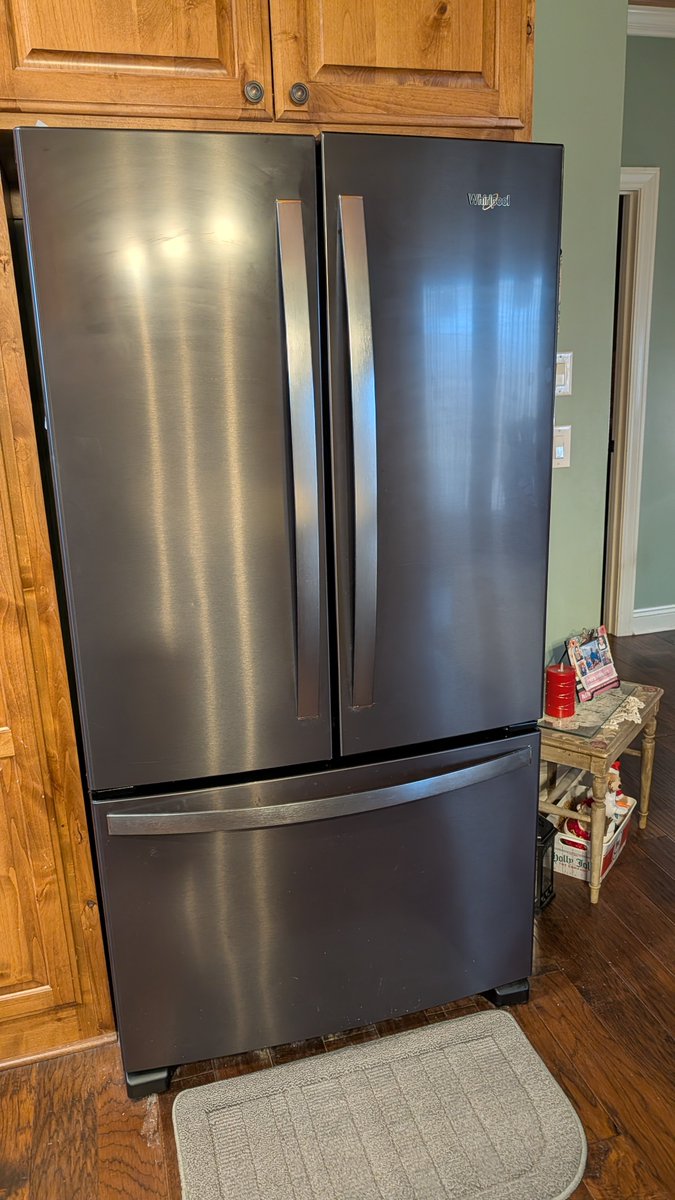
Mayflower, AR 🇺🇸 English
tom retweetledi

MAGA check-in: got your Trump phone yet? Paid for it with the $5K DOGE check or the $2K tariff dividend?
ICE enjoying that $50K signing bonus? ATC get those $10K checks?
Anyway, congrats on the wins: Mexico paid for the wall, the swamp got drained, and all the pedophiles are locked up — love that for you.
Also: huge shoutout for ending the Russia/Ukraine war, annexing Greenland, reopening Alcatraz, and making Canada the 51st state. Busy year!
And wow — inflation is over, groceries are cheaper, electricity is down, natural gas is down, healthcare is half price, and drug prices are 1,400% lower (yes, that’s how percentages work, obviously).
Plus tariffs are paid by “other countries” — definitely not Americans — and Trump’s patriotic gold watches were ABSOLUTELY not made in China.
Yay!!!! 💥
English
@LogWeaver China will implode before taking on any kind of global leadership role.
English

Ray Dalio just released 500 years of data showing exactly how empires collapse.
His conclusion? America is in Stage 6 of 9.
The dangerous stage.
Here's what his math actually says about where we're headed:
Dalio studied every major empire collapse since 1500.
Dutch. British. American.
The pattern repeats with machine-like precision every 50-100 years.
Not because of politics or ideology.
Because of math.
The "Big Debt Cycle" has nine stages.
We're currently in Stage 6.
The dangerous one.
Here's how it works:
Stages 1-4: The Rise
Countries borrow to build infrastructure.
Debt is productive. GDP grows faster than debt service costs.
Everything feels sustainable.
This was the U.S. from 1945-2000.
Low debt-to-GDP. Strong productivity growth.
Borrowing made sense.
Stage 5: The Top
Debt service hits 15-20% of GDP.
Interest costs start crowding out productive spending.
But everyone's too comfortable to notice.
Markets boom. Wealth gaps explode.
The U.S. crossed this threshold around 2008.
Stage 6: The Crisis
This is where we are now.
Federal debt exceeds 120% of GDP.
Two choices: Let interest rates rise and crash the economy.
Or print money and create inflation.
Both destroy wealth.
Just differently.
In the 1930s, we chose deflation.
In 2008, we chose money printing.
In 2026, we're doing both at the same time.
Stages 7-9: The Reset
Either massive restructuring through negotiation.
Or war.
History shows wars resolve 90% of these cycles.
Not because humans are violent.
Because debts become mathematically impossible to service.
Dalio's data is clear:
When internal inequality peaks AND external rivals emerge, conflicts become inevitable.
The U.S. has both right now.
Wealth inequality hasn't been this high since 1929.
China's GDP grew 6-8% annually while we borrowed to maintain consumption.
Dalio's advice for Stage 6 is simple:
Sell debt. Buy gold.
Not because gold produces anything.
Because governments print money to escape debt traps.
Gold has risen 3x since 2020.
Exactly as the model predicted.
But here's what actually matters for regular investors:
You can't stop the Big Cycle.
But you can position for it.
Dalio's framework identifies five big forces that drive every transition:
1. Productivity growth
2. Debt cycles
3. Money supply
4. Wealth gaps
5. Geopolitical power shifts
When all five align in the same direction, the cycle turns.
Right now, all five are pointing toward Stage 7.
Productivity growth is slowing.
Debt service costs are rising faster than GDP.
Money supply expanded 40% since 2020.
Wealth concentration is at century highs.
China is building parallel financial infrastructure.
The math doesn't lie.
So what does positioning actually look like?
Dalio's research across 500 years shows three consistent patterns:
Pattern 1: Fiat currencies lose value during Stage 6-7 transitions
Every time. No exceptions.
Governments print to escape debt traps.
The dollar, pound, and euro all follow the same path.
This is why gold and hard assets outperform during these periods.
Pattern 2: Geographic diversification matters more than asset class diversification
When one empire declines, another rises.
Dutch to British. British to American.
The cycle doesn't end. It relocates.
Portfolios concentrated in declining empires get crushed.
Pattern 3: Volatility spikes 3-5x during Stage 6
The 1930s saw 50%+ market swings.
The 1970s stagflation created wild inflation volatility.
2008-2009 saw daily 5% moves.
Stage 6 isn't calm. It's chaos punctuated by brief stability.
Here's the data that should terrify you:
U.S. debt-to-GDP: 120% (highest since WWII)
Annual interest costs: approaching $1 trillion
China's GDP growth: 6-8% while U.S. averages 2-3%
Time between 1929 inequality peak and crash: 8 months
Time since current inequality peak: We're in it now
English
@WallStreetApes Bought an Epson printer and the supplied ink ran out fast. bought brand new ink at Best Buy. Epson Brand ink for an Epson printer. Put the ink in and it worked fine, but the printer needed an update so I did. Now the ink is not "certified Epson ink" and I cant print.
English

American bought a computer to do work on. She also bought a new HP printer and the ink she needs to print what she’s writing
She’s unable to print because even though she bought the printer and ink, her printer wants her to pay for a subscription to use it
What a scam
English
tom retweetledi

The Dark Economics Behind China’s High-Speed Rail ‘Miracle’ - The Ponzi Scheme of Chinese HSR.
China’s High-Speed Rail: The Land Scam Hiding in Plain Sight.
China built the world’s largest high-speed rail network—over 45,000 kilometers long. On the surface, it looks like a triumph of modern infrastructure, a symbol of national pride, and a bold flex from the Communist Party. But here’s the truth the CCP won’t tell you: China’s high-speed rail isn’t about transportation—it’s about real estate.
In this video, I expose the hidden logic behind China’s high-speed rail boom. While the world marvels at the sleek trains and endless tracks, what’s really happening behind the scenes is a massive land finance scheme—a capital game where officials and developers cash in, while ordinary people foot the bill.
Forget everything you’ve been told about Chinese efficiency or technological superiority. The real engine driving this overbuilt system is land speculation, local government debt, and a political culture addicted to GDP hype. I break it all down with personal stories, hard numbers, and blunt truth.
English