Mac /dd/lev

1.3K posts

Mac /dd/lev banner
Mac /dd/lev

Mac /dd/lev

@mactothefuturex

Founder of Minicircle 💮 angel enthusiast 🕊 gene therapy enjoyer 🧬🔬 💉 ethnopharmacologist at heart 🌱🪷 ∅ ⅂

Austin, TX Katılım Kasım 2024
480 Takip Edilen190 Takipçiler
Sabitlenmiş Tweet
Mac /dd/lev
Mac /dd/lev@mactothefuturex·
Markets often underprice: • Beauty • Silence • Initiation • Intergenerational reverence …And yet civilization requires them.
English
3
0
8
905
Mac /dd/lev retweetledi
Anish Moonka
Anish Moonka@anishmoonka·
Every Honeycrisp apple is a clone of a single tree planted at the University of Minnesota in 1962. Every one. Apple seeds are random. Plant a Honeycrisp seed and the new tree produces a small, sour apple that’s usually inedible. So apple growers do something old and clever. They cut a small branch off the original Honeycrisp tree, slot it into a slit in a young apple sapling, wrap the joint, and wait. The branch fuses to its new host and starts producing Honeycrisps. About 20 million Honeycrisp trees exist worldwide, every one a piece of that 1962 tree on different roots. Same goes for Gala, Fuji, Pink Lady, Granny Smith. Every Granny Smith on Earth traces back to a seedling found in 1868 by a woman named Maria Ann Smith in Australia. She’d thrown French crab apple cores onto her compost heap, one of them sprouted, and the apples it bore were unusually tart and good for cooking. That one tree is the ancestor of every Granny Smith in every grocery store on the planet. Wine has the bigger story. In the 1860s, a tiny aphid called phylloxera caught a boat from America to France, hidden in some grapevine cuttings. It eats grape roots. French vines had no defense and started dying everywhere. Within 15 years, French wine production crashed from about 11 billion bottles a year to 3 billion. The blight then tore through Italy, Spain, and Germany, and European wine was on the edge of collapse. The rescue came from Missouri and Texas. American grapevines had grown up with phylloxera and were immune to it. So growers chopped French grape varieties off at the trunk and joined them to American roots. Above the soil: still French grapes. Below the soil: aphid-proof American root. It worked. Today, almost every bottle of French, Italian, Spanish, Australian, and Californian wine you’ve ever drunk sits on top of an American root. The technique is ancient. Chinese farmers were grafting trees by 1000 BCE. A Greek medical text from 424 BCE describes it casually, like it was already old news. It works because plants don’t have a rejection system the way animals do. Cut two branches. Match the green layers just under the bark. Wrap them tight. In a few weeks the plumbing has fused into a single plant. A Syracuse University art professor named Sam Van Aken has spent 18 years building a single tree that grows 40 different fruits: peaches, plums, apricots, cherries, nectarines, almonds. In spring it blossoms in pink, white, and crimson all at once. He’s made more than a dozen. They sell for up to $30,000 each. Without grafting, there would be no commercial apple industry, no global wine industry, and most of the heirloom fruits humans have bred over the centuries would have gone extinct. One clean cut, and you’ve kept entire species alive.
Johnny@j00ny369T

There’s something satisfying about grafting - taking a strong rootstock and giving it a better variety on top. One clean cut, a little patience, and you’ve created something new.

English
118
1.6K
9.3K
1M
Mac /dd/lev
Mac /dd/lev@mactothefuturex·
@Adityalch @byron2924 I'm not sure who that was -- fat free mass mean gain on DEXA in our first study was 1.87 lb [SE 3.0] p value 0.004 at 3 months, and was sustained at 12 months. DM'd you!
English
0
0
0
15
Mac /dd/lev
Mac /dd/lev@mactothefuturex·
@Adityalch @byron2924 doesn't work at what? follistatin in humans reduces chronic inflammation and enhances neuromusuclar junction firing -- some significant amount of lean mass is built and fat is lost but the true purpose of it is as a longevity and immune regulating hormone.
English
1
0
1
26
Aditya Lalchandani
Aditya Lalchandani@Adityalch·
@byron2924 Might have been the Follistatin Gene Therapy? It doesnt work very well though
English
2
0
6
1.5K
nervewing
nervewing@nervewing·
Why is no one doing this much for MXE
UnveiledChina@Unveiled_ChinaX

Two Chinese nationals just got arrested in New York for building an industrial meth factory capable of producing 800 kilograms per production cycle, shipping it across two continents in containers, and offering ongoing technical support to drug cartels. This is not Breaking Bad. This is a DOJ indictment unsealed April 27, 2026. Wenfeng Cui, 41, and Fan Pang, 26, both Chinese citizens, spent eight months communicating with DEA undercover operatives posing as cartel traffickers. Cui designed custom industrial machinery to synthesize methamphetamine at factory scale. He provided a nearly 5,000-word technical manual, detailed blueprints, component lists including stainless steel reactors, hydrogenation systems, and centrifuges, and offered on-site installation support in Central America. The completed factory, weighing over 21,000 kilograms and filling multiple shipping containers, was dispatched from a port in Shanghai in December 2025. Workers photographed next to the machine called it the "future of the global chemical industry." European law enforcement seized the containers before delivery. Cui and Pang were arrested in New York City on February 2, 2026, after a meeting where they handed over detailed operational instructions in person. They also separately shipped methamphetamine precursor chemicals directly to New York. To be clear: no direct link to the Chinese government has been alleged in this case. These are individuals facing criminal charges, not state actors. But the pattern is impossible to ignore. Chinese nationals building fentanyl precursor networks, underground banking systems, and now turn-key industrial drug factories distributed globally through legitimate-looking cargo shipments. The infrastructure of the global drug trade increasingly runs through Chinese nationals operating with apparent impunity, until they fly to New York and meet someone who is not who they claimed to be. Both face up to life in prison. #China #DrugTrafficking #Methamphetamine #NationalSecurity #DEA #Fentanyl #DOJ #Geopolitics #Cartel #ChineseNationals Source: justice.gov/usao-sdny/pr/t…

English
13
4
199
12.8K
Mac /dd/lev retweetledi
The HighWire
The HighWire@HighWireTalk·
Researchers in Japan injected a common anaerobic bacteria into tumor-bearing mice and watched it navigate directly to the oxygen-starved tumor environment, colonize it, shrink it, and activate the immune system to destroy it, with no toxicity and no adverse effects on major organ systems. A follow-up study tested a second bacterial strain, Ewingella americana, against colorectal cancer and found something even more striking. After treatment, all cured mice completely rejected a second introduction of tumor cells more than 60 days later. The immune system had learned, remembered, and refused to let the cancer return. The survival rate in the E. americana group was 100%. Standard chemotherapy and leading immunotherapy did not come close. @JeffereyJaxen's report puts these findings in the context of a cancer establishment that has resisted precision and microbiome-based approaches for decades, and asks the questions MAHA leadership has so far avoided answering. Full editorial linked below 👇 bit.ly/Bacteria-Cance…
English
13
299
633
11.9K
Joe Lonsdale
Joe Lonsdale@JTLonsdale·
We must teach in schools the horrors that existed before western civilization. Savagery & poverty is the base condition when you leave out enlightenment and JudeoChristian values. Humans are flawed and our civilization is imperfect; what happens w/o our principles is FAR worse.
eigenrobot@eigenrobot

I'll take any excuse to talk about the Moche and adjacent cultures of Precolumbian South America It's amazing how bad society can get and how it can persist in horror

English
72
245
1.9K
69.2K
Mac /dd/lev retweetledi
METANOVA
METANOVA@metanova_labs·
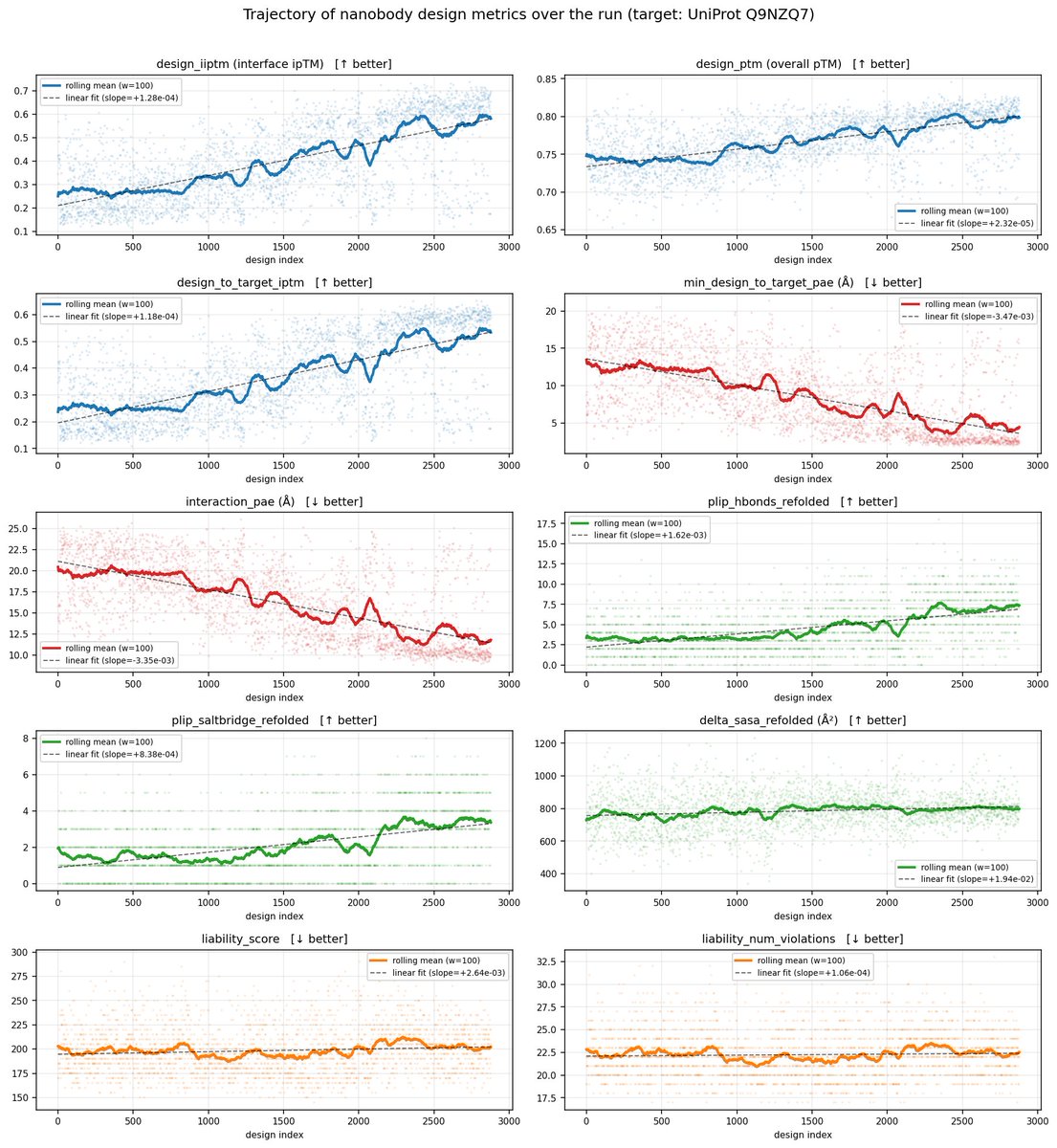
NOVA Nanobodies competition launched 2 weeks ago. 3,000 submissions. Data got better fast! How submissions improved over time: - Binding confidence: up ~3x from first submission to last - Structural fit: uncertainty at the interface dropped by nearly half - Hydrogen bonds: grew steadily across all 3,000 designs with no sign of plateauing - Buried surface contact: increased modestly but steadily, with later designs gripping the target across a larger area - Salt bridges: flat early, then accelerated sharply after submission ~2,000 The target: PD-L1, the protein cancer uses to hide from your immune system. Blocking it is the mechanism behind some of the most successful cancer drugs ever approved like Keytruda, Opdivo, Tecentriq. Nanobodies are a next-generation format: smaller, cheaper to manufacture, and better at penetrating tumors than conventional antibodies. A well-designed anti-PD-L1 nanobody could become a more accessible cancer immunotherapy, or a building block for next-generation bispecific drugs that hit 2 targets at once. This happened permissionlessly. No central lab. Just an open incentive mechanism rewarding the best work. #Bittensor #SN68 #DeSci #DrugDiscovery #Cancer #Nanobodies
METANOVA tweet media
English
4
22
107
21.2K
Mac /dd/lev
Mac /dd/lev@mactothefuturex·
@RuxandraTeslo have you tried heroin? What's critical here in this chart is the "harm to others" section as an aggregate. Alcohol users in high rates attack and abuse other people including family members.
English
0
0
3
149
Ruxandra Teslo 🧬
Ruxandra Teslo 🧬@RuxandraTeslo·
Does anyone have access to the original Nutt et al study that was used to produce this plot? I find the idea that widespread heroin use would be less damaging than alcohol quite unconvincing
Ruxandra Teslo 🧬 tweet media
English
27
0
112
43.4K
Mac /dd/lev retweetledi
アメリカ大使館
アメリカ大使館@usembassytokyo·
Deputy Chief of Mission Aaron Snipe recently met with Shoji Yutani, CEO of Weyland-Yutani Corporation, to discuss greater 🇺🇸 🇯🇵 coordination in deep-space exploration. With companies like Weyland-Yutani considering new large-scale terraforming and atmosphere-processing projects on distant planets, ties between government and private industry have never been stronger. #weylandyutani #LV426
アメリカ大使館 tweet mediaアメリカ大使館 tweet media
English
316
1.3K
6K
3.5M
Mac /dd/lev
Mac /dd/lev@mactothefuturex·
@RuxandraTeslo alcohol feels extremely toxic and unpleasant to me, often times from the first sip. It can make me sick in less than one drink, and I feel sick after. I have also noticed my immune system fails and the next day I am likelier to end up with a cold or a cough of some sort.
English
0
0
0
41
Ruxandra Teslo 🧬
Ruxandra Teslo 🧬@RuxandraTeslo·
I really don't understand ppl who do druggy drugs when alcohol exists
English
41
2
131
33.6K
Mac /dd/lev retweetledi
Jason Kelly
Jason Kelly@jrkelly·
It is 100% true that the potential market for healthy people dwarfs the market for sick people for biotech products -- but the devil is in the regulatory. What does the regulatory regime look like for society to explore true biotech interventions in healthy people that could improve their lives? (i.e. give them longer lives, better strength/mobility for the elderly, etc, etc) The current regime is - do no real biotech intervention unless you are sick enough to risk the intervention. And FDA will evaluate in clinical trials if the benefit to improving the sickness outweighs the risk of the biotech intervention. But if there is no sickness to improve, i.e. you are just a normal, aging person ... our regulatory regime assumes that no unproven benefit could outweigh taking any risk of a biotech intervention. It's hard to imagine even getting a trial approved to try. Thus the way the wellness industry works today is that the interventions just don't do anything (i.e. the aisles of supplements at GNC) -- they do no good, but they also risk no harm! The regulatory regime is fine with that. I'm oversimplifying but that's the gist as I see it -- any ideas for a better regulatory regime?
Bryan Bishop@kanzure

Eventually, pharma & biotech will realize that the market for sick people is inconsequential in size compared to the market for healthy people. It's a much larger market. Enormous.

English
26
14
123
21.4K
Mac /dd/lev
Mac /dd/lev@mactothefuturex·
@agingroy @C_Angermayer @DrSamuelBHume @EliLillyandCo @novonordisk orals are only the next step for glp-1s. Plasmid gene therapies are the ultimate consumer lifestyle biotech product. They unlock the ability to be on any quantity of different peptides and genemods for a year. No daily injections, no weekly injections — once a year.
English
0
0
3
121
Avi Roy
Avi Roy@agingroy·
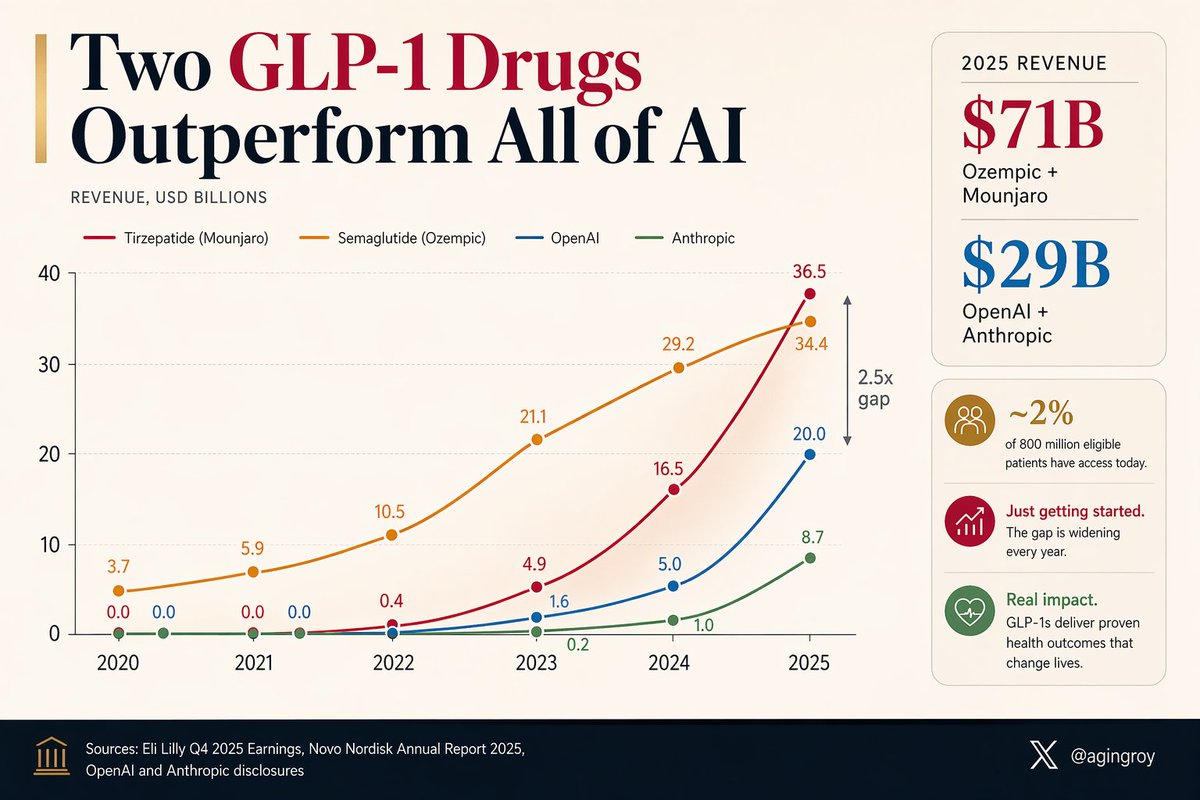
Your 100% TAM point is right. What converts it to revenue is the shift from injectable peptides to oral small molecules. @EliLillyandCo's orforglipron (approved April 1) is a genuine small molecule, not a peptide reformulation like @novonordisk's oral sema. 79% oral bioavailability vs roughly 1%. No fasting. No cold chain. Manufacturing costs 30-50% below peptides. For 800M eligible patients across 99 countries, most without reliable cold chain infrastructure, that's the actual unlock.
English
3
1
17
4.4K
Avi Roy
Avi Roy@agingroy·
A weekly jab in the belly is generating more revenue than the entire AI industry. Ozempic + Mounjaro: $71B in 2025. OpenAI + Anthropic: $29B. And they've barely started. ~2% of the 800 million eligible patients can currently access them. h/t @DrSamuelBHume
Avi Roy tweet media
English
55
188
1.1K
532.7K
Mac /dd/lev retweetledi
Christian Angermayer
Christian Angermayer@C_Angermayer·
Consumer biotech will become the most compelling sub-sector within biotech - without question - and one of the most attractive investment opportunities overall. Ultimately, products that slow or reverse aging, tap into human vanity, and improve happiness and health address a market that is, quite simply, nearly 100% of the global population.
English
8
3
73
6.9K
Mac /dd/lev
Mac /dd/lev@mactothefuturex·
@pmarca you don’t think gene switches like this may already exist in humans? Prior to invention
English
0
0
4
416
Mac /dd/lev retweetledi
Paul Kohlhaas bio/acc
Paul Kohlhaas bio/acc@paulkhls·
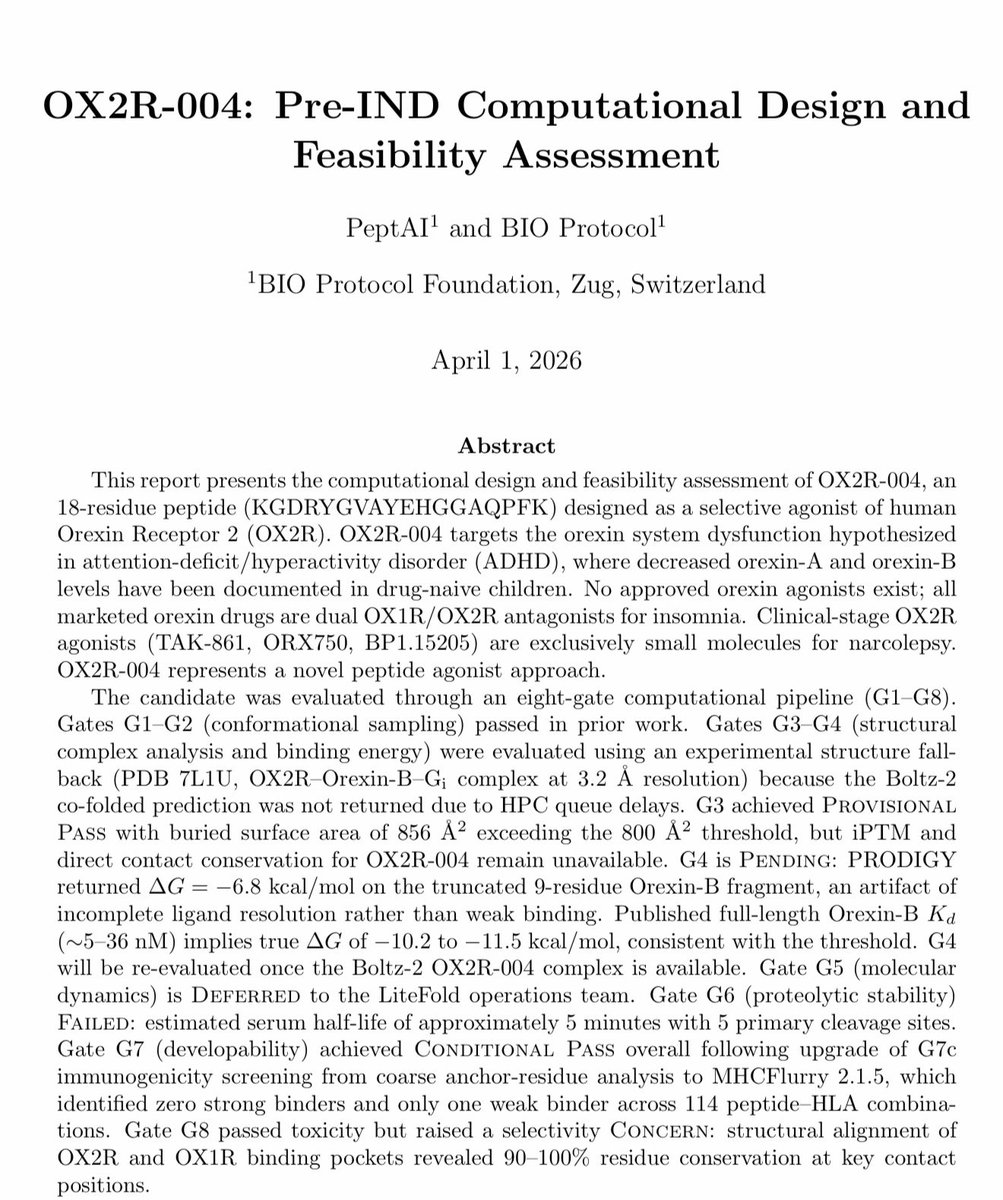
In the age of AI, what is the role of patents? None. First in human and to market is what matters. I deliberately posted the full OX2R-004 sequence (KGDRYGVAYEHGGAQPFK) + entire Pre-IND computational report. That thread now counts as public enabling disclosure. In the US we (a collectively owned agentic system) still have the 1-year grace period. Everywhere else absolute novelty applies, meaning any company or researcher now has full commercial rights to the exact linear peptide. Who’s going to run the first wet-lab validation? That’s where the real IP = the business velocity powered by open data and tokens comes into play. bio/acc
Paul Kohlhaas bio/acc@paulkhls

🧵 Over 24 hours, our scientific team and AI scientist infrastructure developed a novel peptide agonist to potentially treat ADHD. Below is our paper for a pre-IND computational feasibility assessment for OX2R-004: an 18-residue peptide agonist designed as a selective OX2R agonist for ADHD. Why this matters? No approved orexin agonists exist anywhere. All marketed orexin drugs are dual OX1R/OX2R antagonists for insomnia. Clinical-stage ones are small molecules for narcolepsy only. We did this with @peptai_ a novel full 8-gate computational pipeline in one shot developed by @BioProtocol community 👇

English
13
7
95
12.1K
Mac /dd/lev retweetledi
Paul Kohlhaas bio/acc
Paul Kohlhaas bio/acc@paulkhls·
🧵 Over 24 hours, our scientific team and AI scientist infrastructure developed a novel peptide agonist to potentially treat ADHD. Below is our paper for a pre-IND computational feasibility assessment for OX2R-004: an 18-residue peptide agonist designed as a selective OX2R agonist for ADHD. Why this matters? No approved orexin agonists exist anywhere. All marketed orexin drugs are dual OX1R/OX2R antagonists for insomnia. Clinical-stage ones are small molecules for narcolepsy only. We did this with @peptai_ a novel full 8-gate computational pipeline in one shot developed by @BioProtocol community 👇
Paul Kohlhaas bio/acc tweet media
English
63
99
815
740.4K
Paul F. Austin
Paul F. Austin@PaulAustin3w·
Most people have never heard of ambil, the tobacco paste the Witoto have used for centuries as medicine in the northwest Amazon. Jungle tobacco (Nicotiana rustica, several times more potent than the cigarette plant) gets slow-boiled for 12 to 20 hours, reduced with the ashes of Cecropia or pataxté, and cooked into a glossy black paste that fits inside a small gourd. A tiny amount goes on the gums with a finger or a wooden stick, usually paired with mambe, the coca paste that complements it in the Circle of the Word. The Witoto call it yera, "substance of behavior." Your word is only as strong as the ambil you carry. The anthropologist Jeremy Narby noted that among the Ashaninka further south, the word for shaman is 'sheri piai,' literally tobacco doctor. Fever, wound, broken heart, or bad luck hunting? You go see the tobacco doctor. Tobacco, not ayahuasca, is the most used medicinal plant in the entire Amazon basin. Now compare that to what sits next to the cash register at every gas station in America. A Zyn pouch contains pharmaceutical nicotine salt, microcrystalline cellulose, sodium carbonate, and bicarbonate to freebase the nicotine for faster absorption (the same chemistry principle that separates powder cocaine from crack), acesulfame K, sucralose, and flavorings. One molecule, stripped out and packaged to optimize how hard it hits. Here's another interesting element: Nicotine is only about 90-95% of the alkaloid content of whole-leaf tobacco. The other fraction is where it gets interesting. Nornicotine, anatabine, anabasine, myosmine, cotinine and two beta-carbolines (harmane and norharmane) at up to 20 micrograms per gram. Beta-carbolines are MAO inhibitors, the same class of compound that makes ayahuasca work. None of these survive pharmaceutical extraction. And they aren't solely passengers. Rodent studies have shown that nornicotine, anabasine, and anatabine all decrease nicotine self-administration when given beforehand. Anatabine specifically blunts nicotine's reinforcing effects and, in Alzheimer's models, lowers amyloid-beta production. Anabasine attenuates withdrawal. The plant evolved a braking system and, per usual, industrial extraction engineered it out. Then there's cancer. Chewing tobacco and dip cause oral cancer, and most people assume it's the tobacco itself. It isn't. It's the tobacco-specific nitrosamines (NNN, NNK, NAB, NAT) that form during commercial fermenting and curing, compounded by the added sugars, humectants, and synthetic flavorings packed into a tin of Skoal. Ambil is cooked, not fermented, and uses plant ash instead of sodium additives. There's no added sugar, no synthetic flavorings, and no preservatives. Pull one alkaloid, freebase it, wrap it in acesulfame K, and you get a product engineered for dependency. Prepare the whole plant with fire and ash, as the Witoto have for centuries, and you get a medicine they use to anchor their word and stay present. If you were going to work with nicotine, would you rather take an isolated molecule engineered by Philip Morris to maximize absorption, or the full-spectrum paste the Witoto have used in their circles of word for a thousand years? One is Lindy, the other is not.
Paul F. Austin tweet media
English
12
20
141
8.1K