
Mandresh
7.6K posts


Mandresh
@mandresh
IT strategist. Technology enthusiastic, will be entrepreneur one day. Typical Libran. !! All opinions expressed are mine and not of my employer etc. etc. etc.


Today, India takes a defining step in its civil nuclear journey, advancing the second stage of its nuclear programme. The indigenously designed and built Prototype Fast Breeder Reactor at Kalpakkam has attained criticality. This advanced reactor, capable of producing more fuel than it consumes, reflects the depth of our scientific capability and the strength of our engineering enterprise. It is a decisive step towards harnessing our vast thorium reserves in the third stage of the programme. A proud moment for India. Congratulations to our scientists and engineers.








Hey @PiyushGoyal ji, While you gloat on India-EU FTA, you must answer the following questions first: 👉 Why did BJP oppose India-EU FTA in 2013? 👉 Why did India decline to sign the CPTPP in 2018? • Comprehensive and Progressive Agreement for Trans-Pacific Partnership - an existing trade deal between Canada and multiple countries in the Indo-Pacific region, including Australia, Brunei, Chile, Japan, Malaysia, Mexico, New Zealand, Peru, Singapore, and Vietnam 👉 Why did India withdraw from RCEP in 2019? • Regional Comprehensive Economic Partnership - a comprehensive free trade agreement between 10 ASEAN Member States and ASEAN's free trade agreement (FTA) partners which include - Australia, China, India, Japan, Korea and New Zealand 👉 Lastly - but most important: What is the update on the India-US trade deal? • Do you realise what kind of havoc the 50% tariff has created for Indian businesses - especially the small and medium ones? Care to answer any of these?

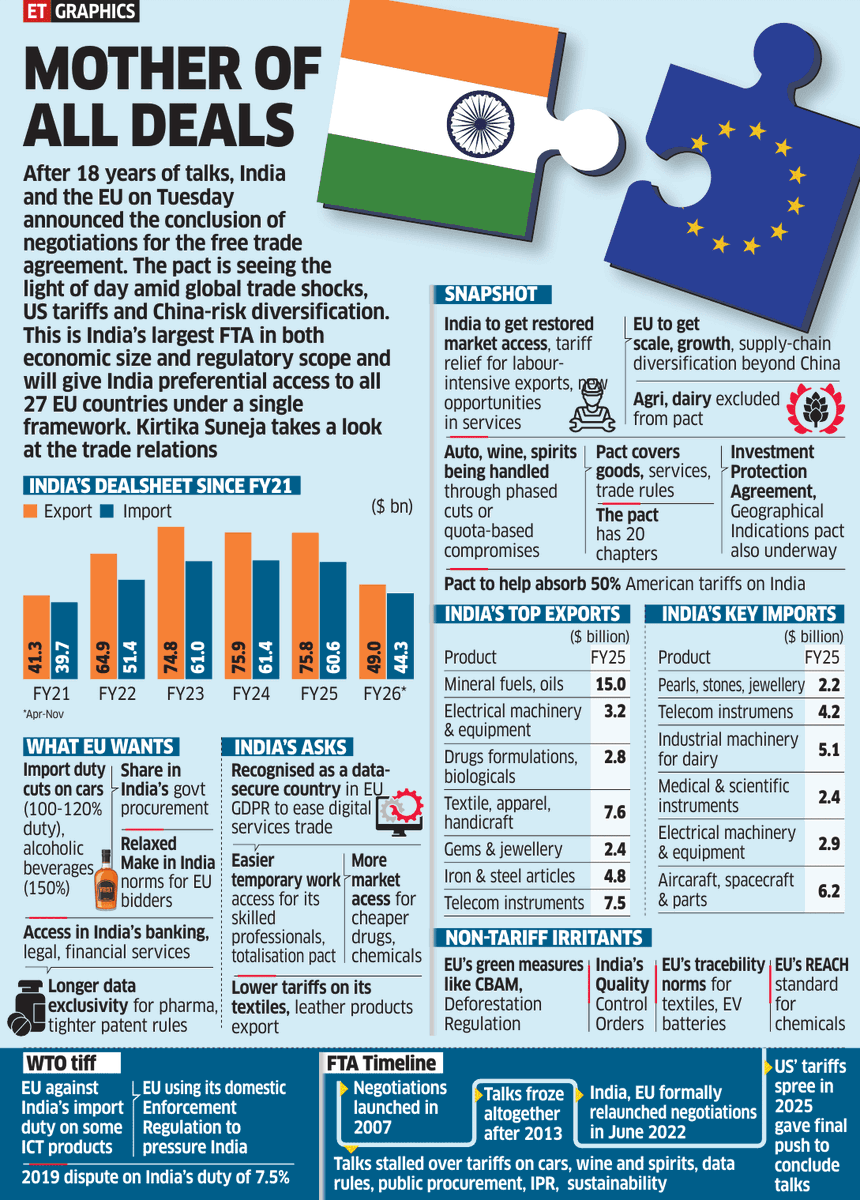

India and the 27-nation European Union first started negotiations for a Free Trade Agreement in June 2007. 16 rounds of negotiations took place but were suspended in May 2013 because of lack of agreement on many important issues. Talks on an FTA remained suspended till June 2022 when they were resumed. This hugely-hyped FTA is the biggest trade opening India has given to any trade partner (tariff reduction or relief on over 96% of EU exports to India) and it is expected to double India's imports from the EU. Its impact on India's trade deficit will have to be monitored closely. The Modi Government’s failure to secure an exemption for India’s aluminium and steel-makers from the Carbon Border Adjustment Mechanism (CBAM) is one of @INCIndia’s key concerns regarding the FTA. India’s aluminium and steel exports to the EU have already fallen from $7 billion to $5 billion and are only expected to fall further beginning this year due to the enforcement of the CBAM since January 1, 2026. Over time, CBAM will also expand to include other categories of India’s industrial exports and can effectively nullify any gains India secures from the FTA. There are also concerns about the EU's strict health and product safety rules, which will continue to be in force over Indian exports even after the FTA. This can easily become a non-tariff trade barrier, and the EU has been accused of the same by other trade partners. Questions over Intellectual Property (IP) rights for our pharmaceutical sector are also unanswered. The EU has also claimed privileged access to Indian services market in key sectors like financial services and maritime transport - exceeding India’s commitments with any other trading partner, including the UK and Australia. The inclusion of automobiles in the FTA is also a concern. The Modi Government opened up India’s automobile sector for the first time ever in its FTA with the UK, and the FTA with the EU only opens up further risk for domestic automobile manufacturers. At a time when Electrical Vehicles (EV) are emerging as one of the most critical technologies of the 21st century, great care will have to be taken to ensure that India’s EV industry is not vanquished. Of course, the final concern is about India’s largest export to the EU - refined fuels. A large portion of this fuel is sourced from Russia, and there needs to be clarity on the future of these trade routes amidst pressure from Washington DC.

India and the 27-nation European Union first started negotiations for a Free Trade Agreement in June 2007. 16 rounds of negotiations took place but were suspended in May 2013 because of lack of agreement on many important issues. Talks on an FTA remained suspended till June 2022 when they were resumed. This hugely-hyped FTA is the biggest trade opening India has given to any trade partner (tariff reduction or relief on over 96% of EU exports to India) and it is expected to double India's imports from the EU. Its impact on India's trade deficit will have to be monitored closely. The Modi Government’s failure to secure an exemption for India’s aluminium and steel-makers from the Carbon Border Adjustment Mechanism (CBAM) is one of @INCIndia’s key concerns regarding the FTA. India’s aluminium and steel exports to the EU have already fallen from $7 billion to $5 billion and are only expected to fall further beginning this year due to the enforcement of the CBAM since January 1, 2026. Over time, CBAM will also expand to include other categories of India’s industrial exports and can effectively nullify any gains India secures from the FTA. There are also concerns about the EU's strict health and product safety rules, which will continue to be in force over Indian exports even after the FTA. This can easily become a non-tariff trade barrier, and the EU has been accused of the same by other trade partners. Questions over Intellectual Property (IP) rights for our pharmaceutical sector are also unanswered. The EU has also claimed privileged access to Indian services market in key sectors like financial services and maritime transport - exceeding India’s commitments with any other trading partner, including the UK and Australia. The inclusion of automobiles in the FTA is also a concern. The Modi Government opened up India’s automobile sector for the first time ever in its FTA with the UK, and the FTA with the EU only opens up further risk for domestic automobile manufacturers. At a time when Electrical Vehicles (EV) are emerging as one of the most critical technologies of the 21st century, great care will have to be taken to ensure that India’s EV industry is not vanquished. Of course, the final concern is about India’s largest export to the EU - refined fuels. A large portion of this fuel is sourced from Russia, and there needs to be clarity on the future of these trade routes amidst pressure from Washington DC.
This is why I'm delighted that the India-EU FTA has been negotiated. 👇 It is, of course, excellent on its own merits - creating a market of 2 billion people and creating synergies between 2 of the 4 leading economic formations in the world. But as I had tweeted in July just after Trump announced 25% tariffs on India, this is the best way to get leverage with the US. American companies won't want to be a comparative disadvantage to their European counterparts in one of the largest and fastest growing markets in the world. You can expect pressure mounting on the Trump administration to mend ties with India.