
Dr. Manu Kumar 👋🏽

30.3K posts

Dr. Manu Kumar 👋🏽 banner
Dr. Manu Kumar 👋🏽

Dr. Manu Kumar 👋🏽

@ManuKumar

Cofounder/CEO @HiHello 👋 Cofounder @CartaInc 🥧 Chief Firestarter @K9Ventures 🦮 OG Pre-Seed Investor @lyft @twilio @auth0 @lucidchart @everlaw @forethought_ai

Palo Alto, CA Katılım Nisan 2008
2.8K Takip Edilen33.1K Takipçiler
Dr. Manu Kumar 👋🏽
Agree with this. The charge dispute system is biased against merchants. There is no logic to it. We can provide evidence but there are no controls on how that evidence is reviewed or any justification for why banks rule a certain way. @stripe just passes the buck along to banks. Merchants are Stripe’s customers. We cannot influence the process banks use as individual merchants, but Stripe can.
Chris Riley@LCSlates

Well so much for that. Already lost. The system is utterly fucked and broken. @stripe 48-page evidence package. Easy to read, Table of contents, filled with visuals (a junior bank employee could easily understand everything). The customer used the product for 49 days, was logged in 13 hours before filing the chargeback, then canceled the subscription 5 hours after the dispute was already filed. *Technically they are still ACTIVE. Here's everything we submitted: PAYMENT INTEGRITY • AVS postal-code check: PASS • CVC check: PASS • Stripe Radar score: Normal (22 / low risk) • Auth success rate on customer email: 100% • Card brand, last-4, fingerprint, exp, billing ZIP all confirmed by issuer CUSTOMER USE POST-CHARGE • 35 distinct active days in 49 days • 393 authenticated session-refresh events • 17 long-form SEO articles generated • 18 AI images generated • 3 WordPress sites configured (admin credentials added) • 4 Google accounts authenticated via OAuth • Customer added their own paid OpenAI API key (BYOK) • 4 team members added TIMING • 49 days between charge and dispute • Logged into the dashboard 13 hours BEFORE filing the chargeback • Canceled the subscription 5 hours AFTER the dispute was filed INDEPENDENT IP CORROBORATION • Stripe captured IP at checkout: Manchester, UK • Microsoft Clarity captured 22 of 38 sessions over 60 days: also Manchester, UK • Two unrelated 3rd parties placing the same person in the same city across payment + 60 days of authenticated use THE KICKER - THE CUSTOMER'S OWN PUBLIC WEBSITE CURRENTLY DEPENDS ON OUR PRIVATE CDN • Articles generated on his account are LIVE on his own public WordPress sites • Page source contains img tags pointing INSIDE our private R2 bucket • Last-Modified headers on those CDN files match the EXACT minute his account generated them • Currently fetched by every visitor to his website CRYPTOGRAPHIC IDENTITY CHAIN (Automattic / Gravatar) • Every WordPress author avatar = SHA-256(author email) • 3 of his sites, 3 perfect SHA-256 matches against the gmail addresses in our DB • Automattic has no relationship with us, the customer, or the bank • Effectively unforgeable email-to-WP-admin binding DOMAIN OWNERSHIP (third-party attestation) • Google Search Console verified ownership on 4 separate domains • Public WHOIS: 2 of his domains registered 9 SECONDS APART through the same registrar account • Both registered 5 MONTHS BEFORE he bought our subscription • Pre-existing content business, not a stolen-card test VISA CE 3.0 ELIGIBLE • Same payment credential had a $0.00 trial-start invoice marked "paid" 7 days before the disputed charge • Same customer, email, payment method, subscription • Exactly the prior-undisputed-transaction proof Visa CE 3.0 requires The chargeback dispute system is broken.


English
1
0
1
336
Dr. Manu Kumar 👋🏽 retweetledi
Selina Wang
Selina Wang@selinawangtv·
I asked a 12-year-old in Beijing if AI scares her. Her answer: "If I use AI, then I will be the scary person." While American parents debate whether kids should use AI at school, China has made it mandatory and is rushing to embed AI across society My report from China 👇 @ABC
English
55
146
571
167.1K
Dr. Manu Kumar 👋🏽 retweetledi
Patrick OShaughnessy
Patrick OShaughnessy@patrick_oshag·
Krishna Rao is the CFO of Anthropic, and this is his first podcast appearance. He joined the company two years ago when run-rate revenue was about $250M. Today it is $30B. He has helped raise ~$75B and is responsible for the procurement and allocation of compute. I feel lucky we get to hear what it is like to sit inside a company this consequential at a moment this pivotal. We discuss: - The cone of uncertainty - How he allocates compute across Trainium, TPUs, and GPUs - What investors misunderstand about model companies - Why the returns to frontier intelligence keep rising - Platform vs application and where Anthropic builds its own products - How Anthropic uses Claude internally I have asked my closing question about the kindest thing more than 500 times. Krishna's answer is one I have never heard before. Enjoy! Timestamps: 0:00 Intro 2:38 The Compute Canvas 6:51 The "Cone of Uncertainty" 11:58 Why the Returns to Frontier Intelligence Are So High 16:45 Recursive Self-Improvement 20:20 Scaling Laws 23:30 Sourcing $100 Billion in Compute 28:05 Platform vs. Application Strategy 32:52 Pricing Dynamics 38:48 How Anthropic’s Finance Team Uses Claude 43:24 Raising Capital & Overcoming Investor Skepticism 52:32 Public Perception, Risks, and Government Regulation 57:25 Mythos Release 1:12:33 What Could Derail the AI Revolution? 1:13:47 Biotech and Healthcare 1:15:31 The Kindest Thing
English
84
777
6.6K
3M
Dr. Manu Kumar 👋🏽
@garrytan Stopped using KQED as a source a long time ago. Their bias is extremely clear. Thanks for calling it out.
English
0
0
4
263
Garry Tan
Garry Tan@garrytan·
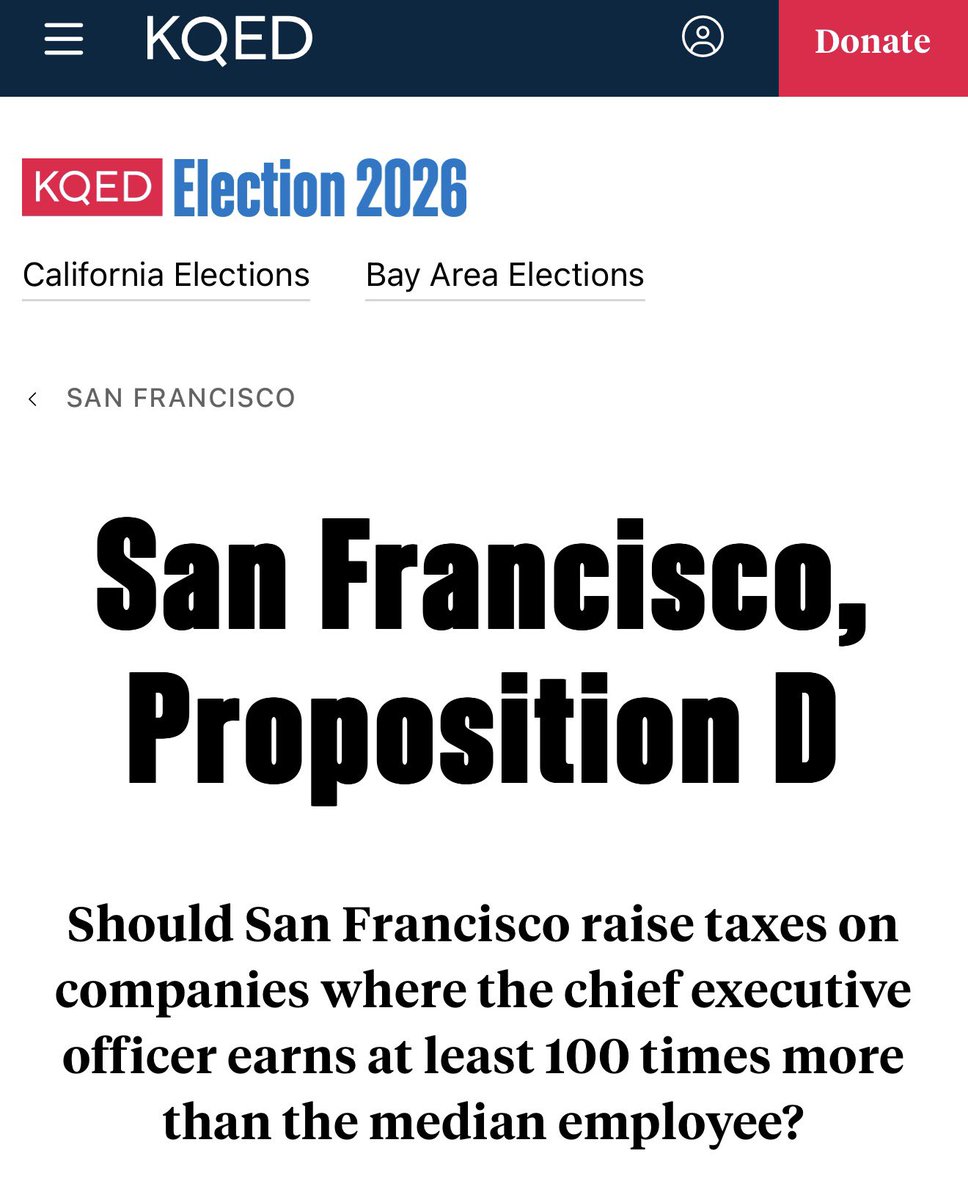
KQED published a "voter guide" on Prop D that is six sentences long It never mentions that the "CEO tax" is actually a gross receipts tax on sales, not on executives It never mentions Google (32:1 ratio) is EXEMPT while Walgreens (410:1) gets an 800% tax increase It never mentions grocery stores run on 1-3% margins and can't absorb this It never mentions the Dodd-Frank formula is trivially gameable It never mentions the Board of Supervisors can't adjust the rates without going back to voters If you're going to call something an explainer, explain something. Otherwise you're just laundering anti-tech anti-prosperity talking points as journalism. KQED fails to do even basic journalism and fails the people of the San Francisco Bay Area
Garry Tan tweet media
English
35
56
567
29.9K
Dr. Manu Kumar 👋🏽 retweetledi
Garry Tan
Garry Tan@garrytan·
Sanders and AOC introduced a bill to pause ALL AI data center construction. 300+ local bills filed. Half of planned 2026 data centers facing delays or cancellation. Each one brings billions to local economies. The people who say they want American jobs are trying to block the biggest job creation engine since the interstate highway system.
Garry Tan tweet media
English
6.8K
3K
15.1K
22.2M
Dr. Manu Kumar 👋🏽 retweetledi
Patrick OShaughnessy
Patrick OShaughnessy@patrick_oshag·
A list of surprising and mind-boggling stats from this conversation: - NDR is over 500% on an annualized basis - Anthropic's first dollar of revenue came in March of 2023 - Over 90% of code inside Anthropic is written by Claude Code - The head of tax is the heaviest token user on the finance team - Run rate revenue went from $9B to $30B in one quarter (reportedly, on pace for $50B by end of next month) - Cowork is growing faster than Claude Code did at the same point in its life - Signed two double-digit million-dollar commits in a 20-minute Uber ride to the podcast - Krishna spends 30-40% of his time on compute decisions - 9 of the Fortune 10 are customers - $100B combined commitment of compute - 30 different product and feature releases in January alone - A prior model found 22 security vulnerabilities in an open source codebase; Mythos found 250 - The finance team has built a library of over 70 Claude skills specific to finance - Anthropic raised $75 billion since Krishna joined two years ago - The day of the Series E first close was the day the DeepSeek news broke - When Meta and others made huge poaching offers, Anthropic lost two people on the technical side while other labs lost dozens - All seven co-founders are still at the company - The company is just over five years old
Patrick OShaughnessy@patrick_oshag

Krishna Rao is the CFO of Anthropic, and this is his first podcast appearance. He joined the company two years ago when run-rate revenue was about $250M. Today it is $30B. He has helped raise ~$75B and is responsible for the procurement and allocation of compute. I feel lucky we get to hear what it is like to sit inside a company this consequential at a moment this pivotal. We discuss: - The cone of uncertainty - How he allocates compute across Trainium, TPUs, and GPUs - What investors misunderstand about model companies - Why the returns to frontier intelligence keep rising - Platform vs application and where Anthropic builds its own products - How Anthropic uses Claude internally I have asked my closing question about the kindest thing more than 500 times. Krishna's answer is one I have never heard before. Enjoy! Timestamps: 0:00 Intro 2:38 The Compute Canvas 6:51 The "Cone of Uncertainty" 11:58 Why the Returns to Frontier Intelligence Are So High 16:45 Recursive Self-Improvement 20:20 Scaling Laws 23:30 Sourcing $100 Billion in Compute 28:05 Platform vs. Application Strategy 32:52 Pricing Dynamics 38:48 How Anthropic’s Finance Team Uses Claude 43:24 Raising Capital & Overcoming Investor Skepticism 52:32 Public Perception, Risks, and Government Regulation 57:25 Mythos Release 1:12:33 What Could Derail the AI Revolution? 1:13:47 Biotech and Healthcare 1:15:31 The Kindest Thing

English
16
87
696
174.7K
Dr. Manu Kumar 👋🏽 retweetledi
Andrew Ng
Andrew Ng@AndrewYNg·
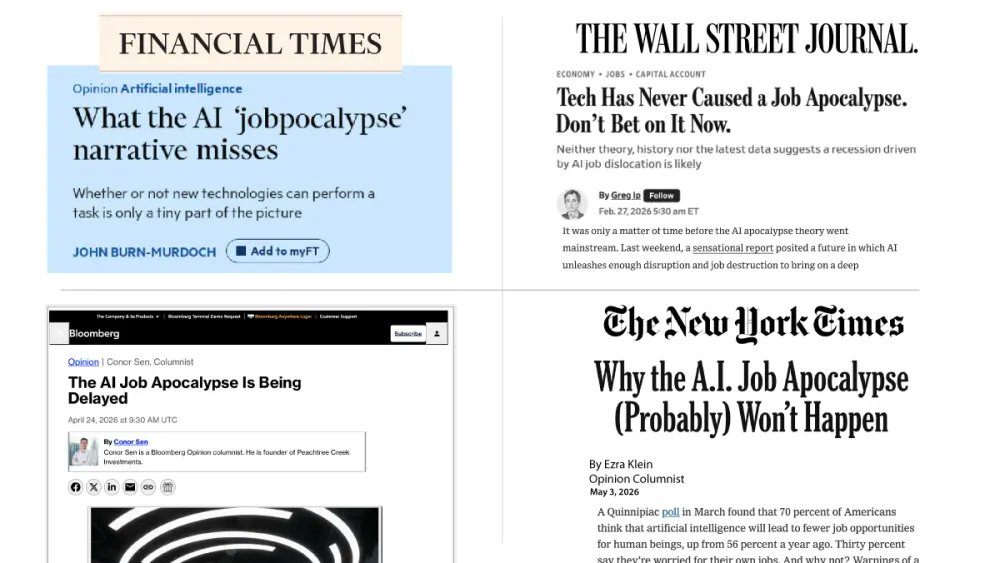
There will be no AI jobpocalypse. The story that AI will lead to massive unemployment is stoking unnecessary fear. AI — like any other technology — does affect jobs, but telling overblown stories of large-scale unemployment is irresponsible and damaging. Let’s put a stop to it. I’ve expressed skepticism about the jobpocalypse in previous posts. I’m glad to see that the popular press is now pushing back on this narrative. The image below features some recent headlines. Software engineering is the sector most affected by AI tools, as coding agents race ahead. Yet hiring of software engineers remains strong! So while there are examples of AI taking away jobs, the trends strongly suggest the net job creation is vastly greater than the job destruction — just like earlier waves of technology. Further, despite all the exciting progress in AI, the U.S. unemployment rate remains a healthy 4.3%. Why is the AI jobpocalypse narrative so popular? For one thing, frontier AI labs have a strong incentive to tell stories that make AI technology sound more powerful. At their most extreme, they promote science-fiction scenarios of AI “taking over” and causing human extinction. If a technology can replace many employees, surely that technology must be very valuable! Also, a lot of SaaS software companies charge around $100-$1000 per user/year. But if an AI company can replace an employee who makes $100,000 — or make them 50% more productive — then charging even $10,000 starts to look reasonable. By anchoring not to typical SaaS prices but to salaries of employees, AI companies can charge a lot more. Additionally, businesses have a strong incentive to talk about layoffs as if they were caused by AI. After all, talking about how they’re using AI to be far more productive with fewer staff makes them look smart. This is a better message than admitting they overhired during the pandemic when capital was abundant due to low interest rates and a massive government financial stimulus. To be clear, I recognize that AI is causing a lot of people’s work to change. This is hard. This is stressful. (And to some, it can be fun.) I empathize with everyone affected. At the same time, this is very different from predicting a collapse of the job market. Societies are capable of telling themselves stories for years that have little basis in reality and lead to poor society-wide decision making. For example, fears over nuclear plant safety led to under-investment in nuclear power. Fears of the “population bomb” in the 1960s led countries to implement harsh policies to reduce their populations. And worries about dietary fat led governments to promote unhealthy high-sugar diets for decades. Now that mainstream media is openly skeptical about the jobpocalypse, I hope these stories will start to lose their teeth (much like fears of AI-driven human extinction have). Contrary to the predictions of an AI jobpocalypse, I predict the opposite: There will be an AI jobapalooza! AI will lead to a lot more good AI engineering jobs, and I’m also optimistic about the future of the overall job market. What AI engineers do will be different from traditional software engineering, and many of these jobs will be in businesses other than traditional large employers of developers. In non-AI roles, too, the skills needed will change because of AI. That makes this a good time to encourage more people to become proficient in AI, and make sure they’re ready for the different but plentiful jobs of the future! [Original text in The Batch newsletter.]
Andrew Ng tweet media
English
552
1.2K
5.2K
757K
Kia K.
Kia K.@imkialikethecar·
Folks: what are your best “pro-Billionaires” arguments?
English
6
0
2
1.2K
Dr. Manu Kumar 👋🏽 retweetledi
Yun-Ta Tsai
Yun-Ta Tsai@yunta_tsai·
There was no award when Newton discovered three laws of forces, nor when da Vinci painted the Mona Lisa. There was no Grammy for Beethoven or Chopin, nor a Nobel Prize in Literature for Homer. Masterpieces do not seek transient trophies but aim to be timeless.
English
680
3.4K
21.2K
1.1M
Dr. Manu Kumar 👋🏽
This is fascinating. As a former @StanfordHCI researcher who worked on new input technologies this works lights me up. One of the most cool applications of AI I’ve seen and it throws back to the research done by my PhD advisor @TerryWinograd in his seminal work called SHRDLU. Such a back to the future moment.
Google DeepMind@GoogleDeepMind

We’re reimagining a 50-year-old interface - the mouse pointer - with AI. 🖱️ These experimental demos show how people can intuitively direct Gemini on their screens using motion, speech, and natural shorthand to get things done 🧵

English
0
0
1
403
Dr. Manu Kumar 👋🏽 retweetledi
Garry Kasparov
Garry Kasparov@Kasparov63·
Socialism is like polio, it comes back when people forget about the horrible damage it did last time.
English
3.1K
18.8K
103.9K
12.6M
Dr. Manu Kumar 👋🏽
We provide digital business cards for large enterprise companies. Lots of big names that you would recognize. We literally help them to eliminate paper. And they still pay us by check sent via snail mail. It is bonkers! I mean we’ll take the money, but that they haven’t figured out electronic payments by now is astounding.
English
0
0
0
91
Auren Hoffman
Auren Hoffman@auren·
why do companies (like doctors, etc) still bill you by snail mail? can't they at least send you an email with the bill? seems almost criminal to send a snail mail -- bad for the business and bad for the consumer
English
7
0
15
1.8K
Dr. Manu Kumar 👋🏽 retweetledi
Thinking Machines
Thinking Machines@thinkymachines·
People talk, listen, watch, think, and collaborate at the same time, in real time. We've designed an AI that works with people the same way. We share our approach, early results, and a quick look at our model in action. thinkingmachines.ai/blog/interacti…
English
437
1.8K
14.8K
7M