

Marcin
110 posts

Marcin retweetledi

Marcin retweetledi




Take whatever number of people you thought might be in jobs related to AI deployment in the enterprise and multiply it by 10. Then probably 10 again.
A major topic that keeps coming up in talking to CIOs across enterprises of all sizes and industries is the implementation gap for getting agents to work at scale and organizations on mission critical work.
As the task goes from implementing a chat system that’s basically an LLM plus search, to connecting to real production systems that both can deliver meaningfully better productivity gains but also introduces meaningfully more risk, a whole new set of work has to be done.
You have to ensure the right level of protection of data, updates to access control controls, migration of legacy systems to common modern platforms, create observability across what agents are doing, implement new workflows, figure out the human in the loop moments, drive the change management of the new workflows, and more.
Then, all of a sudden the model capabilities get updated and you have to do a set of the above steps over again. Half of what you’ve done is obsolete, and the other half needs to be upgraded to take advantage of new capabilities. Or, token budgets run hot and you have to peel off some of the workloads to lower cost models that will be more cost effective. But then you have to go through those same steps.
Enterprise are trying to figure out what is the right set of roles to go and implement the systems in their organization to ensure that the workflows are actually being executed properly, ensure it’s not just slop being produced, and to make sure their organization remains safe and secure.
Many companies are starting by repositioning existing IT talent in these functions, but there’s also a growing need for the equivalent of internal FDEs to go take on these tasks in an enterprise. The looks incrementally closer to software engineering than it does traditional IT implementation.
Next, almost all AI vendors (labs and the software players) will have some form of next-gen FDE or Applied AI architecture functions to help support these use-cases. The benefit here will be these companies have an incentive to make their capabilities work well so they can bring best practices from a range of customers they’re seeing and directly from the product innovation.
And finally, we’re seeing the rise of all new AI services firms or major parts of existing services firms move into AI implementation. Companies will often want to bring in ostensibly neutral players that can work across their tech stack but also have seen best practices across their vertical. There are going to be tons of new service providers that get launched to do this, and many will eventually go and disrupt (or get acquired) by the larger player.
Either way, all told, we’re in for years of AI diffusion, and along with it tons of new roles and areas of work to be done to deploy AI at scale.
English
@dee_bosa @henrysward That will need to be a huge rug to pull out from under SASS companies for the three 1T companies coming for IPOs this year (SpaceX, OpenAI, Anthropic)
English

sharp take from Carta CEO @henrysward: AI is eating software’s investor base. The AI boom may be forcing investors to sell the last software cycle (SaaS) to buy the next one (AI IPOs)
“Everyone’s worried about B2B software and what’s going to happen there. The other way to think about it is all the investors that invest in SaaS are tech investors, and they have allocation requirements.
If they’re raising this much money for SpaceX, and they’ve got OpenAI and Anthropic, they have to have money to invest in these IPOs.”
In other words: some of the SaaS selloff may be less “AI killed software” and more “funds need cash for the AI IPO wave”
question is whether that capital rotates back.
English
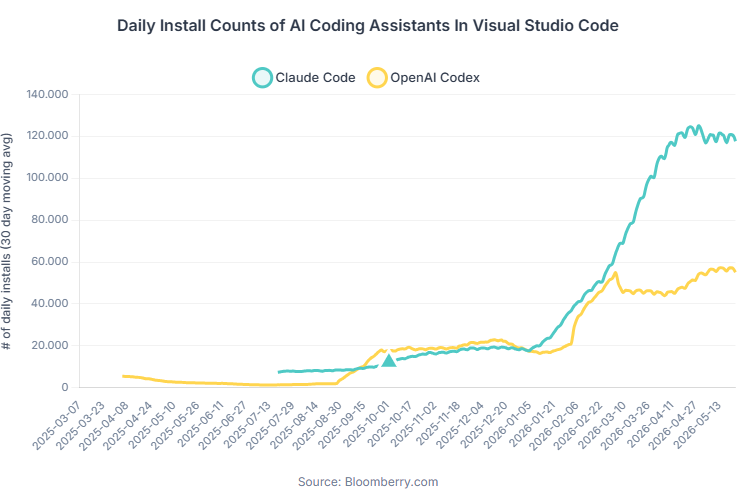
@RihardJarc This also correlates to VSCode adding Github Copilot to the core, so there is less need to install any additional extensions
English
It's clear that growth for coding tools such as Claude Code has decelerated from the pace it was since the start of the year.
It might be compute- constrain related or due to many clients blowing their full-year AI budgets.
Monitoring this trend very closely with all the alt data. I will provide regular updates.
English

Jony Ive: Using touchscreens for basic car controls is a 'dumb design' that endangers lives.
"People are dying because of dumb design."
"Multi-touch shouldn't be in a car. It requires by definition that you're looking at a display."
When the man who popularized the touchscreen admits putting an iPad in your dashboard is a deadly mistake, automakers must listen.
I grew up in cars with analog switches, and I miss them. You could operate the radio or the climate control by pure muscle memory while keeping your eyes on the road.
Now, the data backs up that everyday frustration. A University of Washington study proves touchscreens cause lane drifting. Starting in 2026, Euro NCAP will actually strip 5-star safety ratings from cars that refuse to use physical buttons for basic controls.
We sacrificed safe, intuitive hardware for flat screens. It is time to bring the buttons back.
Source: Cleo Abram
English

Introducing Ferrari Luce, the first electric Ferrari designed by LoveFrom.
English
If AI will be able to replace me then it will be good enough that i can ask it to make me 1mln on stock market then retire.
Sara@SaraDiscovers
Software Engineers, what's your plan B if Al replaces you?
English

Solving remaining 10% of edge cases, creative thinking, top down planning, decision making, choosing right model for the job, using least token possible, optimising workflows
NOVA@Its_Nova1012
Software Engineers, if AI writes 90% of the code, what will make you irreplaceable?
English

Whenever an AI tells me I'm absolutely right, my trust in it drops by a bit
English

The right way to use AI in schools is to have sharply different policies about how much you allow it. Using AI should be encouraged in some situations and absolutely banned in others.
English


why are companies laying off X% of their workforce instead of reducing salaries to everyone by X%? the savings could be much higher
English