Let's talk about revenue and distribution.
Recently there has been a lot of buzz about apps making big $ on mobile.
Our nature is to focus on big numbers and there is nothing wrong with it, but we often forget about business fundamentals and by that I mean:
IF YOU BRING TRAFFIC YOU WILL GENERATE REVENUE
We need to distinguish between two things -- I'm going to use popular terms Product Fit and Market Fit.
If you have a great product, but a horrible market side, you're not going to go far.
As an example, let's take an ice cream stand (it's a product).
You have the greatest ice cream in the world. Everyone loves it.
But you put it in the middle of the mountain with one person passing by a day (traffic), additionally, it's winter (timing).
How much are you going to sell? 0 or 1 (probably 0).
Now, picture setting up this ice cream stand in the middle of summer at a beach where 100,000 people pass by every day. Your ice cream is terrible (product). Every person who tries it never returns (high churn), but it doesn't matter. They paid upfront. You generated revenue in a short time.
Statistically, average industry e-commerce conversion rates are 1-3%.
100k * 1% is 1000. So you've sold 1000x more ice creams than your mountain competitor.
We can delve deeper: with a great product and market strategy, we can achieve a higher conversion rate and maintain recurring customers.
Nonetheless, this applies to mobile apps or any product as well.
What you're seeing online right now is people using TikTok and Instagram to generate a lot of traffic, which then converts into money.
If their product is great, then it's amazing, because people stay and they keep increasing the revenue. If not, then well, they still made money.
Here are some fundamental truths:
- If you have a poor product and no traffic, you will generate no revenue.
- If you have a great product but no traffic, you will still generate no revenue.
- If you have a poor product but significant traffic, you will generate revenue; however, once the traffic source stops, your business will decline.
- If you have a great product and significant traffic, you will generate revenue and your business will grow.
I'm sure you know which path is the proper one if you want to do it long-term.
If you just want to make a quick buck short-term then a great product is not necessarily required.
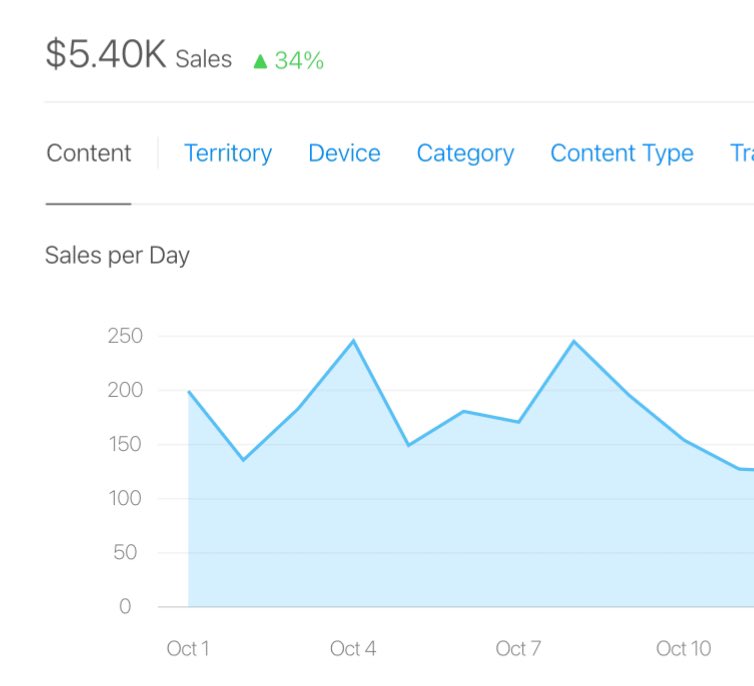
October was my highest month so far in this App Store game.
In Feb I had $50 and April was my first $100 month. I was sooo happy with these numbers. It showed me what was possible.
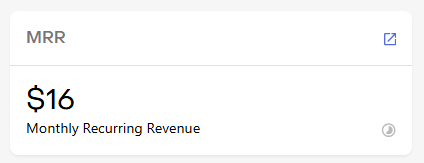
I won’t be posting my MRR here anymore, but I’ll continue to post about it on the blog.
When creating ads, here’s something to keep in mind about the CTA section:
Different distribution channels have different buying temperatures. A user seeing a display ad on a website is not as interested in buying something as someone that made a search query
Generally, the distribution channels go like this in term of buying temperature (from low to high):
Display -> video -> social -> search
The colder the traffic, the less effective a hard CTA will be. The hotter the traffic, the harder the CTA can be
For example, a CTA that says “buy insurance today” is very hard. This can work on BOF google searches, but will flop on TikTok
A way to go about softer CTA’s is to frame it as low investment benefits:
“Find out what you can cover with insurance” is a much softer CTA that might work on something like TikTok, for example
From there, you’d lead to a landing page where you warm up the lead. Something like a quiz could work for that
Keep this in mind when making ads. Not all channels are the same
I'm playing around with an idea that helped me and I think can serve you as well:
Focus on the next step, and nothing else
When I set goals for the week, my goal was to get as much done as I possibly could. As a result, I would pick as many tasks as I could think of – I would write down every single thing that would move me in the right direction, put it on a whiteboard, then pick items from there every day
This sounded good on paper, but it did have a problem I did not initially anticipate – it failed to focus the energy on a single point
I would experiment with content, make app changes, learn about the TT algo and setup, reach out to influencers – all in a single week
And while I theoretically did make progress by crossing these tasks off the list, at the end of the week I did not feel like I was getting any closer to the goal. Furthermore, I was feeling a heavy fog of confusion almost constantly – I had zero clarity on what I was working towards, all under the creed of taking as much action as I could
But I realised that action for the sake of action is not going to do anything. Doing 10 things at once does not 10x the results – it merely splits my energy by 10. And it seems that results follow a power-law, where you'll get no results unless you put in more energy towards a single thing than 99% of people do, point at which you get 1000x results
I realised that it's stupid to try and make progress in 10 areas in a week. I also realised it's stupid to think in terms of weekly goals in the first place
Why? Because if you measure progress in terms of time, you'll be tempted to cram in as much stuff as you can within that window, which leads to the initial problem I mentioned. Furthermore, there is no way of knowing whether a task will take one hour or three days (especially when exploring a new domain)
Instead, here's what I do:
First, I set a big goal (e.g. get a 10k view video, get 1.5k registered users, etc). I also give myself a reward for completing it (e.g. buy a cool leather jacket)
Then, I think of the immediate next step I need to take in order to reach that goal (e.g. I need multiple devices to test content from, so I need to learn how to efficiently activate new devices – therefore the next step is "activate 5 new iPhones")
Next, my mission is to complete that goal in as short of a timeframe as I possibly can
This approach gives me something invaluable – clarity
I know where the next goalpost is. I also know what the next action is. All I gotta do is take that step.
This helps me manage the anxiety and confusion of entrepreneurship. It helps me work within the brain's natural channel capacity. It formats work in a way that allows the subconscious mind to digest it
You know that generalised state of confusion that freezes you? The one where you don’t know which way is forward?
More often than not, that doesn’t come from not knowing the answer, but not knowing the question
Spend some time and figure out what it actually is that you want to know. In most cases, once the question is clear, you can get an answer pretty quickly
There is one thing that, if done right, can 10x the monetisation of any app — but barely any apps do it
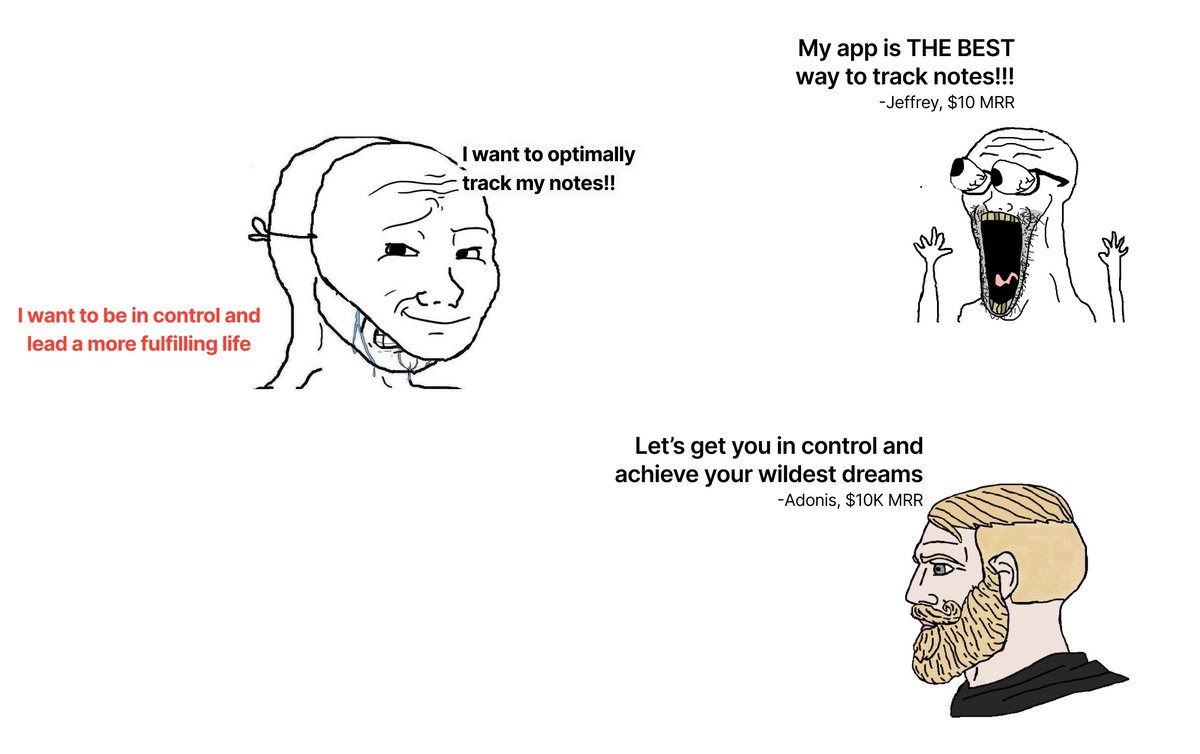
First, let’s get back to the basics — what is an app? One might say that an app is a little tool that fixes a specific problem. I think that’s the farthest thing from the truth. That line of thinking is an exact representation of the root problem. So what are apps?
For me, apps are sales at scale
When making an app, your number 1 priority is not UI, functionality, copy, or UX. Your number 1 priority is understanding people. Your goal is to understand what drives people, what their deepest desires are, what they yearn for — then selling *that* to them
Here’s the thing — open a random app from the store and take a look at the onboarding. You’ll see stuff as:
- the best way to track your notes
- make music easily
- share pictures with your friends
But all of these are bullsh*t.
People don’t care about tracking their notes, they care about feeling in control. They don’t care about making music, they care about expressing themselves freely and being appreciated for it. They don’t care about sharing pictures, they care about making beautiful memories with friends
The deeper you dig, the more you can monetise. Once you hit the deepest level of human desire is when you can start charging €19,99 / mo for your apps
So, what’s the takeaway here?
First, figure out what *really* motivated your avatar. Then, sell them that — use words and imagery that helps them visualise that dream scenario. Use clever UX to agitate that desire and create a stronger pull towards your solution. But above all else, start with empathy — figure out what makes your user tick, and give it to them
web2app Funnels are generating MILLIONS For mobile apps in 2024....
I've collected 1500 screenshots of 50 funnels of best apps on the market.
✨ Weight Loss
📅 Habits
📚 Microlearning
🩺 Health
🧘 Meditation
🌍 Languages
Like + comment "web2app" and I'll send it to you (must be following so I can DM you)!
This setup makes it easy to compare the approaches top apps use to draw users in through web and mobiel apps funnels. Whether you're looking for inspiration or new ideas for your own web-to-app approach, this collection has you covered.