Markus Eckstein

1.3K posts

Markus Eckstein banner
Markus Eckstein

Markus Eckstein

@Markuseckstein3

#Pathologist #Physician Scientist @UniFAU University Hospital Erlangen, Germany #pathology #biomarker_research - My opinions are my own

Erlangen, Germany Katılım Temmuz 2017
598 Takip Edilen1.4K Takipçiler
Sabitlenmiş Tweet
Markus Eckstein
Markus Eckstein@Markuseckstein3·
🌶️🌡️Summary of my uropathology for urologists and oncologists series! 👉check it out! and retweet if you like! @urotoday @OncoAlert @Uroweb @EAUYAUrology @EAU_YAUroTech @EauPatient @niklas_kluemper @onkowissen x.com/Markuseckstein…
Markus Eckstein@Markuseckstein3

Today I will start a new small series: Uropathology for urologists and uro-oncologists. @urotoday @OncoAlert @imedverse Let us start with my favorite topic: Urothelial Cancer! You will often hear urothelial cancer is a heterogeneous disease, but why ?

English
3
26
46
34.5K
Markus Eckstein retweetledi
Markus Eckstein
Markus Eckstein@Markuseckstein3·
Remarkable and important results, that 1) impressively underline efficacy of EVP in MIBC, but 2) only in case of pCR. If no complete remission achieved no substantial benefit over no treatment. Why are these patients not responding ? Biomarker and histology work up required !
Niklas Klümper@niklas_kluemper

It’s great to see the full KEYNOTE-905 publication in @NEJM—congrats to all involved: in 344 randomized pts (median FU 25.6 mo), periop enfortumab vedotin + pembrolizumab significantly improved 2-yr EFS (74.7% vs 39.4%; HR 0.40) and OS (79.7% vs 63.1%; HR 0.50) and markedly increased pCR (57.1% vs 8.6%) vs surgery alone! Notably (and expected), EFS in the EVP-treated non-pCR group is markedly worse vs those achieving pCR (with HR 0.76 vs no periop therapy), underscoring the urgent need for robust predictive biomarkers (e.g., NECTIN4 expression/amplification?) to better guide patient selection upfront and optimize strategies for patients which are likely to not achieve pCR @Markuseckstein3 @PTarantinoMD @DrChoueiri @OncoAlert @urotoday @weoncologists @tompowles1 @Uromigos @Uroweb @montypal @JoshMeeks @shilpaonc @PGrivasMDPhD

English
2
5
11
1.2K
Markus Eckstein retweetledi
Markus Eckstein
Markus Eckstein@Markuseckstein3·
Today I will start a new small series: Uropathology for urologists and uro-oncologists. @urotoday @OncoAlert @imedverse Let us start with my favorite topic: Urothelial Cancer! You will often hear urothelial cancer is a heterogeneous disease, but why ?
English

7
24
134
51.9K
Markus Eckstein
Markus Eckstein@Markuseckstein3·
@Banana_Oncology … and may need no answer because the trial was conducted - and gladly with Pd-1/ctla4 dependent on design ; and not with anti Tigit
English
0
0
1
39
Banana Oncology
Banana Oncology@Banana_Oncology·
"So much investments in drug development and there is little benefit to patient survival"
Banana Oncology tweet media
English
3
7
78
15.1K
Markus Eckstein retweetledi
Stephan P. Rosshart
Stephan P. Rosshart@SRosshart·
Please retweet! Ever wondered how to establish and maintain wildlings – and why they matter? Our new paper “Game of microbes: a wildling ’s guide” is now out in Trends in Microbiology dlvr.it/TRl1Zs - Thread below with key previous work @TrendsMicrobiol @CellPressNews
English
1
22
33
2.9K
Markus Eckstein
Markus Eckstein@Markuseckstein3·
Fantastic overview of @SRosshart, who is dedicated to utilizing and propagating specific wildling mice with a finely tuned immune system due to exposure to external pathogens and exposures that subsequently develop a realistic gut microbiome. These mice are particularly intriguing for immunology research! - they have true immunosystem!
Stephan P. Rosshart@SRosshart

Please retweet! Ever wondered how to establish and maintain wildlings – and why they matter? Our new paper “Game of microbes: a wildling ’s guide” is now out in Trends in Microbiology dlvr.it/TRl1Zs - Thread below with key previous work @TrendsMicrobiol @CellPressNews

English
0
0
0
298
Markus Eckstein retweetledi
Fred R. Hirsch
Fred R. Hirsch@fred_hirsch·
Presented today at ELCC in Copenhagen results from PD-L1 AI Blueprint Project demonstrating that AI PD-L1 assessment is at least as good as manual in many cases better, even compared to manual expert assessment !
Fred R. Hirsch tweet media
English
0
10
15
1.5K
Markus Eckstein
Markus Eckstein@Markuseckstein3·
@WalterStadler5 @scserendipity1 @WalterStadler5, that’s interesting! I’ve heard many people quoting EV and other ADCs as targeted therapies while simultaneously distinguishing them from chemotherapy. Like you, I’m wondering why this happens …
English
0
1
2
313
Arndt Vogel
Arndt Vogel@ArndtVogel·
Real-world clinical utility of tumor whole genome sequencing in solid cancers @NatureMedicine doi.org/10.1038/s41591… 👉actionable biomarkers in 73% of pts (27% for reimbursed and 63% for experimental💊 👉clinical consequences for 41% of tested pts 🧐NGS is key today @myESMO @ASCO
Arndt Vogel tweet media
English
2
17
47
3K
Markus Eckstein
Markus Eckstein@Markuseckstein3·
Some intriguing analysis (sankey plot) reveals that the additive value of whole genome sequencing (WGS) over a simulated 523 gene assay (likely based on Illumina TSO500+) is remarkably minimal. In contrast, the failure rate of WGS is notably high, ranging from 15% to 20%. Conventional panel sequencing, on the other hand, exhibits significantly lower failure rates. Moreover, many tumor patients included in the study have tumor types where next-generation sequencing (NGS)-based therapy stratification is already standard of care (SOC), such as non-small cell lung cancer (NSCLC), which constitutes the largest population within the group. Given these considerations, should we argue that WGS should be preferred for all these patients at baseline? For instance, as we run it in our German precision medicine network, it is quite expensive compared to panel sequencing. However, it is possible that germline variants are already a good indicator to justify WGS. What are your thoughts, @ArndtVogel, from a medical oncologist’s perspective?
English
0
0
4
125
Markus Eckstein
Markus Eckstein@Markuseckstein3·
What comparator would be used to empirically demonstrate that patients achieving pCR may safely skip surgery? Would this be based on a synthetic control arm, as accepted by the FDA in selected circumstances, using propensity matching to EVP+ radical cystectomy pCR cohorts (e.g from 303/304)? A critical point that we still see often after EVP pCR during path assessment is the persistence of CIS that seems not to be served by EVP - wonder how this will affect longer term bladder intact survival as it is the root of MIBC and potential relapses.
English
0
4
10
573
Markus Eckstein retweetledi
Niklas Klümper
Niklas Klümper@niklas_kluemper·
Important trial tackling the right question first: can we safely preserve the bladder after cCR with EVP? But 9 cycles of EVP is associated with significant cumulative toxicity —especially neuropathy. In EV302 EPAR data, the KM curves show a clear exposure–toxicity relationship, with higher ADC exposure driving earlier and more frequent ≥G2 neuropathy. And G2 is already life-changing: difficulty buttoning shirts, typing, gait instability, chronic pain—this isn’t “mild.” We’ve learned before: In B15, 3 cycles neoadj EVP achieved similar pCR rates as 4 cycles in 905 → more is not always better. Effect of adjuvant EV not tested properly (VOLGA will be informative in this regard!) Maybe even fewer cycles can be sufficient. Response adapted dosing? (Imaging, ctDNA and/ or utDNA Dynamics)?) So yes—answering “bladder preservation safe?” first is the right strategy which will increasingly asked by the patients in real-world. But: ➡️ EV dose reduction & discontinuation must be proactive ➡️ Early signs of neuropathy should trigger action, not delayed adjustments ➡️ Cumulative exposure matters more than cycle count alone “EVP first, ask later” should not come at the cost of irreversible toxicity in a curative setting where surgery also cures many patients @UroDocAsh @tompowles1 @Uromigos @urotoday @Markuseckstein3 @OncoAlert @weoncologists @DrChoueiri @PGrivasMDPhD @AndreaNecchi @shilpaonc
Niklas Klümper tweet media
Tom Powles@tompowles1

A 240 pateint single arm trial exploring 9 cycles of EVP without planned surgery in MIBC. This will answer the key questions ‘What happens if we don’t do cystectomy in those with clinical complete response after initial EVP’.It assesses cCR rates and bladder intact EFS. It will clarify ‘EVP 1st ask questions later’ #GUtrendingTopics @OncoAlert

English
3
6
23
2.5K
Markus Eckstein retweetledi
Ashish M. Kamat, MD, MBBS
Ashish M. Kamat, MD, MBBS@UroDocAsh·
Pleased to share that the 2026 @NCCN Bladder Cancer Guidelines now incorporate the @IBCG_BladderCa risk stratification framework for intermediate-risk NMIBC. A milestone reflecting more than a decade of collaborative work by colleagues worldwide einpresswire.com/article/901009… @UrogerliMD @drtanws @shilpaonc @pjhensley11 @mouwlab @AndreaNecchi @LAUrology_NL @AmirHorowitz @karima_oualla @PGrivasMDPhD @paolo_gontero @pcvblack @MaxKates @SpiessPhilippe @RobertoContieri @KKBree @LauraBukavinaMD @MRoupret @joanfundi @UroToday @BladderCancerUS @WorldBladderCan
English
5
41
105
16.6K
Markus Eckstein
Markus Eckstein@Markuseckstein3·
From both a pathological and a clinical perspective, several additional points that are in line with your thoughts @UroDocAsh should be considered: 1.As you already pointed out, the survival benefit seen in EV-303 and EV-304 is driven largely by the combination of surgery and the potency of EVP. 2.Patients who achieve a pathological complete response (pCR) do very well in both trials. However, it is important to emphasize that in both studies all patients that were included in final analyses also underwent cystectomy as an integral part of treatment. 3.pCR is, by definition, a pathological endpoint. It will be very difficult to reproduce pCR assessment, which is based on thorough embedding and evaluation of tumor beds in cystectomy specimens, by using re-TURBs or clinical response assessments instead. These are not equivalent. We know this from many other tumor types, including breast cancer, NSCLC, and colorectal cancer. 4.“Unreal” pCRs are an inherent problem in current MIBC diagnostic practice. EV-303 shows a complete resection rate of around 9% in the control arm, which is not the same as pCR, and the literature reports complete resection rates of approximately 10–25%. This means that a substantial proportion of patients classified as having achieved “pCR” may no longer have had a target lesion at the time of evaluation. We still classify them as pCR, although the tumor itself may in fact have been resistant to EVP and insufficiently treated by this regimen, while ultimately being cured by cystectomy. It is the Schrödingers Box of response assessment! 5.And this does not even take into account other high-risk lesions such as CIS, which are not adequately targeted by systemic therapies and remain an important source of MIBC recurrence. Bladder-sparing treatment is certainly an option for a very carefully selected subgroup of patients. Thus this trial will surely deliver first results to answer the question of which patients can safely forgo cystectomy at this point. That said, this highly informative trial is undoubtedly of major importance for moving the field forward, provided we draw the right conclusions from it. What we need are better definitions and, potentially, robust biomarkers as safety nets, including ctDNA and especially utDNA, together with clinico-pathological criteria that can reliably identify patients who are suitable candidates for this type of treatment.
English
0
0
2
44
Ashish M. Kamat, MD, MBBS
Ashish M. Kamat, MD, MBBS@UroDocAsh·
Great points. B15 establishes the potency of EVP but we have to be careful not to conflate maximum systemic efficacy with total local clearance - they’re not the same thing, and the 55.8% pCR rate, impressive as it is, didn’t eliminate the need for the adjuvant tail to drive EFS and OS. If a patient achieves cCR after 3-4 cycles, pushing to 9 without a surgical safety net is a significant gamble on the durability of that systemic response. We know pCR plateaus - beyond a threshold we’re trading efficacy for toxicity - and cCR ≠ pCR regardless. 9 cycles as the defining threshold feels like a blunt instrument for a question that requires a scalpel (at least for now!)
Tom Powles@tompowles1

Thanks Laura . My feeling is that the relationship between response in the primary tumour and metastatic sites varies between pateints. It will depend on the extent of MRD and the size of primary tumor. The biology/heterogeneity will also have an important role. 4 cycles will probably be too few for some, while 9 will be too much for others. Using pCR or cCR to define duration of therapy maybe counterproductive (like using IMDC to pick ipi/nivo treatment in RCC). utDNA and ctDNA together maybe be better at this. Designing studies with utDNA and ctDNA is hard as it takes a while to get initial results, but it’s a useful exploratory endpoint. I think we should do these studies too. EV209 asks is we can get the same results as in B15 if we do exactly the same thing except we don’t do surgery in some. It’s an interesting time as things change and I might not be right about this (e.g utDNA) @MattGalsky @shilpaonc @UroDocAsh @MichvdHeijden

English
2
6
33
6.1K
International Society of Urological Pathology
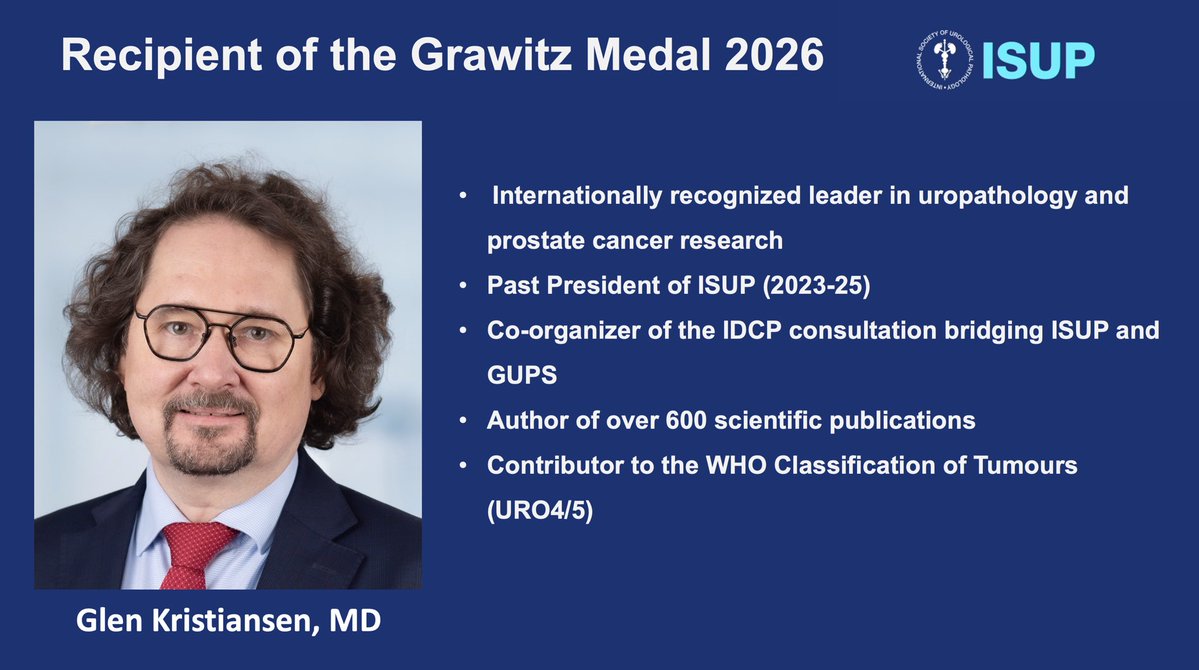
Congratulations to Glen Kristiansen, recipient of the 2026 Grawitz Medal from ISUP! 🏅 A global leader in uropathology, his work—including 600+ publications and contributions to WHO classification—has greatly advanced the field. #USCAP2026
International Society of Urological Pathology tweet media
English
1
4
32
1.9K
Markus Eckstein
Markus Eckstein@Markuseckstein3·
That probably speaks for the fact that patients with ctDNA- non pCR are responders where tumor cells have not been cleared yet. Did the authors calculate any correlations with MDACC regression scoring classes that we for example report for every neoadjuvantly treated breast patient on resection specimens ? That would be very important because if there is an association, ctDNa would lose to differentiate responders without complete clearance versus truly therapy resistant patients - that would be exciting !
English
0
0
0
160
Kazuki Nozawa, MD
Kazuki Nozawa, MD@kazuki_nozawa·
pCR after neoadjuvant chemotherapy has long been considered a strong prognostic marker. But adding ultra-sensitive ctDNA changes the picture. In the PREDICT-DNA trial (NeXT Personal @PersonalisInc ), ctDNA-negative patients among non-pCR cases showed outcomes comparable to pCR. @JCO_ASCO Small sample size—but a highly impactful finding. ascopubs.org/doi/10.1200/JC…
Kazuki Nozawa, MD tweet media
English
3
74
192
29.7K
Markus Eckstein retweetledi
Markus Eckstein
Markus Eckstein@Markuseckstein3·
🌶️🌡️Summary of my uropathology for urologists and oncologists series! 👉check it out! and retweet if you like! @urotoday @OncoAlert @Uroweb @EAUYAUrology @EAU_YAUroTech @EauPatient @niklas_kluemper @onkowissen x.com/Markuseckstein…
Markus Eckstein@Markuseckstein3

Today I will start a new small series: Uropathology for urologists and uro-oncologists. @urotoday @OncoAlert @imedverse Let us start with my favorite topic: Urothelial Cancer! You will often hear urothelial cancer is a heterogeneous disease, but why ?

English
3
26
46
34.5K
Markus Eckstein retweetledi
Markus Eckstein
Markus Eckstein@Markuseckstein3·
To give a you better understanding why that is the case, we have to start with the urothelium! It is the common ground for all different types of urothelial cancer.
English
1
2
6
1.6K
Laura Bukavina
Laura Bukavina@LauraBukavinaMD·
I get it and cleanest way by looking at 1 thing at a time but need for surgery is really not answered by prolonging systemic beyond a threshold of max response but it’s a question of appropriate biomarker(s) cCR=pCR we all know pCR does plateau beyond which the gain is just toxicity .. it’s incredibly difficult to imagine majority of my real world patients tolerating this
English
2
2
10
2.8K
Tom Powles
Tom Powles@tompowles1·
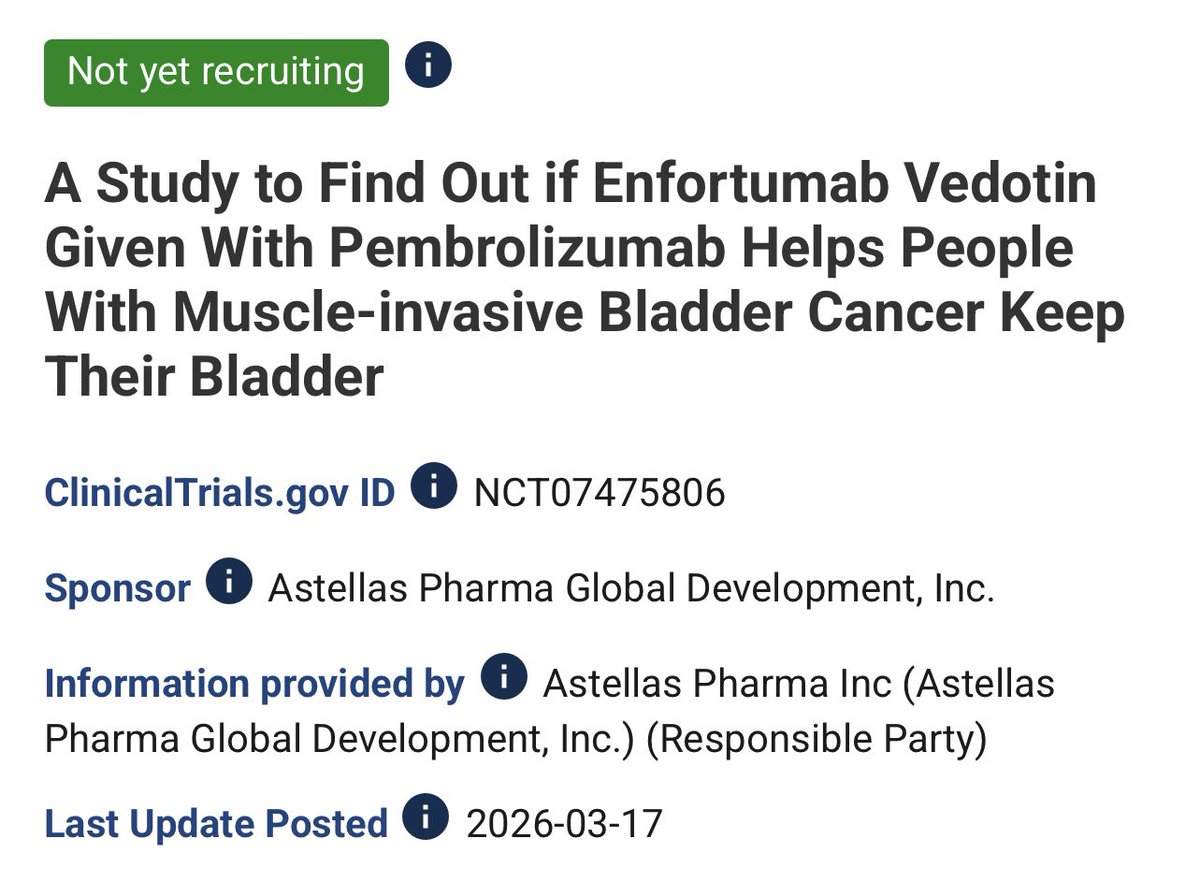
A 240 pateint single arm trial exploring 9 cycles of EVP without planned surgery in MIBC. This will answer the key questions ‘What happens if we don’t do cystectomy in those with clinical complete response after initial EVP’.It assesses cCR rates and bladder intact EFS. It will clarify ‘EVP 1st ask questions later’ #GUtrendingTopics @OncoAlert
Tom Powles tweet media
English
13
69
184
48K