

Marty
16.3K posts

Marty
@martyluko
just trying to get and make this bread 🍞
Florida, USA Katılım Şubat 2013
771 Takip Edilen2.1K Takipçiler

Marty retweetledi

Marty retweetledi

every time you replace “this is hard” with “what’s the first step?” you shift brain activity from your amygdala (fear) to your prefrontal cortex (problem-solving).
that’s neuroplasticity in real time.
For all Curious@fascinatingonX
🚨BREAKING: Science confirms that brain cells are influenced by our self-talk.
English
Marty retweetledi

Marty retweetledi

The real supply is the 95% of all $BTC ever to exist that are already freely circulating. Daily issuance DOES NOT MATTER in a market of eternal units trading billions of volume every day. It's time to stop focusing on it.
Adam Simecka@AdamSimecka
Saylor: "I just bought over 1 month's supply of the entire bitcoin supply in a single day." Bitcoin: "I think I'm going to go down."
English
Marty retweetledi
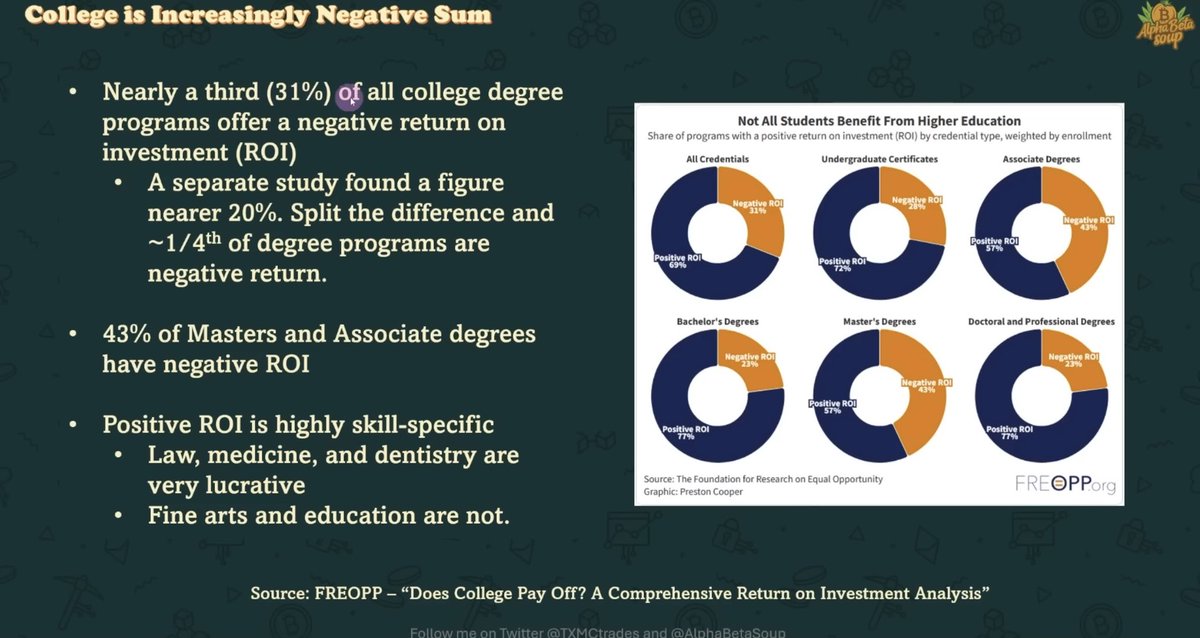
Those who watched last week's @AlphaBetaSoup_ learned that:
-only 30% of recent college grads are working full time jobs related to their skills
-another third are jobless
-half of labor markets nationwide have a mismatch between middle skills credentials and local labor demand
-28% of associates/undergrads programs have NO direct occupational match
-25-30% of ALL college degree programs have negative ROI
-43% of Masters and Associates programs have negative ROI
-the fields which have poorest ROI (humanities, fine arts, general studies) are the only ones with rising enrollment
-the fields with best ROI (medicine, law, dentistry) have seen weak/declining enrollment
-the share of tenured faculty at universities has fallen by almost half since 1987
-the ratio of teachers to administrators at universities has fallen 35-40% since 1990
These are all interrelated problems. The tl;dr is that our system of higher education is failing at a moment when our need for youth to excel is at its greatest, because they are a fleeting commodity.
But instead we are driving up costs of education, expanding the menu of degree programs in ways that do not match actual labor demand thus setting grads up for failure, bloating administrative staff, eroding tenured teaching faculty in lieu of contingent appointments and more student teachers, and collapsing the wealth premium for a degree from where it was mid 20th century.
College grads are now walking unprepared into the worst labor market in US history.
Is it any wonder why enrollment has fallen double digit %s since 2012? It shouldn't be.


Barefoot Student@BarefootStudent
43% of young US grads are underemployed, per Bloomberg.
English
Marty retweetledi

2022: "Plastics and chemicals in my clothes? You're crazy man!"
2026: America's 2nd largest state launches an investigation over toxic chemicals in activewear.
You're not wrong. Just early.
Attorney General Ken Paxton@KenPaxtonTX
🚨BREAKING: I launched an investigation into Lululemon over the potential presence of toxic "forever chemicals" in activewear.
English
@NoahRyanCo @CoachDanGo Imitation is the sincerest form of flattery Dwight schrute once said
English

A cheat code I use for my workouts is 100 grams of dried mangoes.
Learned it from an old coach of mine years ago and never looked back.
When you’re training hard, your muscles can pull glucose directly from your bloodstream without needing insulin through something called GLUT4 translocation.
It’s like a bypass lane that only opens up during intense exercise and 100g of dried mangoes hit that lane perfectly.
It’s fast sugar to spike blood glucose quickly while tasting delicious.
Why does this matter mid-workout?
Intense training runs almost entirely on glycogen. Once those stores start depleting, your explosiveness drops, your pump disappears, and cortisol spikes to compensate.
A few pieces of dried mango between sets keeps the tank from hitting empty.
The glucose also pulls water into your muscle cells at an intracellular level meaning better hydration, fuller contractions, and more blood flow exactly when you need it.
Low blood sugar mid-session is a low key reason why most people fade in the back half of their workouts.
The result is you perform better, sustain output longer, recover faster, and leave the gym less wrecked than you otherwise would.
It’s also a great excuse to eat dried mangoes giving me one more reason to look forward to working out.
Noah Ryan@NoahRyanCo
Always saw the biggest guy at my college gym eating sour patch kids inbetween his sets and my underdeveloped brain could not comprehend why a man so jacked would eat something so taboo (this was peak low-carb era). But now I understand. Fast carbs (glucose, dextrose, sucrose) enter your bloodstream immediately. Working muscles sucks that glucose out of your blood via GLUT4 transclocation, independent of insulin. You bypass the usual metabolic bottlenecks and feed your engines mid-burn. High intensity training is heavily dependent on glycogen and glycolosis. Burn through your glycogen stores and your performance suffers. Less explosiveness, no pump, more cortisol. Keeping your muscles fueled mid-workout gives you everything you want and need. Glucose has an osmotic effect. It pulls water into muscle cells and hydrates you at an intracellular level (very anabolic btw). You get better bloodflow, bigger/fuller muscles, better contraction. You can sustain peak output for the entirety of your workout. Its not just your muscles that are being fueled either. Your brain is a glucose hog. Low blood sugar during long sessions is the leading cause of fatigue and poor motor output. Hence why glucose microdosing is beneficial for cognitive tasks as well (especially hybrid psycho/physiological tasks like martial arts, sports etc.) Better yet, exogenous glucose blunds cortisol-induced tissue breakdown. Extremely anti-catabolic. You perform better, you feel better, you recover better, and you leave your workout less fried than you otherwise would. All while giving you a perfect excuse to get your sugar fix in guilt free.
English
Marty retweetledi
There is no "opting out" as long as you live under the same systems of rules and govt as everyone else. Your bills are paid in fiat. Your wages are in fiat. You pay taxes in fiat. The same law enforcement and judicial apparatus protects your physical property. Save in whatever you want but this framing of "exiting the system" implies a level of freedom you are not realizing
English
Marty retweetledi

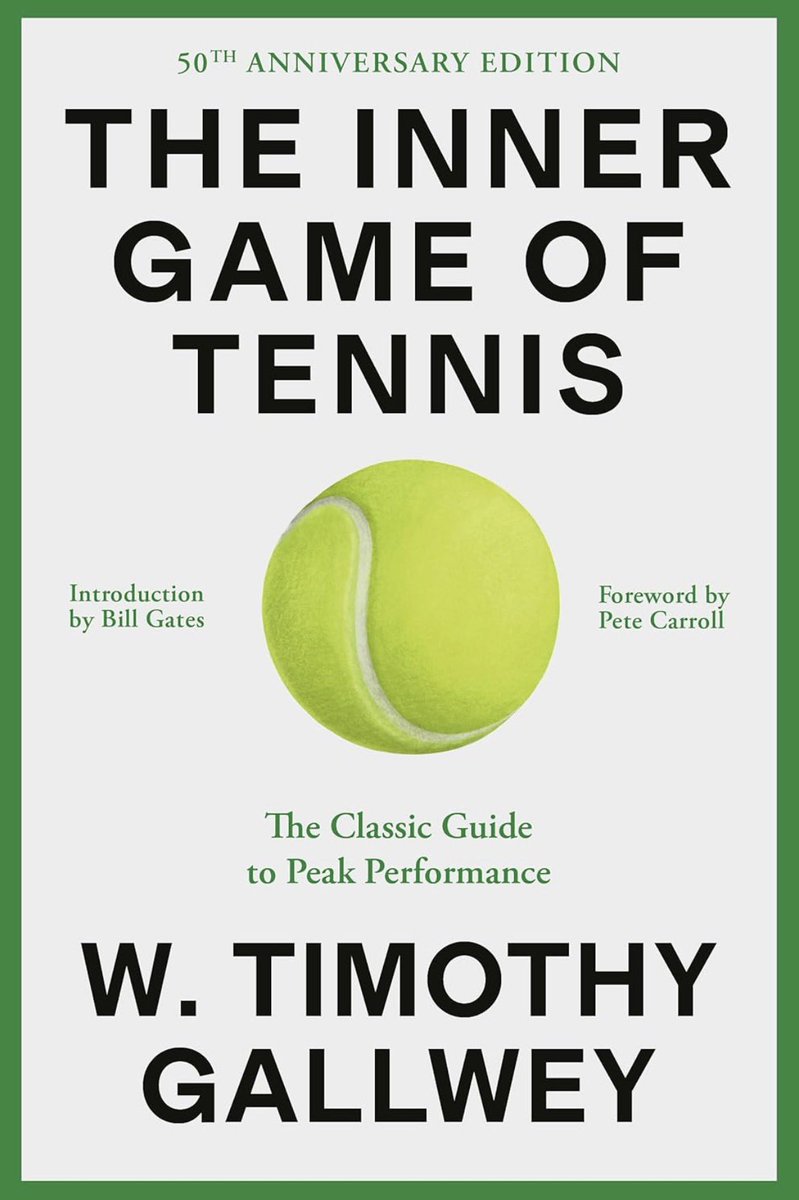
“Fighting the mind does not work. What works best is learning to focus it.”
~W. Timothy Gallwey
Book Summary: The Inner Game of Tennis: The Classic Guide to Peak Performance

English
Marty retweetledi

🚨BREAKING: 8 weeks of gratitude practice physically rebuilds the neural pathways between your memory and reward centers.
Your brain physically rewires itself every time you feel grateful.
Eight weeks of intentional gratitude practice creates measurable structural changes in the neural pathways connecting your hippocampus to your ventral tegmental area. The memory center starts talking to the reward center in a fundamentally different way. New synaptic connections form. Existing ones strengthen. The physical architecture of how you process positive experiences rebuilds itself.
Most people approach gratitude like a mood they can choose to feel. A psychological vitamin they remember to take when life gets difficult. The neuroscience reveals something far more profound.
Gratitude is a biological intervention that sculpts brain tissue.
Researchers tracked participants practicing gratitude exercises for two months using brain scans. They watched new neural highways construct themselves in real time. The anterior cingulate cortex developed stronger connections to the medial prefrontal cortex. The brain learned to route positive emotional experiences through higher order thinking centers instead of storing them as fleeting feelings.
Every positive experience you’ve ever had exists as a neural trace in your memory network. Most sit dormant, accessible only when something external triggers the specific sensory combination that originally encoded them. You smell coffee, suddenly remember a conversation from years ago. Random. Unreliable. Outside your control.
Gratitude practice systematically rewires that retrieval system.
After two months, participants could voluntarily access positive memories with increasing ease. Their brains had built stronger pathways between memory storage areas and emotional processing centers. They experienced deeper emotional resonance during memory retrieval. The quality of remembering itself had improved.
The participants also started noticing positive details in their present environment they had previously filtered out. Their attention systems recalibrated. The same neural pathways pulling positive memories forward were scanning current experiences more thoroughly for elements worth encoding as positive memories.
Their brains became biased toward collecting evidence that life contains meaningful moments.
Most cognitive interventions try to change how you interpret negative experiences. Gratitude practice changes how thoroughly you notice positive ones. It teaches your visual and emotional processing systems to detect opportunities and pleasures that were always present but neurologically invisible.
The timeline reveals something crucial about neural plasticity.
Weeks one through three showed minimal structural changes.
Participants felt slightly more positive, but brain scans looked identical to baseline. Weeks four through six showed the first measurable increases in gray matter density. Weeks seven and eight revealed entirely new neural network formation.
Two months. Your nervous system can physically restructure itself with consistent practice.
The method was almost embarrassingly simple. Participants wrote down three specific things they felt grateful for every evening, explaining why each mattered. No meditation apps. No guided visualizations. Just pen, paper, and the requirement to identify gratitude targets with enough detail that their brains had to actively search for positive elements.
Specificity drives the neural development.
General statements like “I’m grateful for my family” generate different brain activity than precise observations like “I’m grateful my daughter laughed at my terrible joke during dinner because it showed me she still finds me funny despite growing more independent.”
The brain needs detailed targets to practice connecting memory specifics to emotional rewards.
After eight weeks, participants developed a fundamentally different relationship with their attention and memory systems. Someone whose brain automatically scans for and emotionally amplifies aspects of experience that make existence feel worthwhile.
The neural pathways remain permanent after practice ends.
Gratitude carves lasting roads through consciousness.

Darshak Rana ⚡️@thedarshakrana
Gratitude rewires the brain. Gratitude rewires the brain. Gratitude rewires the brain. Gratitude rewires the brain. Gratitude rewires the brain. Gratitude rewires the brain. Gratitude rewires the brain. Gratitude rewires the brain. Gratitude rewires the brain.
English
Marty retweetledi

Quite sobering tweet.
I think crypto's "easy money era" lasted 6 years from 2017 to 2022.
There were less people & tickers. Less exchanges & less markets. Liquidity + attention was more focused.
After FTX collapsed, the crypto we knew died imo. Binance really went off the leash (in a bad way).
Extraction era began. Memecoins casino (98% lost money), celebrity coins (all rugged), the trenches culture (you gave away your money to scam KOLs). To top it all off we got the most crypto (retarded) president that completely killed this industry.
The only products left to survive are the ones you won't make much money on:
- Stablecoins (can't make money off of it)
- RWA (can't make money off of it)
- Prediction market (most of you will lose $)
- AI (most of you won't make any $)
- Perp DEXes (most of you will lose $)
You won't make any serious easy money no more. Adapt and develop real skills or die.
Ignas | DeFi@DefiIgnas
Crypto easy money era has ended. Historically, most easy money periods last 3-7 years: - California Gold Rush lasted 7 years. - Tulip mania lasted 3 - The dot-com bubble about 5 years before the Nasdaq dumped by 78% - Japan's bubble was 6 years, then Nikkei took 34 years to recover So most speculative booms in history last 3-7 years. Crypto easy money started in 2017 with ICOs. Then DeFi summer 2020. NFTs in 2021. Airdrops. Points farming. Memecoins. That's ~8 years of easy money. We are already past that as every easy money model has been discovered, exploited, or arbitraged to max competition. Philosophical hard-forks like BTC -> BTC Gold or ETH -> ETH classic are over as crypto ossified not just technically. ICOs got regulated. Airdrops get farmed by industrialized sybils. Memecoin launches went from community fun projects to extraction tools. The gold rush analogy seems quite good here as FOMOs end the same way: Surface deposits get exhausted and then industrial mining takes over. (Literally same happened to BTC mining moving from retail to institutions who even IPOed from BTC mining.) So here’s where crypto is now: TradFi suits moving in, tokenization, RWAs, corpo-sloppo permissioned chains, and regulation. The Trump family & insiders are the last to get easy money from crypto. For retail, the surface easy money gold picking is gone. What's left to earn requires real infra, real users, real revenue which means more specialization, specific knowledge and REAL hard effort. Not sure how many of us who got easy money are ready to grind harder now. So many builders, KOLs, projects are extracting as much as they (we) can before leaving crypto coz adapting to the new hard-money period is gonna be hard. Question is: where to pivot for easy money? Asking for a friend.
English
Marty retweetledi

Marty retweetledi

A short afternoon nap restores brain neuroplasticity.

English
Starting a war and guilt tripping your allies for not helping/joining is next level petty 🤣
Mario Nawfal@MarioNawfal
🚨🇺🇸🇬🇧 Secretary of War Hegseth just called out the UK for not helping with the Strait of Hormuz. "Last time I checked there was supposed to be a big bad Royal Navy that could be prepared to do things like that." x.com/atrupar/status…
English

Google is basically saying:
“We’ve cut the quantum resources needed to break Bitcoin’s encryption by 20x. We can now break it. We can prove it. We’re just not going to tell you how.
We’ve slowed down research to give crypto a chance. You have until 2029 to figure out a solution. Good luck.”
nic carter@nic_carter
Many are wondering "what Google saw" that caused them to revise their post-quantum cryptography transition deadline to 2029 last week. It was this: research.google/blog/safeguard…
English
Marty retweetledi

Comparing 1990 first-time homebuyers to 2025 first-time homebuyers doesn’t radicalize you enough.

English
Marty retweetledi
As I first explained a year ago, Global M2 is bullshit for trading. It doesn't really exist. It's a made up aggregate of a bunch of different countries domestic money supply, which is then arbitrarily converted into dollars. Half of the aggregate is just China alone and their domestic liquidity is not the same as the United States AT ALL. Over 90% of the data points in a daily global M2 series are just FX fluctuations and not even money aggregates. Everyone who peddled this metric is an idiot for not understanding these things and misleading people. I said it from the beginning. (Original thread below)
Edward Morra@edwardmorra_btc
What exactly went wrong here?
English

Marty retweetledi

UNREAL:
🇺🇸 Brian Armstrong is blocking the CLARITY Act to protect a 34% commission fee.
Not for crypto freedom.
Not for retail investors.
For his own bottom line.
Every time he says "this bill isn't good for crypto."
He means "this bill isn't good for Coinbase revenue."
People lie. Numbers don't.
Remember that next time he plays the hero.
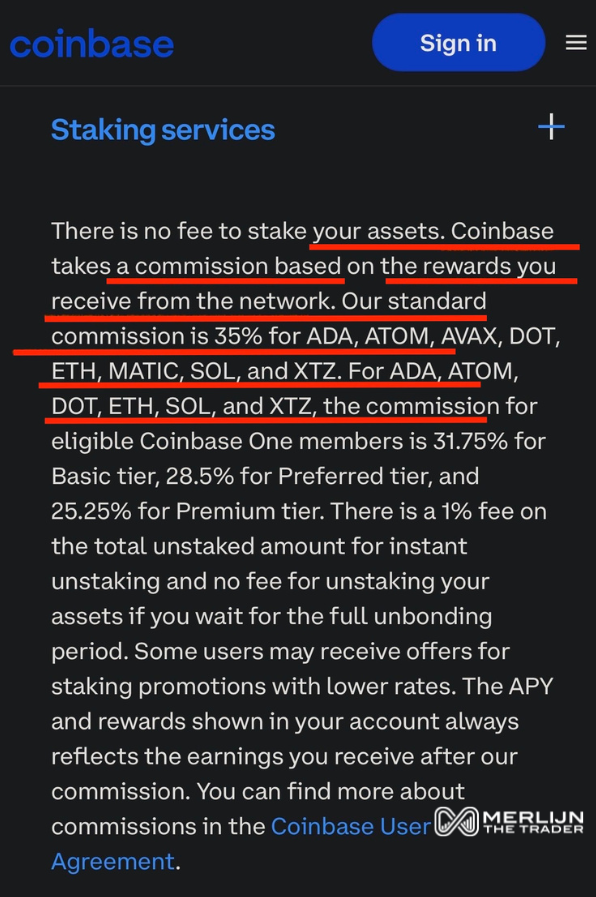
Merlijn The Trader@MerlijnTrader
🇺🇸 Brian Armstrong just killed the CLARITY Act. AGAIN. Trillions waiting on the sidelines. Institutions ready to deploy capital. One stablecoin yield disagreement. One CEO. One veto. The crypto industry's biggest enemy right now is not the SEC. It's Coinbase.
English