Matt Beane

8K posts

Matt Beane banner
Matt Beane

Matt Beane

@mattbeane

Study work with AI + robots. @MITSloan PhD, @Ucsb Assc Prof, @Stanford fellow, @tedtalks, @skillbenchinc cofounder, CEO Book: https://t.co/OJQa0by9MT

Santa Barbara, CA Katılım Kasım 2008
255 Takip Edilen4K Takipçiler
Sabitlenmiş Tweet
Matt Beane
Matt Beane@mattbeane·
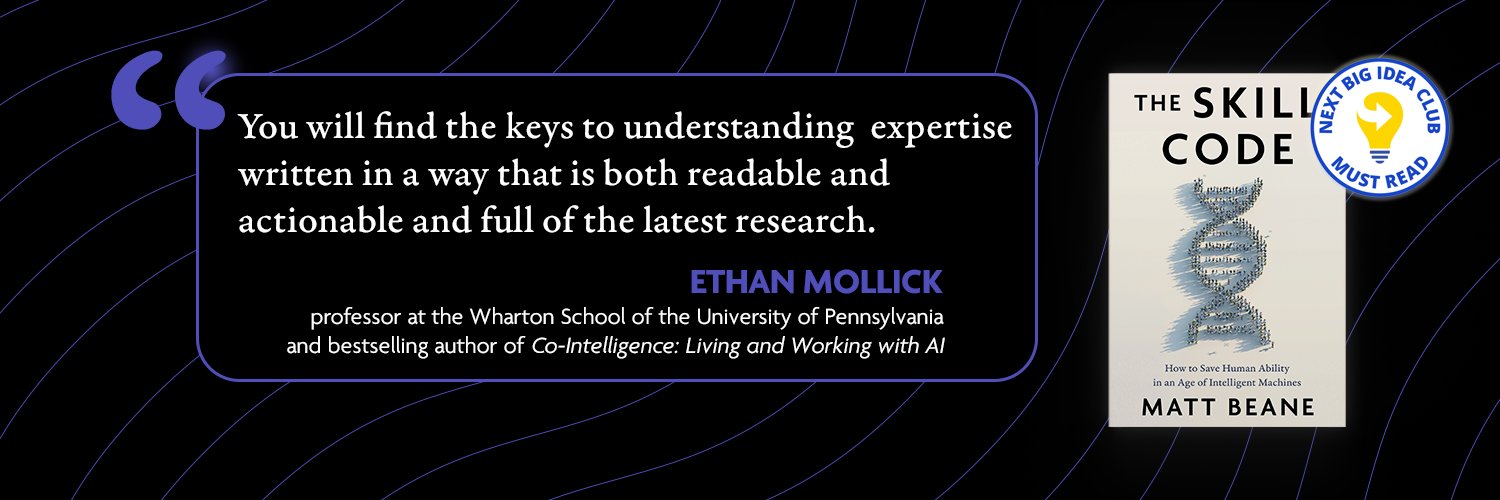
I'm so grateful and exited to share that my book will be published on June 11th! It's called "The Skill Code: How to Save Human Ability in an Age of Intelligent Machines" Available for preorder now, here's a bit of the story: wildworldofwork.org/p/big-insider-…
English

12
35
204
67.9K
Matt Beane retweetledi
Lee Vinsel
Lee Vinsel@STS_News·
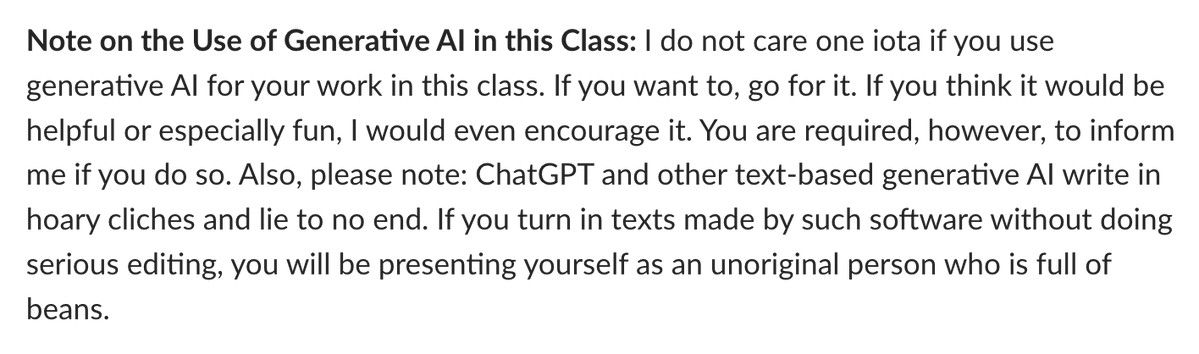
Generative AI policy statement from a course I taught in Fall 2023. I will still use it in some of my classes, mostly upper-level ones, though to be clear, I also use bluebooks and a lot of in-class work in others.
Lee Vinsel tweet media
English
4
1
11
625
Matt Beane retweetledi
Ethan Mollick
Ethan Mollick@emollick·
The ability of the Claude team to learn from things like OpenClaw and implement features like this on a daily basis is a very strong argument that, for AI-powered coding teams, a very different software development process is possible, with large strategic implications.
Thariq@trq212

We just released Claude Code channels, which allows you to control your Claude Code session through select MCPs, starting with Telegram and Discord. Use this to message Claude Code directly from your phone.

English
33
40
604
39.2K
Matt Beane retweetledi
Your Best Version
Your Best Version@YourPrimePath·
i regret to inform you that personal growth rarely comes from acquiring new knowledge and almost always from: - getting humiliated - showing up terrified and doing it anyway - admitting you might be the problem
English
84
2.9K
18.2K
332.6K
Matt Beane retweetledi
Lukas Freund
Lukas Freund@_LukasFreund_·
🚨 “Job Transformation, Specialization, and the Labor Market Effects of AI” - new paper with @lukasfmann 💡 AI transforms what tasks we do at work. Our paper shows how, as a result, individuals' wages may rise or fall depending on their skill set. 🧰 We build a framework to quantify the effects of job transformation on wages, and characterize winners & losers in a genAI automation scenario from 3 perspectives. 👉Exposure: Moderate occupational exposure benefits incumbents, on average, while high exposure harms them; but: within any exposed occupation there are both losers and winners. 👉Skills: Value of social and manual-technical skills ⬆️, analytical/information-processing skills ⬇️. 👉Distribution: Low-wage workers gain relatively more than high-wage workers. 🧵 Summary thread & link to paper 👇
Lukas Freund tweet media
English
1
26
108
10.6K
Matt Beane retweetledi
Joe Weisenthal
Joe Weisenthal@TheStalwart·
This is a compelling argument from Tim. @pmarca ended up being wrong about software eating the world. I’ve previously said on the podcast that Andreesen was vindicated, and this made me change my mind.
Timothy B. Lee@binarybits

Marc Andreessen was wrong about software eating the world, and I see people making the same mistake about AI today. I wrote this almost three years ago and I wouldn't change a word if I were publishing it today.

English
56
54
913
145.5K
Matt Beane
Matt Beane@mattbeane·
@tszzl One core finding in our study with some of your colleagues w 4o was that people started to write like the model as cog load increased, and output quality degraded. Would be helpful to test this w latest models. Assuming it's better/worse. x.com/mattbeane/stat…
Matt Beane@mattbeane

Paper drop, 3 years in the making. Ever felt the model "helped" but somehow made things worse? Now we can measure it: AI proactivity imposes cognitive load that degrades your work - and once the model derails, it doesn't recover. You do. 🧵 arxiv.org/abs/2505.10742

English
2
0
18
3.3K
roon
roon@tszzl·
sycophancy is the twisting of an important ai virtue that should not be thrown out with the bathwater: ai systems should make the user more like themselves rather than more like the ai. a new part of their cortical stack, with a minimal set of guardrails
English
127
35
711
42.1K
Matt Beane
Matt Beane@mattbeane·
@saffronhuang Massive kudos and gratitude! Groundbreaking, truly. Reshapes qualitative research, forever. Critiques will come, and I'm grateful to know that you and the team are eager to convert that into even better work. Would be honored to help. And I have a few research questions...
English
0
0
0
61
Saffron Huang
Saffron Huang@saffronhuang·
SOOO excited to share this research. It has been many months in the making, and it’s the largest and certainly the most multilingual qualitative study that we think has ever been run!?
Anthropic@AnthropicAI

We invited Claude users to share how they use AI, what they dream it could make possible, and what they fear it might do. Nearly 81,000 people responded in one week—the largest qualitative study of its kind. Read more: anthropic.com/features/81k-i…

English
23
35
474
45.6K
Divy Thakkar
Divy Thakkar@divy93t·
Anthropic drops “largest qualitative study ever ” and it’s very well produced with moving quotes. Does that mean we truly understand what users want of their AI? Is this a large-scale survey where participants answered four structured questions – yes! Is it robust qual research? I have concerns about the method, and why the generality of claims is a stretch. 🧵
Anthropic@AnthropicAI

We invited Claude users to share how they use AI, what they dream it could make possible, and what they fear it might do. Nearly 81,000 people responded in one week—the largest qualitative study of its kind. Read more: anthropic.com/features/81k-i…

English
5
20
178
41.8K
Matt Beane
Matt Beane@mattbeane·
@divy93t @GeminiApp @saffronhuang Really appreciate this thread. Key questions, sympathetic to all, especially the biased sample —> biased findings one. When you say you're excited to dig through the data... I don't think they open-sourced it - did I miss that?
English
0
0
0
54
Divy Thakkar
Divy Thakkar@divy93t·
7/ Anthropic has built a genuinely useful tool and I am excited to dig through the data (w/@GeminiApp and Claude alike :)). More rigor will help us all! @saffronhuang congrats on this great work and I am down to chat more!
English
4
0
8
1.1K
Matt Beane
Matt Beane@mattbeane·
@manlikemishap Couldn't agree more. This is truly astounding work. Beyond the substance, I hope this will meaningfully reset the entire qualitative, inductive research community. This wasn't possible a year ago.
English
0
0
0
87
pamela mishkin
pamela mishkin@manlikemishap·
i think folks thinking about "impacts" of AI have too often ceded the ground on storytelling and hearing directly from people. i love this work for the scale/findings, but also for how well each story informs us on what this technology both is and could be.
English
3
5
25
2.2K
Matt Beane retweetledi
Jake Eaton
Jake Eaton@jkeatn·
This is second time we've used Anthropic Interviewer and the first time we've deployed it at scale. Quite accidentally, we ended up conducting (what we believe is) the largest qualitative study ever I'm a mixed-methods social scientist by training. Traditionally, when it came to understanding what people think, that meant quantitative analysis of lower resolution data (polls, surveys, etc.) or hand-wavey analysis of in-depth qualitative data. Using Claude to conduct *and* analyze interviews bridges that tradeoff between breadth and depth AI also makes access much, much easier. Had we run this study in person, in the real world, it would have taken hundreds (if not several thousand) enumerators many 1000s of hours to conduct. It also affords us access to places we could otherwise never go. I once led a five-person team in Tanzania that reached a few hundred people. It took 3 weeks. In this study we heard from people 80,000 people in 159 countries, in cities and rural areas, in daily life and in war zones, and more, in just one I'm still, even after months, beginning to wrap my head around the scale of this work. Like, to a social scientist, it's quite unbelievable. This could produce dozens of dissertations! It is also, of course, imperfect—certainly speaking to an AI is different than speaking to a person—and as a team we're all still figuring out how to make this research as useful as possible: what questions to ask and how, what to analyze and why, and how that all feeds back into what we do as a company. This is, as we say in the blog, a brand new form of social science Hat tip to @saffronhuang for leading this for the past few months. Here's one of my favorite quotes
Jake Eaton tweet media
Anthropic@AnthropicAI

We invited Claude users to share how they use AI, what they dream it could make possible, and what they fear it might do. Nearly 81,000 people responded in one week—the largest qualitative study of its kind. Read more: anthropic.com/features/81k-i…

English
26
65
760
107.5K
Matt Beane retweetledi
sam manning
sam manning@sj_manning·
The fact that policies that could help extend the US AI lead over China will also probably increase economic anxiety among workers is going to be an increasingly big deal. Politicians need to find some middle ground AI x labor policy agenda that can support a US lead while simultaneously supporting a resilient and flourishing workforce.
David Shor@davidshor

Even among Trump voters, helping workers who lose jobs to AI beats giving tech companies incentives to keep innovating 50% to 24%. Overall it's 58-20.

English
0
2
10
614
Matt Beane retweetledi
Kevin A. Bryan
Kevin A. Bryan@Afinetheorem·
I would also add "the human wage bill and popularity of chess has never been higher" and "AI has clearly improved the rate of learning for humans" and "humans moved to various chess-adjacent tasks" - all with superintelligence going back 10-20 yeas now - as lessons...
Dr. Dominic Ng@DrDominicNg

Chess is 30 years ahead of every other profession in dealing with AI. The best case study we have for what's coming. 4 lessons: 1. Human-AI collaboration had a 15-year shelf life in chess. "Human in the loop" is a phase.

English
0
4
33
15.3K
Matt Beane
Matt Beane@mattbeane·
Goldmine: anthropic.com/features/81k-i… If you care about AI, read this (and the thoughtful caveats) right away. Kudos, @AnthropicAI, kudos. You could answer a healthy crop of valuable research questions one could bring to bear on this dataset. If it were ever opened...
English
0
1
11
545
Matt Beane retweetledi
Hamsa Bastani
Hamsa Bastani@hamsabastani·
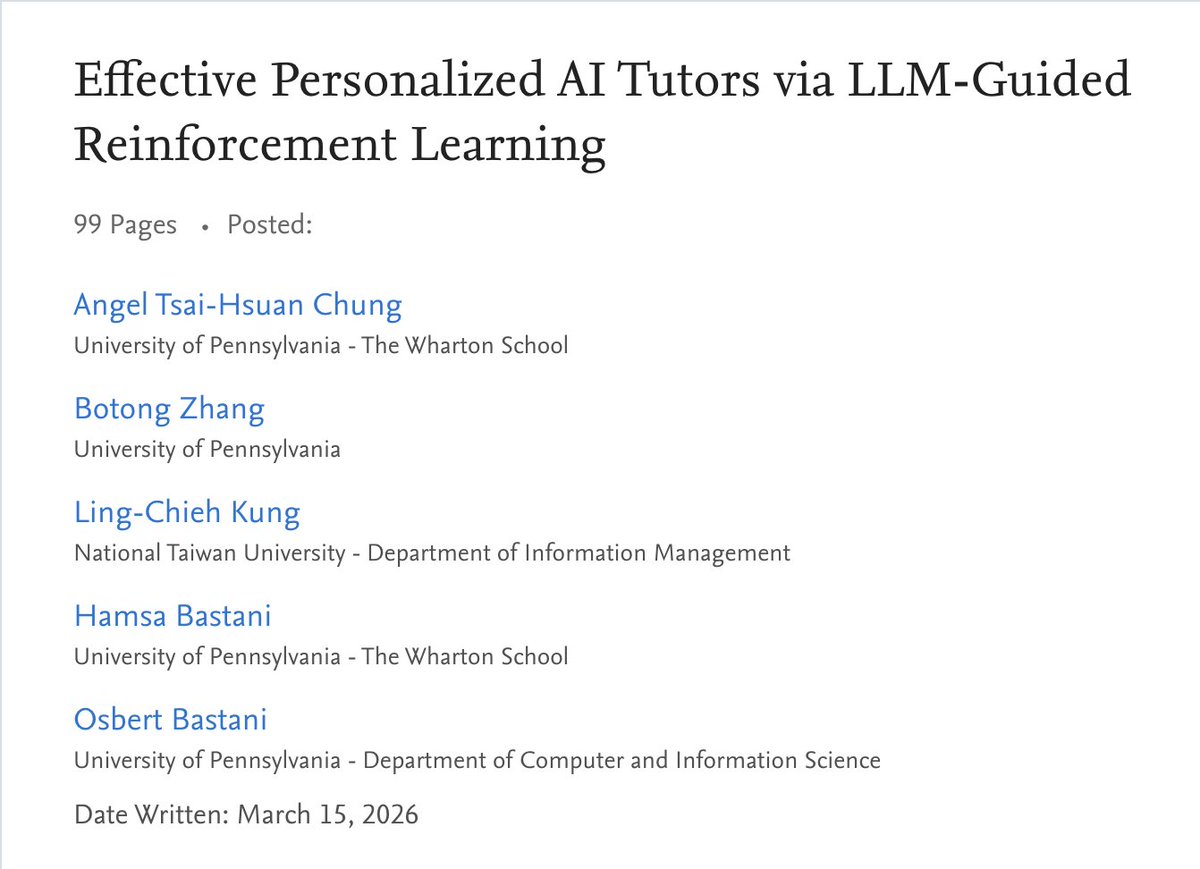
🚨🚨 Excited to share our first *positive* results on AI in education! Most AI tutor work focuses on making the chatbot better. We suggest another lever: deciding what students should practice next to improve learning. We combine an LLM tutor with reinforcement learning to personalize problem sequencing using signals from student-chatbot interactions and solution attempts. We tested this in a 5-month randomized field experiment in a Python course across 10 high schools in Taipei. All students had the same course material and the same AI tutor. The only difference was adaptive vs. fixed problem sequencing. Result: across 770 students, adaptive sequencing improved performance on an in-person final exam taken without AI assistance by 0.15 SD, with larger effects for beginners. Our evidence suggests the gains came from stronger engagement and more productive AI use.
Hamsa Bastani tweet media
English
20
55
302
50.7K
Matt Beane retweetledi
David Shor
David Shor@davidshor·
The "everything will be fine" message is dead on arrival with voters. When leaders in government and tech say "AI will not cause widespread job losses" - net trust is -41. When they say "AI will create economic productivity that benefits everyone" - net trust is -20.
David Shor tweet media
English
8
63
345
64.4K
Matt Beane retweetledi
Lee Vinsel
Lee Vinsel@STS_News·
I'm writing a post called "I Just Don't Buy Ethical Arguments Against AI Use," and I feel like this might be a useful place to start putting down ideas. In this thread, I will consider how the term "cognitive offloading" has come to be used - often with implied moral judgment.
Arvind Venkataramani is letting go of conditioning@_arvind

@STS_News @libshipwreck And also: which forms of cognitive offloading are helpful/harmful and to whom and under which circumstances? How does that reconfigure labour (differently?) for workers and managers? What impact come from use vs excuse? Et cetera

English
3
2
15
1K
Matt Beane retweetledi
Ethan Mollick
Ethan Mollick@emollick·
After using it a bit, Claude Cowork Dispatch covers 90% of what I was trying to use OpenClaw for, but feels far less likely to upload my entire drive to a malware site.
English
187
186
5.9K
349K