José M Peñaloza

6.6K posts

José M Peñaloza

José M Peñaloza

@maur_jmp

husband, brother, son, uncle, excited about oncology - esposo, hno, hijo, tio

Katılım Ağustos 2009
2.4K Takip Edilen363 Takipçiler
José M Peñaloza retweetledi
Tom Powles
Tom Powles@tompowles1·
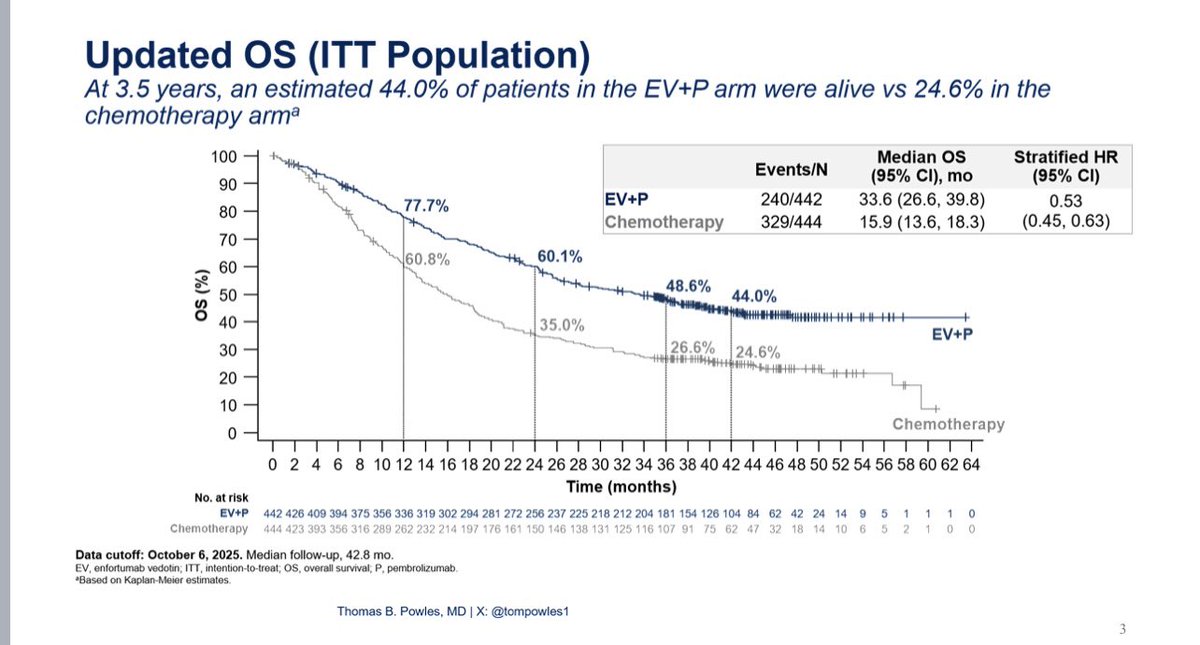
The 3.5yr OS from EV302 continues to show transformative benefit (HR 0.53 (0.45-0.63)) #ASCO26 for EV/pembro. The landmark OS for the CR population (30%) is ~90%. Median time to CR is 4.5 months (responses mature over time). Response rates of platinum chemo after EVP is 21% (OS 11 months). This should be considered a 2nd line standard. Median duration of EV was 7 months - longer in responders. Optimal duration of EV trials are needed. @OncoAlert
Tom Powles tweet mediaTom Powles tweet mediaTom Powles tweet mediaTom Powles tweet media
English
4
45
86
4.8K
José M Peñaloza retweetledi
Tom Powles
Tom Powles@tompowles1·
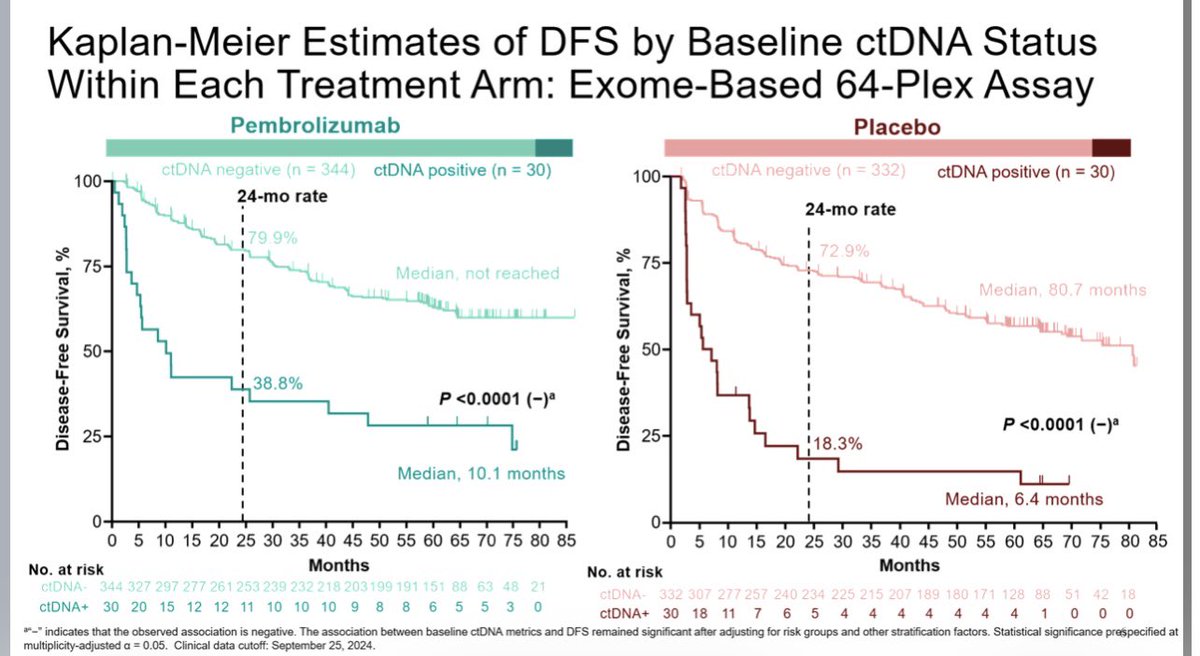
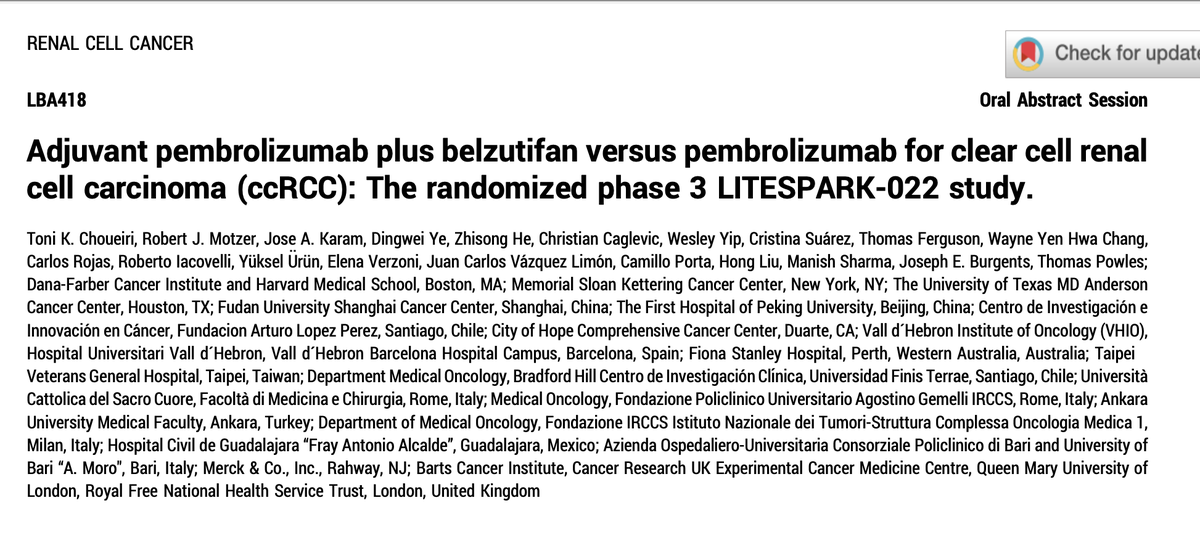
Clear cell RCC sheds low levels of ctDNA, but positivity and ctDNA dynamics are relevant in the adjuvant setting @DrChoueiri #ASCO26. This analysis is with an exome based personalised technique and shows a lack of sensitivity (5-8% ctDNA+ve rate vs 40% radiological relapse rate) but good specificity (almost all ctDNA +ves relapse). Whole genome ctDNA analysis should work work better. There is a future for ctDNA in renal cancer, we’re just not quite there yet IMO.
Tom Powles tweet mediaTom Powles tweet mediaTom Powles tweet mediaTom Powles tweet media
English

5
33
72
4.8K
José M Peñaloza retweetledi
Daniel V. Araujo
Daniel V. Araujo@DVAraujoMD·
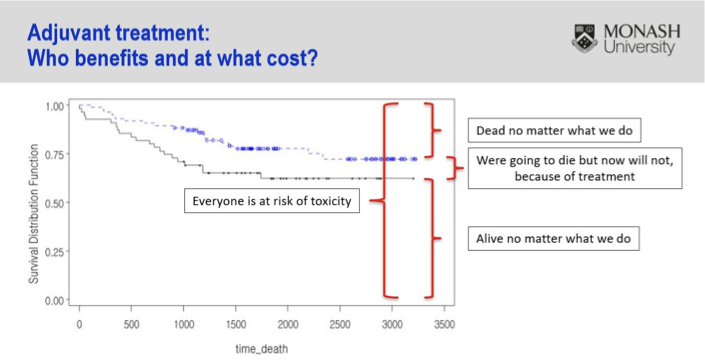
A really thought-provoking study at #ASCO26 (Abstr 4512, Clinical Science Symposium): decision regret after adjuvant pembrolizumab in RCC. 🔹 The question Do patients regret receiving adjuvant pembro — and if so, is it driven by long-term toxicity that CTCAE grading doesn't adequately reflect? They built a patient co-designed tool focused on long-term toxicity. 🔹 The study 104 RCC pts post-adjuvant pembro across 3 London centres, median f/u 30 mo. Pts completed the Ottawa Decision Regret Scale alongside their own rating of irAEs as life-changing, significant, or non-significant. 🔹 What they found 28% rated their toxicity as significant and 11% as life-changing — but these ratings did NOT correlate with CTCAE grade (a third of G1–2 events were rated significant), and regret was identical for G1–2 vs G3–4 irAEs. Regret was driven by patient-perceived long-term toxicity, especially permanent endocrine and MSK irAEs — and not by disease recurrence (only 1/14 who relapsed expressed regret). Lower baseline expectations of toxicity → more regret. 🔹 My take Striking that >1 in 4 reported significant and >1 in 10 life-changing toxicity. What concerns me most isn't that CTCAE missed these events — it's that the grade didn't correlate with how significant patients found them, nor with regret at all. That deviates from the very purpose of grading. The hard part: a regret analysis is tough to contextualize when the alternative, no treatment, risks recurrence — arguably worse than a long-term toxicity. Adjuvant therapy is challenging by nature: most patients are either cured already or destined to recur regardless — we expose everyone to toxicity to benefit a minority. We urgently need biomarkers to find the few who truly benefit. This slide from @Prof_IanD says it all 👇 Looking forward to seeing the presentation! 🔗 asco.org/abstracts-pres… #kcsm #ASCO26 @BethN01 @tompowles1
Daniel V. Araujo tweet media
English
5
24
86
20.4K
José M Peñaloza retweetledi
Enrique Grande
Enrique Grande@drenriquegrande·
⚡️ Phase 3 LITESPARK-022 in high-risk ccRCC after nephrectomy: adjuvant pembrolizumab + belzutifan vs pembrolizumab alone (n=1,841). 24-month DFS: 80.7% vs 73.7% (HR 0.72; P=0.0003). First phase 3 adjuvant trial to demonstrate DFS benefit vs pembrolizumab monotherapy — a potential new standard of care. #KidneyCancer ascopubs.org/doi/10.1200/JC…
Enrique Grande tweet media
English
0
20
51
3.3K
José M Peñaloza retweetledi
Enrique Grande
Enrique Grande@drenriquegrande·
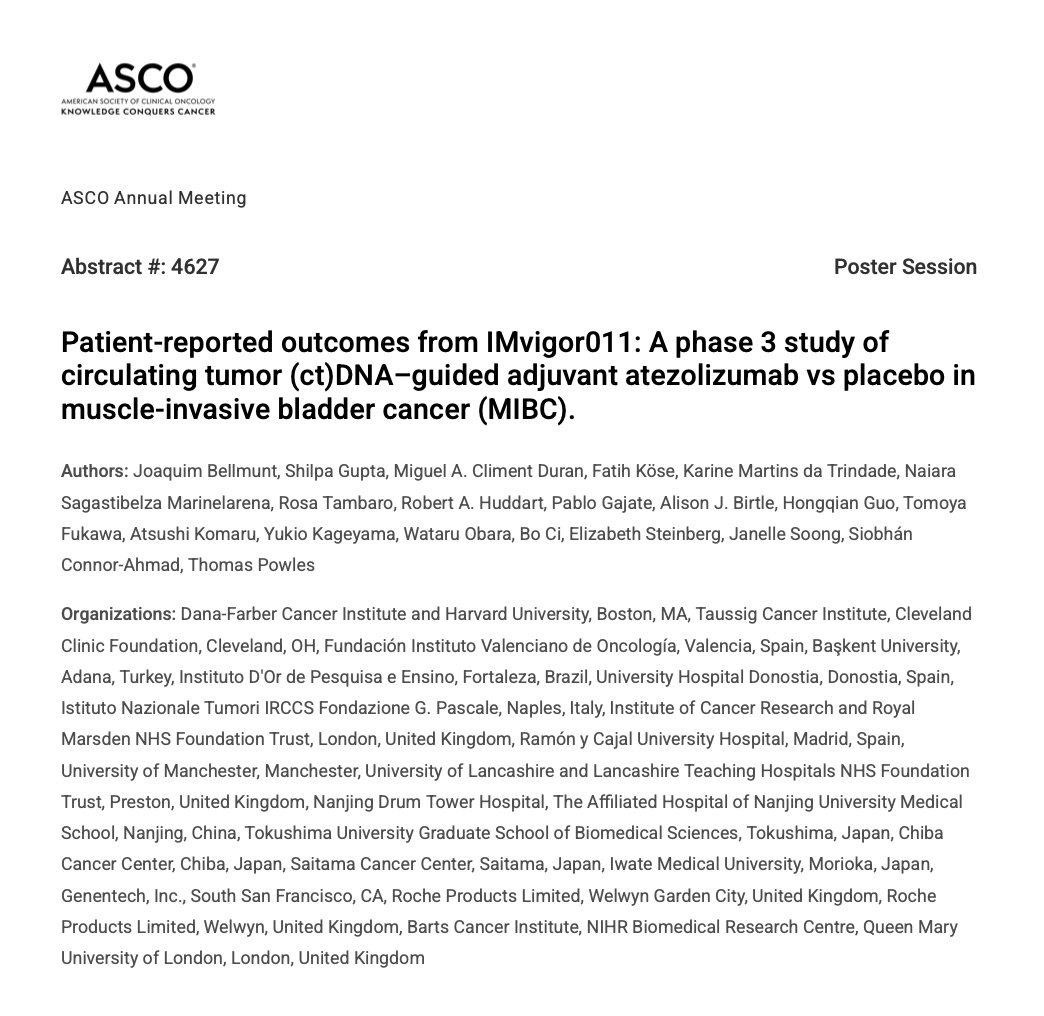
⚡️ IMvigor011 at #ASCO26: ctDNA-guided adjuvant atezolizumab in MIBC improved DFS and OS in ctDNA+ patients — with no negative impact on patient-reported QoL. >90% of patients reported little or no treatment side-effect burden throughout therapy. Efficacy and tolerability together. Relevant for shared decision-making in the adjuvant setting. #BladderCancer @OncoBellmunt @ASCO asco.org/abstracts-pres…
Enrique Grande tweet media
English
1
15
38
1.8K
José M Peñaloza retweetledi
Advances, an ASTRO Journal
Advances, an ASTRO Journal@Advances_ASTRO·
🚨Hungry for a new α/β study?🚨 🧪📉 We often quote α/β ratios in clinic as if they’re fixed truths — but where do those numbers actually come from? This study compared in vitro vs. clinical α/β estimates across prostate, breast, and head & neck cancers and... ... they often do NOT match. Key findings: 📍Prostate: in vitro α/β ~3.8 Gy vs clinical ~2.3 Gy 🦀Breast: fairly similar (~3.6-3.9 Gy) 🗣️H&N: clinical estimates actually HIGHER than lab estimates (~14 vs 9 Gy) Why it matters for everyday radonc 👇 ⚠️ The “standard” α/β assumptions we use for BED/EQD2 calculations, hypofractionation discussions, and protocol design may oversimplify real tumors. 🧬 Tumor heterogeneity, hypoxia, stem-cell populations, ADT, and the tumor microenvironment likely make clinical tumors behave very differently from cell lines grown in a dish. 💡 Practical takeaway: When we debate fractionation schedules or compare regimens, remember that the radiobiology behind those BED calculations is probably messier than the spreadsheet suggests. The paper also reinforces that the classic “10 Gy for most tumors” assumption likely doesn’t hold true for many disease sites. 📚 advancesradonc.org/article/S2452-… @ASTRO_org
Advances, an ASTRO Journal tweet media
English
2
19
46
2.5K
José M Peñaloza retweetledi
Giulia Marvaso
Giulia Marvaso@GiuliaMarvaso84·
One of the standout talks of #ESTRO2026 👏 'A lot to be proud of' @alison_tree brilliantly highlighted how modern #RadOnc in #PCa is evolving beyond technology alone , with increasing focus on continenze, sexual function and QoL alongside outstanding cancer control!
Giulia Marvaso tweet mediaGiulia Marvaso tweet mediaGiulia Marvaso tweet mediaGiulia Marvaso tweet media
English
2
21
59
12.8K
José M Peñaloza retweetledi
Enrique Grande
Enrique Grande@drenriquegrande·
ICI rechallenge in metastatic clear-cell RCC (real-world, n=288): median OS 33.2 months, PFS 8.5 months. Rechallenge ≥6 months after prior ICI was associated with improved OS (34.9 vs 19.4 months; P=0.014) and PFS, independent of prior ICI type or sequencing strategy. Timing — not agent selection — may be the key determinant of benefit. 📄 ESMO Open 2026 esmoopen.com/article/S2059-… #KidneyCancer #Immunotherapy
Enrique Grande tweet media
English
2
22
44
2.5K
José M Peñaloza retweetledi
Pierre Blanchard, MD
Pierre Blanchard, MD@PBlanchardMD·
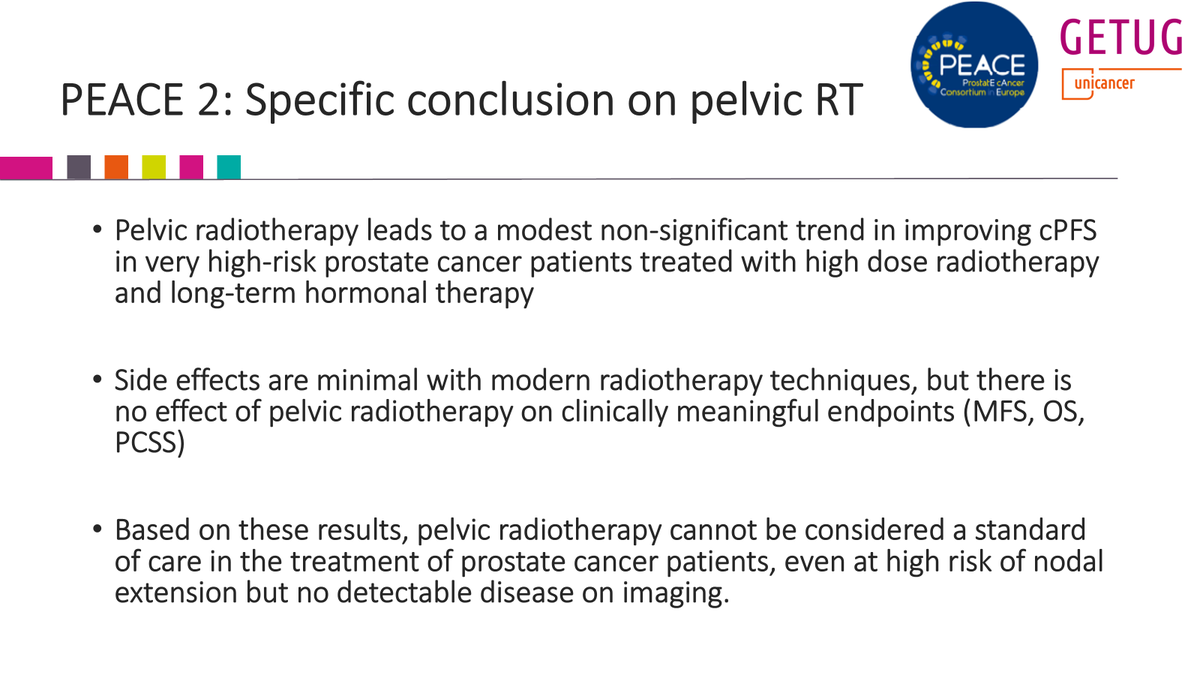
Conclusion: Pelvic RT is NOT SOC in #prostatecancer pts, even at high risk of nodal disease, staged with CI. We need to improve risk stratification to escalate/deescalate according to individual risk. But the notion of vHR prostate cancer may need to be redefined. 5/5
Pierre Blanchard, MD tweet mediaPierre Blanchard, MD tweet mediaPierre Blanchard, MD tweet media
English
2
17
50
1.9K
José M Peñaloza retweetledi
OncoAlert
OncoAlert@OncoAlert·
Day THREE of #ESTRO26 Coverage by OncoAlert 🚨 Salvage Hypofractionated Accelerated versus Standard Radiotherapy for Biochemical Recurrence after Radical Prostatectomy (SHARE): A Phase 3 Randomized Clinical Trial Presented by Youngju Song 🇰🇷 #RadOnc ☢️ The 4-year biochemical progression-free survival rates were similar (80.1% in the hypofractionated arm and 78.1% in the conventional arm). Although late gastrointestinal toxicities were more frequent in the hypofractionated arm, they were not severe and self-limiting. Considering that there was no significant difference in patient-reported outcomes, hypofractionated radiotherapy could be considered a viable alternative treatment option in the salvage setting. @ESTRO_RT @yasemin09896924 @LindaMrissa @christian_roenn @Valeriadionisi @gerryhanna @clchiang_hk @mtugceyilmaz @B_Tomasik @gmpetrianni @CiroFranzese1 @Atem84 @piet_ost @brachyexpert @BlanceS90 @The_PT_Explorer @BarbaraJereczek @Mat_Guc @ZilliThomas @AnnaKirby17 @PBlanchardMD @achoud72 Pinging OA faculty @MKnoll_MD @_ShankarSiva @Icro_Meattini @seanmmcbride @NiuSanford @nataliagandur @acampsmalea @to_be_elizabeth
OncoAlert tweet mediaOncoAlert tweet mediaOncoAlert tweet mediaOncoAlert tweet media
English
0
17
28
1.5K
José M Peñaloza retweetledi
Piet Ost
Piet Ost@piet_ost·
PACE-NODES PACE-NODES (n=1166): Pelvic nodal SBRT adds modest acute GI AEs vs prostate-only SBRT, resolving by 12 weeks, confirmed in the patient-reported QoL. #ESTRO26
Piet Ost tweet mediaPiet Ost tweet media
English
0
23
48
2.9K
José M Peñaloza retweetledi
Dong Nguyen
Dong Nguyen@DongNguyeb·
That’s interesting to observe @DrSpratticus , a RadioOnco, give criticism to some Urology panel guidelines #AUA26 To Urology community, most of what he is saying comes from not fully understanding how guideline methodology actually works, which then leads to unsupported accusations about “bias” or “industry influence.” The bellow long post will help all of you understand why To Daniel, you are always to academic debate with ME.
English
1
3
3
1.1K
José M Peñaloza retweetledi
Alastair Lamb
Alastair Lamb@LambAlastair·
Nice plenary on extended #PLND in #ProstateCancer at #AUA26 from Dr Jean Lestingl. Phase 3 study in press @TheLancetOncol •n=300, limited vs extended •node count: 3 vs 17 (unlike Touijer) •⬇️BCR for GG3-5 but no diff in mets/survival (my)THM: await results of #ElIPSE_Trial!!
Alastair Lamb tweet mediaAlastair Lamb tweet mediaAlastair Lamb tweet mediaAlastair Lamb tweet media
English
1
11
39
3.7K
José M Peñaloza retweetledi
Tom Powles
Tom Powles@tompowles1·
The FDA approves the signatera ctDNA assay for muscle invasive bladder cancer patients post surgery. This is based on the results of Imvigor011 study (atezo vs placebo in ctDNA positives, surveillance for the ctDNA negatives). It opens a new chapter for personalised therapy in urothelial cancer. Focusing on early treatment for those patients that need it and sparing those at lower risk potentially harmful treatment makes sense. ‘It is the first companion diagnostic approval in the field of blood-based MRD.’ natera.com/company/news/s…
Tom Powles tweet media
English
8
67
184
16.1K