Megi Dervishi @ ICML 🇰🇷

4 posts

Megi Dervishi @ ICML 🇰🇷

Megi Dervishi @ ICML 🇰🇷

@megdrv

PostDoc @amilabs | PhD @MetaAI @psl_univ
Paris, France Katılım Ağustos 2022
120 Takip Edilen53 Takipçiler
Megi Dervishi @ ICML 🇰🇷
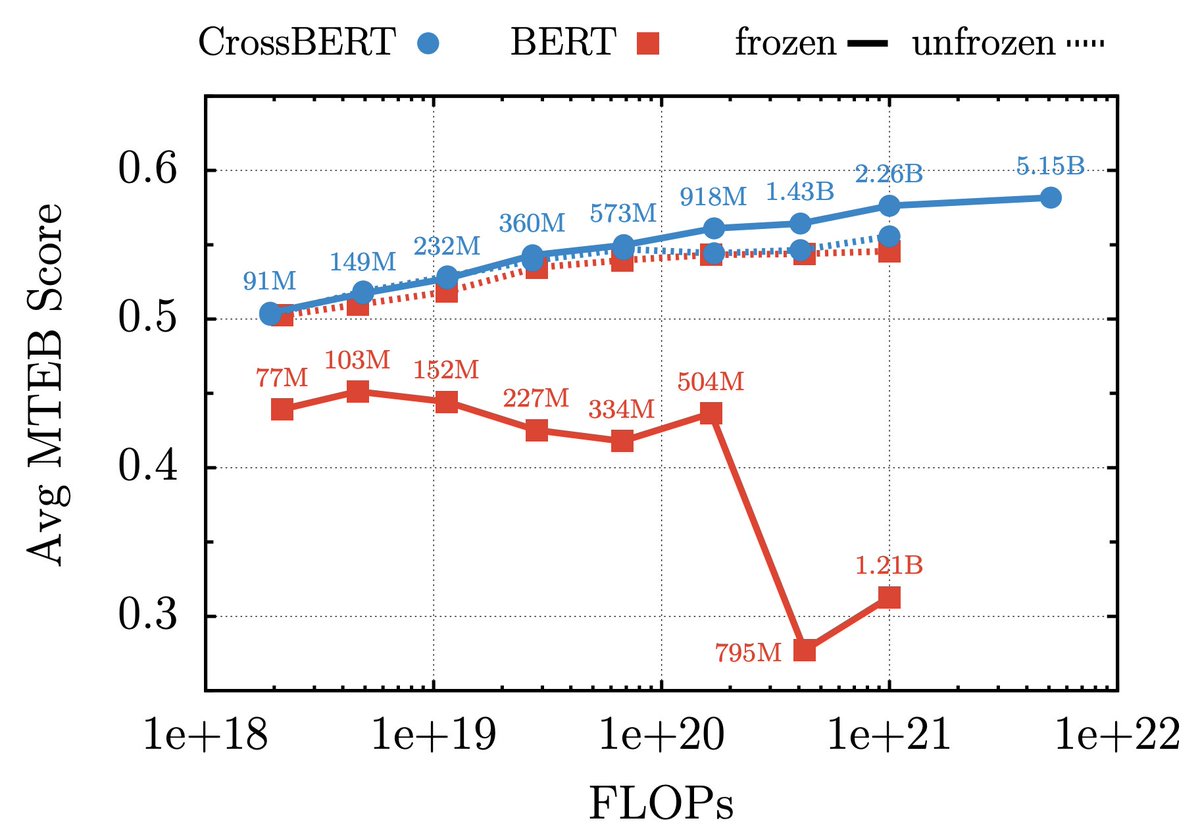
🇰🇷 #ICML2026 Alert! 🇰🇷 Come check out our new work with @mathuvu_ and @ylecun 👀 📍 Starting 2PM - Poster #1606 💡 Representation learning for text done efficiently - clean scaling, 2× retrieval, ~100× less compute. 🚨 Spoiler Alert: BERT does not scale
Megi Dervishi @ ICML 🇰🇷 tweet media
English
0
10
9
668
Megi Dervishi @ ICML 🇰🇷 retweetledi
Saining Xie
Saining Xie@sainingxie·
see you at ICML in Seoul and the AMI × SBVA mixer on thursday evening! looking forward to meeting everyone :) luma.com/rv0q6b5q
English
10
14
192
31.3K
Megi Dervishi @ ICML 🇰🇷 retweetledi
Yann LeCun
Yann LeCun@ylecun·
V-JEPA: a step towards getting machines to understand how the world works by watching. The Joint embedding Predictive Architecture (JEPA) is a non-generative architecture that predicts the representation of a signal from a corrupted or transformed version of that signal. In V-JEPA the signal is a short video that is corrupted by masking a large portion of each frame. After training, the learned representation is used as input to a simple classifier tested on action recognition from videos. The system gives excellent results on action recognition on SSv2 and K400 with frozen backbone and fine-tuning. blog post: ai.meta.com/blog/v-jepa-ya… paper: ai.meta.com/research/publi… code (CC-BY-NC): github.com/facebookresear…
AI at Meta@AIatMeta

Today we’re releasing V-JEPA, a method for teaching machines to understand and model the physical world by watching videos. This work is another important step towards @ylecun’s outlined vision of AI models that use a learned understanding of the world to plan, reason and accomplish complex tasks. Details ➡️ bit.ly/49fCeaM We're releasing a collection of V-JEPA vision models trained with a feature prediction objective using self-supervised learning. The models are able to understand and predict what is going on in a video, even with limited information. It learns by predicting missing or obscured parts of a video in its internal feature space. Unlike generative approaches that fill in missing pixels, this flexible approach enables up to 6x improvements in training and sample efficiency. The models were pre-trained on entirely unlabeled data, and a small amount of labeled data can be used to train a task-specific prediction head on top after pre-training. Our results show that, using a frozen backbone, our top V-JEPA models achieve 82.0% on Kinetics-400, 72.2% on Something-Something-v2 and 77.9% on ImageNet1K — competitive with or exceeding previous leading video models. We believe that this work is an important milestone on the path to advancing machine intelligence.
English
25
212
1.2K
159.7K