
Startup Lawyer

1.6K posts

Startup Lawyer banner
Startup Lawyer

Startup Lawyer

@mgorb79

I’m Mike Gorback 👋 Startup Lawyer and Partner @klgates (ex-@hansonbridgett, ex-@wilsonsonsini). Angel Investor. Tweets do not = legal advice. 😁 DMs open.

Palo Alto, CA Katılım Ekim 2013
1.1K Takip Edilen1.6K Takipçiler
Sabitlenmiş Tweet
Startup Lawyer
Startup Lawyer@mgorb79·
Welcome to my new followers and all of you reaching out in my DMs! I tweet about SAFEs, SAFEs, SAFEs, other startup law stuff (incorporation, founder issues, equity and cap tables, M&A, technology agreements, etc), SAFEs, and the occasional SAFE. I love working with awesome founders who are building life-changing tech, and along with my colleagues at @HansonBridgett am passionate about supporting underrepresented founders. If you dig my content please consider following. Thank you! 🙏🚀😁
English
5
2
32
6.1K
Startup Lawyer retweetledi
Peter Walker
Peter Walker@PeterJ_Walker·
Solo founders have shot upwards since ChatGPT launched. VCs remain more hesitant to fund them, yes. But that's less and less every year. Data only looks at companies on Carta, which implies the startup would like to give equity to its employees even if it doesn't raise VC.
GIF
English
19
20
96
22.2K
Startup Lawyer retweetledi
Peter Walker
Peter Walker@PeterJ_Walker·
Here's real data on what SAFE valuation caps are for companies raising their early rounds in major US markets. - Medians are already high - 90th percentiles are wild - Yes, this is a LOT of AI companies - about 90% of startups start fundraising on SAFEs
Peter Walker tweet media
English
6
11
76
8.8K
Startup Lawyer
Startup Lawyer@mgorb79·
@PeterJ_Walker Terrible. Founders often underestimate how quickly equity can go out the window. At the very least I’d hope those advisors are on some legit vesting schedules. But a vesting schedule is only as good as the founder’s willingness to terminate the relationship.
English
1
0
3
347
Peter Walker
Peter Walker@PeterJ_Walker·
Pre-seed advisors to startups received 0.24% in equity last year (on median). 9% of them got more than 1% of the company. I'm sure there are advisors worth 1% of a startup in the very early days...but not many.
Peter Walker tweet media
English
12
13
119
15.7K
Eli Albrecht
Eli Albrecht@Eli_Albrecht·
Do not ever form an entity in California.
English
18
6
100
14.8K
Startup Lawyer
Startup Lawyer@mgorb79·
Nope. Nobody is raising that much (at that implied valuation) without going through a lot of diligence and proving a real business. Even at a $20m raise, you can’t raise that at say $100m valuation just on a deck and an idea. You will have had to show you’re a real company. Also, the reps and warranties are actionable if they were false when made.
English
1
0
3
3K
Bobby from Dupe.com
Bobby from Dupe.com@ghoshal·
An actual startup scam playing out rn, it's basically a superannuation. Company raises $50M+ seed Hires a few ppl to make it seem like its a real company Ships absolute garbage to prove they're working Founders pay themselves $350k-$500k a year forever Put the $50M into a 2.5% yield treasury earning $1M+/yr for free No legal obligation to return the money.
English
173
66
2.6K
408.5K
Startup Lawyer retweetledi
Gabriel Jarrosson
Gabriel Jarrosson@GJarrosson·
Series A has been seen as an indication of Product Market Fit, and a de-risked investment. But they’re getting harder and harder to come by. It’s been nearly two years since Lightspeed partner Nnamdi Iregbulem wrote about The Series A Bust. A common explanation for the Series A winter is raised expectations – investors are demanding to see better metrics and traction. Most companies don't meet this new, higher bar, hence fewer deals get done. But what about YC? Well… 45% of YC companies get to Series A (median ARR is $1M+, trending up) Can you find another place where that is true in any set of potential investments in the world?
Gabriel Jarrosson tweet media
English
4
6
48
7.3K
Steph from OpenVC
Steph from OpenVC@StephNass·
@mgorb79 I mean it as a mindset rather than a rule. Keep raising until money is in the bank
English
1
0
1
17
Steph from OpenVC
Steph from OpenVC@StephNass·
"I have a $4M term sheet. But I know I don't have a deal until I have two. Starting reaching out to 134 highly-curated VCs now" Right mindset + execution. He's gonna make it.
Steph from OpenVC tweet media
English
4
2
52
8.1K
Startup Lawyer retweetledi
Rohit Mittal
Rohit Mittal@rohitdotmittal·
more founders are starting companies than ever before and fewer (as a percentage) are becoming very big very fast the $1M-$5M arr is the threshold i've seen when founders see significant slowdown in growth founders need to ask themselves what they want to build sometimes, the answer is that this is not the company that'll be a billion dollar outcome but the important thing is to ask the question and be clear about why you want to pursue this if you want to build the largest company you possibly can, you should go for it but if you don't feel like this is your life's work, it's better to focus on your efforts on your next big idea many founders get stuck because they started the wrong company or went to the wrong market or had the wrong timeline changing directions to work on your next big thing is a first step towards success
English
7
2
37
6.2K
Startup Lawyer retweetledi
Logan Gott
Logan Gott@LoganTGott·
The founders booking 30+ calls a month from LinkedIn all do the same 5 things: 1. Post 6-7x a week (not 2-3) 2. Send 200 connection requests weekly to qualified leads 3. DM every single new connection within 24 hours 4. Follow up 2-3 times on non-responders 5. Post 2x+ lead magnets a week Then do that for 90 days.
English
26
16
287
26.1K
Startup Lawyer retweetledi
Seb Johnson
Seb Johnson@SebJohnsonUK·
Sequoia Capital is no longer the world's greatest VC firm. 2025 will go down in history as the year that @IndexVentures took the crown. The firm netted 9 BILLION DOLLARS from its exits in 2025: > Wiz acquisition to Google: $4.1 billion netted > Dream Games buy out from CVC: $560 million > Scale AI semi-acquisition by Meta: $1.8 billion > Figma IPO: $2.1bn Another portfolio company, Revolut, hit a valuation of $75bn which could end up returning even more than Wiz. It is surely the greatest firm in the world right now. @mhbergen has written an amazing piece in @business about the firm's performance as well as its potential succession plan The article also has some data on DPI (one of the most important metrics in VC which indicates the cash returns to LPs): > Index’s 2012 fund had a DPI of 11 as of last year > Its 2015 $780m growth fund has a DPI of 5.1 2025 will go down in history as the year Sequoia Capital lost its crown as the world's greatest VC to none other than a EUROPEAN firm. In the words of Julien Codorniou (@codorniou), Partner at @20vcFund: “It’s the only European VC who managed to win in the US... It wasn’t a given” Silicon Valley invented the VC model but it's now a European firm that is doing it better than anyone else. Congrats @shardul_shah, @ninaachadjian, @martinmignot, @janatindex, @narimer, @dannyrimer
English
20
46
692
80.5K
Todd Saunders
Todd Saunders@toddsaunders·
Series A is when your company finally has enough money to afford bad decisions that feel professional, sound reasonable in board meetings, and slowly drain the speed and truth that created momentum in the first place. This is the stage where founders feel pressure to “act like a real company.” > Pressure to add layers. > Formalize decisions. > Create distance between the people building the product and the customers living with its consequences. That instinct is usually wrong. At Series A, your real advantage is still speed, closeness to customers, and the ability to do things that feel slightly uncomfortable to investors but deeply valuable to users. Things like: > replying in minutes. > shipping products off roadmap. > keeping founders in sales and support far longer than a clean org chart would suggest. Process is for the sake of process is not maturity. It is a trade. When you trade speed, honesty, and direct customer feedback for optics and structure, you do not become a "real" company. You become a slower one with better slides.
Todd Saunders tweet media
English
13
19
195
22.3K
Andrew D'Souza
Andrew D'Souza@andrewdsouza·
We have a slide in our Series A deck called “Reasons NOT to invest.” Two of them: - We have zero PhDs on our team, and none of us went to or dropped out of an Ivy League school - We’re not based in San Francisco, and we have no intention of moving there Most investor decks have a team slide filled with logos, schools, big companies, and familiar signals. We chose to position our team differently. There’s broad agreement in Silicon Valley about what the future is supposed to look like. If you’re building something that challenges that consensus, you’re often surrounded by very smart people explaining why it won’t work. That’s a hard environment to think freely or take unconventional bets. We’re building @boardyai from Toronto with a team of "big kids" who genuinely love what we do. What we lack in traditional credentials, we make up for in ambition, imagination, and intensity. Most importantly, we’re having fun, and there’s nothing more powerful than people whose work feels like play. You can build something world-changing from anywhere. You don’t need a specific background, location, or resume to matter. Boardy exists to prove that, and to help others do the same.
Andrew D'Souza tweet media
Andrew D'Souza@andrewdsouza

x.com/i/article/2006…

English
28
11
218
49.9K
Startup Lawyer
Startup Lawyer@mgorb79·
@Melt_Dem I don’t charge anything for a SAFE. I just point my clients to the YC website!
English
0
0
1
26
Meltem Demirors
Meltem Demirors@Melt_Dem·
seeing some law firms charging startups $20k+ for incorporation, a SAFE plus a few side letters. this is insane and frankly disgusting. a SAFE is a template with three fields you change for your company. side letters are largely template. it costs $400 to incorporate.
English
97
26
644
54.1K
Startup Lawyer retweetledi
Peter Walker
Peter Walker@PeterJ_Walker·
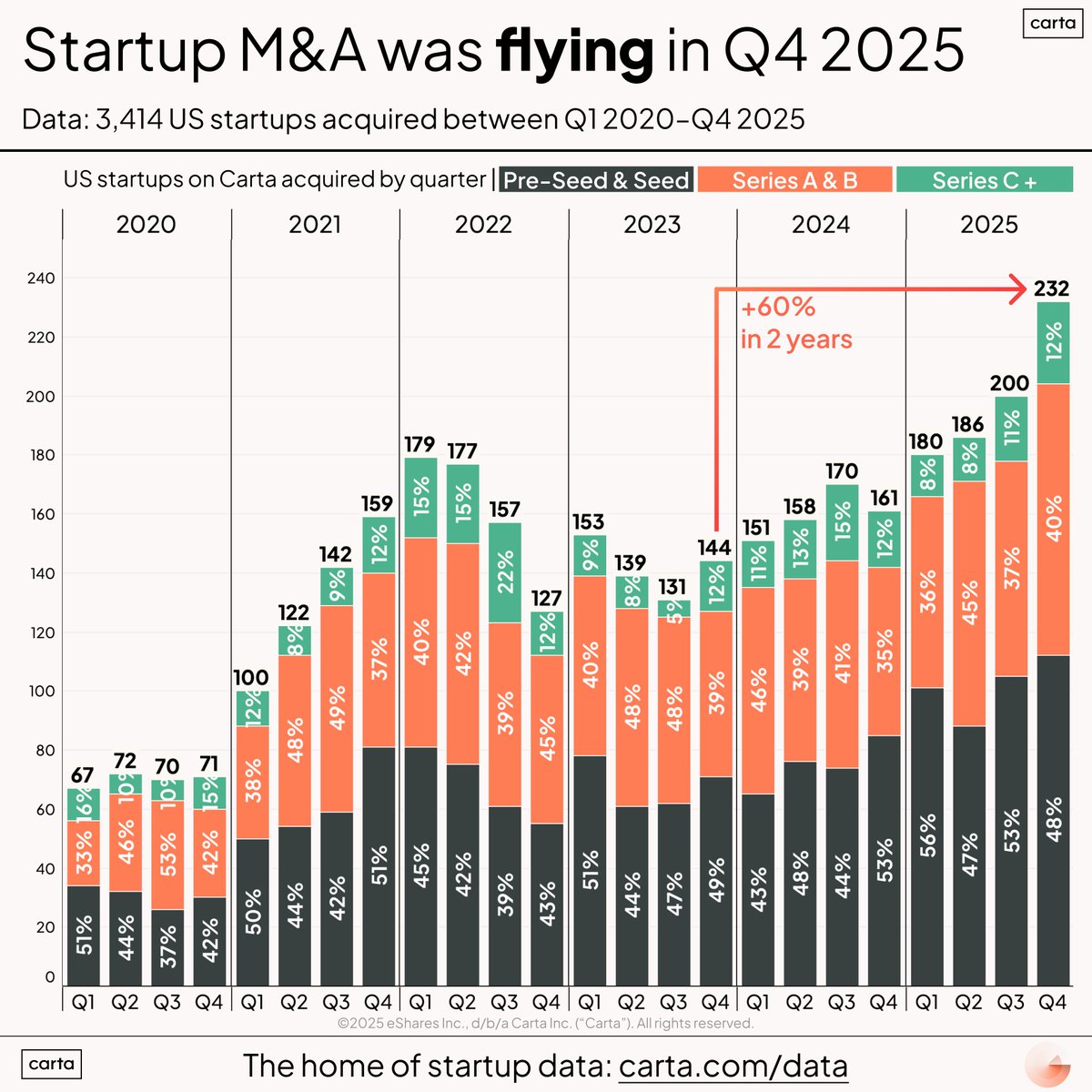
Startups are FLYING off the shelves these days. 232 Carta companies were acquired in Q4, new record. That's up 60% from Q4 2023. That includes 28 transactions involving companies at Series C or beyond (2nd-best quarter ever) so it's not all small acquihires
Peter Walker tweet media
English
7
18
89
16.1K
Startup Lawyer retweetledi
GREG ISENBERG
GREG ISENBERG@gregisenberg·
ive been hanging out with founders under 22 lately living in sf/nyc and they're built different. my observations of these young founders getting rich with AI: 1. these kids grew up watching YT creators flexing Porsches and private jets from their bedrooms. but when they looked at their own reality, they saw $200k college tuition and $45k entry-level jobs. the math didn't work. so they decided to skip the broken system entirely. 2. that economic reality shaped everything about them. they're unapologetically capitalistic in a way that reminds me of the 80s Wall Street era. pure survival capitalism. they think they need millions just to live comfortably, they look at $4,000 studio apartments in ny, and they're not wrong. tons of economic pressure for everyone right now and inflation worries. 3. so they formed group chats with other founders. their mentors are podcasts. they're plugged in and learning 24/7, treating business like a multiplayer video game they're trying to beat. 4. sam altman said something that stuck with me: older generations use ChatGPT as a Google replacement, but these kids use it as an operating system. they see this AI era as their gateway out of economic reality. 5. everything they do is optimized for virality. their startup journey reads like a Netflix documentary with built-in trailers. every product decision considers "will this clip work on X?" they reverse engineer social algorithms with their business models. it's like NELK Boys meets Spielberg meets YC demo day. 6. they build products designed to go viral on specific platforms. they'll time launches around trending topics. they'll create TikToks showcasing their SaaS tool like entertainment content. 7. some go the cash flow route, building consumer mobile apps like nikita or build saas portfolios. others raise millions in VC funding. the more the vc the better they think. 8. they document every failure, breakthrough, and late-night coding session. their businesses are performance art for the algorithm age. 9. they're not trying to fix the broken system that priced them out. they're building entirely around it. and they're winning because they accepted the new rules while everyone else is still playing by the old ones. 10. a lot will fail in public and end up working at companies. it'll be crushing. especially the ones that raise tons of vc. that's the game. but some will succeed in ways we've never seen before. 11. they think in portfolios from day one. not “this is my startup,” but “this is one bet.” apps, tools, experiments, accounts. they expect most to die and one to change their life. 12. many are hyper-capitalistic. michael douglas in wall street energy, but with claude, cursor, and viral clips instead of suspenders and cigars. theyve got big dreams and aren't afraid to go after them. 13. the same inflated world that crushed previous generations might have created the most resourceful generation of entrepreneurs we've ever seen. they are turning systemic failure into competitive advantage. pretty genius when you think about it. the kids are alright.
GREG ISENBERG tweet media
English
225
276
3.6K
597.7K
Adam Robinson
Adam Robinson@RetentionAdam·
$10M ARR is the FU MONEY of SaaS. At $10M ARR bootstrapped, you and your co-founder clear $1M+/year in salary and dividends easily. You can sell instantly for $30-40M. There are hundreds of EBITDA buyers at this level vs. a handful at $1B valuations. From here, you can do whatever you want. Hire a CEO and work 1 hour/week. Grind 100 hours if that's your thing. Raise $50M from a position of strength. Scale to $25M ARR with 25 people and pay yourself $10-15M/year. Most companies never get here because VCs show up early with decacorn dreams and money you don't need. That capital interferes with the one thing that makes you great: product-market fit. Bootstrapping to $10M ARR is easier and less risky than creating a VC-backed unicorn, with a far higher probability-weighted outcome. If you can find PMF and use customer money to get to $10M, you can do anything you want with your life.
English
123
114
2.2K
552.6K
Rohit Mittal
Rohit Mittal@rohitdotmittal·
venture-backed means you need a 100x outcome - that’s how investors underwrite every deal investors want 100x because only 2-3 companies in their portfolio will actually return material capital - that’s how their fund works but 90% of venture-backed companies will never get there 58,000 VC-backed companies in the US right now 1,259 exits in 2024 total that’s a 2.2% exit rate in any given year here’s what happens to the other 97.8%: scenario 1: the profitable zombie you’re running a business that does $2M ARR with 60% gross margins you’re breakeven or close to it customers love the product and renew every year but you’re growing 50% not 500% you already raised a series a, the metrics for series b are too far off you are already diluted that only a higher valuation round makes sense - a down round will kill your ownership and hence the motivation you may be able to sell now but won’t because the math doesn’t work you can’t shut down because revenue is real and team depends on you so you’re stuck running a breakeven but capped business you can’t exit scenario 2: the unprofitable grind you’re doing $800K ARR burning $150K a month (i’ve seen way higher burn for similar revenue) you have 10 months of runway left your last round was 18 months ago at a $25M valuation you’re not hitting the metrics for the next round VCs stopped caring about you, probably already written you off months ago you need to either cut team by 60% to get to default alive or find an exit but no one buys companies at this stage with this cap table so you’re stuck running an unprofitable business you can’t raise for scenario 3: the honest outcome you realize after 4 years this isn’t going to be the outcome anyone signed up for you want to sell and move on you talk to business brokers - they don’t touch deals under $5M ARR with high pref stack (many vcs kill these deals) you talk to strategic buyers - they want you to stay for 3 years with aggressive earnouts you talk to financial buyers - they offer 1x revenue which doesn’t even cover the pref stack the exit strategy for most founders is eventual exhaustion you grind until: - you run out of money and shut down - you run out of energy and walk away - investors finally write it off and you acquihire the team for $500K just to reset (paid over multiple years) there are other scenarios like shutting down the company early and returning capital, hiring someone else to run the company, or doing a hard pivot - depending on how much money you’ve left in the bank the system has no infrastructure for the honest exit no one is helping founders who built real products with real customers but didn’t hit the expected growth trajectories everyone just pretends and waits and hopes somehow the math will change
English
21
15
210
17.4K
Startup Lawyer
Startup Lawyer@mgorb79·
@TheGeorgePu Appreciate this sentiment, but have seen way too many amazing co-founder relationships and far too many toxic ones to generalize one way or the other.
English
0
0
2
39
George Pu
George Pu@TheGeorgePu·
Unpopular opinion: most co-founder relationships make things worse. Two people. Two visions. Two egos. Endless 'alignment' meetings. Solo is lonely. But at least the arguments are shorter.
English
162
9
367
29.6K