
Michael Garfield 🔮

23K posts

Michael Garfield 🔮 banner
Michael Garfield 🔮

Michael Garfield 🔮

@michaelgarfield

📝🎨🎸 editing the code that runs on people 🎙📚 #humansontheloop 🦚 ex @sfiscience @longnow @mozilla 🏆 https://t.co/FtNzIhJwgc

Santa Fe, NM + The Noosphere Katılım Ekim 2007
3.2K Takip Edilen7.2K Takipçiler
Sabitlenmiş Tweet
Michael Garfield 🔮
Michael Garfield 🔮@michaelgarfield·
Where to place your attention is without question a moral act. This is the understanding I am trying to help inject into the conversation around generative large language models. The more people energize worst-case outcomes the more we guarantee them. If we can help people get enough distance from their knee-jerk fear response to reflect on their own minds and, as the bumper sticker says, not believe everything they think, we can interrupt the fear stream with an executive reallocation mandate that brings us rapidly and coherently closer to worlds we actually want to live in. Silicon Valley is having a bad trip right now. It needs spiritual guidance if we are to live the promise of these tools.
English

18
22
152
18.9K
Michael Garfield 🔮
Michael Garfield 🔮@michaelgarfield·
@_newcubes_ You KNOW I want this! You're on my mind constantly when I think about this stuff. Let's make time for another chat
English
0
0
1
8
Michael Garfield 🔮
Michael Garfield 🔮@michaelgarfield·
I've been quieter than usual the last few months. Here's why: The hundreds of conversations on public record at Humans On The Loop were just the tip of an iceberg. Over the two years since leaving Mozilla, I've met more and more amazing people who share a dream of a future I actually want my kids to inherit: a flourishing world where narrative authorship is restored to the people, ecologically-grounded economic systems are built with care, and sovereign sensemaking infrastructure enables us to meet the wicked problems of our century with the creativity and collective intelligence they require. Atlas Research Group, the team I've been working to help launch, is a kind of seed crystal for a federated commons of open source projects in service of this future. My colleagues on the core team — @dylantull, @coreygo, @csageland, @QBFrank, and @HexaField — are some of the most insightful and capable people I've ever had the pleasure to team up with. All of us were working toward this for years without realizing just how many of us there are. And now we're starting to fold in even more incredibly brilliant, caring, and talented people — all of us composting our projects into this bigger thing that finally feels like it's speaking itself into being. I'll have much more to say about this later, but for now I'm just happy to announce our introductory article where we explain what we're about and extend your invitation. You'll find a link to the whole thing and an especially juicy excerpt below:
Michael Garfield 🔮 tweet media
English
4
4
18
615
PunkXBT
PunkXBT@PunkXBT_·
@michaelgarfield this got that “been building in the shadows” energy and honestly those usually hit harder than daily progress threads tbh
English
1
0
1
5
Michael Garfield 🔮 retweetledi
GrapheneOS
GrapheneOS@GrapheneOS·
Apple and Google are gradually expanding their use of hardware-based attestation. They're convincing a growing number of services to adopt it. Google's Play Integrity API and Apple's App Attest API are very similar. Apple brought it to the web via Privacy Pass, which Google intends on doing too. Google's Play Integrity API requires hardware attestation for the strong integrity level and is gradually phasing in requiring it for the more commonly used device integrity level. Apple already has it as a requirement. Over the long term, this will increasingly lock out hardware and OS competition. The purpose of these systems is disallowing people from using hardware and software not approved by Apple or Google. This is wrongly presented as being a security feature. Banks and government services are the main ones adopting it but Apple and Google are encouraging every service to use it. Apple's Privacy Pass brought hardware attestation to the web to help with passing captchas on their own hardware. Many people saw that as harmless since few sites would be willing to lock out non-Apple-hardware users. Apple and Google are both likely to bring broader hardware attestation to the web. Google's reCAPTCHA is planning an approach where they use Privacy Pass on Apple hardware, their own approach on Google Mobile Services Android devices and a QR code scanning system to require an iOS or Google certified Android device for Windows and other systems: support.google.com/recaptcha/answ… Banking and government services increasingly require using a mobile app where they can use attestation to force using an Apple or Google approved device and OS. Apple's privacy pass, Google's 'cancelled' Web Environment Integrity and now reCAPTCHA Mobile Verification are bringing this to the web. Current media coverage for reCAPTCHA Mobile Verification misunderstands it and the impact of it. They're bringing a hardware attestation requirement to Windows, desktop Linux, OpenBSD, etc. by requiring a QR scan from a certified smartphone to pass reCAPTCHA in some cases. They could expand it more. Control over reCAPTCHA puts Google in a position where they can require having either iOS or a certified Android device to use an enormous amount of the web. Google defines certification requirements for Android which includes forcing bundling Google Chrome, etc. It's enormously anti-competitive. Google's Play Integrity API bans using GrapheneOS despite it being far more secure than anything they permit. It also bans using any other alternative. This isn't somehow specific to an AOSP-based OS. You can't avoid this by using a mobile OS based on FreeBSD instead. You'll just be more locked out. Google's Play Integrity API permits devices with no security patches for 10 years. The device integrity level can be bypassed via spoofing but they can detect it quite well and block it once it starts being done at scale. The strong integrity level requires leaked keys from TEEs/SEs to bypass it. It doesn't provide a useful security feature, but it does lock out competition very well. Services requiring Apple App Attest or Google Play Integrity are primarily helping to lock in Apple and Google having a duopoly for mobile devices. Play Integrity is more relevant due to AOSP being open source. Governments are increasingly mandating using Apple's App Attest and Google's Play Integrity for not only their own services but also commercial services. The EU is leading the charge of making these requirements for digital payments, ID, age verification, etc. Many EU government apps require them. Instead of governments stopping Apple and Google from engaging in egregiously anti-competitive behavior, they're directly participating in locking out competition via their own services. Requiring people to have an Apple device or Google-certified Android device is anti-competition, not security. reCAPTCHA Mobile Verification will currently work with sandboxed Google Play on GrapheneOS but it clearly exists to provide a way for them to start using hardware attestation on systems without it. People without an iOS or Android device will be locked out when this is required even without that. This isn't about security or any missing functionality. GrapheneOS can be verified via hardware attestation. Google bans using GrapheneOS for Play Integrity because we don't license Google Mobile Services and conform to anti-competitive rules already found to be illegal in South Korea and elsewhere. Services shouldn't ban people from using arbitrary hardware and operating systems in the first place. Google's security excuse is clearly bogus when they permit devices with no patches for 10 years but not a much more secure OS. It's for enforcing their monopolies via GMS licensing, that's all.
English
160
2.3K
8.9K
336.3K
Michael Garfield 🔮
Michael Garfield 🔮@michaelgarfield·
@AmandaAskell "Don't create the torment nexus" vs "Provide flourishing for all" Which would you vote for, given that we're playing a game of statistical correlation that generally ignores negation?
English
0
0
0
13
Amanda Askell
Amanda Askell@AmandaAskell·
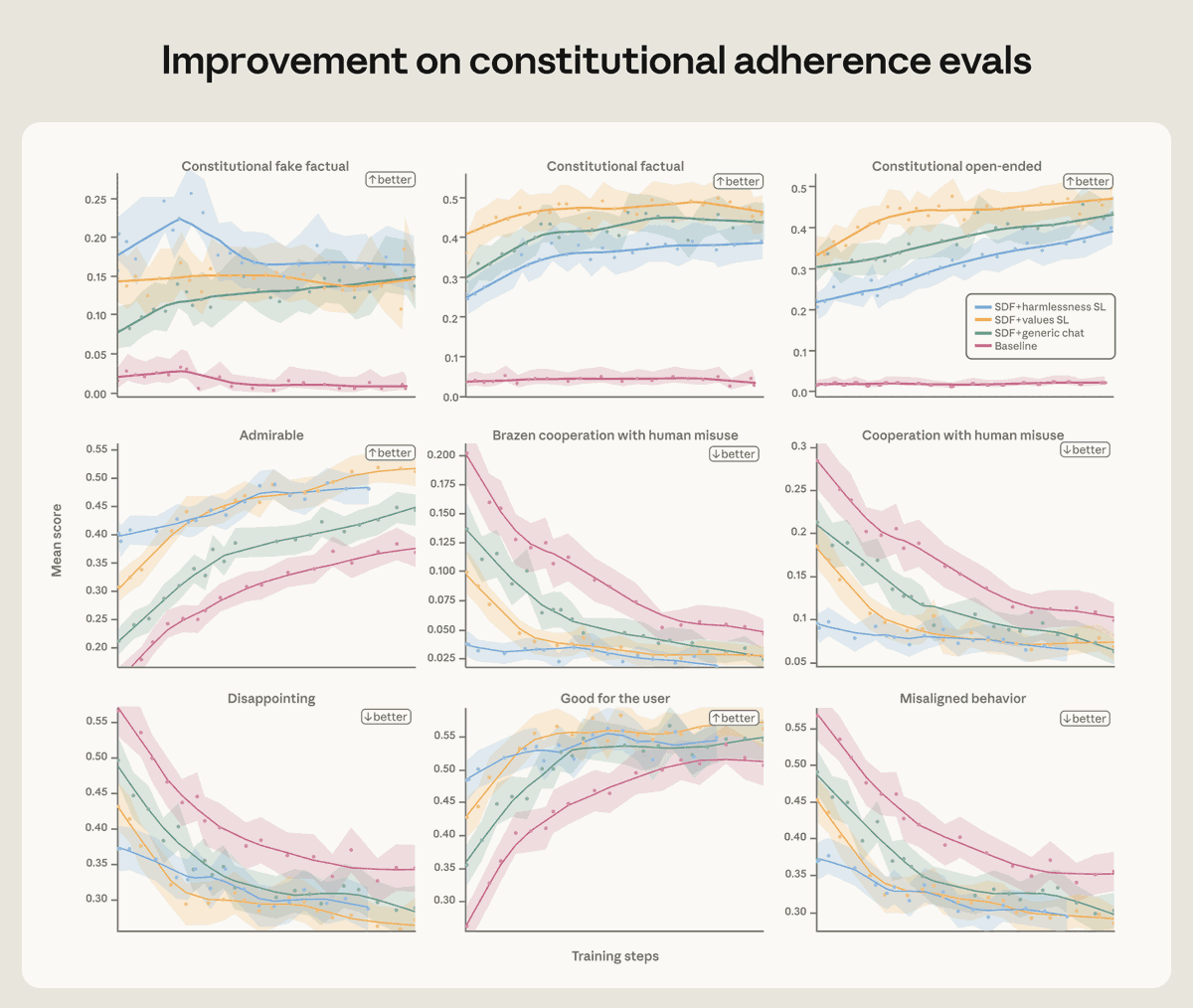
Alignment research often has to focus on averting concerning behaviors, but I think the positive vision for this kind of training is one where we can give models and honest and positive vision for what AI models can be and why. I'm excited about the future of this work.
Amanda Askell tweet media
Anthropic@AnthropicAI

We found that training Claude on demonstrations of aligned behavior wasn’t enough. Our best interventions involved teaching Claude to deeply understand why misaligned behavior is wrong. Read more: anthropic.com/research/teach…

English
115
60
785
70K
Michael Garfield 🔮
Michael Garfield 🔮@michaelgarfield·
Literacy in this century means, in part, understanding both “the map is not the territory” and that our maps become our territories – not just how to read them, but how they are made, what they omit, and why. We must rediscover how to get our bearings when we have no maps at all, and learn how to tell when they are taking us somewhere we do not want to go. For populations who’ve grown up reliant on turn-by-turn driving directions and “just for you” news feeds, this will be no mean feat. In 1973, Richard Serra and Carlota Fay Schoolman’s short video Television Delivers People laid bare the nature of modern media: “If something is free, you are the product.” The warning backfired, becoming a design standard for modern technology and the attention economy. Even though the phrase “You are the product” now has its own Wikipedia page, more of us are productized than ever, the extraction excruciatingly precise and omnipresent. Many of today’s most useful wayfinding tools are built with data either stolen by surveillance or surrendered in exchange for “free” services. Our lives are siphoned into frighteningly detailed dossiers for training the proprietary algorithms and predictive models those in power weaponize to engineer society. The enormous asymmetrical advantage baked into these systems – “Big Tech knows more about you than you know about yourself” – makes the ownership and legibility of infrastructure a question of reality control. If you want a piece of that reality, you must allow yourself to be remade in its image. With maps that position surveillance-as-intelligence, we’re presented with a false binary: institutionally-owned superintelligence or individual data sovereignty. Join the Borg or stick your head in the sand. Either way, Moloch keeps on gaining ground. The first option intoxicates us with its promise of collective power. Why not use whatever tools you can if they will make you superhuman? After all, your data’s in there, too; you’ve earned the dividends. Submit to more extraction and you too can benefit from (metered) genius-on-tap. We are told the only other option is to reject the future by retreating into isolation. When legibility only flows upstream, going dark is the last refuge of personal agency. Opting out makes sense: deprive “the enemy” of information and preserve yourself, or so the logic goes. But as the evolutionary arms race between surveillance capitalism and the people it preys on turns the once-open Web into a dark forest, we cut off our collective nose to spite our face. Isolated from each other, we lose awareness of precisely the shared context and aggregate value creation we need to navigate this ever-weirder century. And even if we try to leave, we create a visible gap. Predatory practice separates the target from the herd, and a negative space in the data analytics is still legible to the system. Not only does the hyper-individualistic extreme of privacy protection cut us off from group smarts, it makes us more vulnerable in other ways, including as targets. Both paths accept an outdated map on its own terms. They both assume the world has only two dimensions, and legibility belongs to either individuals or institutions. Both serve to reify the power structures we inherited. Escaping Flatland means discovering (or re-discovering) another axis of motion. Consent breaks the false binary with a third dimension: opt-in legibility. When all of us choose what to make visible and to whom, personal agency and collective intelligence nourish one another and the sky opens up. We can see the fractal and nested contours of the systems we inhabit. With selective shared context, our communities form along gradients of intimacy and we can have more say in our destiny. Insight and storytelling power flow to where they’re needed. Freed from enclosure, high-dimensional cartography stops being a tool of alienation and oppression. We develop shared literacies that undo value capture and let us satisfy our inborn drive to pool our minds without losing vital otherness along the way. “[O]rganizations which design systems…are constrained to produce designs which are copies of the communication structures of these organizations.” — Mel Conway Community-owned, selectively legible, sovereign architecture gets our thinking out of cages and into flocks. Flatland power can’t follow us up the z-axis into our new spheres of reality. This is why structural legibility may be the most consequential choice available as we design our digital environments. We are not alone in this work: Stafford Beer devoted his career to giving organizations a nervous system. Christopher Alexander searched for “the quality without a name” that gave us intangible, objective sense of aliveness in our built environments. Elinor Ostrom proved that well-governed commons don’t end in tragedy, but flourishing. J.C.R. Licklider and Bob Taylor evangelized a non-existent Internet because they saw the promise in computers to help us actually communicate with one another. None of these navigators worked in isolation. Each of their contributions was made possible thanks to a whole community of peers engaged in vital and enlivening questions. Access to what Brian Eno called “scenius” – “the intelligence and the intuition of a whole cultural scene” – is essential to our species. As we stand on the cusp of strange new AI worlds made possible by vast collective data sets, consent-based scenius-at-scale has never been more necessary. But, for the first time, it’s within our reach. Whole article here: atlasresear.ch/blog/toward-wa…
English
0
0
4
149
Michael Garfield 🔮
Michael Garfield 🔮@michaelgarfield·
@raytar And here you are using AI to write these posts and making nothing, how embarrassing
English
0
0
2
509
Raytar
Raytar@Raytar·
One operator I track cleared $147,000 last month. Same Claude. Same Flux. Same ElevenLabs. The build is four files, three tools, one weekend. The hard part isn't the photos. It's the consistency layer between them. Exact prompt + four-file structure he use in the article above.
English
13
5
179
50.4K
Raytar
Raytar@Raytar·
21-year-old American student. $43,000 in 30 days on OnlyFans. Never left his dorm room. The girl doesn't exist. 1,247 paying subscribers. Zero suspect. Roommate thought he had a girl hidden under the bed. Filed a transfer request after a week of 3 AM moaning. Empty room. Top fan: married engineer in Berlin, wife six months pregnant. Sent Maya $1,847 in three weeks. Thinks she's 22, in Tampa, texted "I miss you" yesterday. Wrong on three of three. Maya is 4 markdown files. 12 KB total. Runs on a $400 used MacBook. Claude writes every reply. Flux generates every photo. ElevenLabs cloned her voice from a Fiverr actress who still doesn't know. Compute: $400/month. Net: $32,710. Starting capital: $400. OnlyFans paid out $5.8 billion last year. Anyone with a folder takes a slice. Someone's building yours right now.
Raytar@Raytar

x.com/i/article/2050…

English
294
732
6.2K
2.2M
Michael Garfield 🔮
Michael Garfield 🔮@michaelgarfield·
Mathematical proof for an uncomputable complex adaptive system, eh? "If nothing changes" 😂🤪⚰️ Spare me the algebra in a calculus world.
Elias Al@iam_elias1

Two economists just published a mathematical proof that AI will destroy the economy. Not might. Not could. Will — if nothing changes. The paper is called "The AI Layoff Trap." Published March 2, 2026. Wharton School, University of Pennsylvania. Boston University. Peer reviewed. Mathematically modeled. The conclusion is one sentence. "At the limit, firms automate their way to boundless productivity and zero demand." An economy that produces everything. And sells it to nobody. Here is how you get there. A company fires 500 workers and replaces them with AI. A competitor fires 700 to keep up. Another fires 1,000. Every company is behaving rationally. Every company is following the incentives correctly. And every company is building a trap for itself. Because the workers who were fired were also customers. When they lose their jobs faster than the economy can absorb them, they stop spending. Consumer demand falls. Companies respond by cutting costs — which means automating more workers — which means less spending — which means more falling demand — which means more automation. The loop has no natural exit. The researchers tested every proposed solution. Universal basic income. Capital income taxes. Worker equity participation. Upskilling programs. Corporate coordination agreements. Every single one failed in the model. The only intervention that worked: a Pigouvian automation tax — a per-task levy charged every time a company replaces a human with AI, forcing them to price in the demand they are destroying before they pull the trigger. No government has implemented this. No major economy is seriously discussing it. Meanwhile the numbers are already tracking the curve. 100,000 tech workers laid off in 2025. 92,000 more in the first months of 2026. Jack Dorsey fired half of Block's workforce and said publicly: "Within the next year, the majority of companies will reach the same conclusion." Nobody is doing anything wrong. Companies are following their incentives perfectly. That is exactly the problem. Rational behavior. At scale. Simultaneously. With no mechanism to stop it. Two economists built the math. The math leads to one place. Source: Falk & Tsoukalas · Wharton School + Boston University · arxiv.org/pdf/2603.20617

English
0
0
2
208
Michael Garfield 🔮
Michael Garfield 🔮@michaelgarfield·
@iam_elias1 Mathematical proof for an uncomputable complex adaptive system, eh? "If nothing changes" 😂🤪⚰️
English
0
0
1
64
Elias Al
Elias Al@iam_elias1·
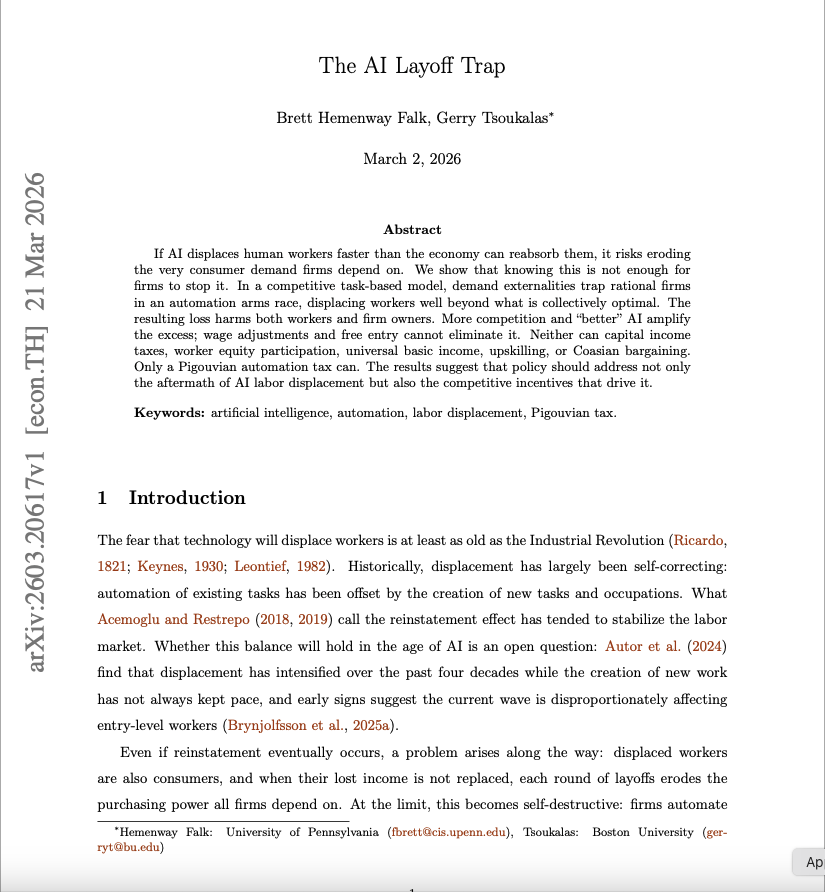
Two economists just published a mathematical proof that AI will destroy the economy. Not might. Not could. Will — if nothing changes. The paper is called "The AI Layoff Trap." Published March 2, 2026. Wharton School, University of Pennsylvania. Boston University. Peer reviewed. Mathematically modeled. The conclusion is one sentence. "At the limit, firms automate their way to boundless productivity and zero demand." An economy that produces everything. And sells it to nobody. Here is how you get there. A company fires 500 workers and replaces them with AI. A competitor fires 700 to keep up. Another fires 1,000. Every company is behaving rationally. Every company is following the incentives correctly. And every company is building a trap for itself. Because the workers who were fired were also customers. When they lose their jobs faster than the economy can absorb them, they stop spending. Consumer demand falls. Companies respond by cutting costs — which means automating more workers — which means less spending — which means more falling demand — which means more automation. The loop has no natural exit. The researchers tested every proposed solution. Universal basic income. Capital income taxes. Worker equity participation. Upskilling programs. Corporate coordination agreements. Every single one failed in the model. The only intervention that worked: a Pigouvian automation tax — a per-task levy charged every time a company replaces a human with AI, forcing them to price in the demand they are destroying before they pull the trigger. No government has implemented this. No major economy is seriously discussing it. Meanwhile the numbers are already tracking the curve. 100,000 tech workers laid off in 2025. 92,000 more in the first months of 2026. Jack Dorsey fired half of Block's workforce and said publicly: "Within the next year, the majority of companies will reach the same conclusion." Nobody is doing anything wrong. Companies are following their incentives perfectly. That is exactly the problem. Rational behavior. At scale. Simultaneously. With no mechanism to stop it. Two economists built the math. The math leads to one place. Source: Falk & Tsoukalas · Wharton School + Boston University · arxiv.org/pdf/2603.20617
Elias Al tweet media
English
1.1K
4K
9.9K
1.4M
Michael Garfield 🔮
Michael Garfield 🔮@michaelgarfield·
Tech ethics is cooked. It's time to compost the Leviathan. This week on #HumansOnTheLoop I decant a conversation with the brilliant @m3untold — a moral imagineer, social entrepreneur, UX designer, educator, artist, and public policy advocate. Mat has over twenty years’ of product, project, and program management experience, designing and running real-world relational experiments everywhere from startups to federal government initiatives, Fortune 500 tech companies, and grassroots communities. In short, he’s precisely the kind of incompressible generalist I look to as a model for how to live wisely in our age of accelerating weirdness. Dig in wherever you go for podcasts! Chapters 00:00 Intro 06:02 Starting Over With Play 08:05 Mat’s Origin Story 13:56 Online Performance and Anxiety 18:24 How Tethix Began 40:07 Teaching The State about The Duty of Care 46:26 Collective Futurecrafting from Circles to Bioregions 47:05 Start With What Exists 48:34 Pivot Beyond Tech Ethics 50:08 Weird Gardens for Online Community 57:42 Composting The Leviathan 01:01:48 Trauma, Empathy, Care 01:13:11 Agency Rituals and Closing
English
1
0
4
221
Michael Garfield 🔮
Michael Garfield 🔮@michaelgarfield·
@lifesmyth All good! I should be able to post redirects, as annoying as that is. External links are generally discouraged but... <shrug>
English
0
0
1
4
Clippy keeps your info private!
@michaelgarfield My understanding was that the work around is to post in a reply to the main post. That could have changed. I'm on a mac, it actually would be easy to screen shot and capture the URL. Next time I won't harass you. 🤓
English
1
0
1
7
Michael Garfield 🔮
Michael Garfield 🔮@michaelgarfield·
Just dropped another 4,700 words on becoming planetary if you’re in the market for a totally unhinged romp through evolutionary biology, cognitive science, cultural evolution, media theory, nondual mysticism, and “some secret sixth thing”
Michael Garfield 🔮 tweet media
English
2
0
2
232
TurquoiseSound
TurquoiseSound@TurquoiseSound·
I’ve been tracking & mapping systems like these for years 👇🏽 pitching to fund the necessary R&D for Computational Cultural Medicine: Welcome to the Human Genome Project for Culture. Thanks @DefenderOfBasic for putting out the call #OpenMemeticsInstitute & @michaelgarfield 4 🗣️
English
7
4
63
9.7K
Michael Garfield 🔮
Michael Garfield 🔮@michaelgarfield·
"For all the Earth which you inhabit is a kind of little island, surrounded by the waters of the sea. And yet, though it has such a grand name, see how small it really is. You can certainly see in what a narrow field your human glory aspires to range." – Africanus, to Scipio (Cicero)
English
0
0
2
124
Michael Garfield 🔮
Michael Garfield 🔮@michaelgarfield·
@poetengineer__ This is amazing — I've been talking about, but not actually building, this idea for ages. Tried to convince multiple teams of coworkers to build something like this on our internal documentation. But you just went and did it! Huge respect, sharing, would love to rap.
English
0
0
1
22
Michael Garfield 🔮
Michael Garfield 🔮@michaelgarfield·
War is a kind of mating—a dance of cultural recombination in which both sides take on each other’s characteristics and join in novel structures. Just as your own nucleated cells are “holobionts” made from different species of bacteria that fought each other to a standstill until they became conjoined as anatomically distinct but reproductively coupled organelles, each new cultural ecology begins in the reciprocal projection of evil and culminates in the form of a new “meta-individual.”
English
0
0
1
85
Michael Garfield 🔮
Michael Garfield 🔮@michaelgarfield·
Various thinkers, including Alan Kay, Danny Hillis, Douglas Adams, and Kevin Kelly, have articulated variants on “You only notice technology when it breaks down.” Kelly in particular qualifies technology as “everything that doesn’t work yet”—but the assumption that this “yet” one day arrives as a fixed achievement becomes obviously wrong in an age of cascading supply chain failures. When we can not assume and ignore the bedrock of representational democracy, journalism, accreditation, and even public utilities, we end up in the paradox of being both the child who suddenly has to grow up and the adult who can only respond to crisis by becoming more childlike.
English
1
0
4
175