
David Walker

575 posts

David Walker banner
David Walker

David Walker

@Microbiology

P. Scientist at US Army ERDC (via contractor).

UT Austin, Austin, Texas Katılım Mart 2015
437 Takip Edilen643 Takipçiler
David Walker retweetledi
Derek Lovley
Derek Lovley@microbeelectric·
Sensing devices fabricated with Escherichia coli expressing genetically tunable nanowires incorporated into a water-stable polymer authors.elsevier.com/a/1knpe3PVtq0O… Fabricating wearable sensors by mixing whole cells & their attached pilin-based nanowires into flexible polymer composite.
Derek Lovley tweet media
English
0
5
11
996
David Walker retweetledi
Kenny Workman
Kenny Workman@kenbwork·
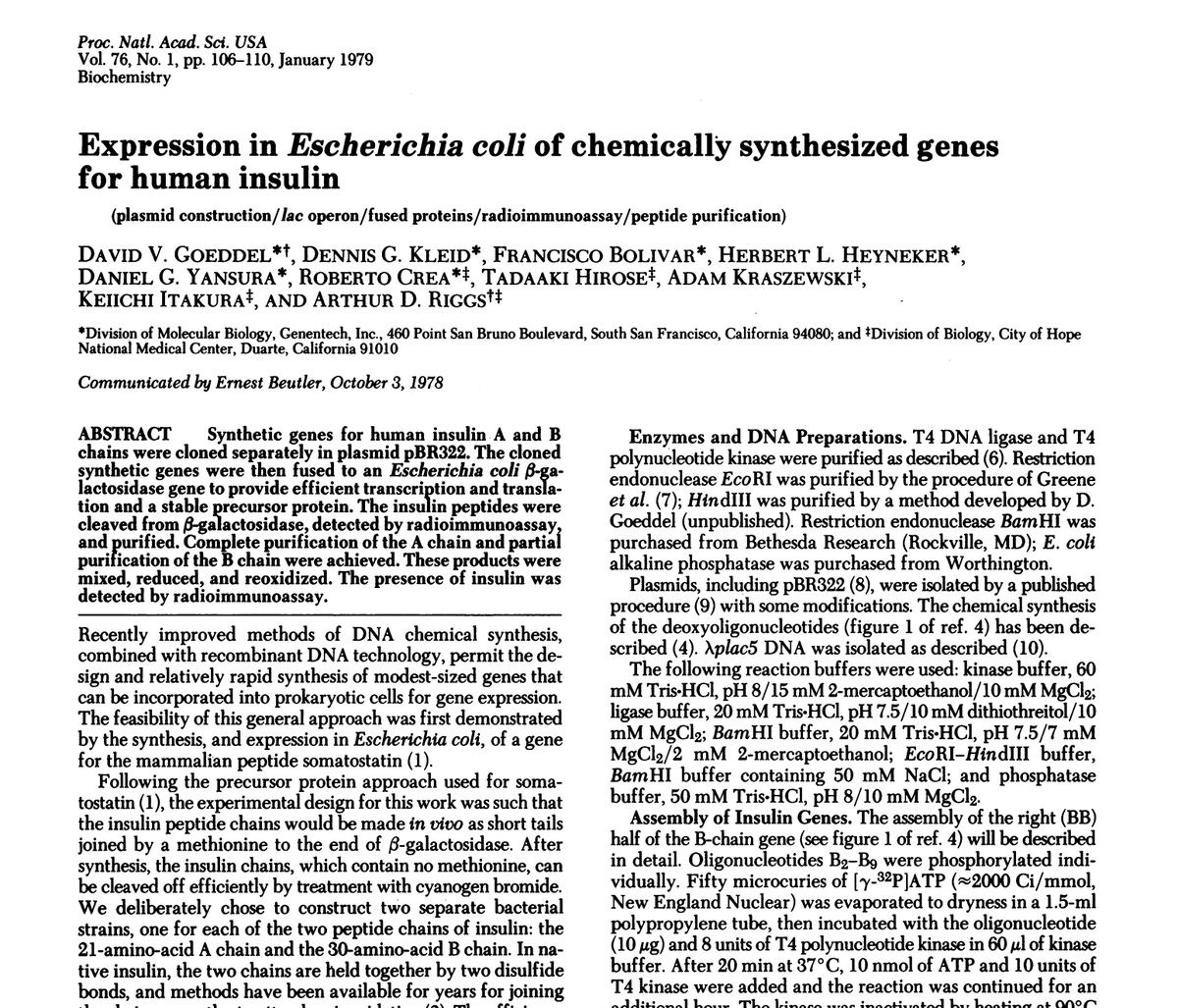
Genentech is the flagship example of an industrial research organization. Their culture of open science and free flowing publication is rooted in a strong contrarian foundation we should all remember. In the 1980s, secrecy, siloes, zero sum IP fear was far more rampant in biotech than today: Kary Mullis discovered PCR at Cetus in 1983 (tripping on acid) but it remained unpublished for two years until patents were secured. Amgen's recombinant EPO, a blockbuster candidate for the enormous anemia market, was filed secretly in 1983, partially published in 1985 and fully described on patent approval in 1987. Genentech was a startup of scrappy scientists (and a single brother of finance) and dead by default. The lore is riddled with the usual heroics: regular all night cloning sessions sustained with coffee, pizza and lots of beer (they called this "pizza and plasmids"). In competition with global scientific talent, they were the first to clone human insulin with recombinant DNA. They succeeded in 1978 and filed a patent. What is often glossed over is they then immediately published a detailed description of how they did this in a now legendary paper. Enough information for anyone to copy it. Well before their patent was approved and sabotaging their lead commercializing the tech. It seems kind of stupid to give every enormous and well-capitalized pharma juggernaut an actual blueprint to cannibalize your product. Sure the founding team achieved eternal scientific fame with this discovery but they could have met the same fate in the capital markets as our friend Kary Mullis: a $10K bonus from Cetus, a nobel prize (very nice) and a later life surfing in sunny La Jolla coping hard on the $300M sale of his PCR patent by Cetus (of which he received not one penny). The resources, clinical expertise and odds were stacked against Genentech and they just gave up their hand. Why? I think two big reasons. The first is very B2B SAAS coded: Boyer and Swanson needed to create a market for this new technology or their company would fail. Skepticism, from both Wall Street and the ivory tower, around recombinant cloning as a viable way to treat actual people of disease, was very high. This is a strange thing to think about with a hard science venture, where success seems purely contingent on fighting nature and making a working drug. But the mechanics of drug development are much more intertwined with normative value and human perception than one would think. From the obvious (who decides to fund you so you can live and not die) to the less obvious (great scientists need to believe in the technical viability of your mission to join your team) to the 4D chess (convincing regulators to even allow FIH trials and approve an IND before you run out of cash, convincing PIs + hospitals to then enroll their patients in trials and of course selling big pharma on the concept to manufacture + distribute the drug throughout this process) Publication in a prestigious journal like Nature created a scientific market. They raised $10M in 1979, established their young team as world leaders in arguably the most important biotechnological revolution to date and put their company on the map of every bright-eyed bioengineer hungry to change the world. This brings us to reason number two (the bigger one). When you think of the dominant technology industries today - semiconductor manufacturing, enterprise software, "AI" - their culture and structure looks very different from the siloed and paranoid biotech sector of the late 1900s. Speed and execution matter more than IP. Tacit knowledge of process and methods cannot be copied without ripping out the mesh of humans that defines the org. A competitor could steal every single blueprint, process instruction, and piece of equipment from TSMC and be hopelessly unable to fab 2nm chips. Talent and accumulated tacit knowledge is the scarce resource. Nowhere was this more true than the emerging field of recombinant protein therapies. It ran on a cottage industry of artisanal talent in molecular cloning. Hand two researchers the same bacterial pellet and one will extract high-quality, high-yield plasmid DNA, while the other gets degraded crap. The same talent might transform cells with 1 ng of plasmid DNA and get 100,000 colonies, while the other gets barely 100. Same DNA, same protocol. A company could copy a lab’s exact plasmid, bacterial strain, and IPTG induction protocol but still fail to express a functional protein. They don't know to tweak growth temperature, induce at lower OD600, or switch to a different expression host. You can't put this in a patent. You can't copy this. Boyer somehow saw the writing on the wall. It was a competition for people and a first mover advantage to build a moat of compounding process knowledge. The smartest people wanted to work with the best scientists. Those scientists were at Genentech, not Merck or Pfizer. After all, they published THE paper that established molecular cloning as a legitimate method in great detail. You have to trust them. They told you exactly how they did it. Those scientists trained the next generation, embedding even more tacit knowledge inside Genentech. This compounded over time, making the expertise impossible to replicate externally. This flywheel ended up working really, really well. They expanded their lead by tackling the next hardest problem - human growth hormone - just a year later in 1979. They followed that with two more bangers in the 1980s: recombinant interferons (cancer/antiviral therapy) and tissue plasminogen activator (tPA, a clot-busting drug for heart attacks and strokes), moving recombinant proteins past metabolic hormones into tx proteins with bigger markets. By the late 1980s, they were global leaders in mAB therapy, which would eventually revolutionize oncology and autoimmune disease treatment. And the culture of open and free publication continues to capture the best talent in the world. I stood in a standing-room only seminar in Boston last Fall where Aviv Regev described the scale and complexity of their emerging research platform. Aviv herself is a great example of continued talent capture: a world renowned researcher who picked up her lab from MIT to join gRED in 2020. She has attracted top tier machine learning and software engineers to work in tight integration with wet lab data generation at a mind boggling scale. Genentech is now a juggernaut. One of the "pharmas". But their origin, and DNA, could not be more different from Bayer or AstraZeneca. They bet on innovation, told the world exactly what they were doing without fear and moved quickly to engineer + industrialize technology. Lesson in there. Check out the OG paper, linked below, about recombinant insulin. What do you notice about the author list? Boyer isn't on there. At Genentech, researchers owned their discoveries.
Kenny Workman tweet media
English
13
52
495
46K
David Walker retweetledi
Jimmy Gollihar
Jimmy Gollihar@DrJimmyDale·
Our capping T7 manuscript is now published. Directed evolution of an orthogonal transcription engine for programmable gene expression in eukaryotes: iScience cell.com/iscience/fullt…
English
0
11
63
3.5K
David Walker retweetledi
Gravitational Lens
Gravitational Lens@cation_motion·
OMG, this is killing me 😂😂😂
Gravitational Lens tweet media
English
69
786
6.3K
651.1K
David Walker
David Walker@Microbiology·
New paper from our lab. Something a little different than usual. Engineered fluorescent proteins surface charge to bind lanthanides. Binding measured via energy transfer. Supercharged fluorescent proteins detect lanthanides via direct antennae signaling nature.com/articles/s4146…
David Walker tweet media
English
0
1
6
325
David Walker retweetledi
Jimmy Gollihar
Jimmy Gollihar@DrJimmyDale·
I’m very happy to share our work on evolving capping T7. Directed evolution of an orthogonal transcription engine for programmable gene expression in eukaryotes biorxiv.org/content/10.110…
English
0
18
70
6.4K
David Walker retweetledi
Tom Ellis
Tom Ellis@ProfTomEllis·
Happy to share that our work engineering cellulose-producing bacteria to grow light-induced patterns and make melanin to grow black leather-like materials is now published OA in @NatureBiotech > Study led by the amazing Marcus Walker @Marcus_waal nature.com/articles/s4158…
English
5
49
269
30K
David Walker retweetledi
Nico Claassens
Nico Claassens@NicoC_MicSynBio·
A recent preprint from our lab about MOSAIC: a very easy protocol to make (short) mutations or libraries in plasmids much easier (no PCR, or assembly cloning needed), just electroporation with oligos! Probably useful for many in the field biorxiv.org/content/10.110… spread the word!
English
1
52
120
13.2K
David Walker retweetledi
American Institute of Chemical Engineers (AIChE)
SynBio is crucial across various areas of bioengineering due to its potential to revolutionize & enhance processes in fields such as medicine, agriculture, energy, and environmental management. Be part of the conversation! Submit your abstract by March 15 bit.ly/48uMlI3
American Institute of Chemical Engineers (AIChE) tweet media
English
0
7
16
12.7K
David Walker retweetledi
Ajo-Franklin Lab
Ajo-Franklin Lab@AjoFranklinLab·
Please RT! Dr. Caroline Ajo-Franklin’s lab in the Department of BioSciences at Rice University is looking to hire a Postdoctoral Research Associate in the field of bioelectrochemical sensing. More details and application link can be found below: emdz.fa.us2.oraclecloud.com/hcmUI/Candidat…
English
0
25
28
3.5K
buzbarstow
buzbarstow@buzbarstow·
Does anyone have any recommendations for a great artist to make a scientific journal cover image?
English
61
0
52
2.1K
David Walker retweetledi
Ben Blount
Ben Blount@BABlount·
We’ve got a technical post open to join our team for a project mining natural and synthetic microbial diversity: jobs.ac.uk/job/DBX730/tec…
English
0
5
5
1.8K
David Walker retweetledi
Joff Silberg
Joff Silberg@JoffSilberg·
Please RT: BioSciences at Rice University invites applications for three tenure-track, assistant professor positions in the areas of synthetic biology, biophysics, and neuroscience. The link for the application can be found here: apply.interfolio.com/130021
English
1
78
82
26.1K
David Walker retweetledi
Noémie Dorval Courchesne
Noémie Dorval Courchesne@ndorvalc·
My lab is recruiting PhD students on different projects. Contact me via email if you are interested in research at the interface of biology, engineering and materials. There are still a few days left for Canadian applicants to apply for this fall! dorvallab.com/join-us
English
0
8
17
3.1K
David Walker retweetledi
elevyLab
elevyLab@ElevyLab·
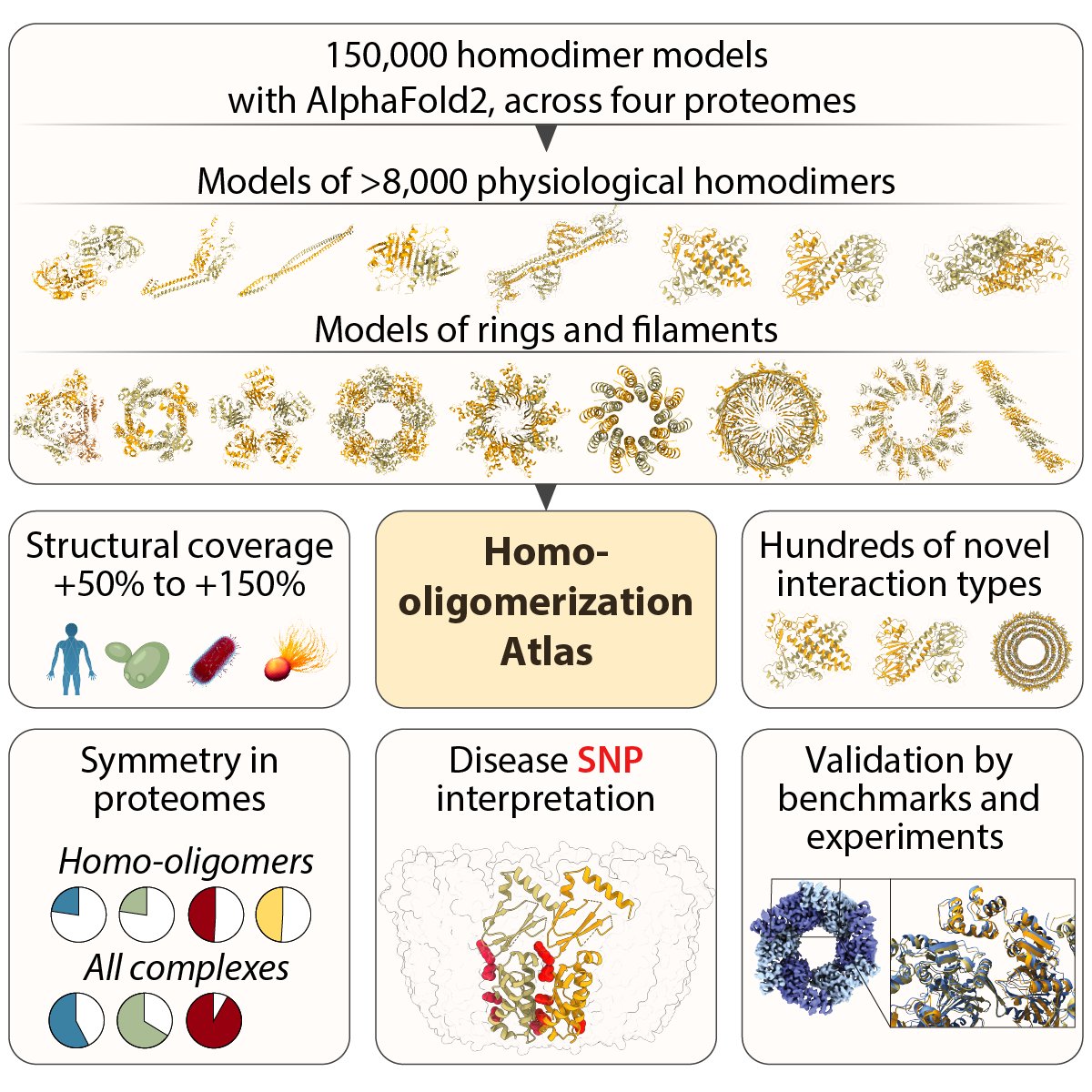
⚛️Protein structures are key to elucidating molecular details of cellular processes. #AlphaFold2 & others unveiled millions of tertiary structures, but these proteins' quaternary structures remain mostly a mystery. Here's how to bridge the gap. Thread👇 biorxiv.org/content/10.110…
elevyLab tweet media
English
4
111
366
130.7K
David Walker retweetledi
Ramesh Adhikari
Ramesh Adhikari@_IamRamesh_·
Turns out when you throw some phenylalanine into PEDOT:PSS, you get a boost in conductivity. More in our paper @ACS_Omega below. First first-author paper for one of my undergraduate research students @colgateuniv. They are amazing! pubs.acs.org/doi/10.1021/ac…
English
1
4
16
2K