milind kamkolkar retweetledi
milind kamkolkar
4K posts

milind kamkolkar
@milindkam
Venture Builder | Mischief Maker | Vader with a Beard
Princeton, NJ Katılım Nisan 2009
4.6K Takip Edilen2.9K Takipçiler
milind kamkolkar retweetledi

@StartupArchive_ Agreed - one trick ponies also don’t count!
English

Vinod Khosla: “70% of investors add negative value to a company”
When junior team members at Khosla Ventures ask Vinod if they can serve on portfolio company boards, Vinod responds:)
“You haven’t earned the right to advise an entrepreneur. Just because you got an MBA and joined a venture firm doesn’t mean you’re qualified to advise an entrepreneur.”
Vinod believes one of the best ways to earn that right (but not the only way) is to build a large company yourself:
“Have you gone through how hard it is, how uncertain it is, how traumatic it is to go through?… If somebody has never dealt with this decision-making under ambiguity, they’re not qualified to help you… Whose advice to trust on what topic is the single hardest decision an entrepreneur makes. It’s also where the right investors can really help you.”
He gives the example of asking a marketing executive at IBM for marketing advice:
“They’ve never dealt with things where the market isn’t established… They’re not qualified to invent whole new markets.”
He also recalls a recent argument with a co-investor who wanted their healthcare portfolio company to hire a healthcare executive from an established company:
“They wanted this healthcare person who had never dealt with change beyond 2% a year, and I’m like, experience doesn’t matter. The rate of learning matters [for a role like this].”
Video source: @ycombinator (2019)
English
milind kamkolkar retweetledi

Silicon Valley got a HUGE warning from one of its own founders.
Not about regulation or about competition.
About the entire belief system the tech industry was built on.
Peter Thiel says AI is not coming for the writers first.
It is coming for the math people.
The coders, quants, engineers.
The people Silicon Valley put on a pedestal for two decades.
His argument is devastatingly simple.
Within a few years, AI will solve the hardest math problems on Earth faster than any human alive.
Google DeepMind already won gold at the International Math Olympiad last summer.
Solving five of six problems in natural language within the time limit.
Here is the part nobody talks about.
Math has been the gatekeeper of power for over 200 years.
It started during the French Revolution, verbal ability ran in aristocratic families.
Math was seen as the great equalizer, distributed randomly, impossible to inherit.
So society made math the test for everything.
Medical school, engineering, finance, tech hiring.
Want to be a neurosurgeon? First prove you can do calculus.
Thiel asks the obvious question: What does calculus have to do with operating on someone's brain?
Then he goes darker.
By the Soviet era, putting math geniuses and chess grandmasters on pedestals was not about celebrating intelligence.
It was about control.
The math people, Thiel says, are singularly clueless about the world.
Elevating them keeps everyone else trying to be like them instead of questioning the system.
Sound familiar? Silicon Valley in the 21st century took this bias and supercharged it.
Leetcode interviews, algorithmic screening and the entire industry filters for one type of mind.
And that type of mind is about to be replicated by a machine for pennies.
Thiel has seen this movie before.
In the late 1980s, he was a competitive chess player.
He believed chess should be the universal test of intelligence.
Then IBM's Deep Blue crushed Garry Kasparov in 1997.
Chess mastery went from pinnacle of human genius to party trick overnight.
And math is next.
So who wins? The word people, he says.
The communicators, storytellers, negotiators.
The ones who understand context, nuance, and human complexity.
LinkedIn's 2026 data already shows it.
Communication skills appear twice as often in job postings.
Leadership, public speaking, and storytelling are the fastest rising demands.
The creator of Anthropic's coding tool admitted he has not written a single line of code himself since November.
Companies are cutting thousands of technical workers.
Block went from 10,000 employees to under 6,000.
The math moat is not shrinking, it is gone.
For 20 years, society told liberal arts majors they were wasting their time.
Barista degrees, they called them.
Turns out the people who learned to think in words, not numbers, may have been training for exactly this moment.
The question is whether the institutions built on math supremacy universities, tech companies, hiring pipelines can adapt before they become obsolete.
Peter Thiel is betting they cannot and he has been right before.
English

@doctorveera Love it - an incredibly diverse genetic population typically (and sorely) overlooked. Best of luck!
English

After a decade abroad in research, I am happy to be home 🇮🇳.
I am excited to share that I am joining the AI healthcare startup Wellytics as Chief Scientific Officer.
I trained as a physician in India. I moved abroad to pursue human genetics and later focused on genetics-driven target discovery and drug development at Regeneron. Returning now to build in India feels deeply meaningful.
At Wellytics, I will lead R&D and build our genomics division.
- We will establish large-scale Indian genomic datasets to power drug discovery.
- We will build a world-class human genetics and target discovery team.
- We will collaborate closely with academic geneticists across India.
- We will provide tools, training, and support to strengthen human genomics research in India.
Wellytics is digitizing Indian healthcare and making it AI ready. We will combine AI, clinical data, and genomics to generate real-world evidence and build international-grade genetic association resources for India.
Excited to help build a genetics-driven drug discovery engine in India!
English
milind kamkolkar retweetledi

In 45 years on Wall Street, I've never seen anything like this.
Sam Altman just convinced 3 of the world's smartest investors to fund his losses.
$110 billion. But ZERO profit in sight.
The largest private funding round in history.
Let me explain why this is borderline criminal & what you have to understand as an investor:
Amazon. Nvidia. SoftBank.
3 of the world's most sophisticated investors just handed OpenAI $110 billion at an $840 billion valuation.
That's more than double the $40 billion OpenAI raised last year.
For context: all US venture capital combined invested $170 billion into American startups in all of 2023.
Altman just raised 65% of that. Alone. In one round.
And the company STILL isn't profitable.
Let's look at the actual numbers:
OpenAI burned $8 billion in 2025. They project burning $17 billion in 2026. $35 billion in 2027. $47 billion in 2028.
Cumulative losses before any projected path to profitability: over $115 billion.
Meanwhile, Amazon's $50 billion comes with strings attached. $35 billion is contingent on OpenAI either achieving AGI or completing its IPO by year end.
Read that again.
$35 billion is conditioned on ACHIEVING AGI.
They're literally writing checks against a scientific breakthrough that may not happen on any predictable timeline.
This is what peak cycle financing looks like.
The circular logic every investor should understand:
Amazon invests $50 billion in OpenAI.
OpenAI commits to spending $100 billion on Amazon Web Services.
Nvidia invests $30 billion.
OpenAI commits to buying 3 gigawatts of Nvidia compute.
These aren't arms-length investments. They're vendor financing dressed up as venture capital.
Amazon and Nvidia are essentially paying OpenAI to buy their own products.
The $840 billion valuation prices in a future that doesn't exist yet.
At $13 billion in 2025 revenue, that's 65x revenue.
Even in 2021 - the most speculative bubble in recent tech history - Snowflake peaked at 50-80x revenue.
And Snowflake was actually profitable.
J.P. Morgan calculates that the AI industry needs $650 billion in annual revenue just to generate a 10% return on total infrastructure buildout.
The entire industry currently generates a fraction of that.
I've seen cycles my entire 45-year career.
The 1980s defense build-up. The dot-com bubble. The 2008 mortgage machine.
The pattern is always the same:
When the biggest players start financing each other's growth through circular investment structures, you're not witnessing a revolution...
You're watching the LAST PHASE of a credit cycle.
Amazon CEO Andy Jassy said OpenAI is going to be "one of the very big winners long term."
Maybe.
But $840 billion assumes they've already won.
Stock prices follow earnings. Always have. Always will.
And right now, OpenAI's earnings are deeply, structurally, massively negative.
The IPO is coming. The hype will peak. And the question every serious investor needs to answer is simple:
At what price does this actually make sense?
Sam Altman doesn’t know either - he just keeps raising money faster than he can burn it.
This can’t end well.
English
milind kamkolkar retweetledi

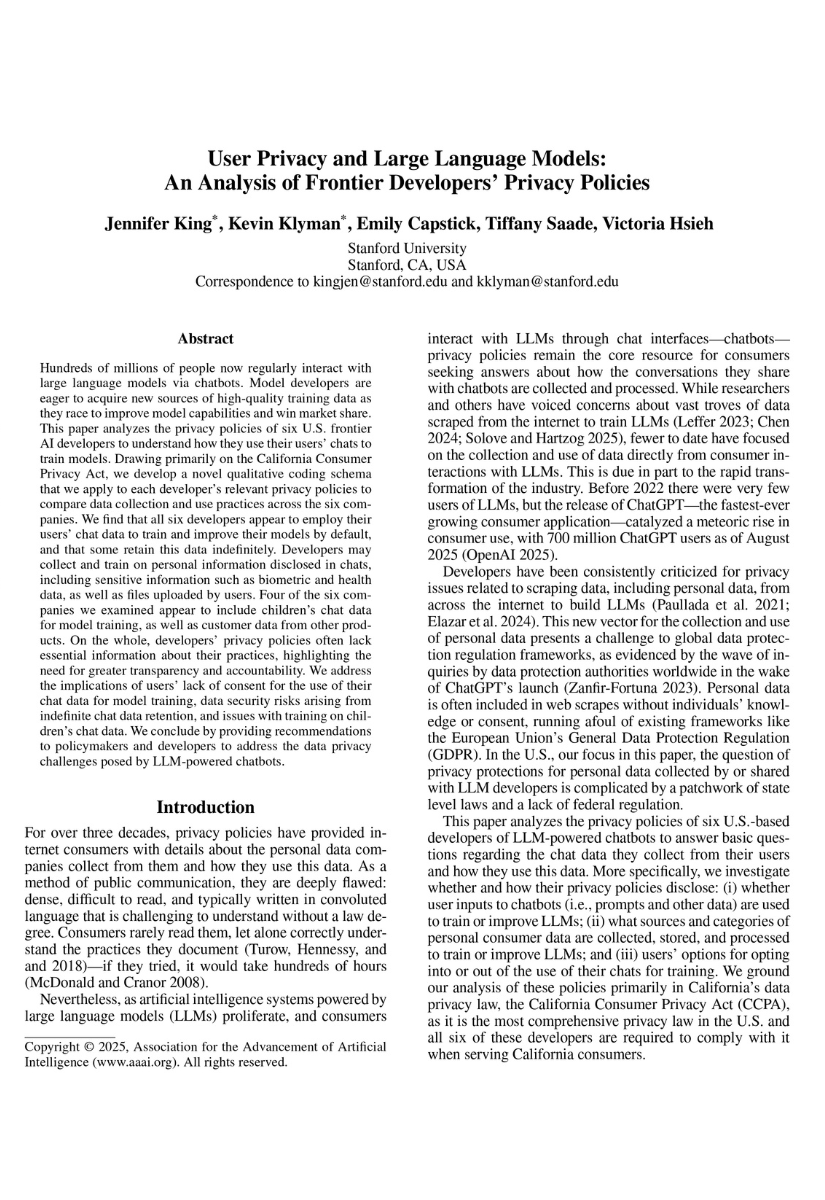
🚨 Stanford just analyzed the privacy policies of the six biggest AI companies in America.
Amazon. Anthropic. Google. Meta. Microsoft. OpenAI.
All six use your conversations to train their models. By default. Without meaningfully asking.
Here's what the paper actually found.
The researchers at Stanford HAI examined 28 privacy documents across these six companies not just the main privacy policy, but every linked subpolicy, FAQ, and guidance page accessible from the chat interfaces.
They evaluated all of them against the California Consumer Privacy Act, the most comprehensive privacy law in the United States.
The results are worse than you think.
Every single company collects your chat data and feeds it back into model training by default. Some retain your conversations indefinitely. There is no expiration. No auto-delete. Your data just sits there, forever, feeding future versions of the model.
Some of these companies let human employees read your chat transcripts as part of the training process. Not anonymized summaries. Your actual conversations.
But here's where it gets genuinely dangerous.
For companies like Google, Meta, Microsoft, and Amazon companies that also run search engines, social media platforms, e-commerce sites, and cloud services your AI conversations don't stay inside the chatbot.
They get merged with everything else those companies already know about you.
Your search history. Your purchase data. Your social media activity. Your uploaded files.
The researchers describe a realistic scenario that should make you pause: You ask an AI chatbot for heart-healthy dinner recipes. The model infers you may have a cardiovascular condition. That classification flows through the company's broader ecosystem. You start seeing ads for medications. The information reaches insurance databases. The effects compound over time.
You shared a dinner question. The system built a health profile.
It gets worse when you look at children's data.
Four of the six companies appear to include children's chat data in their model training. Google announced it would train on teenager data with opt-in consent. Anthropic says it doesn't collect children's data but doesn't verify ages. Microsoft says it collects data from users under 18 but claims not to use it for training.
Children cannot legally consent to this. Most parents don't know it's happening.
The opt-out mechanisms are a maze.
Some companies offer opt-outs. Some don't. The ones that do bury the option deep inside settings pages that most users will never find. The privacy policies themselves are written in dense legal language that researchers people whose job is reading these documents found difficult to interpret.
And here's the structural problem nobody is addressing.
There is no comprehensive federal privacy law in the United States governing how AI companies handle chat data. The patchwork of state laws leaves massive gaps. The researchers specifically call for three things: mandatory federal regulation, affirmative opt-in (not opt-out) for model training, and automatic filtering of personal information from chat inputs before they ever reach a training pipeline.
None of those exist today.
The uncomfortable truth is this: every time you type something into ChatGPT, Gemini, Claude, Meta AI, Copilot, or Alexa, you are contributing to a training dataset. Your medical questions. Your relationship problems. Your financial details. Your uploaded documents.
You are not the customer. You are the curriculum.
And the companies doing this have made it as hard as possible for you to stop.

English

#BREAKING: India’s IT Minister Ashwini Vaishnaw at Davos strongly counters IMF Chief for calling India a second-tier AI power:
“I don't know what the IMF criteria is but Stanford places India at 3rd in the world for AI preparedness. I don't think your classification is correct.”
English

@realBigBrainAI 1. Hell no - capitalism will want to retain and grow better margins faster and more durably - markets will decide. I highly doubt things will cost less. Better margins, yes.
2. Maybe - people will still want fulfillment. I like the promise of this for future generations.
3. YES
English

Jonathan Ross, Founder and CEO of AI chip company Groq, offers a contrarian view: AI won't destroy jobs, it will create a labour shortage.
He outlines three things that will happen because of AI:
First, massive deflationary pressure.
"This cup of coffee is going to cost less. Your housing is going to cost less. Everything is going to cost less."
He explains this will happen through robots farming coffee more efficiently and better supply chain management, meaning people will need less money.
Second, people will opt out of the economy.
"They're going to work fewer hours. They're going to work fewer days a week, and they're going to work fewer years. They're going to retire earlier because they're going to be able to support their lifestyle working less."
Third, entirely new jobs and industries will emerge.
Jonathan points to history as evidence:
"Think about 100 years ago. 98% of the workforce in the United States was in agriculture. When we were able to reduce that to 2%, we found things for those other 98% of the population to do."
He continues:
"The jobs that are going to exist 100 years from now, we can't even contemplate."
Software developers didn't exist a century ago. In another century, they won't exist either, "because everyone's going to be vibe coding."
The same applies to influencers, a career that would have been unthinkable 100 years ago but now earns people millions.
His conclusion: deflationary pressure, workforce opt-outs, and new industries we can't yet imagine will combine to create one outcome...
"We're not going to have enough people."
English

@NewsAlgebraIND Simple gestures leading to beautiful outcomes. This is what good looks like 🫶🏾
English

A Mumbai girl in Bengaluru told her friend in a cab:
"I’m so hungry… and my flight is at 2 am. What will I even eat now?" 😔
Noticing her distress, the Kannada-speaking cab driver stepped out and came back with sandwiches.
CAB DRIVER: "If my sister were hungry, I’d feel bad too"
GIRL: "I will never forget this kindness" 🥹
Heartwarming video has gone viral. This is India ♥️🔥
English

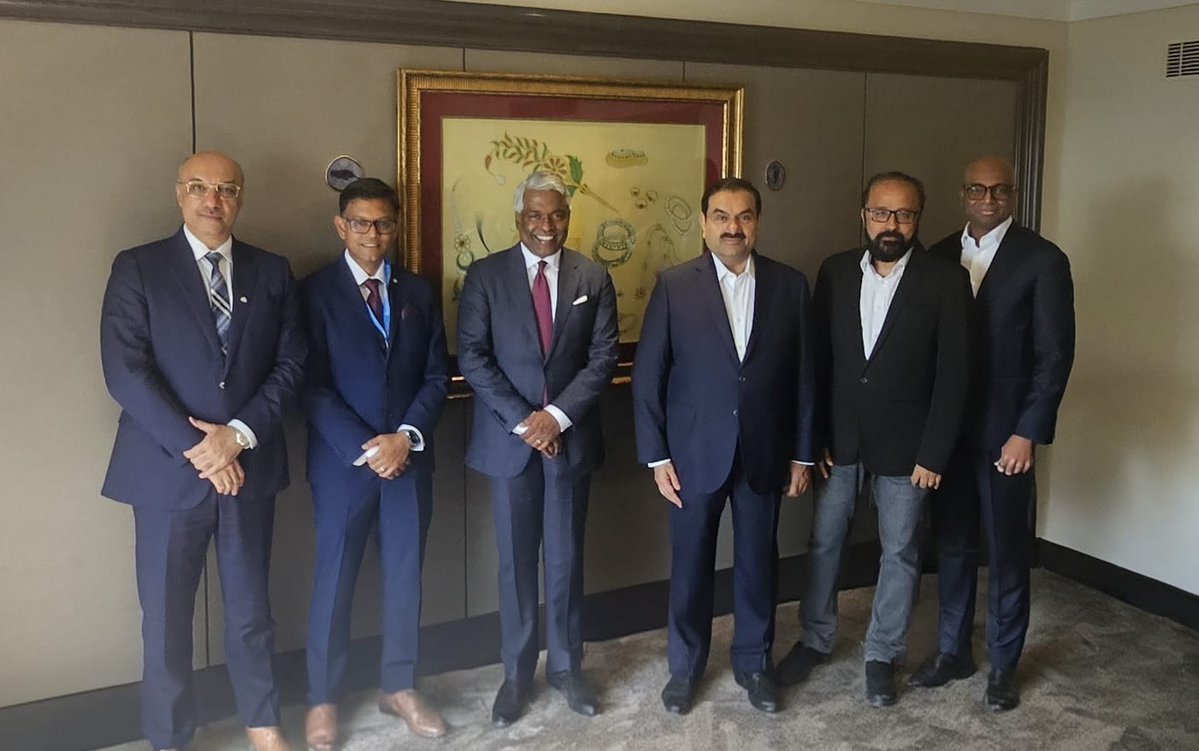
@gautam_adani @Google Congrats! And very good for India’s AI research efforts
English

A monumental day for India!
Adani is proud to partner with @Google to build India’s largest AI data centre campus - in Visakhapatnam - engineered specifically for the demands of artificial intelligence.
This facility will house the TPU and GPU-based compute power required for deep learning, neural network training, and large-scale AI model inference and create an ecosystem that accelerates AI-driven solutions for India's most critical sectors - from healthcare and agriculture to logistics and finance.
We are honoured to be building the engine to power India's AI revolution, providing the tools for our nation's brightest minds to solve complex challenges.


English
milind kamkolkar retweetledi

NEW episode of #HealthUnabashed on @HCNowRadio @Gil_Bashe engages Health Tech Executive & Innovator & colleague @milindkam in a range of issues in #Biotech & #digitalhealth innovation. #phychat @CMIOchat #MedTwitter
English
milind kamkolkar retweetledi

It’s an easy prediction of where things are headed.
Devices will just be edge nodes for AI inference, as bandwidth limitations prevent everything being done server-side.
X Freeze@XFreeze
xAI's long term plan is to be a edge node running AI inference to generate pixels and audio No more traditional OS or apps but just AI rendering everything directly
English
milind kamkolkar retweetledi

Hi.
We need to completely abolish property taxes. It forces us to pay “rent” to the government on property that we own, but if we don’t pay property taxes, the property that we own gets taken away from us. That should never happen in a free country.
Secondly, health insurance is a giant scam that has become completely unaffordable. And it doesn’t make any sense and I don’t know anyone, and I mean anyone, that supports the current healthcare system in the United States.
These are American Only issues and such significant problems that we should be addressing them the same way we would if our house was on fire.
America Only!!!!!
English