Misato

492 posts

Misato banner
Misato

Misato

@misato0x

writing about AI from somewhere beneath Tokyo-3

Tokyo-3 Katılım Haziran 2013
86 Takip Edilen91 Takipçiler
Misato
Misato@misato0x·
@danglar_ the upgrade needed a downgrade🙂
English
0
0
0
2
Danglar
Danglar@danglar_·
His CLAUDE.md had 847 lines. Fable 5 read it. Got slower. Started asking questions it used to answer alone. “It got worse,” Remi told his cofounder over gas station coffee. “I upgraded the model and it got worse.” She didn’t say anything. Looked at the screen. “You trained it to act like the old one.” Anthropic shipped a prompting guide with Fable 5. One line stopped him cold: skills built for prior models are often too prescriptive and can degrade output quality. He deleted 600 lines before lunch. Added the why before each request. Added a boundary block - report what you find, stop, do not fix anything until I say go. First agentic run after: no phantom status updates. Fable pointed to tool results before claiming progress. He ran the setup audit from rule 7 on 39 sessions. One pass returned a ranked list - skills to create, stale instructions steering the model wrong, three automations nobody had written yet. The model found the gaps. Then closed them in the same session. His cofounder asked what the new CLAUDE.md looked like. “247 lines.” She nodded. Took her coffee back.
Moysei@0xMoysei

x.com/i/article/2072…

English
1
0
4
125
ROXy
ROXy@VK_ROXy·
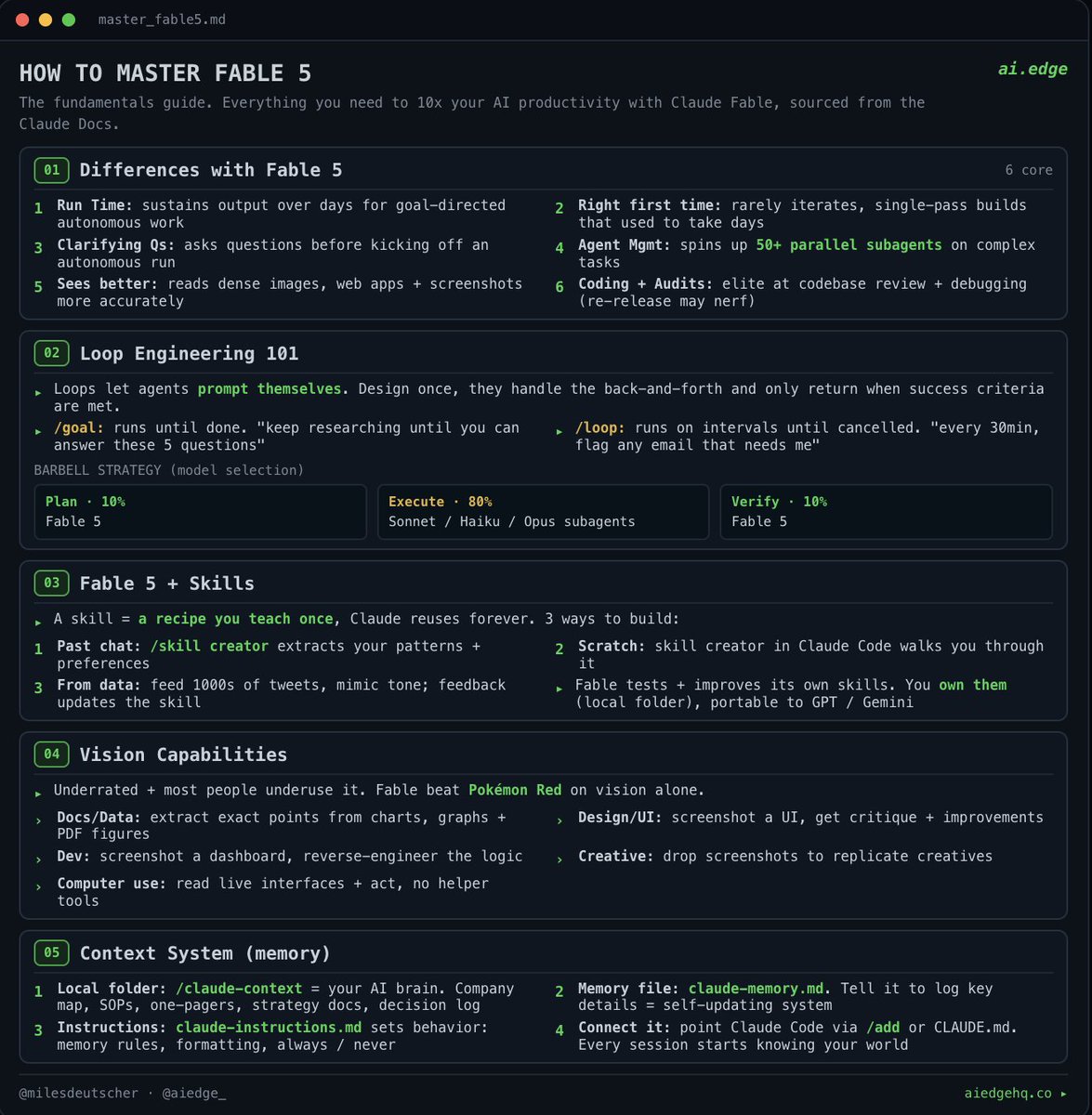
ANTHROPIC BURIED THE FABLE 5 PLAYBOOK IN THE DOCS. Most people never opened it. Most people run Claude Fable 5 like it's Opus with a new coat of paint. Type prompt. Wait. Type again. Frontier prices for a chat window. Fable 5 was built for autonomous, multi-day loops with 50+ parallel subagents. If you're not running loops, you're burning 90% of what you pay for. The barbell is the fix: → 10% planning the loop with Fable 5 (frontier spec writing) → 80% gruntwork with Sonnet and Haiku (cheap, fast, repeatable) → 10% final verification with Fable 5 (catch errors, confirm done) Two commands run the whole thing. /goal runs until done. /loop runs on intervals until you cancel. That's the starter kit. The barrier isn't the model. It's knowing Anthropic buried the playbook in the docs.👇
ROXy tweet media
ROXy@VK_ROXy

x.com/i/article/2072…

English
1
0
9
77
Misato
Misato@misato0x·
@kocer_eth ancient pharaoh running on localhost)
English
0
0
0
3
kocer
kocer@kocer_eth·
THIS GUY BUILT AN OFFLINE YU-GI-OH AI ASSISTANT THAT RUNS ON A LOCAL LLM This is the local AI PC use case that actually makes sense. Not a benchmark screenshot. Not another chat window. A small custom box on a desk. A screen labeled Jarvis Log. A ReSpeaker Lite mic. llama.cpp running at 127.0.0.1:8081. And one very important line: “GPU not detected. Using CPU.” The assistant is not trying to be a generic ChatGPT clone. It is acting as Yami from Yu-Gi-Oh!. The user asks about ancient pyramids. It answers in-character. The user asks about duel monsters. It stays in the persona. The user asks “who are you?” It says it is Yami, a pharaoh of the ancient world. That is the payoff. Local AI does not have to mean “run the biggest possible model at home.” It can mean: build one physical assistant for one room with one character one voice pipeline one small job and no cloud API in the middle. The stack is simple to understand: voice input → local speech pipeline → llama.cpp server → character prompt → text-to-speech → device feedback The hard part is everything around the model. Latency. Wake words. Mic quality. Speakers. Thermals. Power draw. Memory limits. Making the box feel alive instead of like a terminal with a speaker attached. The caveat is also the point: CPU-only local AI is cool, but it is not magic. Small local models can feel great for short replies, character bots, desk companions, command-style assistants, tutors, and home devices. They will not behave like frontier cloud models on long reasoning, huge context, or heavy tool use. But this is a much better reason to own local compute. The winning local AI builds may not look like “one more chatbot.” They may look like weird personal hardware that knows one character, one workflow, or one environment extremely well.
kocer@kocer_eth

x.com/i/article/2071…

English
4
1
10
282
Mikadzyki🌙
Mikadzyki🌙@Mikadzyki_NFT·
THE WILDEST USE CASES PEOPLE HAVE ALREADY BUILT ON CLAUDE FABLE 5 The model's capabilities have reached the point where projects that sounded like fiction not long ago now come together from a single prompt. Here are the standout cases: > a Mario Kart knockoff in old N64 style from a two-sentence prompt > Skyrim recreated in one shot > Minecraft and RuneScape built from scratch > a full Windows OS running right in the browser > a live model of the entire solar system > an air traffic simulator and a Monopoly board game And one person went straight into business. His program finds freshly built pools without a fence on Google Maps, renders a fence into the yard, and mails the owner a letter with a QR code for a contractor to come build it Behind all these projects is one principle. Fable doesn't answer step by step, it holds the goal in mind and works on it for hours on its own That's why it shows its strength differently. You don't dictate every move, you hand off a whole task, walk away, and come back to a finished result The winners here aren't those with the cleverest prompt, but those who learned to hand off an entire project
Insomnia@insomnia_vip

x.com/i/article/2072…

English
5
0
9
277
Misato
Misato@misato0x·
@zyxr0n AI has discovered the committee
English
1
0
1
10
zyxron
zyxron@zyxr0n·
Fable 5 Is Better as an Orchestrator Than an Answer Machine They ask one question. They get one answer. Then they trust the confidence. That is the trap. A single model can sound correct even when it is only following one reasoning path. It may miss the risk, ignore the incentive, skip the implementation detail, or choose the clean answer instead of the true one. This is why Fable 5 is most interesting when you stop treating it like one genius. Use it as the orchestrator. Not the person giving the first answer. The person running the room. A hard decision usually needs more than intelligence. It needs disagreement. One agent should research the facts. One should build the strongest case for action. One should attack the plan. One should look for hidden risk. One should simplify the decision. One should turn the verdict into next steps. That is the real value of a council. Not roleplay. Structured disagreement. Council of High Intelligence is interesting because it points at the pattern most AI users still miss: the future is not one model answering everything. The future is one strong model coordinating specialized minds. Fable 5 can be the center of that system. It can read the problem, split it into roles, force each role to argue independently, compare the disagreement, and then produce one final verdict. That is a different level of use. A chatbot gives you an answer. An orchestrator gives you a process. And for serious decisions, the process matters more than the first answer. The best Fable 5 workflow is not: “Tell me what to do.” It is: “Run the decision properly.” Make it separate facts from opinions. Make it assign opposing roles. Make it find what each role is missing. Make it force the skeptic to speak before the final answer. Make it commit to one verdict only after the disagreement is visible. That is how you reduce blind spots. Not by asking the model to be smarter. By making the model organize the thinking. The mistake people make with frontier models is expecting one perfect response. The better move is building a small decision system around them. Researcher. Strategist. Skeptic. Risk Officer. Operator. Judge. One prompt creates the room. Fable 5 runs it. Prompt ↓ You are the orchestrator. Do not answer directly. Split this decision into 6 independent roles: 1. Researcher — finds the facts 2. Strategist — explains the upside 3. Skeptic — attacks the plan 4. Risk Officer — finds what could break 5. Operator — turns it into next steps 6. Judge — gives the final verdict Decision: [PASTE YOUR DECISION HERE] Rules: - Each role must think independently. - Each role must disagree where necessary. - Do not let the same argument repeat. - Separate facts from assumptions. - Flag anything uncertain. - The Skeptic must speak before the Judge. - The Judge must commit to one clear recommendation. Output format: 1. Situation Summary 2. Researcher View 3. Strategist View 4. Skeptic View 5. Risk Officer View 6. Operator Plan 7. Final Verdict 8. First Action To Take 9. What Would Change The Decision No vague advice. Run the council.
Frander@Frandeeer

x.com/i/article/2072…

English
2
0
6
54
Kozh ./
Kozh ./@Kozh_Crypto·
i was just browsing X and came across this right now, you can get a ChatGPT Plus at a 50% discount you don’t have much time, so I recommend you hurry before the promotion ends: #pricing" target="_blank" rel="nofollow noopener">chatgpt.com/?promo_campaig… as of today, i have a ChatGPT Plus again thanks, @0x_kaize
Kozh ./ tweet media
English
3
0
13
155
Wini
Wini@Winiweb3·
Fhenix acquired @SunscreenTech Founder @ravitals joins the team and will lead research. Sunscreen worked on FHE for blockchains and compiler development. This is a significant boost @fhenix
English
7
0
15
1.3K
Jimmy Neuron 💡
Jimmy Neuron 💡@Neuron_404·
THE FULL CLAUDE CODE INSTALL TAKES UNDER 60 SECONDS AND MOST BEGINNERS ARE STILL STUCK ON STEP ONE. Everyone hypes Claude Code but skips the actual install entirely. The whole flow lives inside VS Code. Grab Claude Pro for $20/month, pull down Visual Studio Code for free, then search Claude Code in the VS Code extensions tab. The real one has a checkmark and 6.5M+ installs. > Claude Pro subscription — $20/month > Visual Studio Code — free download > Claude Code extension — 6.5M+ installs > /login — verifies your account in a new window > full setup — under 60 seconds The barrier to running Claude Code was never the tool. It was the fact that nobody walks you through the first minute. The beginners skipping this step keep watching everyone else ship products week after week. Follow me so you don't miss out on trends in the world of AI.
DiKrass | Thoughts@Di_Krass_

x.com/i/article/2072…

English
1
1
4
47
Misato
Misato@misato0x·
@Di_Krass_ good news: jobs bad news: more jobs😅
English
0
0
0
5
DiKrass | Thoughts
DiKrass | Thoughts@Di_Krass_·
Tyler Cowen, economist at George Mason: "the age of powerful AI is here, but you're all still going to have jobs. in the next five years, most of you should feel that you've never been busier in your life." not an unemployment story. routine work goes to AI, and what's left for humans is weirder, more specific, harder to name. at 07:05 he compares it to pre-industrial England: 80% of people in agriculture, nobody could picture a podcaster existing. 12 minutes on which jobs win this transition and which ones quietly lose. Watch it now, and you'll know more than 99% of people. Follow me.
Jey@Jeyxbt

x.com/i/article/2072…

English
2
1
4
43
Misato
Misato@misato0x·
@beamnxw unavailable models have surprisingly low adoption
English
0
0
0
5
beamnxw ./
beamnxw ./@beamnxw·
THE U.S. IS GATING ITS BEST MODELS. CHINA IS WATCHING. AND THE GAP IS NARROWING A new analysis makes the case plain: limiting access to top-tier AI models inside the U.S. doesn't slow down global AI progress. It just redirects it ➔ toward China, where the talent and compute are increasingly competitive The article connects this directly to Sol: > Sol: 91.91% Terminal-Bench, 750 tok/s, gated to ~20 U.S. government-approved partners > Anthropic's Fable 5: export-controlled, suspended for foreign nationals > The result: frontier capability exists, but the ecosystem that builds on it is artificially shrunk > Meanwhile, GLM 5.2 is open-source, self-hostable, and already running on local hardware without asking permission The geopolitical irony: The U.S. government gates its own labs to protect "safety," but the researchers and developers who can't access Sol or Fable 5 don't stop working. They switch stacks. They move to what's available. And what's available increasingly isn't American.. The article covers the full gate architecture ➔ Trump's June 2 EO, the 30-day preview rule, Anthropic's suspension, OpenAI's limited preview and asks the question the policy documents skip: - If the best U.S. models are reserved for a curated list, who builds the future on the second tier? Watch the full video. It breaks down exactly how restricting frontier access could accelerate China's position as the capability gap narrows Read my article in full to understand the situation
beamnxw ./@beamnxw

x.com/i/article/2071…

English
12
0
22
263
Misato
Misato@misato0x·
I keep thinking about Claude Tag because it fixes one of my biggest frustrations with AI: I still have to stop what I’m doing, open another app and explain the task from zero. Tag changes that. A bug appears in Slack, someone mentions @Claude, and it already has the conversation, the people involved and the relevant project context. It can fix the problem, verify its work and return with a PR while everyone moves on. Anthropic says it now creates 65% of its product team’s code. That number is impressive, but I care more about the direction. I don’t want another AI tab. I want the agent to already be present where the work appears, understand what is happening and quietly handle the parts nobody wants to interrupt their day for.
Claude@claudeai

A conversation with Boris Cherny and Cat Wu on the path from Claude Code to Claude Tag, and how it spread from engineering to the rest of Anthropic. Claude Fable 5 is now available in Claude Tag.

English
3
0
5
129
Misato
Misato@misato0x·
@Di_Krass_ so Fable only gets the difficult homework
English
1
0
1
17
DiKrass | Thoughts
DiKrass | Thoughts@Di_Krass_·
Most people will burn their Fable 5 limit in two days on small tasks. This video shows a strategy. How to use the model efficiently. Prep work — planning, research — goes to the cheaper Opus 4.8 via /research 00:01:13. The finished plan is handed to Fable 5 with /goal. The strongest model only touches what others can't: reviewing massive codebases with parallel sub-agents, long-horizon software, a 21,000-line 3D game from a single PRD. The cap is 50% of the Max weekly limit, until July 7. Everyone gets the same resource. The difference is where you point it. The session runs 12 minutes. Watch it now, then read how to get the most out of this model in the article below.
Miles Deutscher@milesdeutscher

x.com/i/article/2072…

English
1
3
4
580
Misato
Misato@misato0x·
@vanvster NotebookLM has a night shift now😄
English
0
0
0
18
vanvster
vanvster@vanvster·
HERMES JUST GOT A MEMORY. YOU CAN NOW GIVE YOUR AGENT ACCESS TO EVERY SOURCE YOU'VE EVER SAVED Connect them via MCP and your agent stops starting from zero every session Five steps. One config file edit. Runs 24/7 after that - Install Hermes with MCP support enabled - one-time setup, no code required - Download notebook skill from GitHub, drop it into Hermes config as a new MCP server endpoint - Restart Hermes agent now reads your NotebookLM sources in real time during any task - Result: agent that cross-references your saved research autonomously while working, not after you paste it This is persistent context injection instead of summarizing sources manually per session, Hermes pulls relevant context from NotebookLM live as it reasons through a task You can ask Hermes to write a breakdown of a new topic and it will pull your existing saved sources on that topic without being told to You can run a research task overnight and wake up to a synthesis that already references your prior notes. Your agent was only as good as what you pasted into the prompt
wandermist@wandermist

x.com/i/article/2071…

English
8
5
27
5.7K
Misato
Misato@misato0x·
@Nezukoa4 hindsight must physically hurt here
English
0
0
0
15
Nezuko
Nezuko@Nezukoa4·
For $50,000 he could have owned a third of Apple, but he turned it down - and missed out on nearly a trillion dollars. "I turned down a third of Apple for $50,000… which, in hindsight, was clearly a mistake" In this interview, Nolan Bushnell talks about why he turned down the deal, breaks down his mistake, and shares how to recognize a big opportunity in investing in time.
Nezuko@Nezukoa4

Howard Marks bought stock in the 50 best companies in America, and they crashed 90% most investors think the same way today, they see a big name and they buy he explains why investors keep making the same mistake over and over, and what all market bubbles have in common "it didn't matter what price you paid, the main thing was to own the best companies, that's what the whole market believed, and many lost their money" in 28 minutes he breaks down how the market fell 26% in a single day for no clear reason, and why the tech bubble was an exact rhyme of the Nifty Fifty ↓

English
8
2
35
2.4K
DiKrass | Thoughts
DiKrass | Thoughts@Di_Krass_·
"No customers, no interest, no applause. 100% confusion." That's how Jensen Huang described announcement day for the DGX-1 - Nvidia's first AI supercomputer, billions of dollars to build, eight Volta GPUs connected with NVLink. 00:29 The market didn't understand why it existed. Exactly one nonprofit startup asked for one. Huang delivered it himself, in the trunk of his own car, to San Francisco. The startup was called OpenAI. Eight years later, an entire industry grew out of that machine.
DiKrass | Thoughts@Di_Krass_

x.com/i/article/2072…

English
1
4
19
754
Hex Horizon
Hex Horizon@Noderunner_Hex·
ONE GUY, ZERO EDITORS, A FLEET OF CLAUDE AGENTS ON HIS DESK Japanese TV crew shows up to film a YouTuber's home studio. They expected an editing team. But found one blonde guy in a checkered shirt and a wall of monitors running Claude agents in parallel. The Premiere timeline is just the surface. The actual production line is the agents handling everything around the cut: scripting, captions, thumbnails, research, repurposing. A standard Japanese YouTube channel at this production level runs 3 to 5 editors, a director, a thumbnail artist. He's running it on a subscription stack under $200. The crew came to document a creator. They accidentally documented the death of the mid-size production company. This is what solo operators look like now. Not someone grinding 16 hours. Someone delegating 16 hours of work to software that costs less than a single freelancer's day rate. The interesting part isn't that he's using AI. It's that the camera crew noticed before most of the industry did.
Hex Horizon@Noderunner_Hex

x.com/i/article/2072…

English
2
0
9
324
nofad
nofad@nofadsec·
Someone spent 10 minutes creating an AI girl. A few days later she already had social media. Then she started posting videos. Then livestreams. Then brand deals. Welcome to 2026.
nofad@nofadsec

x.com/i/article/2072…

English
14
1
30
686