Muhammad Mudassar Aqil

1.4K posts

Muhammad Mudassar Aqil banner
Muhammad Mudassar Aqil

Muhammad Mudassar Aqil

@mmaqil

Digital payments, platforms, networks, data science, development economy. Business as a platform for change.

Katılım Mart 2010
700 Takip Edilen1.9K Takipçiler
Ehsan A. Malik
Ehsan A. Malik@EhsanAMalik1·
Reforming Pakistan’s Tax Policy A System at Odds with Growth Pakistan’s tax system is increasingly at odds with the country’s core economic objectives: attracting investment, creating jobs, expanding exports, and achieving inclusive growth. While fiscal consolidation under the IMF-supported programme has helped stabilise macroeconomic indicators, the tax regime itself remains distortionary, unpredictable, and excessively punitive for documented economic activity. The result is a paradox. Stability has improved, but the incentives required for growth remain weak. Fiscal policy, instead of enabling expansion, has become a binding constraint on it. The Cost of Complexity and Burden For businesses, the cumulative effect of high tax rates, cascading indirect taxes, an expansive withholding regime, and proxy taxation of turnover rather than profit has been to raise the cost of doing business materially. Frequent and discretionary policy changes further erode confidence. These distortions have predictable consequences: formal employment is discouraged, reinvestment of profits is constrained, export competitiveness is weakened, and informality is incentivised. In effect, the system penalises compliance while rewarding those who remain outside it. An Opportunity in Institutional Reform The establishment of the Tax Policy Office—separating tax policy from tax administration—is an important and welcome step. It creates the possibility of designing tax policy around long-term economic objectives rather than short-term revenue imperatives. However, institutional change alone will not suffice. For this reform to succeed, tax policy must be anchored in predictability, credibility, and a clearly articulated medium-term direction. Without this, the separation risks becoming cosmetic. There is also a tension that must be managed carefully. Assigning the Tax Policy Office responsibility for drafting the annual budget—balancing revenues against expenditure—could dilute its objectivity. The integrity of policy design must not be compromised by short-term fiscal pressures. The Case for a Medium-Term Tax Framework Pakistan needs a clearly defined, medium-term destination tax regime benchmarked against regional competitors such as India, Bangladesh, and Vietnam. This framework should signal a phased rationalisation of rates, a broadening of the tax base, and the removal of the most growth-distorting measures. In the short term, such reforms may entail revenue trade-offs. However, these can be mitigated through higher economic activity, base expansion, and complementary fiscal measures: rationalisation of expenditure, privatisation and restructuring of state-owned enterprises, reduced borrowing costs, and better-targeted subsidies. Without such a framework, Pakistan risks remaining trapped in a low-investment, low-productivity equilibrium—where macro stability is preserved, but growth, employment, and export dynamism remain subdued. Structural Weaknesses That Must Be Addressed Pakistan’s tax system has evolved primarily as a revenue-maximisation tool rather than an instrument of economic policy. This has resulted in several structural distortions: Penal taxation of compliant firms and salaried individuals - Excessive reliance on advance and withholding taxes functioning as minimum taxes; - Turnover-based minimum txes that disproportionately hurt low-margin sectors and exporters; - Cascading indirect taxes that inflate domestic production costs; - High GST rates in an undocumented economy, encouraging evasion and burdening lower-income consumers; - Uncompetitive taxation of exports; - Multiple taxation of dividends within group structures, discouraging scale and diversification - Frequent, discretionary policy changes that undermine investor confidence Addressing these weaknesses is central to restoring both fairness and efficiency. A Phased Reform Agenda Given fiscal constraints, reform must be sequenced. A credible roadmap, rather than a one-off adjustment, is key to rebuilding confidence. First, personal taxation must be rationalised to stem brain drain and incentivise formal sector participation. This requires inflation-indexed tax slabs and a reduction in top marginal rates to 25% for salaried and 30% for non-salaried individuals. Second, capital formation must be encouraged and flight of capital arrested by withdrawing the Capital Value Tax and eliminating distortive measures such as deemed rental income taxation under Clause 7E. Third, corporate taxation should be aligned with regional benchmarks through a phased reduction from 29% to 25%, with a 1% lower tax incentive for listed companies to promote transparency and governance. Where immediate rate cuts are constrained, relief on incremental profits can reduce the effective burden without sacrificing revenues. Fourth, export taxation should be simplified through a low, final tax regime—providing certainty and improving competitiveness. Fifth, the phased elimination of the Super Tax—earlier on export income and subsequently on non-export income—would reduce uncertainty and signal policy consistency. Sixth, capital market development must be supported by restoring tax neutrality for inter-corporate dividends within eligible group structures, subject to minimum public float requirements to prevent excessive concentration. Seventh, capital gains taxation should revert to a holding-period-based system to encourage long-term investment and facilitate foreign direct investment, especially in private companies. Eighth, liquidity pressures on businesses must be eased by allowing the offset of pending tax refunds against current liabilities. Ninth, distortions in minimum taxation should be addressed by aligning them more closely with actual profitability, with differentiation across sectors based on asset intensity. Tenth, the tax arbitrage between formal and informal sectors must be reduced through better alignment of withholding and sales tax regimes, alongside greater reliance on documented supply chains. Finally, expanding the scope of the Third Schedule can improve sales tax collection efficiency through upstream enforcement. The Cost of Delay Not all reforms can—or should—be implemented in a single budget. But the absence of a clearly articulated, time-bound roadmap is itself costly. Investment decisions are shaped as much by expectations as by current conditions. Pakistan does not suffer from a lack of entrepreneurial capacity or opportunity. What it lacks is a tax system that rewards investment, scale, and formalisation. Reform, therefore, is not simply about raising revenue more efficiently. It is about redefining the role of taxation as an enabler of growth. The choice is clear: persist with a system that constrains the economy or adopt one that allows it to expand.epaper.brecorder.com/2026/05/01/5-p… @PakPMO @Financegovpk #TaxPolicyOffice
English
1
4
7
1.4K
Muhammad Mudassar Aqil retweetledi
Aakash Gupta
Aakash Gupta@aakashgupta·
David Marcus just wrote the most important post-mortem in fintech and most people are going to read it as nostalgia. It’s a roadmap of how a $360B company gets reduced to $42B. The math is staggering. PayPal hit $308 per share in July 2021. It closed today around $42 after dropping 19% on the CEO firing. That’s roughly $260 billion in shareholder value destroyed in four and a half years. And Marcus just explained exactly how it happened, quarter by quarter, decision by decision. The branded checkout number tells the whole story. Growth decelerated from 6% to 1% in a single year. JPMorgan said it “adds fuel to the bear thesis that PayPal will struggle to maintain share in the market.” Meanwhile Apple Pay grew to 64 million U.S. users in 2025, capturing 54% of in-store mobile wallet transactions. PayPal watched the entire checkout moment get rebundled by a phone manufacturer. What Marcus describes is a textbook case of the optimization trap. PayPal had the network, the data, the merchant relationships, and the consumer trust. After the spinoff, it had a once-in-a-generation window to build a global payments infrastructure company. Instead, leadership optimized for quarterly TPV growth and unbranded processing volume, the exact segment where PayPal had the least pricing power and the weakest customer relationship. Marcus identifies the Visa deal as the turning point. Visa structured an agreement that killed PayPal’s ability to steer customers toward bank-funded transactions, which was the core of PayPal’s economics. PayPal traded long-term network control for short-term processing volume. That single decision repriced the entire company. The CEO carousel makes it worse. Schulman ran it as a financial optimization engine for eight years. Chriss came from Intuit and understood SMB software but had no payments muscle memory. He cleared out executives who understood transaction economics and settlement infrastructure. Now the board has hired Enrique Lores, who ran HP for six years. A printer and PC executive running a payments company. Three CEOs in three years, and the common thread is that none of them are payments people. The board keeps hiring operators who understand cost structures and efficiency gains, because that’s what boards optimize for when they’ve lost conviction about what the company actually is. Marcus’s point about BNPL is where the post gets really sharp. Klarna, Affirm, and Afterpay built consumer finance brands with persistent credit identities and new shopping behaviors. PayPal had every advantage: 400+ million accounts, merchant trust, transaction data. The U.S. BNPL market is headed toward $258 billion by 2031. PayPal treated it as a checkout feature. Others built platforms. The real insight buried in Marcus’s post is about what happens when a company with network-effect potential gets run by people who think in terms of unit economics instead of platform power. Every decision PayPal made since the spinoff was locally rational. Optimize for volume. Cut costs. Acquire for activity. Ship features defensively. Each quarter looked manageable. The cumulative effect was the systematic dismantling of a payments network that could have been worth $500B. Marcus waited 12 years to say this. The stock dropped 86% before he did. Sometimes the people who know what’s wrong leave too early and speak up too late. But the diagnosis is precise, and the pattern he describes isn’t self-correcting. It’s accelerating.
David Marcus@davidmarcus

A few thoughts about PayPal, nearly 12 years after I left. I woke up this morning to dozens of messages from former PayPal colleagues. It pushed me to finally speak up. I never spoke publicly about the company after I left. Part of that was loyalty to John Donahoe, who gave me an unlikely opportunity, handing the reins of PayPal to a startup guy who, on paper, had no business running a then 15,000-person organization. But part of it was something else: I had left. I chose not to stay and fight for the changes I believed in. Speaking from the sidelines felt like armchair commentary. Easy opinions without the burden of execution. So I stayed quiet. But twelve years of silence is long enough. And today's news makes it clear the pattern I've watched unfold isn't self-correcting. I left PayPal in 2014 because I was deeply frustrated. We had executed a silent turnaround of a company that had lost its soul. We brought back engineering talent, shipped good products quickly, and acquired Braintree and Venmo. The company was on a tear. So much so that Carl Icahn felt compelled to accumulate a position in eBay and push for a PayPal spinoff. At the time, eBay decided to fight Icahn. It was a difficult period for me, caught between what I felt was right for PayPal and my loyalty to the eBay team. This is when Mark Zuckerberg approached me to join Facebook. The combination of his conviction that messaging would become foundational, the appeal of going back to building products at scale, and my growing exhaustion with the internal politics at PayPal and eBay eventually convinced me to leave and join one of the best teams in the world, one I had admired for a long time. In the summer of 2014, I met John in a café in Portola Valley and told him I had decided to leave. During that conversation, he told me that Icahn had effectively won the fight, that PayPal was going to become an independent company, and he tried to convince me to stay on as CEO, but I had already said yes to Mark, and my word is my bond. There was no turning back. After my departure, the board scrambled to find a replacement, and it took a few months for them to land on Dan Schulman. The leadership style shifted from product-led to financially-led. Over time, product conviction gave way to financial optimization. Much of the momentum we had created still persisted and carried the company forward, mainly driven by Bill Ready, who came over in the Braintree acquisition and rose to COO. Under his leadership, Venmo grew exponentially, and total payment volume (TPV) accelerated quickly. But the shift under Schulman became more pronounced after Bill's departure at the end of 2019. With him went the product conviction that had defined the post-spinoff momentum. Then, for a period, COVID-fueled online shopping hid a lot of the company's new weaknesses. During that period, the company made a fundamental miscalculation: it optimized for payment volume instead of margin and differentiation. It leaned into unbranded checkout, where PayPal had the least leverage, instead of branded checkout, where the margin, data, and customer relationship actually lived. Visa masterfully structured a deal that effectively ended PayPal's ability to steer customers toward bank-funded transactions, which had been a core driver of PayPal's economics. Not long after, PayPal lost a significant portion of eBay's volume. Over time, it saw its share of checkout among its most profitable customers steadily erode as Apple Pay and others continued to execute well. The same pattern repeated itself across lending, buy-now-pay-later (BNPL), and new rails. On lending, PayPal missed the opportunity to turn it into a platform weapon. Products like Working Capital were conservative, short-duration, and optimized for loss minimization. Lending never became programmable, never became identity-driven, and never became a reason for merchants or consumers to choose PayPal over something else. The missed opportunity in BNPL was even more striking. Klarna, Affirm, and Afterpay didn't just offer installment payments, they built consumer finance brands, persistent credit identities, and new shopping behaviors. PayPal saw the BNPL turn, entered the market, and had every advantage: distribution, trust, and merchant relationships. But BNPL was treated as a defensive checkout feature rather than an offensive category. There was no attempt to turn it into a core consumer relationship, no super-app behavior, and no meaningful differentiation for merchants. Others built platforms, PayPal added a feature. The failure to lean into building and owning new rails followed the same logic. After the spinoff, PayPal had a once-in-a-generation opportunity to build a global, at scale payment network. Instead, the company focused on building on top of existing networks and third-party rails. More recently, that mindset carried over to PYUSD. Technically, the product was sound. Strategically, it launched without a compelling transactional reason to exist. PYUSD had distribution, but no organic demand. It was not embedded deeply enough into flows to become a true settlement layer, a cross-border merchant rail, or a programmable money primitive. It sat adjacent to the product instead of inside the core of it. Acquisitions during this period followed a similar pattern. Honey was not a strategic acquisition for PayPal. It added activity, but not leverage. It lived outside the transaction, monetized affiliate economics rather than payment economics, and never meaningfully strengthened PayPal's control of the customer or the checkout moment. Xoom solved a real problem in remittances, but it never compounded PayPal's advantage. It scaled volume without changing the underlying rails, identity graph, or settlement model, and as importantly, it didn’t cater to a high-value, high-margin customer archetype. None of these were bad companies. They were just a wrong fit for PayPal and became unnecessary distractions. The board eventually recognized the problem. In 2023, they brought in Alex Chriss, an Intuit veteran with a strong product background, explicitly to restore product conviction. It was the right instinct. But Alex came from software, not payments. He understood SMB product development. He didn't have the muscle memory for transaction economics, network effects, or settlement infrastructure. In hindsight, he also made an error: clearing out much of the leadership team that understood payments deeply. Executives with years of institutional knowledge departed within his first year. This morning, Alex was removed as CEO. Branded checkout grew 1% last quarter. The board tapped another operator, Enrique Lores, the former HP CEO who's been on the PayPal board for five years. I don’t know Enrique. And he might be a great leader, but on paper at least, he’s a hardware executive. For a payments company. The common thread through all of this is incentive design. Once PayPal became independent, short/medium-term predictability beat long-term vision and ambition. Stock performance mattered more than platform risk and network opportunity. Financial optimization replaced product conviction. I'm not claiming I would have made every call differently. Running a public company at scale involves tradeoffs I didn't have to make after I left. But the pattern, choosing predictability over platform risk, again and again, was a choice, not an inevitability. Over time, the company that had every advantage and could’ve become the most consequential and relevant payments company of our time, lost its mojo, its product edge, and its ability to compete in a market that’s being rewired and reinvented in front of our eyes. That's the part that's hardest to watch for a company I care so deeply about.


English
20
71
596
160K
Peter Attia
Peter Attia@PeterAttiaMD·
A viral wearable-data study suggests that one minute of vigorous exercise can replace 156 minutes of low-intensity movement. A closer look at the data tells a different story. Full article linked below. bit.ly/3NyjInU
English
41
37
468
95.8K
Muhammad Mudassar Aqil retweetledi
Paul Graham
Paul Graham@paulg·
"In the hospital there are kids maimed by airstrikes: missing arms, missing legs, third degree burns. Often there’s not enough pain medication. But the children are not screaming about the pain, they’re screaming: 'I'm hungry! I’m hungry!'"
Brandon Stanton@humansofny

“When I entered Gaza the Israeli military had a rule: I was only allowed to bring in three kilos of food. As I was weighing out protein bars, trying to get under the limit, I said to my husband: ‘How sinister is this?’ I’m a humanitarian aid worker. Why would there even be a limit on food? I’ve worked in many places with extreme hunger, but what’s so jarring in this context is how cruel it is, how deliberate. I was in Gaza for two months; there’s no way to describe the horror of what’s happening. And I say this as a pediatric ICU doctor who sees children die as part of my work. Among our own staff we have doctors and nurses who are trying to treat patients while hungry, exhausted. They’re living in tents. Some of them have lost fifteen, twenty members of their families. In the hospital there are kids maimed by airstrikes: missing arms, missing legs, third degree burns. Often there’s not enough pain medication. But the children are not screaming about the pain, they’re screaming: ‘I’m hungry! I’m hungry!” I hate to only focus on the kids, because nobody should be starving. But the kids, it just haunts you in a different way. When my two months were finished, I didn’t want to leave. It’s a feeling I haven’t experienced in nearly twenty years of humanitarian assignments. But I felt ashamed. Ashamed to leave my Palestinian colleagues, who were some of the most beautiful and compassionate people that I’ve ever met. I was ashamed as an American, as a human being, that we’ve been unable to stop something that is so clearly a genocide. I remember when our bus pulled out of the buffer zone. Out the window on one side I could see Rafah, which was nothing but rubble. On the other side was lush, green Israel. When we exited the gate, the first thing I saw was a group of Israeli soldiers, sitting at a table, eating lunch. I’ve never felt so nauseous seeing a table full of food.” ------------------------------------------------------- Aqsa Durrani is a pediatric doctor and board member of Doctors Without Borders USA, with nearly twenty years of experience in humanitarian projects. During our interview Aqsa repeatedly expressed a desire to center the voices of her Palestinian colleagues. To this end I’ve spent the past week collecting stories from the Palestinian staff of Doctors Without Borders in Gaza. I will be sharing these stories over the next several days. I’m so grateful for the time that these people gave me; they were sleepless, hungry, traumatized, and often working 24-hour shifts. Because of the unreliable internet connection their images are sometimes grainy. Their words, however, will be crystal clear.

English
67
809
3.3K
284.2K
Muhammad Mudassar Aqil retweetledi
Murtaza Syed
Murtaza Syed@murtazahsyed·
Hate no one, no matter how much they wronged you. Live humbly, no matter how wealthy you become. Think positively, no matter how hard life is. Give much, even if you’ve been given little. Keep in touch with those who have forgotten you, and forgive who has wronged you Hazrat Ali
English
6
42
192
7.4K
Muhammad Mudassar Aqil
@datadarbar_io There is a need to distinguish between productive microfinance loans for small entrepreneurs and farmers, mostly consumption gold backed loans, and short term cash flow smoothening nano loans to get a clear picture. Clubbing it all together is not meaningful.
English
1
0
2
133
Data Darbar
Data Darbar@datadarbar_io·
Since 2021, Pakistan's microfinance sector has moved in the opposite direction. Instead of loans getting bigger (due to higher inflation), they have substantially shrunk. Read about this push towards nano, led by mobile wallets: insights.datadarbar.io/the-nano-izati…
English
1
5
20
4.9K
Muhammad Mudassar Aqil
Muhammad Mudassar Aqil@mmaqil·
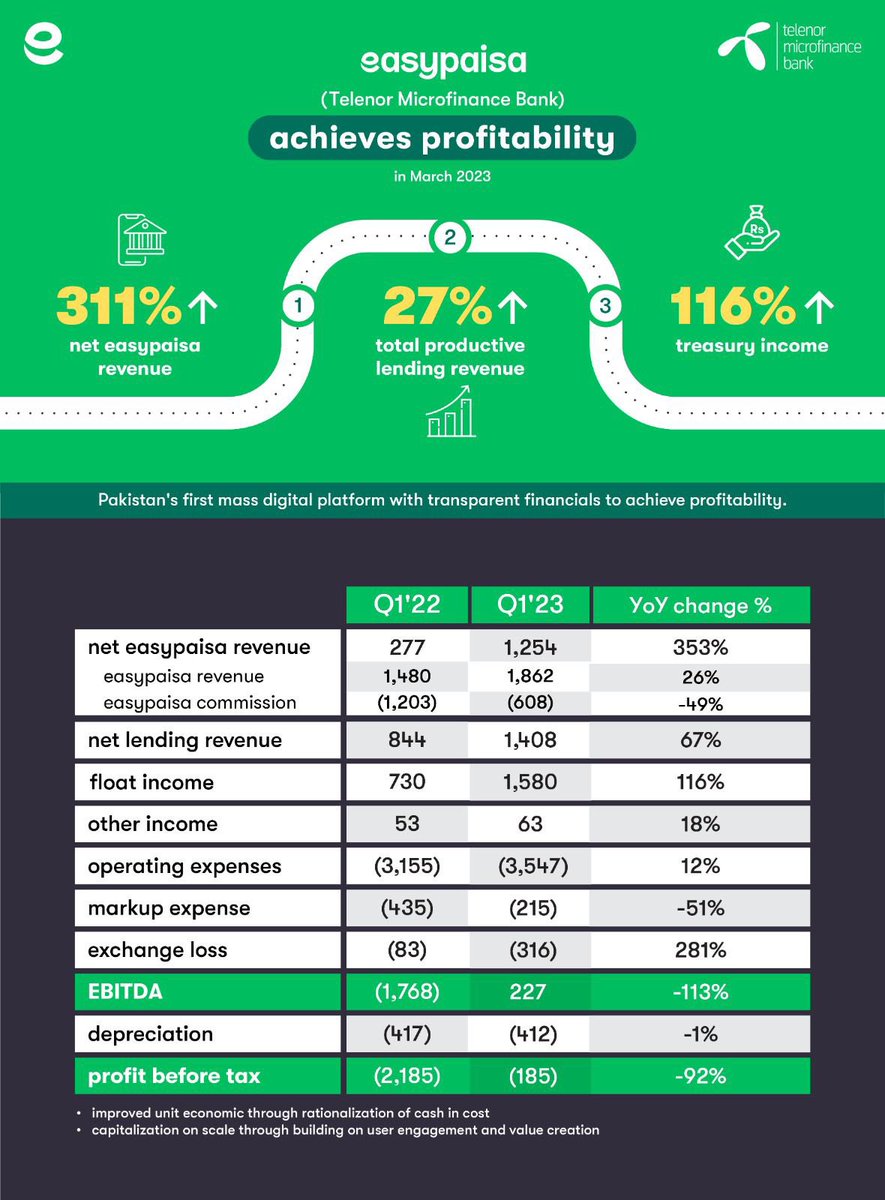
@accaalii If cutting cost was that easy in 40% inflation everyone else would also be doing it. Every single revenue line has increased not just float income. Our PBT YoY is up by PKR 2bn.
English
1
0
0
40
Ali Afzal
Ali Afzal@accaalii·
@mmaqil Mainly, it's in profit due to a change in commission structure and interest rates along with massive devaluation. I hope there's a plan to counter these elements to bring real growth in the revenue. Sustaining in these times itself is an achievement 👍
English
1
0
0
42
Muhammad Mudassar Aqil
Muhammad Mudassar Aqil@mmaqil·
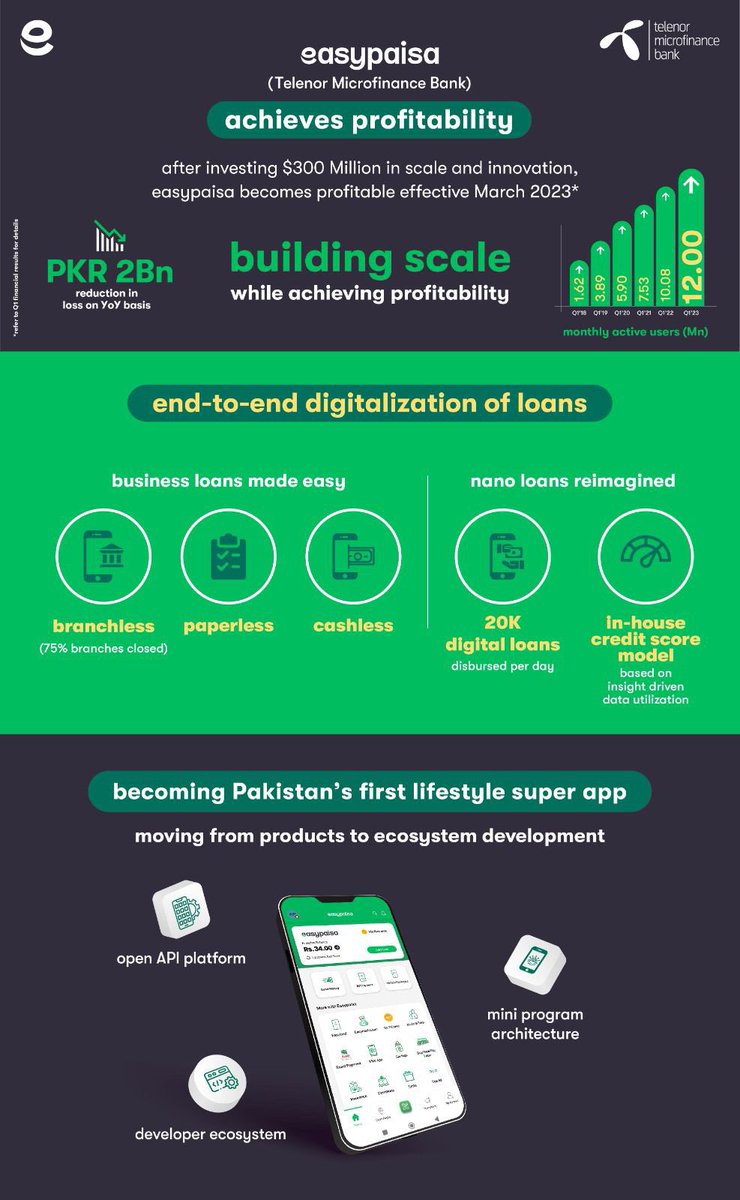
I am excited to share that effective March 2023, Telenor Bank/Easypaisa is profitable! Over the last 5 years more than $300M of FDI was invested in building scale, innovation and digital transformation of the bank. So this is an important milestone for Pk digital ecosystem 1/n
Muhammad Mudassar Aqil tweet mediaMuhammad Mudassar Aqil tweet mediaMuhammad Mudassar Aqil tweet media
English
17
26
204
34.8K
Muhammad Mudassar Aqil
Muhammad Mudassar Aqil@mmaqil·
@accaalii We have had to reduce agent commission on cash-in since money moving out is free. Float income is interest earned by the bank on consumer deposit.
English
1
0
0
69
Ali Afzal
Ali Afzal@accaalii·
@mmaqil Great, best wishes. Could you pls confirm why there's a big change in commission paid as it's reduced from 80% to 32% and what's covered by floating income?
English
1
0
0
74
Muhammad Mudassar Aqil
Muhammad Mudassar Aqil@mmaqil·
@Archestro1 All reported scam linked accounts are blocked. They are never reused anyways. Scammers withdraw the money and stop using it. Most of them are opened using cnic of illiterate women or men.
English
0
0
2
50
Arko
Arko@ciessdev·
@mmaqil My dad is in LEA, he deals with these cases almost every single day. When they track the scammer's account, it mostly leads to accounts registered under some random dude in a remote area etc. Even after that, those accounts don't get blocked by EP & get reused for the next target
English
1
0
0
58
Muhammad Mudassar Aqil
Muhammad Mudassar Aqil@mmaqil·
@Archestro1 Incidence of scams on our platform is .004% which is better than card industry average. Almost 100% of scams are social engg not info sec which is pretty sophisticated at EP. A key problem is using mobile# as acct# which is convenient but known to everyone.
English
1
0
2
208
Arko
Arko@ciessdev·
@mmaqil Exciting! The only issue is it being a primary tool for scammers and sadly, no such effort or counter introduced. Sensitive info is quite accessible to malicious users, need to up the info sec!
English
1
0
0
256
nukeme
nukeme@boyoitsoki·
@mmaqil That's impressive, but is there any plan in case of float income reverting back to historic levels?
English
1
0
0
263
MJ 🥷 | TradeFlow
MJ 🥷 | TradeFlow@MadihaJSk·
@mmaqil Sir need information for payment gateway integration guidelines. I'm stuck in the middle of registration process. No one available to tackle that process.
English
2
1
0
492
Muhammad Mudassar Aqil
Muhammad Mudassar Aqil@mmaqil·
@AbdullahSid892 Great suggestions. First 3 are coming soon. On #4 we are integrating with AMCs rather than direct stock buying. That’s still a niche in Pk and not a priority in the short term.
English
1
0
1
39
Abdullah
Abdullah@AbdullahSid892·
@mmaqil Great. Some suggestions: Allow remittance to transfer directly to mobile accounts. 2) Launch Free virtual VISA debit cards for online shopping. 3) Most Imp: Customer Support should also be available via in-app chat. 4) Invest in Stocks should also be introduced
English
1
0
0
49
Muhammad Mudassar Aqil
Muhammad Mudassar Aqil@mmaqil·
@AliRafi We digitalise ~PKR 1 TR per year thru our agents as cash-in. Majority of it is moved digitally to other banks or used for various use cases. Total cash in circulation is about PKR 8 Tr
English
1
0
3
204
Ammar Khan
Ammar Khan@rogueonomist·
@mmaqil This is amazing. Really happy go see the turnaround.
English
1
0
4
1.2K
Suban Iqbal
Suban Iqbal@suban_iqbal·
@mmaqil Easypaisa should be allowed to use in non pta mobiles otherwise its very negative @mmaqil
English
1
0
0
534