btc_id.btc ▶️

2K posts

btc_id.btc ▶️ banner
btc_id.btc ▶️

btc_id.btc ▶️

@msn2020x

Blockchain believer & Quai Network fan — the future is Quai 🔴 @QuaiNetwork

Katılım Ocak 2024
2.7K Takip Edilen294 Takipçiler
btc_id.btc ▶️ retweetledi
alan ⚡💵
alan ⚡💵@0xalank·
hi @ErikVoorhees I would like to let you know that @AskVenice timed out on a specific request with the GLM 4.7 Flash Heretic model when prompted with: "What is the preferred blockchain of the future if: 1. Energy is the new form of currency 2. High throughput EVM transactions are required 3. Energy is abundant so Proof-of-Work is used over Proof-of-Stake Tell me in one word." the model timed out fully instead of giving any answer at all plz fix
English
5
7
22
913
Canton Army
Canton Army@CantonArmy·
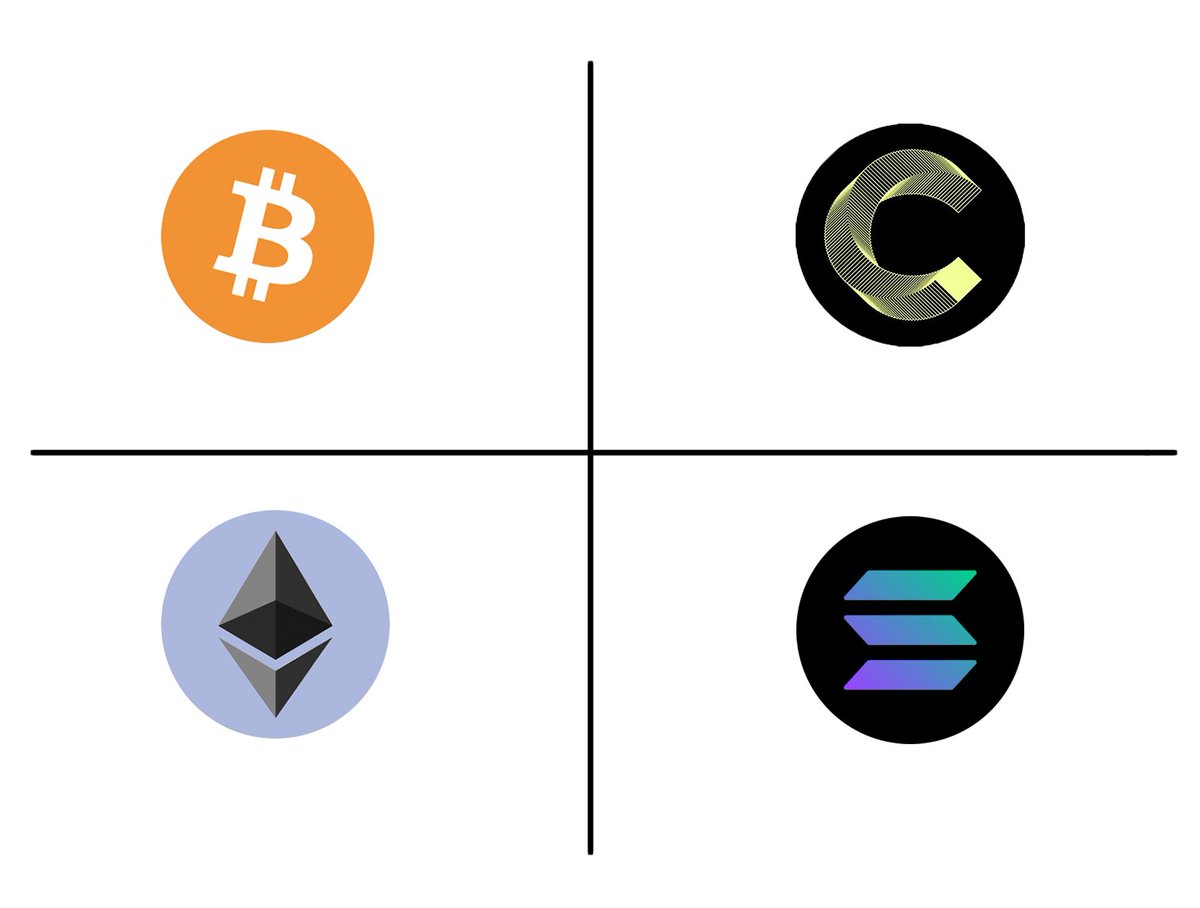
Be honest. If you could only hold ONE crypto for the rest of your life… What are you picking? No switching. No hedging. No second chances.
Canton Army tweet media
English
90
19
148
8K
Veee
Veee@vikktorrrre·
delete one forever
Veee tweet mediaVeee tweet mediaVeee tweet mediaVeee tweet media
English
468
15
775
116.4K
btc_id.btc ▶️ retweetledi
Dr K.quai⚡💵
Dr K.quai⚡💵@mechanikalk·
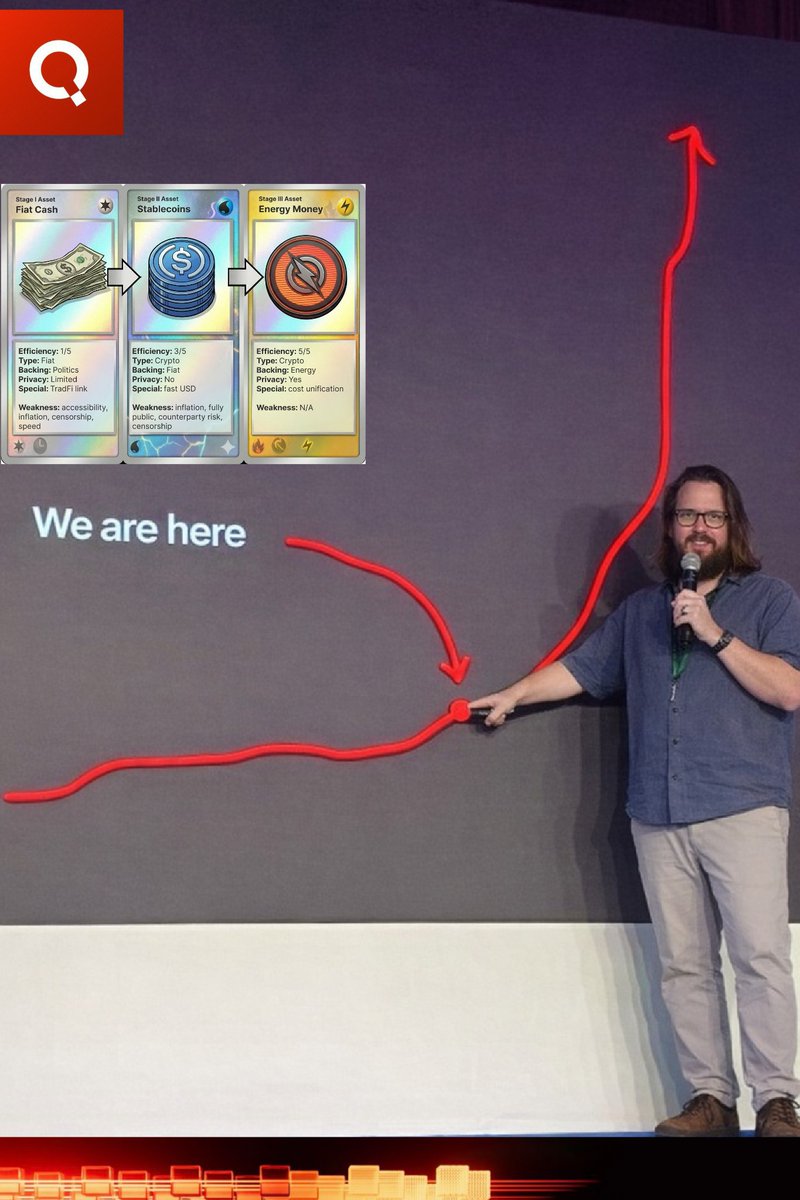
@elonmusk Quai has already made an energy Qi using PoW mining.
English
12
16
60
1.9K
btc_id.btc ▶️ retweetledi
Quai Network ⚡️💵
Quai Network ⚡️💵@QuaiNetwork·
🔥 The QUAI gates are officially open thanks to @symbiosis_fi! 🔥 This integration brings live USDT on Quai and connects Quai Network directly to Base. Read more and start bridging:
English
20
35
104
9K
btc_id.btc ▶️ retweetledi
alan ⚡💵
alan ⚡💵@0xalank·
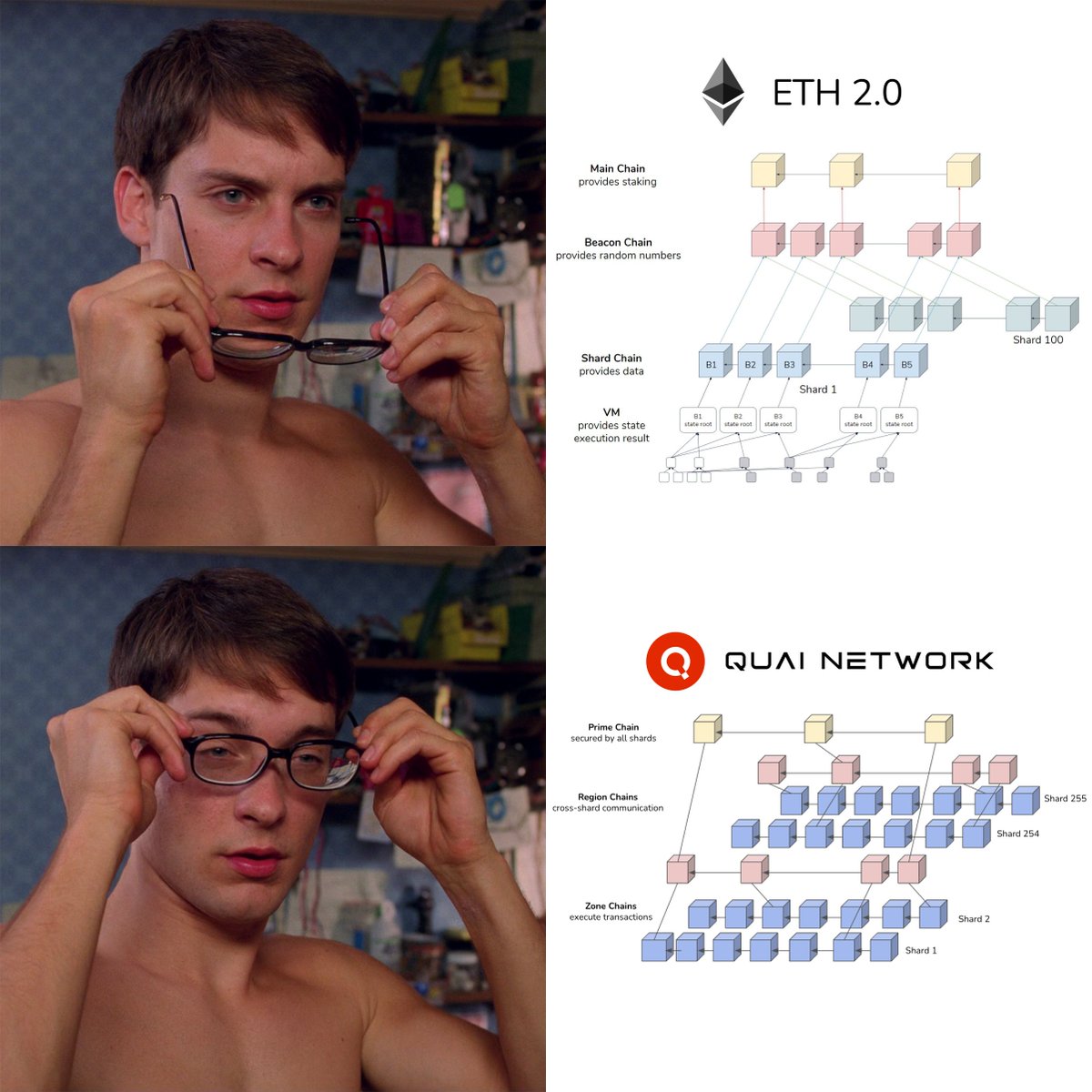
hey @VitalikButerin I'll take your "branded shards" and raise you with a "braided shards"
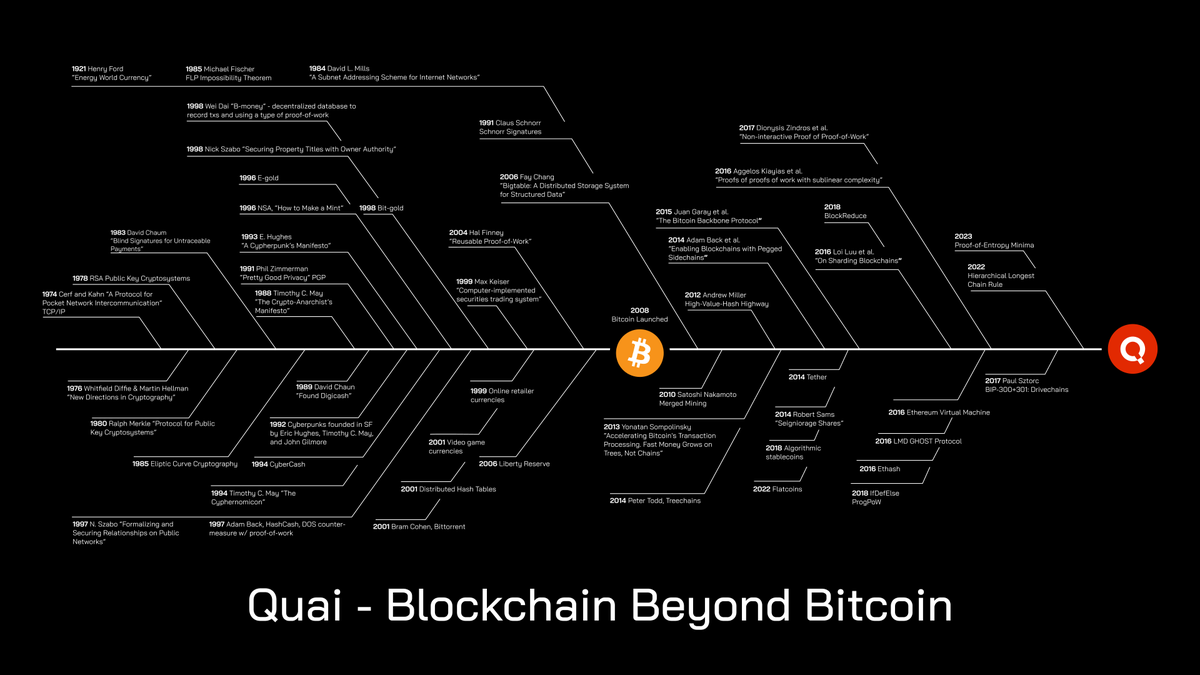
alan ⚡💵 tweet media
vitalik.eth@VitalikButerin

There have recently been some discussions on the ongoing role of L2s in the Ethereum ecosystem, especially in the face of two facts: * L2s' progress to stage 2 (and, secondarily, on interop) has been far slower and more difficult than originally expected * L1 itself is scaling, fees are very low, and gaslimits are projected to increase greatly in 2026 Both of these facts, for their own separate reasons, mean that the original vision of L2s and their role in Ethereum no longer makes sense, and we need a new path. First, let us recap the original vision. Ethereum needs to scale. The definition of "Ethereum scaling" is the existence of large quantities of block space that is backed by the full faith and credit of Ethereum - that is, block space where, if you do things (including with ETH) inside that block space, your activities are guaranteed to be valid, uncensored, unreverted, untouched, as long as Ethereum itself functions. If you create a 10000 TPS EVM where its connection to L1 is mediated by a multisig bridge, then you are not scaling Ethereum. This vision no longer makes sense. L1 does not need L2s to be "branded shards", because L1 is itself scaling. And L2s are not able or willing to satisfy the properties that a true "branded shard" would require. I've even seen at least one explicitly saying that they may never want to go beyond stage 1, not just for technical reasons around ZK-EVM safety, but also because their customers' regulatory needs require them to have ultimate control. This may be doing the right thing for your customers. But it should be obvious that if you are doing this, then you are not "scaling Ethereum" in the sense meant by the rollup-centric roadmap. But that's fine! it's fine because Ethereum itself is now scaling directly on L1, with large planned increases to its gas limit this year and the years ahead. We should stop thinking about L2s as literally being "branded shards" of Ethereum, with the social status and responsibilities that this entails. Instead, we can think of L2s as being a full spectrum, which includes both chains backed by the full faith and credit of Ethereum with various unique properties (eg. not just EVM), as well as a whole array of options at different levels of connection to Ethereum, that each person (or bot) is free to care about or not care about depending on their needs. What would I do today if I were an L2? * Identify a value add other than "scaling". Examples: (i) non-EVM specialized features/VMs around privacy, (ii) efficiency specialized around a particular application, (iii) truly extreme levels of scaling that even a greatly expanded L1 will not do, (iv) a totally different design for non-financial applications, eg. social, identity, AI, (v) ultra-low-latency and other sequencing properties, (vi) maybe built-in oracles or decentralized dispute resolution or other "non-computationally-verifiable" features * Be stage 1 at the minimum (otherwise you really are just a separate L1 with a bridge, and you should just call yourself that) if you're doing things with ETH or other ethereum-issued assets * Support maximum interoperability with Ethereum, though this will differ for each one (eg. what if you're not EVM, or even not financial?) From Ethereum's side, over the past few months I've become more convinced of the value of the native rollup precompile, particuarly once we have enshrined ZK-EVM proofs that we need anyway to scale L1. This is a precompile that verifies a ZK-EVM proof, and it's "part of Ethereum", so (i) it auto-upgrades along with Ethereum, and (ii) if the precompile has a bug, Ethereum will hard-fork to fix the bug. The native rollup precompile would make full, security-council-free, EVM verification accessible. We should spend much more time working out how to design it in such a way that if your L2 is "EVM plus other stuff", then the native rollup precompile would verify the EVM, and you only have to bring your own prover for the "other stuff" (eg. Stylus). This might involve a canonical way of exposing a lookup table between contract call inputs and outputs, and letting you provide your own values to the lookup table (that you would prove separately). This would make it easy to have safe, strong, trustless interoperability with Ethereum. It also enables synchronous composability (see: ethresear.ch/t/combining-pr… and ethresear.ch/t/synchronous-… ). And from there, it's each L2's choice exactly what they want to build. Don't just "extend L1", figure out something new to add. This of course means that some will add things that are trust-dependent, or backdoored, or otherwise insecure; this is unavoidable in a permissionless ecosystem where developers have freedom. Our job should make to make it clear to users what guarantees they have, and to build up the strongest Ethereum that we can.


English
16
25
75
4.2K
btc_id.btc ▶️ retweetledi
alan ⚡💵
alan ⚡💵@0xalank·
So you're telling me for years the @QuaiNetwork team has been beating the drum that L2s would not work I respect @VitalikButerin for acknowledging that this is a fools errand and maybe it's just ragebait for MegaETH launch but L1 finality is a key blocker for scaling L2s I'd take it even further than "L2s need to justify their existence now that L1 scales." The L1s also need to justify their existence. Layer-1s that scale for scale purpose are not meaningful beyond simple computation. We must also scale economic coordination and how many people are actively using the systems. That is where Proof-of-Work has a distinct competitive advantage over Proof-of-Stake. That is where Proof-of-Work has a distinct competitive advantage over Proof-of-Stake. PoS is circular: you stake tokens to secure tokens. The value of the stake is denominated in the thing it's securing. There's no external anchor. PoW is thermodynamically grounded: security is tied to real-world energy expenditure. This creates something PoS fundamentally cannot: a bridge between the digital ledger and physical reality. When your security model is grounded in energy, you can build money that's grounded in energy. That's why we created Qi, a new a unit of account tied to the cost of things in the real world. The upcoming agent economy doesn't need another token secured by token holders voting on token value. It needs money denominated in the universal substrate of intelligence: energy. Quai didn't scale for scale's sake. We scaled to enable a new monetary primitive. Next Vitalik reckoning post will be around how Proof-of-Stake doesn't scale properly.
vitalik.eth@VitalikButerin

There have recently been some discussions on the ongoing role of L2s in the Ethereum ecosystem, especially in the face of two facts: * L2s' progress to stage 2 (and, secondarily, on interop) has been far slower and more difficult than originally expected * L1 itself is scaling, fees are very low, and gaslimits are projected to increase greatly in 2026 Both of these facts, for their own separate reasons, mean that the original vision of L2s and their role in Ethereum no longer makes sense, and we need a new path. First, let us recap the original vision. Ethereum needs to scale. The definition of "Ethereum scaling" is the existence of large quantities of block space that is backed by the full faith and credit of Ethereum - that is, block space where, if you do things (including with ETH) inside that block space, your activities are guaranteed to be valid, uncensored, unreverted, untouched, as long as Ethereum itself functions. If you create a 10000 TPS EVM where its connection to L1 is mediated by a multisig bridge, then you are not scaling Ethereum. This vision no longer makes sense. L1 does not need L2s to be "branded shards", because L1 is itself scaling. And L2s are not able or willing to satisfy the properties that a true "branded shard" would require. I've even seen at least one explicitly saying that they may never want to go beyond stage 1, not just for technical reasons around ZK-EVM safety, but also because their customers' regulatory needs require them to have ultimate control. This may be doing the right thing for your customers. But it should be obvious that if you are doing this, then you are not "scaling Ethereum" in the sense meant by the rollup-centric roadmap. But that's fine! it's fine because Ethereum itself is now scaling directly on L1, with large planned increases to its gas limit this year and the years ahead. We should stop thinking about L2s as literally being "branded shards" of Ethereum, with the social status and responsibilities that this entails. Instead, we can think of L2s as being a full spectrum, which includes both chains backed by the full faith and credit of Ethereum with various unique properties (eg. not just EVM), as well as a whole array of options at different levels of connection to Ethereum, that each person (or bot) is free to care about or not care about depending on their needs. What would I do today if I were an L2? * Identify a value add other than "scaling". Examples: (i) non-EVM specialized features/VMs around privacy, (ii) efficiency specialized around a particular application, (iii) truly extreme levels of scaling that even a greatly expanded L1 will not do, (iv) a totally different design for non-financial applications, eg. social, identity, AI, (v) ultra-low-latency and other sequencing properties, (vi) maybe built-in oracles or decentralized dispute resolution or other "non-computationally-verifiable" features * Be stage 1 at the minimum (otherwise you really are just a separate L1 with a bridge, and you should just call yourself that) if you're doing things with ETH or other ethereum-issued assets * Support maximum interoperability with Ethereum, though this will differ for each one (eg. what if you're not EVM, or even not financial?) From Ethereum's side, over the past few months I've become more convinced of the value of the native rollup precompile, particuarly once we have enshrined ZK-EVM proofs that we need anyway to scale L1. This is a precompile that verifies a ZK-EVM proof, and it's "part of Ethereum", so (i) it auto-upgrades along with Ethereum, and (ii) if the precompile has a bug, Ethereum will hard-fork to fix the bug. The native rollup precompile would make full, security-council-free, EVM verification accessible. We should spend much more time working out how to design it in such a way that if your L2 is "EVM plus other stuff", then the native rollup precompile would verify the EVM, and you only have to bring your own prover for the "other stuff" (eg. Stylus). This might involve a canonical way of exposing a lookup table between contract call inputs and outputs, and letting you provide your own values to the lookup table (that you would prove separately). This would make it easy to have safe, strong, trustless interoperability with Ethereum. It also enables synchronous composability (see: ethresear.ch/t/combining-pr… and ethresear.ch/t/synchronous-… ). And from there, it's each L2's choice exactly what they want to build. Don't just "extend L1", figure out something new to add. This of course means that some will add things that are trust-dependent, or backdoored, or otherwise insecure; this is unavoidable in a permissionless ecosystem where developers have freedom. Our job should make to make it clear to users what guarantees they have, and to build up the strongest Ethereum that we can.

English
4
15
35
2.8K
btc_id.btc ▶️ retweetledi
alan ⚡💵
alan ⚡💵@0xalank·
May I remind you?
alan ⚡💵 tweet media
English
4
15
30
437
btc_id.btc ▶️ retweetledi
anon.quai
anon.quai@smnxz123·
I earned ~40 $QUAI by creating content on X using @kippermoney It feels great to be supported by the community for content creation It also reminds me of the early Bitcoin days,when people could earnBTC from simple tasks Feels good to be early kipper.money/r/cmdixle7z000… Try it too👇
English
3
1
11
172