@zagrebbi @cremieuxrecueil Source on the data? It has each student's race and SAT score?
English
Master Ridley
1.7K posts

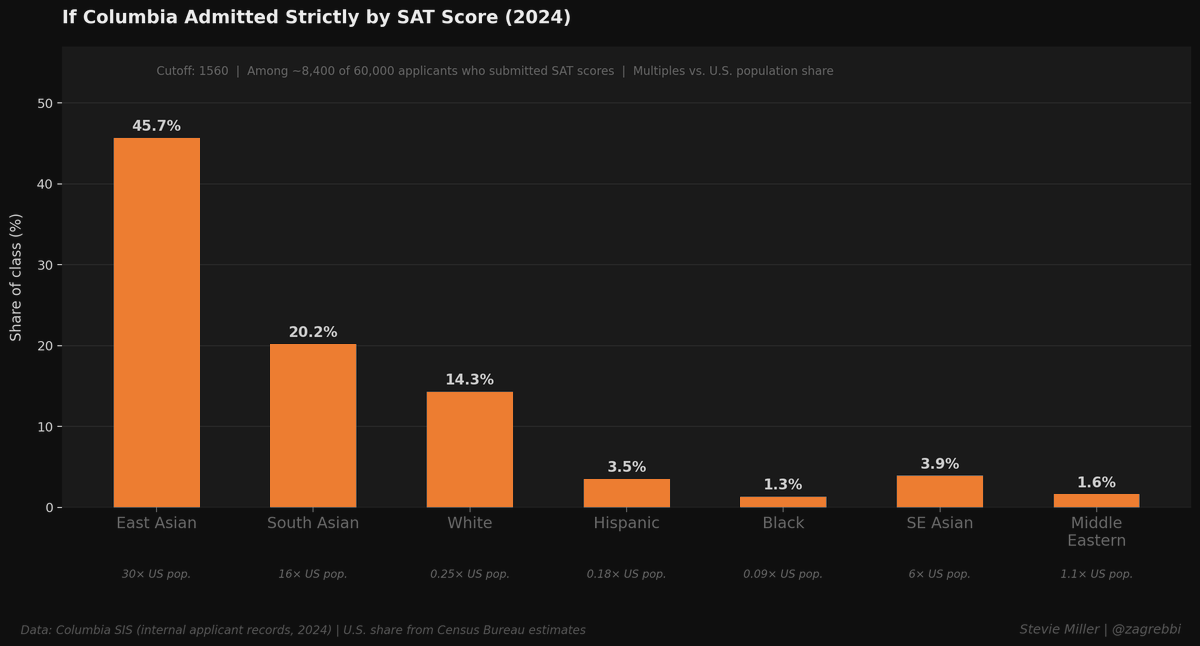
If Harvard admitted students strictly by SAT score, filling slots in descending order starting at 1600, what would be the lowest SAT score admitted to the school? And what would be the resulting demographics of the student body?



Why is matchmaking expensive? To illustrate, here’s how I’ll lose money on a client’s $49,000 package. Client is 46, 6’2, exited tech founder. He’s looking for a woman 27-33, very specific criteria around match personality, appearance, and profession. Without diving into specifics, she: • Isn’t easily searchable online... • Isn’t likely to reply when we find her… • Isn’t likely to be single… • Often has a deal-breaker trait we can’t screen for without a phone call… • Isn’t necessarily interested in my client… I was expecting this to be a difficult search, so I quoted $49,000. I wasn’t expecting ~100 hours of labor to find each match, not including communication with the client! To date I’ve spent $45,000 on salaries for the women staffed on his search, plus $2,750 on styling and photos, and we still owe the client 2 matches... Before considering overhead (let alone opportunity cost) this will be a huge L financially. Things balance out though. Most engagements are profitable. Some engagements are quite profitable. For example, a new client in NYC paid $30,000 and paused after his first match, because he’s 99% sure we found his wife. That's still a new relationship, and engagements last 9 months (6 months of active matching + up to 3 months of pause), so we could be on the hook for more work in coming months. But you get the point 🙏
"My mom said she can drop us off at the airport if your mom can pick us up.”

.@williamhockey is one of the least visible founders in tech relative to what he has created. He co-founded Plaid and is now building Column, a software company that owns a bank, and powers Ramp, Wise, Bilt, Mercury, and others. He funded it himself by borrowing against nearly everything he had in Plaid shares, and has never raised any outside capital. His story matters because so much of the value in our industry gets created through exactly this kind of extreme personal risk. He is maniacal about being the best in the world at his thing, and has spent his entire career betting on himself and doing whatever it takes to win. He also spends a lot of time outside the US (in places like Kinshasa) which has given him a rare perch on the power of the US dollar. We discuss: - Why emerging markets are often the most financially innovative - What owning 100% of his company allows him to do that VC-backed founders cannot - Getting margin called and nearly going bankrupt - Why the best founders are specialists - What it takes to be the best in the world at your thing - How Silicon Valley's consensus culture produces consensus founders - How the US dollar functions as an instrument of national security Enjoy! Timestamps: 0:00 Intro 9:19 Emerging Markets 14:03 Silicon Valley's Elite Consensus Problem 16:03 Rejecting the VC Hamster Wheel 21:45 Equity and Liquidity 26:03 Funding a Bank 29:45 The Necessity of Extreme Founder Risk 37:18 Finding Leverage 45:20 Longevity and Profitability in Banking 48:46 Matching Your Capital Structure to Your Business 51:44 The Unseen Power of the US Dollar 1:02:30 How AI Will Transform Legacy Banks 1:09:23 The Kindest Thing


It's a good question. My guess is the composition of students would not actually change that much. Only about 500 kids get a perfect score each year. Harvard has 2000 slots to fill. The median score of admits _currently_ is like a 1550. And that includes all the athletes, legacy kids and underprivileged minorities. Everyone forgets how smart Ivy League kids actually are!


WSJ: Arab governments were furious about Israel’s attack and the U.S. failure to head it off, officials said. They had aggressively lobbied the Trump administration to stop U.S. and Israeli strikes on Iranian energy infrastructure and now feel a target has been put on their backs, they said… America’s Arab allies are now fuming that they don’t seem to have any influence with the Trump administration despite heavy investments of time and money.