
Sabitlenmiş Tweet
mtn drew
33.5K posts




mtn drew retweetledi

100% correct take
I was chatting to friend quoting forward PE this or that
I said it doesn't matter - what matters in these parabolic charts is understanding greed and fear
No one gives a f about forward PE when they are 3x leveraged and stock drops 10%
FEAR takes over
And at the end of it provides a buying opportunity for the patient
Z@ZeeContrarian1
Around a month ago, a couple of hedge fund friends pitched me on $SNDK, $MU, $SKHY , and the rest of the memory names as their best ideas. The thesis was compelling, and the guys are very smart. Their main argument was simple: these companies were incredibly cheap. P/E of 10. P/E of 8. Some even lower. The interesting part is that not a lot has changed fundamentally since then, yet many of these stocks are down around 50%. We can extrapolate that, since nothing fundamentally changed and the stocks have been cut in half, sentiment is more important than multiples, and you never want to buy at peak sentiment, no matter how cheap the deal looks. Read more about it in my post below, “The Myth of P/E Ratios.”
English
mtn drew retweetledi

[🌲] BREAKING: Leopold Aschenbrenner's Situational Awareness is in process of blowing up. $3.6B in capital has VANISHED as Intel Corporation drops 50%. Leopold has been selling all his positions to cover margin on this one bet. - RTRS
English


wait wait wait... two days ago ken griffin/citadel randomly came out and declared the fed will raise rates, causing semis/ai the get absolutely destroyed into extreme pressure on leopold and SA causing them to liquidate their ENTIRE public equities book through a transaction with a SINGLE BUYER
i mean... who else could it be?
Wall St Engine@wallstengine
Situational Awareness has EXITED its ENTIRE public-equities book, including both long and short positions, through a transaction with a single buyer, according to CNBC’s David Faber.
English
welp
this doesn't inspire confidence
i think i need to take a walk
Andrew Ho@andrewho03
I'm actually fairly bearish on frontier lab valuations. I've never seen the reasons articulated to my satisfaction, so before I go to sleep, I wanted to quickly jot down my thinking here. The basic issue is that the labs are highly unprofitable. This may seem like a simple point, but private market valuations can be relatively irrational; however, like with $SPCX, post-IPO pricing will likely be much more punishing, especially as the standard 6-month lockup period expires and selling pressure intensifies. Many people claim that the labs have high margins. Yet even with high margins, a valuation of $1T would be justified only if the labs were doing nothing aside from serving inference (thus reducing costs only to those relevant to inference) and posting annual revenue numbers in the $100-200 billion range assuming ~80% gross margin and a 20x earnings multiple. This assumption is obviously not true, because the frontier labs have to continually spend money training the next generation of models. This is because of market competition from runner-up firms. For example, if OpenAI had paused model development last year, there would no longer be any point in paying GPT-5 API prices when you can just use Qwen or Kimi instead for much cheaper. Thus, the labs are forced to invest ever-increasing amounts of money in model training, in a way such that at any given point of time, the amount you're forced to invest in the next model is dramatically higher than the amount of money you're actually making, because even if your revenue goes up with higher model capabilities, so do your future training costs. This is a profoundly punishing dynamic which severely penalizes frontrunners. (There is also a related subpoint where frontier labs claim they can distill their leading models to win out at lower intelligence levels as well. This makes no sense because the revenue numbers involved are far too low when taking into consideration the rather low margin of such inference.) Frontier lab valuations appear largely to be based on the assumption that as you scale up, the capabilities which emerge will be sufficiently general and profound that we'll see explosive growth (epoch.ai/publications/e…) from things akin to AI agents starting and autonomously managing entire companies of subagents. But it's not clear to me that this is the case; indeed, as I mentioned in my previous post (x.com/andrewho03/sta…), I believe that capabilities growth will be slower, spikier, and more data-limited than people currently assume. It may be the case that eventually we will see explosive growth of this nature with full automation of the economy, but at the very least my viewpoint implies much longer (multi-decade) timelines until we reach this point. It is not clear to me that the frontier labs will be able to operate unprofitably for so long, although I suppose maybe this foreshadows some sort of inevitable nationalization. I also want to make a broader point about technological diffusion. The reason why technological diffusion is slow isn't just because, e.g., old people take a long time to learn how to use technology (although this is of course a contributing factor to some degree). In my view, it's because when a new, revolutionary technology comes along, the ways to incorporate that technology into subsequent developments are not always obvious, and in fact they cannot necessarily be arrived at through the application of pure reason. If they could be, then perhaps frontier models, at a certain point, would have a perfect understanding of how the LLM application layer should be developed, and they would then autonomously code, deploy, and sell such a layer. But it seems more plausible to me that this diffusion is limited moreso by the hard problem of economic calculation--that is to say, the Hayekian notion through which the price system gradually promotes efficient allocation of resources and which cannot be simulated through central planning--and that even if we froze current capability levels at today's levels, it would take well over two decades to fully integrate in LLMs into our lives. Such a view is consequently rather bearish for the continued profitability of labs as it reduces their prospects for finding, say, something else comparable in profitability to coding agents, which seems to have been a somewhat lucky discovery by Anthropic to begin with. That is to say, even if you spam FDEs you aren't necessarily going to be able to just figure out the "correct" product shapes fast enough. Overall, I don't think that people have clearly reasoned through their mental models for why lab equity should be worth as much as it currently is, and that if you actually bother to write down such a model, you may not arrive at the conclusion that you want to arrive at. This isn't to say that I don't expect AI to experience a huge (industry-wide) boom in the coming decades, but just that I'm not entirely sure I would buy OpenAI or Anthropic stock at latest valuations if I were given the opportunity to do so. Of course, as an ex-lab employee, arguably this is talking against my own book; I should really be giving people more reasons to be bullish. But in the end, my influence is so small that it doesn't make a difference, so why not have some fun?
English
@mhonkasalo i think a lot of people have been wanting him to fail ever since he had his big raise
English

re: Leopold's fund performance.
Not sure I understand the headlines. He was up like 20x & then gave back maybe ~30-50%? Still sick performance in a few years.
He's raising more capital?
Given it's a fund, assumed he was in the business of getting more money in the door?
English
*unaware of it, ignoring it, or rewarding it
Are companies taking big risks that may or may not provide the ROI that investors are looking for? Of course. As they should be. I'm not going to pretend I know how to spend their money better than they do.
I really think, for now, it still just comes down whether you believe that AI will keep getting better and more useful at a similar pace and/or growing in new users at a similar pace (I do).
I also think the hyperscalers are taking a more measured approach than many people give them credit for (relative to the Big 2 AI Labs anyway). They are much bigger than just their AIs - they have to think about the rest of their business. And maybe that's why they've been struggling but not collapsing.
English
Maybe you think we're not in a speculative investor bubble, but we're in a speculative corporate capex bubble.
If that were the case, would the hyperscaler stocks be getting killed every time they announce they are increasing capex like they have been?
A stock market bubble requires that whatever the irrational behavior driving it is, investors are either unaware of it or ignoring it. Neither is true when it comes to AI capex; it's all anyone is talking about. The numbers get published every quarter and investors are punishing stocks for it.
English
if stocks were in a bubble due to AI, it doesn't take a genius to realize that bubble has popped.
i don't think we were in a bubble.
if we were in a bubble and June was NOT the top, then the early June pullback would have been left in the dust. it wasn't - NDX is now firmly below the June lows.
if we were in a bubble and June WAS the top, then that was a very modest bubble. Here is a chart of the rolling 12-month performance of the NDX since 1985. This year's current peak was below the one in December 2023.

English

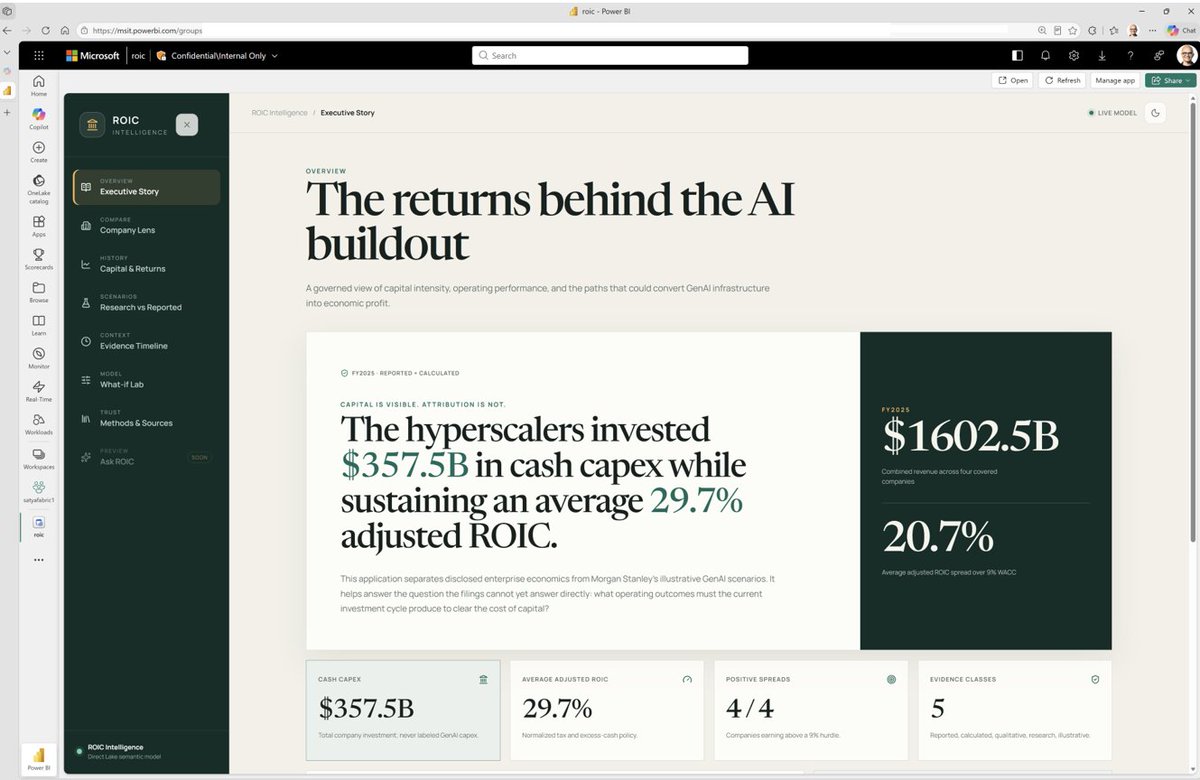
Some more detail on the ROIC Intelligence App I built yesterday and mentioned on today's earnings call.
I took the PDF that Brian Nowak at Morgan Stanley put together for Hyperscale ROIC this week and used Copilot code (coming in our new superapp) with a single prompt + skill (/drill-me) to create the plan, then used autopilot in auto to create the full app (with history, lookups, scenarios, what-ifs, etc). And /rubber-duck to test.
And the best part is that all the artifacts are in my enterprise environment. My app is in Copilot, my code is in GitHub Enterprise; all my data pipelines/lake/semantic models are in Fabric. And everything is under Agent 365 IT/Sec/FinOps control!
So this is not about Tokenmaxxing or vibe coding. Every step of the way the rails are engineered to create value, making everything a long-term reusable asset, with governance/security, and cost controls.
This is the full system to drive business value. Disclosures: This is all pulled from public sources, and for illustrative purposes only...not financial advice! :)
Here is the app and architecture...

English