Nino Mecevic
1.7K posts

Nino Mecevic
@n_mecevic
Finance leader @verizon | ex @oracle @lumentechco | tech + telecom + strategy | Personal takes on all things
New York, USA Katılım Kasım 2015
1K Takip Edilen199 Takipçiler
Nino Mecevic retweetledi

Shopify CEO Tobi Lutke explains Goodhart’s law and why he doesn’t like KPIs or OKRs
“Goodhart’s law is real. The moment a metric becomes a goal, it’s no longer a useful metric… No metric by itself is a complete heuristic for a complex business. There’s a million different tensions in a company, and you can’t keep all of them in harmony by optimizing for one thing.”
For this reason, Shopify doesn’t use KPIs or OKRs. But as Tobi explains, this doesn’t mean they don’t value data and metrics.
“We are extremely data informed. We have invested enormous amounts of money and time into systems that give us basically everything at our fingertips… But what Shopify attempts to do is just not over-fit for what’s quantifiable.”
People love optimizing for highly-quantifiable things because there’s immediate gratification that comes from seeing a number go up. But Tobi thinks that the most important aspects of a product are rarely quantifiable:
“The overlap of the most valuable things you can do with a product and the things that happen to be fully quantifiable are like maybe 20%. Which leaves 80% of a value space unaddressable by the people who only look at quantifiable things.”
He continues:
“Shopify is comfortable with unquantifiable things like taste, quality, passion, love, hate… The sort of deep satisfaction that a craftsperson feels when they’ve done a job well is actually a better proxy if you allow it to be.”
They then have robust analytics systems that tell the company if something’s wrong or a new rollout breaks something.
“We think about it as a cockpit for a pilot. The decisions are still made by pilots, and we think this leads to better results… I think there needs to be more acceptance in business of unquantifiable things… And then metrics take a support function.”
Source: @lennysan (Feb 2025)
English
Nino Mecevic retweetledi

Judging by my tl there is a growing gap in understanding of AI capability.
The first issue I think is around recency and tier of use. I think a lot of people tried the free tier of ChatGPT somewhere last year and allowed it to inform their views on AI a little too much. This is a group of reactions laughing at various quirks of the models, hallucinations, etc. Yes I also saw the viral videos of OpenAI's Advanced Voice mode fumbling simple queries like "should I drive or walk to the carwash". The thing is that these free and old/deprecated models don't reflect the capability in the latest round of state of the art agentic models of this year, especially OpenAI Codex and Claude Code.
But that brings me to the second issue. Even if people paid $200/month to use the state of the art models, a lot of the capabilities are relatively "peaky" in highly technical areas. Typical queries around search, writing, advice, etc. are *not* the domain that has made the most noticeable and dramatic strides in capability. Partly, this is due to the technical details of reinforcement learning and its use of verifiable rewards. But partly, it's also because these use cases are not sufficiently prioritized by the companies in their hillclimbing because they don't lead to as much $$$ value. The goldmines are elsewhere, and the focus comes along.
So that brings me to the second group of people, who *both* 1) pay for and use the state of the art frontier agentic models (OpenAI Codex / Claude Code) and 2) do so professionally in technical domains like programming, math and research. This group of people is subject to the highest amount of "AI Psychosis" because the recent improvements in these domains as of this year have been nothing short of staggering. When you hand a computer terminal to one of these models, you can now watch them melt programming problems that you'd normally expect to take days/weeks of work. It's this second group of people that assigns a much greater gravity to the capabilities, their slope, and various cyber-related repercussions.
TLDR the people in these two groups are speaking past each other. It really is simultaneously the case that OpenAI's free and I think slightly orphaned (?) "Advanced Voice Mode" will fumble the dumbest questions in your Instagram's reels and *at the same time*, OpenAI's highest-tier and paid Codex model will go off for 1 hour to coherently restructure an entire code base, or find and exploit vulnerabilities in computer systems. This part really works and has made dramatic strides because 2 properties: 1) these domains offer explicit reward functions that are verifiable meaning they are easily amenable to reinforcement learning training (e.g. unit tests passed yes or no, in contrast to writing, which is much harder to explicitly judge), but also 2) they are a lot more valuable in b2b settings, meaning that the biggest fraction of the team is focused on improving them. So here we are.
staysaasy@staysaasy
The degree to which you are awed by AI is perfectly correlated with how much you use AI to code.
English

My take: AI is accelerating how quickly people can build real capability.
Young professionals are already adapting by shifting paths, stacking skills, and using AI to enter new fields faster than ever.
Careers are becoming dynamic.
wsj.com/economy/jobs/a… via @WSJ
English

Nino Mecevic retweetledi

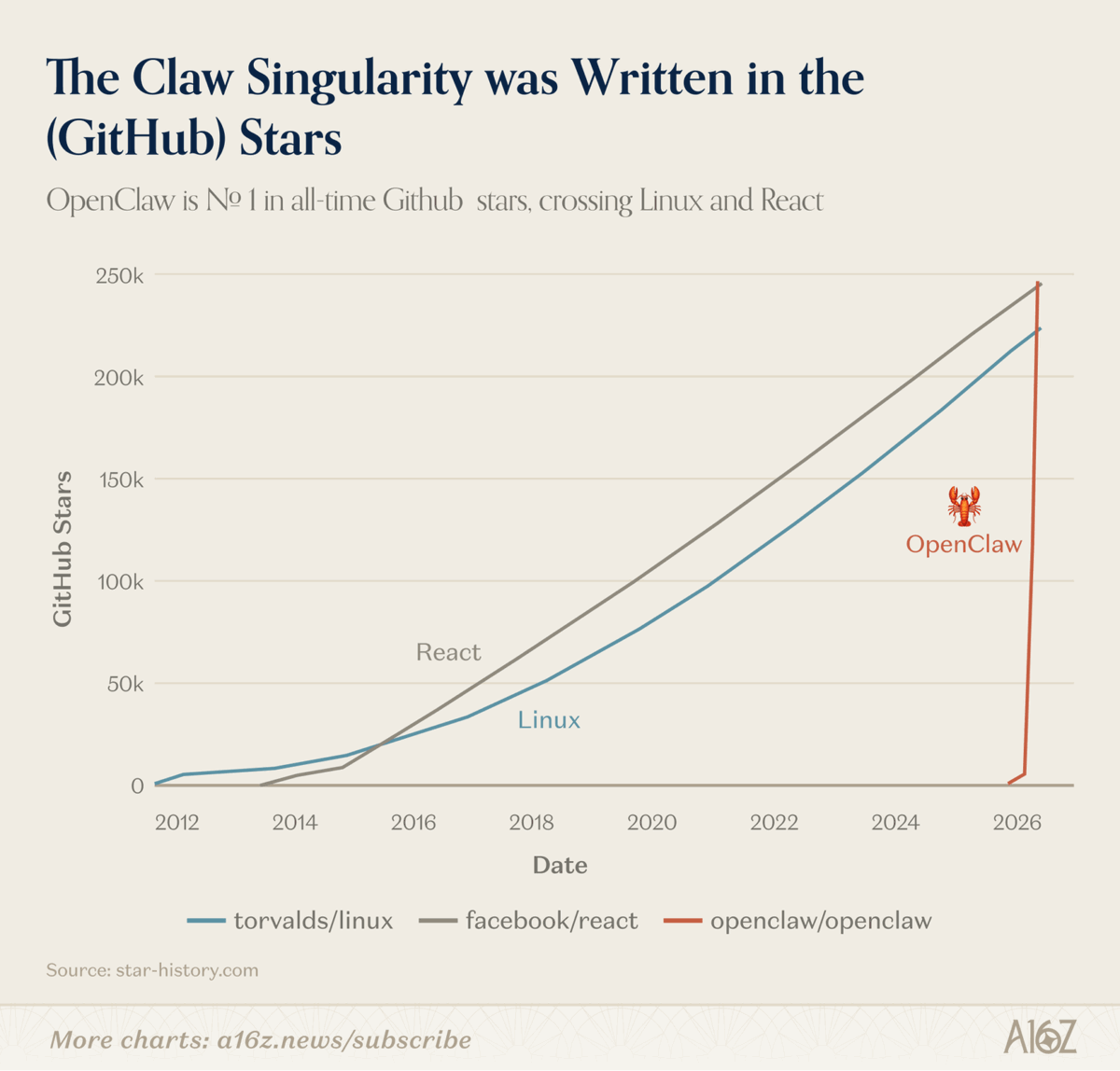
After its release as a side project in January 2026, OpenClaw managed to surpass both Linux and React on its way to the number one all-time leader in Github stars
Full report: a16z.com/100-gen-ai-app…

Olivia Moore@omooretweets
🚨 The @a16z consumer AI Top 100 is back! For the sixth time, we ranked consumer AI websites and mobile apps by usage (monthly unique visits and MAUs). This edition, we changed the rules. Here's why - and what the new list says about where consumer AI is heading 👇
English

Nino Mecevic retweetledi

"Not having a coding experience is becoming an advantage."
Replit CEO Amjad Masad:
"You don't need any development experience. You need grit. You need to be a fast learner."
"If you're a good gamer, if you can jump in a game and figure it out really quickly, you're really good at this."
"Coders get lost in the details."
"Product people, people who are focused on solving a problem, on making money, they're going to be focused on marketing, they're going to be focused on user interface, they're going to be focused on all the right things."
"I think this year it's gonna flip, and I think not having a coding background is gonna be more advantageous for the entrepreneur."
@amasad with @jackhneel
English
Nino Mecevic retweetledi

It remains the case that if you’re paying attention to AI on this site, you’re at least a couple years ahead where the average worker is in your field.
While it will increasingly be very rare in software engineering to not fully be using AI agents for coding, this will remain true for many areas of knowledge work for quite some time. We’re basically at day 1 of this trend in most fields of work.
The advantage that many have, both in IT and as a power user of AI in any job, is to bring in the latest tools to start to transform workflows. You will be years ahead of everyone else.
darren@darrenjr
just talked with two software engineers at a large bank never heard of cursor or claude code we are in a bubble
English

👇
Verizon gained a net 616,000 postpaid phone connections in the fourth quarter, with its new chief executive calling the period a “critical inflection point” wsj.com/business/telec… via @WSJ
English
Nino Mecevic retweetledi

Dillon is in the top .01% percent of engineers, but in the top .001% of proompters
Dillon Mulroy@dillon_mulroy
so maybe the product owners were on to something
English