Non-Fungible Toucan 🦜
5.5K posts

Non-Fungible Toucan 🦜
@navinmogan
This is not a simulation, it’s a circus 🎪
Atlantean coast Katılım Aralık 2014
1.5K Takip Edilen279 Takipçiler

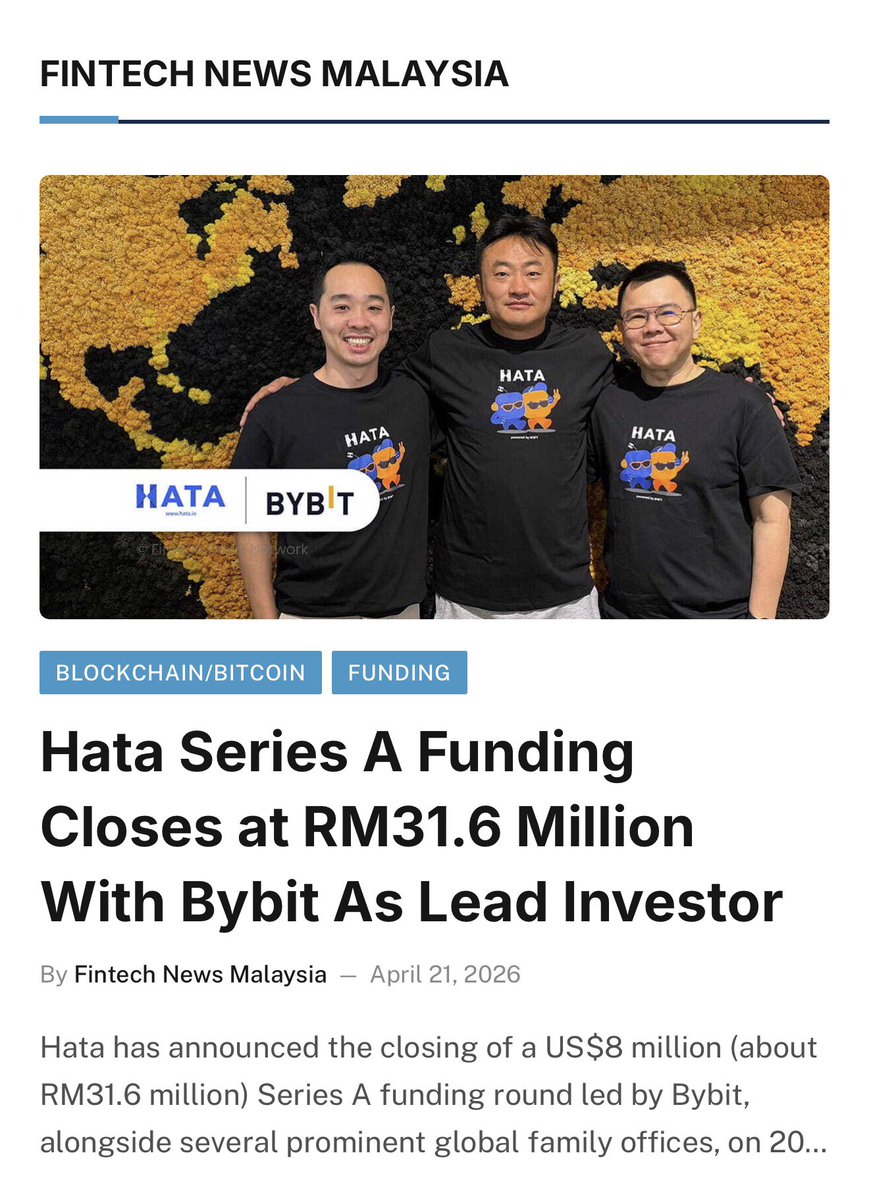
We just closed our Series A. 🚀
US$8M raised, led by Bybit.
209k users and RM1B+ in transactions and counting
Next phase for @hataglobal @hatamalaysia : stronger platform, deeper liquidity, better user experience.
Grateful for the trust. Let’s keep building 💪🏼
Picture from @FintechNewsMy

English

This 16-minute talk by two Anthropic engineers who built Claude Skills will teach
you more about building them right than most developers figure out on their own in months.
Bookmark this & watch, no matter what.
Then read the guide below by @eng_khairallah1
Khairallah AL-Awady@eng_khairallah1
English

I have kids. I work in AI every day. And honestly? I have no idea what their careers will look like in 15 years. But I know what will carry them through.
First, and this might sound unromantic: make money and save it for them. We can debate educational philosophy all day, but the world is changing so fast that financial security might be the most practical gift we can give. Buy some gold bars. Seriously.
Second, nurture their imagination. AI rewards people with initiative and wild ideas. The kid who daydreams, who asks weird questions, who wants to try ten things at once? That kid will thrive. AI can execute. AI can be disciplined. What AI can't do is dream up something nobody's thought of before.
Third, build resilience. There are no more iron rice bowls (guaranteed lifetime jobs). Any stable, predictable job is exactly the kind of job AI will learn to replace. Our kids will likely switch directions many times in their lives. Learn something new, get replaced, pivot, repeat. It's more like being a hunter than a farmer. Schools don't teach this. Schools teach you to follow a linear path: high school, college, grad school, stable job. That linear path is becoming the most dangerous one.
Last, invest in their ability to connect with other humans. Not networking. Not schmoozing. Real emotional connection. Building trust, offering support, making people feel seen. As AI handles more of the rational, analytical work, the human ability to genuinely relate to other humans becomes more rare and more valuable.
I don't have all the answers. But I know that imagination, resilience, and genuine human warmth aren't going out of style anytime soon.
#AI #Parenting #Education #FutureOfWork
English
Non-Fungible Toucan 🦜 retweetledi


@0xkyle__ Used it to visualise customer support insights and the deck it produced was intuitively easy to digest. Amazing for research
English

@PamManderson1 @thecurioustales The obvious question is: Are humans quantum particles too?
English

@thecurioustales Once you realise that quantum particles experience the past present and future simultaneously everything makes more sense. Linear time is just how we experience it.
English

The double slit experiment has haunted physicists for over 200 years.
When you shoot a single photon through two slits in a barrier, it doesn't choose one hole. It goes through both simultaneously, interferes with itself, and lands on the screen as a wave pattern, as if the particle somehow knew both paths existed and took all of them at once.
The moment you place a detector to watch which slit it goes through? The wave pattern vanishes. The photon suddenly behaves like a solid particle. The act of observation collapses the quantum superposition into a single definite reality.
Physicists called this "wave-particle duality" and for generations, we treated it as a quirk of space. A particle's relationship with physical barriers, physical gaps, physical measurement.
What just happened changes the entire frame.
Researchers didn't use slits carved into a material. They used slits carved into time itself — ultra-short switching windows in the electrical properties of a material, flickering on and off at trillionths of a second. Light passed through these temporal gaps the way it would normally pass through spatial gaps. And the interference pattern still appeared. Not across space. Across frequency.
Sit with that for a moment.
The wave behavior of light, the phenomenon we always associated with light spreading through physical space, reproduced itself in the time dimension. The photon interfered with its own past and future states the way it normally interferes across left and right positions.
What this quietly confirms is something theoretical physicists suspected but had never demonstrated: space and time are not just mathematically symmetric in quantum mechanics. They are physically interchangeable in ways that produce identical quantum behavior. The "slits" are interchangeable coordinates. The universe doesn't distinguish between a gap in space and a gap in time when it decides how reality should unfold.
The implications of that sentence are almost impossible to absorb without stopping completely.
We built our entire intuition about quantum mechanics around the geometry of space — particles passing through openings, waves spreading outward, interference happening across a physical screen. Every textbook, every lecture, every thought experiment uses spatial metaphors because that's the dimension we experience as "real" and navigable.
Time, by contrast, we experience as a river we're trapped inside — always moving forward, never able to go sideways in it. We don't experience temporal gaps the way we experience physical ones. A door has two holes, you can walk through either one. A moment in time doesn't seem to have "holes."
Except for a photon, apparently, it does.
The temporal slit experiment forces a deeply uncomfortable update to how we model light, matter, and information. If wave-particle duality operates across time the same way it operates across space, it means quantum superposition — that strange state of "being in multiple states simultaneously until observed" — is not just a spatial phenomenon. A particle can exist in multiple temporal states simultaneously. Its wave function doesn't just spread left and right. It spreads forward and backward in time.
This connects to something that's been sitting at the edge of quantum mechanics for decades: the block universe theory. In Einstein's relativity, past, present, and future all exist simultaneously as coordinates in a four-dimensional spacetime fabric. "Now" is just the slice of that fabric you happen to occupy. Physicists who take this seriously argue that the reason quantum mechanics is so strange is that particles already operate in the full four-dimensional block — they're not choosing a path through space, they're tracing a path through spacetime, and what we call "probability" is our limited three-dimensional perception failing to see the complete trajectory.
The temporal slit experiment edges us closer to that picture being literally, physically, measurably true.
And then there's the measurement problem. The original spatial double slit experiment breaks your brain because the act of looking destroys the wave behavior. Nobody has fully agreed on why. Some say the observer collapses the wave function. Some say the detector entangles with the photon and creates decoherence. Some say the universe splits. The temporal version of the experiment opens a new front in that war. When you measure a temporal slit — when you try to determine which moment the photon passed through — does the interference across frequency collapse the same way interference across space does when you watch it?
That experiment hasn't been done yet. The answer will either confirm that time and space are truly symmetric at the quantum level, or it will break the symmetry and reveal that time has a fundamentally different relationship with observation than space does.
Either outcome rewrites something important.
We think of physics experiments as things that happen in laboratories, relevant to scientists with particle accelerators and cryogenic equipment. But every foundational shift in quantum mechanics eventually rewires technology. The photoelectric effect sounded like a curiosity in 1905. It built every solar panel and digital camera in existence. Quantum tunneling sounded abstract. It gave us the transistor, and therefore every computer.
Wave-particle duality operating across time opens the door to temporal interference as an engineering tool. Controlling how light and matter interfere across time gaps — not space gaps — could produce entirely new forms of signal processing, photonic computing, and quantum communication that don't currently exist even theoretically.
The universe keeps revealing that the constraints we assumed were fundamental were just the limits of our instruments.
Time always looked like a wall.
Turns out it was a slit all along.
All day Astronomy@forallcurious
🚨: Scientists perform first ever double slit experiment in time sending light through temporal slits to reveal wave and particle behavior in a whole new way
English

@wassielawyer @zachxbt So, gambling addicts were once again scammed by insiders...during an investigation into how insiders scam gambling addicts.
What heartwarming irony.🥰
English

Okay thinking this @zachxbt saga through, its pretty fucking wild.
So one or more KOLs pay Zach to investigate Axiom for insider trading by tracking the KOLs' private wallets they use to bundle tokens before shilling.
In the investigation, Zach in the process of conducting it gives the KOLs inside information that he is looking into Axiom.
Zach then announces that an investigation is happening, following which Polymarket creates a prediction market for the target of investigations.
At least one of the KOLs (the only ones with inside information) then psyops the entire timeline into thinking its Meteora with freshly funded wallets, so everyone starts bidding Meteora. They then buy 'No' on Meteora to take the liquidity of anyone who believed it was in fact Meteora.
They then silently take liquidity on Axiom, before bidding it up in the hours leading to the reveal.
Can @MeteoraAG now retain @zachxbt to investigate the KOLs insider trading the prediction markets?
wassieloyer@wassielawyer
Lmfao so the KOLs got the insider information to insider trade the prediction markets.
English

@levikov Great post, but better absorbed if broken into main post and threads
English

Pinterest has 480 million monthly users, the audience is 85% female with household income above $75k, and 87% of them have literally bought something from content they saw on the platform
And every marketer has completely written it off because they think it's a mood board app. Which makes it possibly the most underpriced distribution channel on the internet right now…
Most people have no idea what's happening on Pinterest right now. It's going through the exact same phase TikTok went through in 2020. Shopping features just went live. Shopify integration is active. AI is matching users to purchasable products automatically. But because every brand and agency is fighting over TikTok and Instagram, Pinterest has basically zero competition for organic eyeballs
Organic CPM equivalent on Pinterest right now is roughly $0.12
For comparison. TikTok organic is running $2-4. Instagram organic $6-12. Facebook paid $40-60+ in most verticals
You're getting 50-400x more reach per piece of content on Pinterest. With a higher income audience. And the content takes 15 minutes to make in Canva
But the thing that makes Pinterest actually stupid compared to everything else is content lifespan
Twitter content dies in 18 minutes. Instagram maybe 48 hours. TikTok 3-7 days on a good run
Pinterest content drives traffic for 4-6 months. Some pins still pull clicks after 2 years
Every piece you post is a compounding asset instead of disposable content. A slideshow you make today in Canva can drive traffic for the next year without you ever touching it again. I know someone running a home decor affiliate account making about $7k/month who hasn't posted new content in 4 months. Old pins just keep working. That's physically impossible on any other platform
The demographics are ridiculous for selling stuff too. Pinterest users go there to DISCOVER and PLAN PURCHASES. Not scroll mindlessly. Not argue with strangers. Highest purchase-intent commercial audience on any social platform and nobody is competing for it
Content that prints on Pinterest is dead simple. Aesthetic slideshows with 5-7 images and text overlay. "Best [product] for [specific use case]" roundup pins that get saved to boards by thousands of people planning purchases. Before/after transformations. The Pinterest audience is obsessed with transformation content. Home renovations, skincare results, closet organization, fitness progress
Some mf I follow built 6 Pinterest accounts in the home decor niche and does $30k+/month in affiliate revenue. Total effort is maybe 10 hours a month of making slideshows
(Works for men's niches too btw, just way less competition in women's verticals because all the "alpha male marketing bros" refuse to touch Pinterest. Their loss)
The same playbook that works on TikTok Shop works even better here. Faceless accounts, high volume native content, affiliate structures. Competition is nonexistent and the content compounds forever instead of dying in a week. We're already testing this as a secondary channel for some of our TT Shop brands and the early numbers are kind of absurd for the effort involved
The window is probably 12-18 months before everyone figures this out. Same window TikTok had in 2020-2021 before brands flooded in. Attention moves somewhere new, early movers build distribution cheap, masses arrive, costs go up, and the early movers have infrastructure everyone else is scrambling to build
I'll probably regret pointing this out because the whole advantage is that nobody's paying attention yet
Run the numbers
English

how to build a bootstrapped startup without funding:
1. pick a problem you personally have. if you don't use your own product daily, quit now
2. skip the pitch deck. open your code editor. ship something ugly in a weekend
3. charge money from day 1. free users give you nothing but support tickets
4. use boring tech. PHP, SQLite, vanilla JS. frameworks are a trap that mass waste your time
5. host on cheap VPS ($5-20/mo). not AWS. you don't need kubernetes for 1,000 users
6. do customer support yourself. it's the fastest product feedback loop that exists
7. automate everything you do more than twice. cron jobs > employees.
8. grow on Twitter/X by building in public. your journey IS the marketing
9. keep your burn rate near zero so you never need to raise. ramen profitable > series A
10. say no to investors, cofounders, and "advisors" who want equity for intros
i've been doing this for 10+ years now. no employees, no funding, no board meetings
the entire VC game is designed to make you think you need permission to start
you don't
English


@mattshumer_ This is a wake-up call, thank you for sharing. More people need to read this
English

@obsrvgmi @EvgenyGaevoy 3 red cards in a game and you getting hammered
English

@camiinthisthang Not 3 of the smartest but rather 3 of the most visible.
2022 had so many incredibly smart people leave. Only difference is they weren’t on twitter.
English

I’m telling you guys the next 3 months are about to get wild
All the smart people will either try to go to one of the few crypto projects with sustainable revenue & growth or will leave crypto completely
We saw 3 of the smartest ppl outright leave crypto in the last 48 hours
Linda Xie@lindaxie
Regardless of how I feel about it, I've never had so many people I respect tell me I should leave crypto
English

You can tell the state of every Southeast Asian country by just visiting the mall(tier 1 and tier 2 malls) on the first weekend of the month(after payday) and just observe crowd volume.
Southeast Asians as a law are mall obsessed, so if they're not even turning up the first weekend after payday to even eat out or get a few drinks,
the economy is melting down essentially.
English

@venturetwins Why is X not in the top 10 of any audience cohort?
English
Non-Fungible Toucan 🦜 retweetledi

The Adolescence of Technology: an essay on the risks posed by powerful AI to national security, economies and democracy—and how we can defend against them: darioamodei.com/essay/the-adol…
English